生物成因微晶石英特征及其對海相頁巖儲層孔隙發育的影響
2024-01-01 00:00:00王拔秀張鵬輝梁杰陳建孟祥豪付奕霖鮑衍君
沉積學報 2024年5期
摘 要 【目的】石英是海相頁巖中最重要的礦物之一,以多種形式存在,并具有多種的硅質來源和成因,而不同類型的石英對于巖石力學性能和孔隙演化的貢獻是不同的,且相關研究目前仍較薄弱,制約了對頁巖儲層特征的深入認識。【方法】簡述了近年來海相頁巖石英分類的最新進展,并在此基礎上,在前期研究較為薄弱的下揚子地區,利用鼓地1井上奧陶統五峰組—下志留統高家邊組海相頁巖樣品,綜合運用薄片分析、X射線衍射分析、地球化學分析、場發射掃描電鏡、核磁共振、能譜分析和陰極發光等多種方法手段,探究海相頁巖石英類型和硅質來源,并進一步討論生物成因微晶石英對頁巖力學性質和孔隙發育等儲層性質的影響。【結果】下揚子地區鼓地1井五峰組—高家邊組頁巖石英類型主要為碎屑石英、微晶石英和生物骨架石英,其中碎屑石英為陸源輸入,而微晶石英則為自生來源。硅質生物骨架鏡下證據、生物硅含量、主微量元素特征等指標綜合分析表明硅質生物可為微晶石英提供重要的硅質來源。【結論】海相頁巖中的生物成因微晶石英增強了頁巖的脆性,并且相互連接,形成剛性的硅質基質框架,很大程度上提高了頁巖的力學性能。此外,這一剛性框架能夠有效地保護微晶石英內部的有機質孔隙和粒間孔隙不被壓實,有利于孔隙的保存。
關鍵詞 海相頁巖;生物成因微晶石英;硅質來源;巖石力學性質;孔隙演化
第一作者簡介 王拔秀,男,1998年出生,碩士研究生,海洋地質,E-mail: wbx5566677@163.com
通信作者 張鵬輝,男,副教授,油氣地質、海洋地質和非常規油氣沉積學,E-mail: zph010@163.com
中圖分類號 P618.13 文獻標志碼 A
0 引言
頁巖氣是一種蘊藏于頁巖層系中具有自生自儲特征的非常規天然氣資源,頁巖儲層特征不僅影響頁巖氣的富集程度,而且對于后期勘探開發工作也具有重要影響[1?6]。頁巖儲層特征同時受巖石有機質和礦物組分,以及后期成巖作用(如溶蝕作用、膠結作用和壓實作用等)的控制[7?15]。有機質作為頁巖儲層孔隙的主要載體之一,特別是腐泥型干酪根及固體瀝青常含有豐富的納米級有機質孔隙,早期一些研究普遍認為TOC是影響頁巖孔隙度的重要因素[16?17]。但近年來進一步的研究表明,TOC與孔隙度的關系是復雜的,二者之間并非一定存在相關關系,這可能與頁巖存在顯著的無機孔隙(也稱基質孔隙)有關[12,18?20]。頁巖礦物組成不僅是影響儲層孔隙發育和保存的重要因素,也是影響頁巖氣富集的重要因素[21?22]。頁巖中的脆性礦物能夠形成穩定的框架,可以減少有機質顆粒受到的有效應力,有助于減少對有機質孔隙的破壞,進而有利于孔隙的保存[23?27]。
石英具有高彈性模量、低泊松比和低韌性的特點,是頁巖中最重要的脆性礦物,具有比其他礦物更高的脆性,對巖石強度和儲層質量起著至關重要的積極作用[2,12,24,28]。頁巖中的脆性礦物(包括石英、長石及碳酸鹽礦物等)被廣泛用于脆性指數(BI值)的計算[2,29?31],但目前關于脆性礦物的形式,尤其是石英中的生物成因微晶石英對于頁巖脆性等巖石力學方面影響的研究較少。石英是海相頁巖中最重要的礦物組分之一,以多種形式存在,并存在多種硅質來源和成因[32?33]。在海洋環境中,硅質來源和石英的形成機制是多樣且復雜的,按硅質來源的不同,可分為碎屑硅、生物硅和熱液硅三類[32?37];此外,次生石英還可在成巖過程中通過多種機制形成,如硅質生物碎片的溶解、碎屑石英和硅酸鹽顆粒的溶解或壓溶作用,以及黏土礦物的轉化等[33,38]。二氧化硅有多種來源,包括初級來源和次級來源,不同來源的石英在形態和大小等方面存在差異。近年來,基于硅質來源和石英晶體形態,并借助偏光顯微鏡、場發射掃描電鏡(FE-SEM)、能譜分析(EDS)和陰極發光(SEM-CL)等識別方法,目前已在美國得克薩斯州上白堊統鷹灘組(Eagle Ford)、白堊系莫里組(Mowry)、米德蘭盆地賓夕法尼亞系克萊恩組(Cline)、北達科他州威利斯頓盆地上泥盆統—下密西西比統巴肯組(Bakken)、我國上揚子地區上奧陶統五峰組—下志留統龍馬溪組、上中揚子地區下寒武統牛蹄塘組和塔里木盆地下寒武統玉爾吐斯組等海相頁巖中發現了不同類型的石英[22,25,28,33,39?47]。最新研究顯示,生物硅含量與頁巖孔隙度間可存在較好的正相關關系[12,48],表明生物成因石英對頁巖孔隙的保存具有積極作用。
揚子地塊廣泛發育的古生界富有機質海相頁巖是我國頁巖氣勘探開采的重點目標,近年來在上、中揚子地區已陸續有古生界海相頁巖多套層系頁巖氣的重大突破,并相繼實現試采和商業性開采[49?56];而下揚子地區頁巖氣研究相對滯后,目前在古生界勘探突破較少。盡管目前對上、中揚子地區古生界海相頁巖的初步研究表明微晶石英有利于頁巖孔隙的發育與保存[12,28,32?33,37,57],但總體而言,生物成因微晶石英對于頁巖孔隙演化和儲層力學性質的研究還不夠完善,尤其缺少對下揚子古生界海相頁巖的相關研究。本文梳理了近年來國內外學者對海相頁巖石英分類方面的最新認識,并結合中國地質調查局青島海洋地質研究所于2017年在下揚子巢湖地區實施的全取心鉆井——鼓地1井所揭示的厚層上奧陶統五峰組—下志留統高家邊組海相頁巖,發現前期未引起足夠關注的生物成因微晶石英在該套頁巖中廣泛發育,并進一步討論了生物成因微晶石英特征及其對海相頁巖儲層孔隙發育的影響。以期從新的研究視角進一步揭示下揚子地區古生界海相頁巖孔隙發育規律,并為頁巖氣儲集和賦存機理提供較為可靠的地質依據。
1 頁巖石英的分類與識別
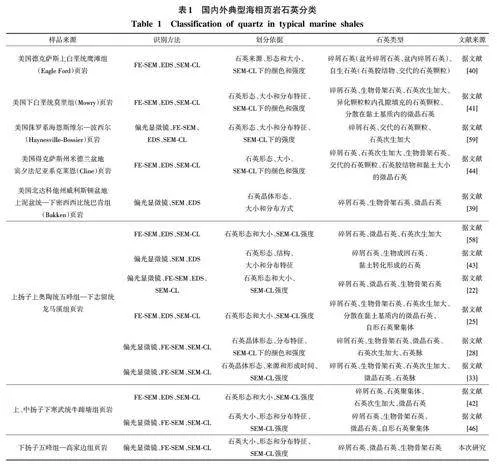
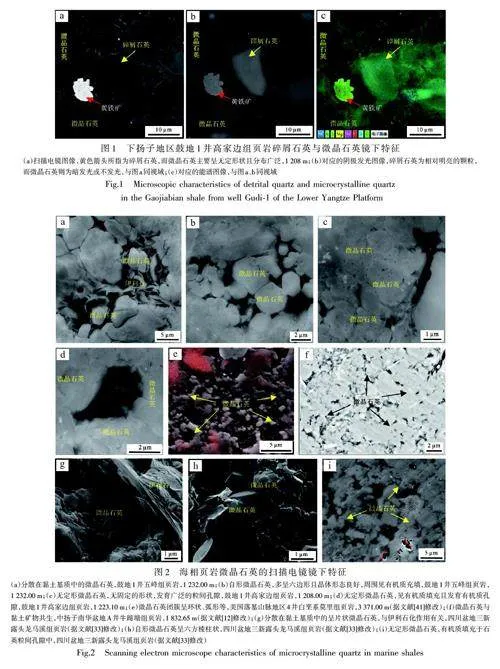
不同類型的石英對于頁巖孔隙發育和演化的貢獻是不同的,因此識別和分析頁巖石英類型至關重要。根據硅質來源和石英晶體形態,并借助偏光顯微鏡、場發射掃描電鏡觀察分析、能譜分析和陰極發光等方法手段,近年來在美國上白堊統鷹灘組頁巖[40]、中國上揚子下寒武統牛蹄塘組頁巖[42,46]和上揚子五峰組—龍馬溪組頁巖[25,33,58]等多套海相頁巖層系中發現了不同的石英類型,詳細石英分類如表1所示。本文借助偏光顯微鏡、場發射掃描電鏡(FESEM)、能譜(EDS)和陰極發光(SEM-CL)等手段,選取下揚子地區鼓地1井五峰組—高家邊組底部黑色富含筆石頁巖層段(1 208.0~1 234.0 m),對應晚奧陶世凱迪階— 早志留世魯丹階,涵蓋Dicellograptuscomplexus ? Paraorthograptus pacificus 帶(WF2~WF3)、Akidograp tus ascensus 帶(LM2)等筆石帶序列[60?61],發現該套頁巖中廣泛存在前期未引起足夠重視的多種石英類型,主要包括碎屑石英、微晶石英和生物骨架石英。總體而言,海相頁巖中碎屑石英主要通過河流搬運和沉積,主要為陸源輸入,由于長距離的搬運,碎屑石英多呈粉砂狀和次圓狀,在SEM-CL下基本為明亮的顆粒[33,41],鼓地1井五峰組—高家邊組頁巖中的碎屑石英表現出類似的特征,且粒徑多介于10~30 μm(圖1)。
頁巖中絕大多數石英可能并非碎屑成因,而主要為自生成因[62]。微晶石英為最常見的自生石英之一,在SEM-CL 下不發光,為灰暗的形式[12,25,32],可見于多套海相頁巖層系(圖2)。根據微晶石英的晶體形態和分布特征,鼓地1井中的微晶石英可進一步細分為3種類型:Ⅰ型,分散于黏土基質中的微晶石英,這類石英在富黏土頁巖中較為常見,在黏土礦物附近呈片狀或顆粒狀分布,多與蒙脫石的伊利石化有關(圖2a,g);Ⅱ型,自形微晶石英(圖2b,h),具有獨特的晶體形態,在拋光樣中多呈六邊形,形貌樣中為六方棱柱狀,發育程度好,直徑多介于1~2 μm;Ⅲ型,無定形微晶石英(圖2c,d),直徑從數百納米到幾微米不等,沒有特定的形狀,發育豐富的粒間孔隙[33]。其中大部分的Ⅱ型和Ⅲ型微晶石英可能來源于放射蟲等硅質生物的溶解,即生物成因來源[62?63]。
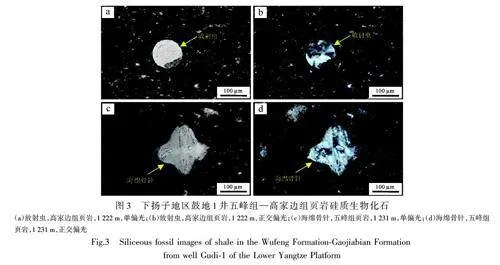
生物骨架石英,主要指硅質生物骨骼、碎片及其分泌物[33],在頁巖中最為常見的是放射蟲和海綿骨針。放射蟲等硅質生物生長發育需要大量的硅,頁巖中大量硅質生物的存在表明沉積時的水體富含硅[23,64?66]。以晚奧陶世—早志留世時期揚子地區為例,揚子地區大致表現為一種隆凹相間的古地理格局,這種格局導致古揚子海與外海隔離,形成半封閉局限滯留海盆,伴隨冰期后海侵事件而導致海平面上升,上升流提供了豐富的營養物質,海洋初級生產力高,硅質生物較為繁盛[67?70]。鼓地1井五峰組—高家邊組頁巖放射蟲和海綿骨針分布較為廣泛(圖3),這些微體生物化石多為硅質、有機質所填充,或被溶蝕而產生孔洞。
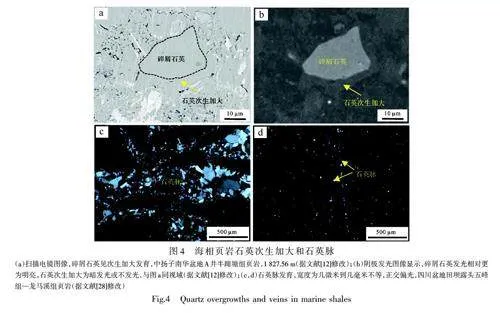
此外,頁巖中石英類型還包括石英次生加大和石英脈,其中石英次生加大在陰極發光圖像下多為暗發光或弱發光,可與碎屑石英相區分(圖4a,b);石英脈常與方解石和黏土礦物等礦物相伴生,這些石英脈寬度多為幾微米到幾千微米不等(圖4c,d)[25,28,33],但這兩種石英類型在鼓地1井中很少見。
2 微晶石英硅質來源的判定指標
頁巖自生微晶石英的硅質來源較為廣泛,包括火山玻璃轉化、黏土礦物轉化、硅酸鹽礦物溶解,以及硅質生物骨架溶解與再沉淀等[33,71?73],可通過鏡下觀察、主微量元素和生物硅含量等多種指標和方法手段來綜合判定樣品中的硅質來源。
2.1 硅質生物骨架
頁巖中存在放射蟲和海綿骨針等硅質生物骨架,可通過鏡下觀察來識別,這些硅質生物可為成巖作用早期自生石英的沉淀提供較為豐富的硅質來源[12,28,66,74]。鼓地1井五峰組—高家邊組頁巖鏡下可見放射蟲(圖3a,b)和海綿骨針(圖3c,d),其中放射蟲多呈紡錘形、橢圓形和圓形,直徑大多在100 μm左右,顯微鏡下部分樣品可見放射狀結構。
2.2 主微量判定指標
2.2.1 主微量元素及其比值
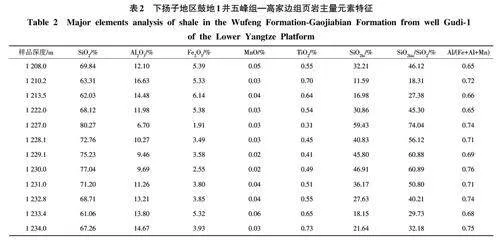
Al/ (Fe+Al+Mn)比值通常用于評估熱液活動對于海洋沉積物的影響,且比值隨著熱液輸入的減少而增加[75],可以作為確定硅質成因的一項關鍵指標。其中,純熱液的Al/(Fe+Al+Mn)比值小于0.01,而日本半深海Kamiaso 生物燧石的Al/(Fe+Al+Mn) 比值為0.60[35,66,75?76]。鼓地1 井五峰組— 高家邊組頁巖的Al/(Fe+Al+Mn)比值為0.65~0.76,平均為0.70(表2),表明硅質為非熱液成因。
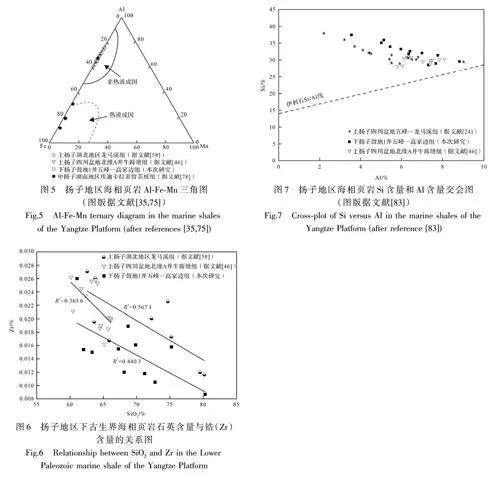
主微量元素含量對于判別硅質來源具有重要意義,其中Fe、Mn元素的富集主要與熱液有關,而Al元素富集則與陸源碎屑相關[66,77],因而可通過Al-Fe-Mn三角圖來判別頁巖是否為熱液成因[35,75]。如圖5所示,選取的揚子地區下古生界海相頁巖樣品具有高Al值和極低的Mn值,為非熱液成因;而中揚子新元古界埃迪卡拉系留茶坡組頁巖則基本落在高Fe值一側[78],反映為熱液成因。Zr可表征與重礦物相關的碎屑輸入[79],在判別頁巖樣品為非熱液成因的基礎上,可通過SiO2與Zr的二元圖解來進一步判斷其是否為生物成因。若SiO2與Zr呈正相關關系,反映為碎屑成因;若SiO2 與Zr呈負相關關系,則表明為生物成因[80]。鼓地1井五峰組—高家邊組頁巖SiO2與Zr呈較好的負相關關系,且相關系數(R2)與已證實硅質為生物成因的上揚子地區牛蹄塘組和龍馬溪組頁巖類似(圖6),因此,鼓地1井五峰組—高家邊組頁巖生物成因構成了硅質的重要來源。
2.2.2 生物硅含量
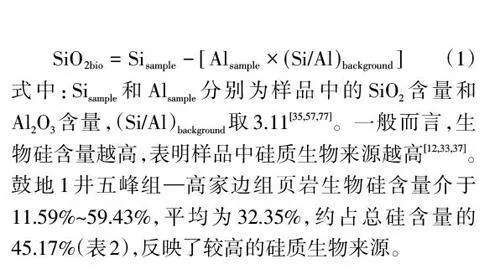
陸殼中SiO2/Al2O3值約為3.6[81?82],即若SiO2/Al2O3值位于3.6附近,則表明頁巖中的硅質均為陸源輸入。鼓地1 井五峰組—高家邊組頁巖SiO2/Al2O3 值介于3.81~11.98,平均為6.25,反映明顯存在其他硅質來源。此外,在Si含量與Al含量交匯圖中,位于伊利石Si/Al 線之上的樣品表明其存在過量硅[83]。鼓地1井頁巖樣品均位于伊利石Si/Al 線的上方區域(圖7),由于前文已排除硅質的熱液來源,故過量硅可視為生物硅。因此,生物硅可通過總硅含量減去碎屑硅含量來估計[21],其含量可通過公式(1)進行計算:
3 生物成因微晶石英對頁巖儲層的影響
3.1 生物成因微晶石英對巖石力學的影響
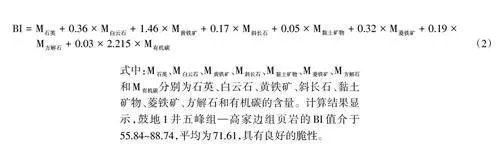
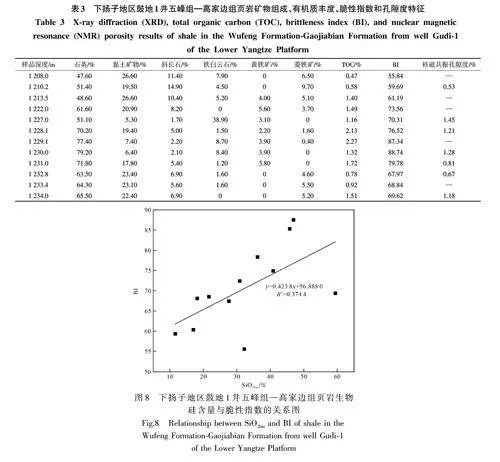
頁巖組分與結構是控制其力學性能的重要因素,高脆性的礦物(包括石英、長石、黃鐵礦和碳酸鹽礦物)對巖石的力學強度具有積極的貢獻[84?85]。脆性指數(BI值),已被廣泛用于表征頁巖的脆性,主要包括基于巖石力學彈性系數(楊氏模量和泊松比)的力學BI值和脆性礦物含量的礦物BI值兩種。力學BI值需要大量樣品的巖石力學分析測試和昂貴的成本,而礦物BI值往往導致巖石脆性的人為優化,為此,本文借助礦物組成和力學性能相結合的方法來計算鼓地1井五峰組—高家邊組頁巖的BI值(表3),計算方法見公式2[31]:
石英與其他脆性礦物相比,具有更高的脆性[2,31],是頁巖中最重要的脆性礦物之一。不同來源的石英是影響巖石脆性的主要因素,會表現出不同的巖石力學性能[30,57,85]。近期的研究表明,與以碎屑石英和蒙脫石伊利石化形成的分散在黏土基質中的微晶石英為主的頁巖相比,以生物成因微晶石英為主的頁巖往往具有更高的楊氏模量與脆性[57]。鼓地1井五峰組—高家邊組頁巖的生物硅含量與BI值具有較好的正相關性(圖8),表明生物成因微晶石英的發育在一定程度上提高了頁巖的脆性,這也與前人在上揚子四川盆地牛蹄塘組頁巖[57]、上揚子四川盆地龍馬溪組頁巖[33]和中、上揚子五峰組—龍馬溪組頁巖[85]等研究較為一致。上述結果進一步表明,存在于頁巖基質中大量的生物成因微晶石英可以相互連接,構成剛性框架[17,33,48],形成有效的支撐,進而提高頁巖的力學性能。此外,近期對上揚子東南緣下寒武統牛蹄塘組頁巖的研究發現,當石英含量介于55%~70%時,碎屑石英和生物成因石英的比例更適合裂縫的產生,頁巖脆性相對更高;而當石英含量高于70%,且其類型主要為生物成因石英時,脆性反而會有所降低[57]。
3.2 生物成因微晶石英對孔隙保存的影響
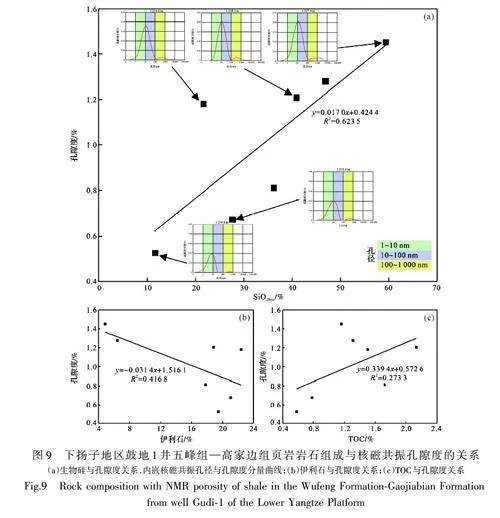
核磁共振(NMR)是一種快速、無創、無損的技術,近年來已被初步應用于測定頁巖的孔隙類型、孔徑分布以及孔隙度等[48,86]。通過分析鼓地1井五峰組—高家邊組頁巖核磁共振孔隙度與巖石組成的關系可知,孔隙度與TOC具有一定的正相關性,與生物硅具有較好的正相關性,而與伊利石之間具有較好的負相關性(圖9),表明TOC對孔隙度具有一定的促進作用,而生物硅的富集有利于孔隙的發育與保存。鼓地1井頁巖樣品中的黏土礦物主要為伊利石,相對含量占97.75%,填充粒間孔隙而導致孔隙度降低。此外,孔隙度分量與孔徑曲線顯示,鼓地1井頁巖中低生物硅含量的樣品以直徑為10 nm(綠色條帶)為主,而較高生物硅含量的樣品在10~100 nm的范圍(藍色條帶)內孔隙度有所增加且孔徑分布更為均勻。這可能是隨著生物硅含量的增加,處于10~100 nm的微晶石英粒間孔隙和有機質孔隙得以更好的發育與保存。
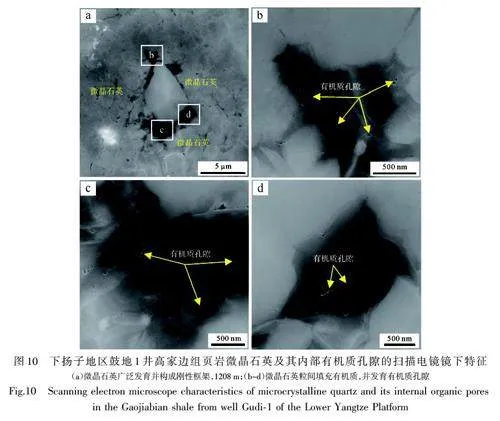
生物成因微晶石英來源于硅質生物的溶解和再沉淀,硅質生物的原始成分一般為蛋白石-A,蛋白石-A是一種高度無序的非晶態硅質物質且性質不穩定,在40 ℃~50 ℃時會發生快速溶解—脫水—再沉淀反應,生成蛋白石-CT,并在60 ℃~75 ℃時會進一步發生溶解—再沉淀反應,逐漸形成高硬度結構的隱晶質和微晶石英集合體[32,48,87?88]。由于蛋白石-A和蛋白石-CT的穩定性均不高,其成巖的溫度和壓力相對較低,在成巖作用早期便完成向更為穩定的生物成因微晶石英的轉變[63,89]。蛋白石-A向蛋白石-CT轉化階段,孔隙度損失率高;而蛋白石-CT向微晶石英轉化階段,孔隙度損失率低,且損失幅度顯著減小[89]。因而這些形成于成巖作用早期的生物成因微晶石英便構成了剛性框架,提高了頁巖的抗壓實能力,并有效抑制原生孔隙在埋藏壓實過程中的進一步減小,從而使原生孔隙得以良好保存,且在發生顯著的孔隙度損失之前就已開始保持孔隙度[48,89]。而在成巖作用晚期,壓實作用對頁巖原生孔隙的破壞程度較為有限,孔隙度損失極為緩慢[89]。在一些生物硅對總硅貢獻較大的海相頁巖中,常見次生有機質填充生物成因微晶石英粒間孔隙空間,且這些有機質內部有機質孔隙較為發育[12,25,33,37,48]。下揚子地區鼓地1井五峰組—高家邊組頁巖Ro 值介于1.67%~2.11%,平均為1.83%,大多處于高成熟階段,同樣可見有機質填充于生物成因微晶石英粒間孔隙空間,且有機質孔隙發育較為廣泛(圖10)。頁巖中有機質和黏土礦物受壓實作用影響易發生塑性變形,而生物成因微晶石英則可形成剛性框架,增強其抗壓實能力,使其內部的有機質孔隙得以保存[33]。近年來越來越多的研究表明,在剛性框架存在的情況下,頁巖原生粒間孔隙和有機質孔隙往往得以較好的保存[17?18,24?25]。對鼓地1井五峰組—高家邊組底部頁巖的研究進一步表明,生物成因微晶石英可在下揚子地區古生界海相頁巖中廣泛發育,有利于孔隙的保存,有助于進一步揭示下揚子地區古生界海相頁巖孔隙發育與演化規律,為尋找頁巖氣有利賦存區提供進一步的地質依據。
4 結論
(1) 海相頁巖石英類型可大致劃分為碎屑石英、自生微晶石英、石英次生加大、生物骨架石英和石英脈五種類型;其中微晶石英作為最常見的一種自生石英類型,基于其晶體形態和分布特征的差異,可細分為分散于黏土基質中的微晶石英、自形微晶石英和無定形微晶石英共3種類型。下揚子地區鼓地1井五峰組—高家邊組頁巖石英類型主要為碎屑石英、微晶石英和生物骨架石英,其中碎屑石英在陰極發光下顯示為明亮的顆粒,而微晶石英呈現為在陰極發光下不發光或暗發光的自生來源特征,生物骨架石英則多為放射蟲和海綿骨針的生物碎片。
(2) 海相頁巖中微晶石英可存在多種硅質來源,鏡下及地球化學指標指示,生物成因構成了鼓地1井五峰組—高家邊組頁巖微晶石英重要的硅質來源。
(3) 生物成因微晶石英對頁巖儲層發育具有重要的影響,能夠增強頁巖的脆性并形成剛性框架,提高了頁巖的力學性質,使其抗壓實能力增強,有利于頁巖內部孔隙空間特別是粒間孔隙和有機質孔隙的保存。
參考文獻(References)
[1] Montgomery S L, Jarvie D M, Bowker K A, et al. Mississippian
Barnett Shale, Fort Worth Basin, north-central Texas: Gas-shale
play with multi-trillion cubic foot potential[J]. AAPG Bulletin,
2005, 89(2): 155-175.
[2] Jarvie D M, Hill R J, Ruble T E, et al. Unconventional shale-gas
systems: The Mississippian Barnett Shale of north-central Texas
as one model for thermogenic shale-gas assessment[J]. AAPG
Bulletin, 2007, 91(4): 475-499.
[3] 張金川,徐波,聶海寬,等. 中國頁巖氣資源勘探潛力[J]. 天然
氣工業,2008,28(6):136-140.[Zhang Jinchuan, Xu Bo, Nie Haikuan,
et al. Exploration potential of shale gas resources in China
[J]. Natural Gas Industry, 2008, 28(6): 136-140.]
[4] 鄒才能,董大忠,王社教,等. 中國頁巖氣形成機理、地質特征及資
源潛力[J]. 石油勘探與開發,2010,37(6):641-653.[Zou Caineng,
Dong Dazhong, Wang Shejiao, et al. Geological characteristics,
formation mechanism and resource potential of shale gas in China
[J]. Petroleum Exploration and Development, 2010, 37(6):
641-653.]
[5] 蔣裕強,董大忠,漆麟,等. 頁巖氣儲層的基本特征及其評價
[J]. 天然氣工業,2010,30(10):7-12.[Jiang Yuqiang, Dong Dazhong,
Qi Lin, et al. Basic features and evaluation of shale gas
reservoirs[J]. Natural Gas Industry, 2010, 30(10): 7-12.]
[6] Loucks R G, Reed R M, Ruppel S C, et al. Spectrum of pore
types and networks in mudrocks and a descriptive classification
for matrix-related mudrock pores[J]. AAPG Bulletin, 2012, 96
(6): 1071-1098.
[7] 劉樹根,馬文辛,Luba J,等. 四川盆地東部地區下志留統龍馬
溪組頁巖儲層特征[J]. 巖石學報,2011,27(8):2239-2252.[Liu
Shugen, Ma Wenxin, Luba J, et al. Characteristics of the shale
gas reservoir rocks in the Lower Silurian Longmaxi Formation,
east Sichuan Basin, China[J]. Acta Petrologica Sinica, 2011, 27
(8): 2239-2252.]
[8] 陳文玲,周文,羅平,等. 四川盆地長芯1 井下志留統龍馬溪組
頁巖氣儲層特征研究[J]. 巖石學報,2013,29(3):1073-1086.
[Chen Wenling, Zhou Wen, Luo Ping, et al. Analysis of the shale gas
reservoir in the Lower Silurian Longmaxi Formation, Changxin 1
well, southeast Sichuan Basin, China[J]. Acta Petrologica Sinica,
2013, 29(3): 1073-1086.]
[9] Ko L T, Loucks R G, Zhang T W, et al. Pore and pore network
evolution of Upper Cretaceous Boquillas (Eagle Ford–equivalent)
mudrocks: Results from gold tube pyrolysis experiments[J].
AAPG Bulletin, 2016, 100(11): 1693-1722.
[10] 譚靜強,張煜麟,羅文彬,等. 富有機質泥頁巖微納米孔隙結
構研究進展[J]. 礦物巖石地球化學通報,2019,38(1):18-29.
[Tan Jingqiang, Zhang Yulin, Luo Wenbin, et al. Research
progress on microscale and nanoscale pore structures of organicrich
muddy shales[J]. Bulletin of Mineralogy, Petrology and
Geochemistry, 2019, 38(1): 18-29.]
[11] Gao Z Y, Fan Y P, Xuan Q X, et al. A review of shale pore structure
evolution characteristics with increasing thermal maturities
[J]. Advances in Geo-Energy Research, 2020, 4(3): 247-259.
[12] Dong T, He Q, He S, et al. Quartz types, origins and organic
matter-hosted pore systems in the lower Cambrian Niutitang Formation,
Middle Yangtze Platform, China[J]. Marine and Petroleum
Geology, 2021, 123: 104739.
[13] 騰格爾,盧龍飛,俞凌杰,等. 頁巖有機質孔隙形成、保持及其
連通性的控制作用[J]. 石油勘探與開發,2021,48(4):687-
699.[Borjigin T, Lu Longfei, Yu Lingjie, et al. Formation, preservation
and connectivity control of organic pores in shale[J]. Petroleum
Exploration and Development, 2021, 48(4): 687-699.]
[14] 徐良偉,楊克基,魯文婷,等. 富有機質泥頁巖微納米孔隙系
統演化特征及模式研究新進展[J]. 沉積學報,2022,40(1):1-
21.[Xu Liangwei, Yang Keji, Lu Wenting, et al. New research
progress on organic-rich shale micro- and nanoscale pore system
evolution characteristics and models[J]. Acta Sedimentologica
Sinica, 2022, 40(1): 1-21.]
[15] 盧龍飛,劉偉新,魏志紅,等. 四川盆地志留系頁巖成巖特征
及其對孔隙發育與保存的控制[J]. 沉積學報,2022,40(1):73-
87.[Lu Longfei, Liu Weixin, Wei Zhihong, et al. Diagenesis of
the Silurian shale, Sichuan Basin: Focus on pore development
and preservation [J]. Acta Sedimentologica Sinica, 2022, 40(1):
73-87.]
[16] Jarvie D M. Shale resource systems for oil and gas: Part 1—
shale-gas resource systems[M]//Breyer J A. Shale reservoirsgiant
resources for the 21st century. AAPG Memoir, 2012:
69-87.
[17] Milliken K L, Day-Stirrat R J. Cementation in mudrocks: Brief
review with examples from cratonic basin mudrocks[M]//Chatellier
J Y, Jarvie D M. Critical assessment of shale resource plays.
AAPG Memoir, 2013: 133-150.
[18] Fishman N S, Hackley P C, Lowers H A, et al. The nature of porosity
in organic-rich mudstones of the Upper Jurassic Kimmeridge
Clay Formation, North Sea, offshore United Kingdom[J].
International Journal of Coal Geology, 2012, 103: 32-50.
[19] Ardakani O H, Sanei H, Ghanizadeh A, et al. Hydrocarbon potential
and reservoir characteristics of Lower Cretaceous Garbutt
Formation, Liard Basin Canada[J]. Fuel, 2017, 209: 274-289.
[20] Nie H K, Sun C X, Liu G X, et al. Dissolution pore types of the
Wufeng Formation and the Longmaxi Formation in the Sichuan
Basin, South China: Implications for shale gas enrichment[J].
Marine and Petroleum Geology, 2019, 101: 243-251.
[21] Ross D J K, Bustin R M. Investigating the use of sedimentary
geochemical proxies for paleoenvironment interpretation of thermally
mature organic-rich strata: Examples from the Devonian–
Mississippian shales, western Canadian sedimentary basin[J].
Chemical Geology, 2009, 260(1/2): 1-19.
[22] Han C, Han M, Jiang Z X, et al. Source analysis of quartz from
the Upper Ordovician and Lower Silurian black shale and its effects
on shale gas reservoir in the southern Sichuan Basin and its
periphery, China[J]. Geological Journal, 2019, 54(1): 438-449.
[23] 盧龍飛,秦建中,申寶劍,等. 川東南涪陵地區五峰組—龍馬
溪組硅質頁巖的生物成因及其油氣地質意義[J]. 石油實驗地
質,2016,38(4):460-465,472.[Lu Longfei, Qin Jianzhong,
Shen Baojian, et al. Biogenic origin and hydrocarbon significance
of siliceous shale from the Wufeng-Longmaxi Formations
in Fuling area, southeastern Sichuan Basin[J]. Petroleum Geology
amp; Experiment, 2016, 38(4): 460-465, 472.]
[24] Guo X W, Qin Z J, Yang R, et al. Comparison of pore systems
of clay-rich and silica-rich gas shales in the Lower Silurian Longmaxi
Formation from the Jiaoshiba area in the eastern Sichuan
Basin, China[J]. Marine and Petroleum Geology, 2019, 101:
265-280.
[25] Dong T, He S, Chen M F, et al. Quartz types and origins in the
Paleozoic Wufeng-Longmaxi Formations, eastern Sichuan Basin,
China: Implications for porosity preservation in shale reservoirs
[J]. Marine and Petroleum Geology, 2019, 106: 62-73.
[26] Chen L, Jiang Z X, Liu Q X, et al. Mechanism of shale gas occurrence:
Insights from comparative study on pore structures of
marine and lacustrine shales[J]. Marine and Petroleum Geology,
2019, 104: 200-216.
[27] 董大忠,梁峰,管全中,等. 四川盆地五峰組—龍馬溪組頁巖
氣優質儲層發育模式及識別評價技術[J]. 天然氣工業,2022,
42(8):96-111.[Dong Dazhong, Liang Feng, Guan Quanzhong,
et al. Development model and identification evaluation technology
of Wufeng-Longmaxi Formation quality shale gas reservoirs
in the Sichuan Basin[J]. Natural Gas Industry, 2022, 42(8):
96-111.]
[28] Qiu Z, Liu B, Dong D Z, et al. Silica diagenesis in the Lower Paleozoic
Wufeng and Longmaxi Formations in the Sichuan Basin,
South China: Implications for reservoir properties and paleoproductivity[
J]. Marine and Petroleum Geology, 2020, 121:
104594.
[29] 李鉅源. 東營凹陷泥頁巖礦物組成及脆度分析[J]. 沉積學報,
2013,31(4):616-620.[Li Juyuan. Analysis on mineral components
and frangibility of shales in Dongying Depression[J]. Acta
Sedimentologica Sinica, 2013, 31(4): 616-620.]
[30] Dong T, Harris N B, Ayranci K, et al. The impact of rock composition
on geomechanical properties of a shale formation: Middle
and Upper Devonian Horn River Group shale, Northeast British
Columbia, Canada[J]. AAPG Bulletin, 2017, 101(2): 177-204.
[31] Huo Z P, Zhang J C, Li P, et al. An improved evaluation method
for the brittleness index of shale and its application: A case study
from the southern North China Basin[J]. Journal of Natural Gas
Science and Engineering, 2018, 59: 47-55.
[32] Xi Z D, Tang S H, Zhang S H, et al. Characterization of quartz
in the Wufeng Formation in northwest Hunan province, South
China and its implications for reservoir quality[J]. Journal of Petroleum
Science and Engineering, 2019, 179: 979-996.
[33] Xu H, Zhou W, Hu Q H, et al. Quartz types, silica sources and
their implications for porosity evolution and rock mechanics in
the Paleozoic Longmaxi Formation shale, Sichuan Basin[J]. Marine
and Petroleum Geology, 2021, 128: 105036.
[34] Reynolds J H, Verhoogen J. Natural variations in the isotopic
constitution of silicon[J]. Geochimica et Cosmochimica Acta,
1953, 3(5): 224-234.
[35] Adachi M, Yamamoto K, Sugisaki R. Hydrothermal chert and associated
siliceous rocks from the northern Pacific their geological
significance as indication od ocean ridge activity[J]. Sedimentary
Geology, 1986, 47(1/2): 125-148.
[36] Moore T C Jr. Biogenic silica and chert in the Pacific Ocean[J].
Geology, 2008, 36(12): 975-978.
[37] Zhao J H, Jin Z K, Jin Z J, et al. Origin of authigenic quartz in
organic-rich shales of the Wufeng and Longmaxi Formations in
the Sichuan Basin, South China: Implications for pore evolution
[J]. Journal of Natural Gas Science and Engineering, 2017, 38:
21-38.
[38] McBride E F. Quartz cement in sandstones: A review[J]. Earth-
Science Reviews, 1989, 26(1/2/3): 69-112.
[39] Fishman N S, Egenhoff S O, Boehlke A R, et al. Petrology and
diagenetic history of the upper shale member of the Late Devonian-
Early Mississippian Bakken Formation, Williston Basin, North
Dakota[M]//Larsen D, Egenhoff S O, Fishman N S. Paying attention
to mudrocks: Priceless!. Geological Society of America,
2015: 125-151.
[40] Milliken K L, Ergene S M, Ozkan A. Quartz types, authigenic
and detrital, in the upper Cretaceous Eagle Ford Formation,
south Texas, USA[J]. Sedimentary Geology, 2016, 339:
273-288.
[41] Milliken K L, Olson T. Silica diagenesis, porosity evolution, and
mechanical behavior in siliceous mudstones, Mowry Shale (Cretaceous),
Rocky Mountains, U. S. A. [J]. Journal of Sedimentary
Research, 2017, 87(4): 366-387.
[42] Niu X, Yan D T, Zhuang X G, et al. Origin of quartz in the lower
Cambrian Niutitang Formation in south Hubei province, Upper
Yangtze Platform[J]. Marine and Petroleum Geology, 2018,
96: 271-287.
[43] 孫川翔,聶海寬,劉光祥,等. 石英礦物類型及其對頁巖氣富
集開采的控制:以四川盆地及其周緣五峰組—龍馬溪組為例
[J]. 地球科學,2019,44(11):3692-3704.[Sun Chuanxiang,
Nie Haikuan, Liu Guangxiang, et al. Quartz type and its control
on shale gas enrichment and production: A case study of the
Wufeng-Longmaxi Formations in the Sichuan Basin and its surrounding
areas, China[J]. Earth Science, 2019, 44(11): 3692-
3704.]
[44] Peng J W, Milliken K L, Fu Q L. Quartz types in the Upper
Pennsylvanian organic‐rich Cline Shale (Wolfcamp D), Midland
Basin, Texas: Implications for silica diagenesis, porosity evolution
and rock mechanical properties[J]. Sedimentology, 2020, 67
(4): 2040-2064.
[45] 張鵬輝,陳志勇,薛路,等. 塔里木盆地西北緣下寒武統黑色
巖系差異性成巖演化及其影響因素[J]. 巖石學報,2020,36
(11):3463-3476.[Zhang Penghui, Chen Zhiyong, Xue Lu, et
al. The differential diagenetic evolution and its influencing factors
of lower Cambrian black rock series in the northwestern
margin of Tarim Basin[J]. Acta Petrologica Sinica, 2020, 36(11):
3463-3476.]
[46] Chen X L, Shi W Z, Hu Q H, et al. Origin of authigenic quartz
in organic-rich shales of the Niutitang Formation in the northern
margin of Sichuan Basin, South China: Implications for pore network
development[J]. Marine and Petroleum Geology, 2022,
138: 105548.
[47] 劉國恒,翟剛毅,楊銳,等. 石英結晶度指數:中國四川盆地及
周緣晚奧陶世—早志留世富有機質頁巖中硅質為生物成因的
定量性新證據[J]. 中國科學(D輯):地球科學,2021,51(7):
1135-1149.[Liu Guoheng, Zhai Gangyi, Yang Rui, et al. Quartz
crystallinity index: New quantitative evidence for biogenic silica
of the Late Ordovician to Early Silurian organic-rich shale in the
Sichuan Basin and adjacent areas, China[J]. Science China
(Seri. D): Earth Sciences, 2021, 51(7): 1135-1149.]
[48] Knapp L J, Ardakani O H, Uchida S, et al. The influence of rigid
matrix minerals on organic porosity and pore size in shale reservoirs:
Upper Devonian Duvernay Formation, Alberta, Canada
[J]. International Journal of Coal Geology, 2020, 227: 103525.
[49] Hao F, Zou H Y, Lu Y C. Mechanisms of shale gas storage: Implications
for shale gas exploration in China[J]. AAPG Bulletin,
2013, 97(8): 1325-1346.
[50] 郭旭升,胡東風,魏志紅,等. 涪陵頁巖氣田的發現與勘探認
識[J]. 中國石油勘探,2016,21(3):24-37.[Guo Xusheng, Hu
Dongfeng, Wei Zhihong, et al. Discovery and exploration of
Fuling shale gas field[J]. China Petroleum Exploration, 2016, 21
(3): 24-37.]
[51] Liu Z Q, Guo S B, Lv R. Shale-gas play risk of the Lower Cambrian
on the Yangtze Platform, South China[J]. AAPG Bulletin,
2020, 104(5): 989-1009.
[52] 張君峰,許浩,周志,等. 鄂西宜昌地區頁巖氣成藏地質特征
[J]. 石油學報,2019,40(8):887-899.[Zhang Junfeng, Xu Hao,
Zhou Zhi, et al. Geological characteristics of shale gas reservoir
in Yichang area, western Hubei[J]. Acta Petrolei Sinica, 2019, 40
(8): 887-899.]
[53] 陳孔全,李君軍,唐協華,等. 中揚子地區五峰組—龍馬溪組
頁巖氣成藏關鍵地質因素[J]. 天然氣工業,2020,40(6):18-
30.[Chen Kongquan, Li Junjun, Tang Xiehua, et al. Key geological
factors for shale gas accumulation in the Wufeng-
Longmaxi Fms in the central Yangtze area[J]. Natural Gas Industry,
2020, 40(6): 18-30.]
[54] 邱振,鄒才能. 非常規油氣沉積學:內涵與展望[J]. 沉積學報,
2020,38(1):1-29.[Qiu Zhen, Zou Caineng. Unconventional
petroleum sedimentology: Connotation and prospect[J]. Acta
Sedimentologica Sinica, 2020, 38(1): 1-29.]
[55] 鄒才能,趙群,叢連鑄,等. 中國頁巖氣開發進展、潛力及前景
[J]. 天然氣工業,2021,41(1):1-14.[Zou Caineng, Zhao Qun,
Cong Lianzhu, et al. Development progress, potential and prospect
of shale gas in China[J]. Natural Gas Industry, 2021, 41(1):
1-14.]
[56] 施振生,邱振. 海相細粒沉積層理類型及其油氣勘探開發意
義[J]. 沉積學報,2021,39(1):181-196.[Shi Zhensheng, Qiu
Zhen. Main bedding types of marine fine-grained sediments and
their significance for oil and gas exploration and development
[J]. Acta Sedimentologica Sinica, 2021, 39(1): 181-196.]
[57] Liu J S, Ding W L, Wang R Y, et al. Quartz types in shale and
their effect on geomechanical properties: An example from the
lower Cambrian Niutitang Formation in the Cen'gong block,
South China[J]. Applied Clay Science, 2018, 163: 100-107.
[58] Yang X R, Yan D T, Wei X S, et al. Different formation mechanism
of quartz in siliceous and argillaceous shales: A case study
of Longmaxi Formation in South China[J]. Marine and Petroleum
Geology, 2018, 94: 80-94.
[59] Dowey P J, Taylor K G. Extensive authigenic quartz overgrowths
in the gas-bearing Haynesville-Bossier Shale, USA[J].
Sedimentary Geology, 2017, 356: 15-25.
[60] Chen Q, Fan J X, Zhang L N, et al. Paleogeographic evolution
of the Lower Yangtze region and the break of the “platformslope-
basin” pattern during the Late Ordovician[J]. Science China
Earth Sciences, 2018, 61(5): 625-636.
[61] 王文娟,陳建文,雷寶華,等. 下揚子巢湖鼓地1 井五峰組—高
家邊組生物地層及部分筆石帶缺失原因[J]. 海洋地質前沿,
2021,37(4):61-67.[Wang Wenjuan, Chen Jianwen, Lei Baohua,
et al. Cause of the partial missing of graptolite zones in
Wufeng and Kaochiapien Formations of well GD-1, Chaohu area,
Lower Yangtze region[J]. Marine Geology Frontiers, 2021,
37(4): 61-67.]
[62] Schieber J, Krinsley D, Riciputi L. Diagenetic origin of quartz
silt in mudstones and implications for silica cycling[J]. Nature,
2000, 406(6799): 981-985.
[63] Schieber J. Early diagenetic silica deposition in algal cysts and
spores: A source of sand in black shales?[J]. Journal of Sedimentary
Research, 1996, 66(1): 175-183.
[64] Lampitt R S, Salter I, Johns D. Radiolaria: Major exporters of
organic carbon to the deep ocean[J]. Global Biogeochemical Cycles,
2009, 23(1): GB1010.
[65] Crosta X, Romero O E, Ther O, et al. Climatically-controlled siliceous
productivity in the eastern gulf of Guinea during the last
40 000 yr[J]. Climate of the Past, 2012, 8(2): 415-431.
[66] 王淑芳,鄒才能,董大忠,等. 四川盆地富有機質頁巖硅質生
物成因及對頁巖氣開發的意義[J]. 北京大學學報(自然科學
版),2014,50(3):476-486. [Wang Shufang, Zou Caineng,
Dong Dadong, et al. Biogenic silica of organic-rich shale in Sichuan
Basin and its significance for shale gas[J]. Acta Scientiarum
Naturalium Universitatis Pekinensis, 2014, 50(3):
476-486.]
[67] Gorjan P, Kaiho K, Fike D A, et al. Carbon-and sulfur-isotope
geochemistry of the Hirnantian (Late Ordovician) Wangjiawan
(Riverside) section, South China: Global correlation and environmental
event interpretation[J]. Palaeogeography, Palaeoclimatology,
Palaeoecology, 2012, 337-338: 14-22.
[68] Liu Y, Li C, Algeo T J, et al. Global and regional controls on marine
redox changes across the Ordovician-Silurian boundary in
South China[J]. Palaeogeography, Palaeoclimatology, Palaeoecology,
2016, 463: 180-191.
[69] Khan M Z, Feng Q L, Zhang K, et al. Biogenic silica and organic
carbon fluxes provide evidence of enhanced marine productivity
in the Upper Ordovician-Lower Silurian of South China[J].
Palaeogeography, Palaeoclimatology, Palaeoecology, 2019, 534:
109278.
[70] Cai Q S, Hu M Y, Zhang B M, et al. Source of silica and its implications
for organic matter enrichment in the Upper Ordovician-
Lower Silurian black shale in western Hubei province, China:
Insights from geochemical and petrological analysis[J]. Petroleum
Science, 2022, 19(1): 74-90.
[71] Peltonen C, Marcussen ?, Bj?rlykke K, et al. Clay mineral diagenesis
and quartz cementation in mudstones: The effects of
smectite to illite reaction on rock properties[J]. Marine and Petroleum
Geology, 2009, 26(6): 887-898.
[72] Thyberg B, Jahren J, Winje T, et al. Quartz cementation in Late
Cretaceous mudstones, northern North Sea: Changes in rock
properties due to dissolution of smectite and precipitation of
micro-quartz crystals[J]. Marine and Petroleum Geology, 2010,
27(8): 1752-1764.
[73] Dong T, Harris N B, Knapp L J, et al. The effect of thermal maturity
on geomechanical properties in shale reservoirs: An example
from the Upper Devonian Duvernay Formation, western
Canada sedimentary basin[J]. Marine and Petroleum Geology,
2018, 97: 137-153.
[74] Lei Z H, Dashtgard S E, Wang J, et al. Origin of chert in Lower
Silurian Longmaxi Formation: Implications for tectonic evolution
of Yangtze Block, South China[J]. Palaeogeography, Palaeo‐
climatology, Palaeoecology, 2019, 529: 53-66.
[75] Yamamoto K. Geochemical characteristics and depositional environments
of cherts and associated rocks in the Franciscan and
Shimanto Terranes[J]. Sedimentary Geology, 1987, 52(1/2):
65-108.
[76] Bostr?m K, Kraemer T, Gartner S. Provenance and accumulation
rates of opaline silica, Al, Ti, Fe, Mn, Cu, Ni and Co in Pacific
pelagic sediments[J]. Chemical Geology, 1973, 11(2):
123-148.
[77] Wedepohl K H. Environmental influences on the chemical composition
of shales and clays[J]. Physics and Chemistry of the
Earth, 1971, 8: 307-333.
[78] Tan J Q, Wang Z H, Wang W H, et al. Depositional environment
and hydrothermal controls on organic matter enrichment in the
lower Cambrian Niutitang shale, southern China[J].
AAPG Bulletin, 2021, 105(7): 1329-1356.
[79] Gambacorta G, Trincianti E, Torricelli S. Anoxia controlled by
relative sea-level changes: An example from the Mississippian
Barnett Shale Formation[J]. Palaeogeography, Palaeoclimatology,
Palaeoecology, 2016, 459: 306-320.
[80] Wright A M, Spain D, Ratcliffe K T. Application of inorganic
whole rock geochemistry to shale resource plays[C]//Canadian
unconventional resources and international petroleum conference.
Calgary, Canada: SPE, 2010: 137946.
[81] Taylor S R, McLennan S M. The continental crust: Its composition
and evolution[M]. Oxford: Blackwell Scientific Publication,
1985.
[82] Taylor S R, McLennan S M. The geochemical evolution of the
continental crust[J]. Reviews of Geophysics, 1995, 33(2):
241-265.
[83] Rowe H D, Loucks R G, Ruppel S C, et al. Mississippian Barnett
Formation, Fort Worth Basin, Texas: Bulk geochemical inferences
and Mo–TOC constraints on the severity of hydrographic
restriction[J]. Chemical Geology, 2008, 257(1/2): 16-25.
[84] Rybacki E, Meier T, Dresen G. What controls the mechanical
properties of shale rocks?–Part II: Brittleness[J]. Journal of Petroleum
Science and Engineering, 2016, 144: 39-58.
[85] Ye Y P, Tang S H, Xi Z D, et al. Quartz types in the Wufeng-
Longmaxi Formations in southern China: Implications for porosity
evolution and shale brittleness[J]. Marine and Petroleum Geology,
2022, 137: 105479.
[86] Liu Z S, Liu D M, Cai Y D, et al. Application of nuclear magnetic
resonance (NMR) in coalbed methane and shale reservoirs: A
review[J]. International Journal of Coal Geology, 2020, 218:
103261.
[87] Isaacs C M. Porosity reduction during diagenesis of Monterey
Formation, Santa Barbara, California: Abstract[M]. AAPG Bulletin,
1981, 65(5): 940-941.
[88] Rice S B, Freund H, Huang W L, et al. Application of Fourier
Transform infrared spectroscopy to silica diagenesis: The opal-A
to opal-CT transformation[J]. Journal of Sedimentary Research,
1995, 65(4a): 639-647.
[89] 盧龍飛,劉偉新,俞凌杰,等. 生物蛋白石早期成巖相變特征
及對硅質頁巖孔隙發育與孔徑分布的影響[J]. 石油實驗地質,
2020,42(3),363-370.[Lu Longfei, Liu Weixin, Yu Lingjie, et
al. Early diagenesis characteristics of biogenic opal and its influence
on porosity and pore network evolution of siliceous shale
[J]. Petroleum Geology amp; Experiment, 2020, 42(3): 363-370.]