成就目標定向與學業成績關系的元分析:自我效能感、學習投入的中介作用
2024-07-03 10:18:54吳佳檜傅海倫
心理科學進展 2024年7期
吳佳檜 傅海倫
摘 ?要??成就目標定向是影響學生學業成績的重要因素, 諸多研究探討了成就目標定向與學業成績之間的內在聯系, 但二者之間相關性的大小、中介和調節機制仍存有爭議。因此當前研究采用元分析方法檢驗效應量的可靠性、自我效能感和學習投入的中介效應以及一系列調節效應。研究共納入符合要求的原始文獻67篇, 含206個效應量。結果發現:(1)掌握接近目標和表現接近目標與學業成績呈顯著正相關, 而掌握回避目標和表現回避目標與學業成績呈顯著負相關, 且各指標與學業成績存在穩健的弱相關。(2)成就目標定向與學業成績的關系受到年齡階段、測量工具的影響, 不受性別比例、成績類型的調節。(3)自我效能感和學習投入在成就目標定向對學業成績影響中發揮著中介作用, 但學習投入的中介作用只存在于中學組, 在大學組學習投入的中介作用不顯著。
關鍵詞??成就目標定向, 自我效能感, 學習投入, 學業成績, 元分析
分類號??B849: G44
1??引言
黨的十九屆五中全會指出, “十四五”時期我國教育發展的主要任務是建設高質量教育體系, 全面提升教育質量。在現行的教育體制下, 學業成績被視為教育質量的重要組成部分, 可以定量評估國家的育人成效, 提升學業成績已然成為社會各界普遍關注的焦點論域。社會認知理論指出個體的學業成績受到內部個體因素和外部環境因素的綜合驅動(Lee & Shute, 2010), 其中個體因素總體上可分為智力因素和非智力因素, 在所有的非智力因素中, 動機是最為核心的一個要素(姜怡,?2022)。而成就目標定向是教育情境中廣泛關注的動機變量(Urdan & Schoenfelder, 2006), 主要是通
過動態的心理過程將目標對學業成績的影響完整地表達出來, 影響著學生的學業成績變化和學業目標的達成(Bardach et al., 2020)。積極的成就目標定向有助于學生建構積極的學業傾向, 高質量地投入到學習活動中, 促進學生發展和學業質量的提升。
近年來, 國內外學者基于成就動機理論對成就目標定向與學業成績之間的關系進行了實證研究, 主要就成就目標定向及其分指標掌握接近目標、掌握回避目標、表現接近目標和表現回避目標等多個維度展開探討。此外, 隨著發展心理學的進一步推進, 當前學術界越發關注成就目標定向對學業成績中介機制的考量, 涵蓋學業自我概念(Albert & Dahling, 2016)、焦慮(M?cklinghoff et?al., 2023)等變量, 梳理文獻發現研究多集中于探討非智力因素層面的自我效能感(Curelaru et al.,?2020; Hunsu et al., 2023; Lu et al., 2022; Ollfors & Andersson, 2022)和學習投入(Antaramian, 2017, Guo & Leung, 2021; Luo & Luo, 2022; Wang et al.,
2023)對學業成績的影響。自我效能感指個體對實現既定目標所需能力的信念感知(Bandura, 1977), 決定著個體投入努力的程度以及克服困難的毅力,?是影響學生學習投入和提高學生學業成績的關鍵因素。學習投入指個體為參與有教育目的的活動所付出的時間和努力(Kahu, 2013), 不僅是衡量學生學習能力的重要尺度, 也是預測學生學業成績的重要近端因素。然而, 聚焦成就目標定向與學業成績關聯強度的研究結果并未統一(Luo et al., 2013; Omer Shehzad, 2019), 二者受哪些調節因素的影響以及中介因素的影響程度也懸而未決(?akir & Gazioglu, 2021; Karlen et al., 2019; Wilby, 2022; Wirthwein et al., 2013)。為此, 本研究基于Elliot和McGregor (2001)對成就目標定向的分類, 并結合成就目標定向理論、期望價值理論和自我效能理論, 采用元分析的方法探究已有研究存在的一致性和差異性, 由此綜合報告成就目標定向與學業成績之間的相關程度, 并重點探討自我效能感和學習投入對二者的獨立和鏈式影響以及潛在的調節因素, 為教育環境與學生發展關系的思考提供依據和新的視角。
2??理論與假設
2.1??成就目標定向概念與測量
早期研究根據行為的目的、行為的指向和行為的原因將成就目標定向劃分為個人觀、情境觀和聯合觀三種取向(陳松, 2011)。個人觀和情境觀將成就目標定向嚴格限定為由行為導致的結果狀態(Ames, 1992; Elliot & Thrash, 2001), 摒棄了成就目標定向結構中的現象主義, 無法映射真實世界中的目標追求; 而聯合觀認為成就目標定向既包含個體在成就情境中發出行為的原因, 也涵蓋成就情境中行為要實現的目標和結果(Kaplan & Maehr, 2006)。關于成就目標定向, 雖然有不同的表述和理解, 但國內外普遍認可的是聯合觀(Alhadabi & Karpinski, 2020)。早期研究將成就目標定向劃分為二因素結構, 該結構呈現的是兩種界定取向:(1)社會認知視角。Dweck和Leggett (1988)將成就目標定向界定為個體在特定環境下的行為目標, 并將其分解為學習目標(以提升自身能力為目標)和表現目標(以獲得他人積極評價為目標) (朱麗雅, 2012)。(2)能力發展視角。Nicholls (1984)從認知發展的視角將成就目標定向界定為學生成就達成過程中與能力相關的具體目標, 并將其分解為任務卷入目標(以掌握新知識為目標)和自我卷入目標(以證明自身能力為目標) (秦紅芳, 2015)。隨著學生適應性心理特征的凸顯, Elliot和Haraekiewicz (1996)以及Elliot和McGregor (2001)將回避定向放入成就目標定向的理論建構中, 將成就目標定向界定為學生在取得成就方面接近、參與和評價學業進展的總體傾向性, 分別提出了掌握目標(以提升自身能力和掌握新知識為目標, 下同掌握接近目標)、表現接近目標(以證明自身能力和獲得他人積極評價為目標)和表現回避目標(以避免顯得能力不足和由此引發的他人消極評價為目標)的三因素結構(王嘉瑩?等, 2022), 以及掌握接近目標、掌握回避目標(以避免無法勝任和不能理解的任務為目標)、表現接近目標和表現回避目標的四因素結構(Magni et al., 2021)。
目前成就目標定向并沒有相對統一的測量工具, 研究者傾向于采用基于成就目標定向結構框架衍生出的一系列代表性問卷, 或是在此基礎上根據研究目的參照自編。代表性測量工具包括:基于單因素的《單一項目量表》(Dweck, 1986); 基于二因素的《成就目標定向量表》(Ames, 1992)、《動機定向量表》(Nicholls, 1984)、《工作目標定向量表》(VandeWalle & Cummings, 1997)和《目標定向調查問卷》(Button et al., 1996); 基于三因素的《成就目標問卷》(Elliot & Church, 1997)和《適應性學習行為量表》(Midgley et al., 1998); 基于四因素的《成就目標問卷》(Elliot & McGregor, 2001)和《成就目標問卷修訂版》(Elliot & Murayama, 2008)。雖然評估方法多樣, 但現如今國內外實證研究中較為盛行的是四因素結構模型(劉在花, 2022; 劉志國?等, 2023; J?rgensen Olsen & Mehus, 2022; Sajedifard & Sajedifard, 2022), 因此本研究亦借用此結構分析成就目標定向并構建效應量提取框架。
2.2學業成績概念與測量
學業成績指學生通過階段性學習后所獲得的學習效果, 由于概念本身具有的復雜性和動態性, 使得學術界對學業成績概念的界定并未取得共識, 盡管不同學者持有不同的判斷標準, 但整體上將學業成績這個無定形的概念劃分成以知識為中心、以技能和能力為中心、以分數和成就為中心、以職業為中心和以意向和堅持為中心這5種不同的流派(Kumar et al., 2021)。由于分數和成就呈現出客觀性、可量化性和可比較性的特點, 使其成為實證研究中學業成績評價的最主要部分。該流派將學業成績定義為學生在完成學校各項任務, 特別是課程學習時取得的成就等級, 是對學生在一定時期內表現出來的明顯行為進行的量化。即學生通過課堂測試、課程作業以及期中和期末考試等各種評估獲得的分數(Yusuf et al., 2016), 可以是所有科目的平均成績, 也可以是某個特定科目的成績。學業成績的評定方式主要有兩種, 分別為課程測驗(為全面考查學生知識掌握情況、解題技巧開展的考試和測驗, 如單學科期中、期末成績或多學科成績平均值)和標準化測驗(為深度探析學生各項能力而組織開展的大規模學業成績調查, 如由OECD開展的PISA項目和IEA開展的TIMSS項目) (Lee & Stankov, 2018)。
2.3成就目標定向與學業成績的關系
成就目標定向是學習者目標達成的重要動力來源, 通過影響個體與學業相關的認知、情感和動機過程進而影響其學業成績(陳陳, 2023; Elliot & Murayama, 2008)。考察成就目標定向與學業成績的關系不僅能夠解釋學生的認知強度差異, 同時還可以透視致使學生成績分化的內在原因, 進而從微觀層面加深對學生學習過程內在機制的理解, 因而有關成就目標定向與學業成績的關系越來越為人們所重視, 已然成為國際認知與心理研究的核心議題(Qian & Lau, 2022)。自20世紀80年代以來, 國內外對成就目標定向與學業成績的關系研究方興未艾, 但多數研究支持的是成就目標定向對學業成績的單向影響(M?cklinghoff et al., 2023), 在學界可用兩個理論進行解釋。首先, 行為動力學說認為成就目標定向是行為發生的助推器, 主要是通過刺激個體以需要為動機的動力系統, 以此誘導個體執行特定的學習活動, 促使其向既定的目標邁進, 影響著個體的學業成績(庫爾特·勒溫, 2011)。其次, 成就目標定向理論認為成就目標定向是帶著動機的內部驅力, 主要通過刺激個體對自身能力水平的知覺系統, 以此推動個體積極主動地適應和改變環境、努力克服困難, 促使其構建積極的學業傾向, 影響著個體的學業成績(Elliott & Dweck, 1988)。
然而, 以往研究對于二者的單向影響尚存在爭論。有研究發現, 接近目標(掌握、表現)可以提高學生的學業成績, 二者之間呈現積極的正相關(Bubic et al., 2015), 也有研究持負相關(Liu et al., 2019)和不相關(King & McInerney, 2014)等不同觀點; 而回避目標(掌握、表現)會導致不良的學習結果, 與學業成績呈負相關(Zhou et al., 2019), 也有研究持正相關(Kennedy & Tuckman, 2013)和不相關(Elliot & McGregor, 2001)等不同觀點。可見成就目標定向與學業成績的相關性呈現不同的結論, 使得二者的關系具有不確定性。對于整個領域而言, 任何一個單獨的研究都是基于研究者個性化的設計和樣本估計得出的結果, 與總體情況可能存在一定的偏差(靳娟娟?等, 2023)。因此, 以往關于成就目標定向與學業成績關系的實證研究結論存在分歧的原因, 可能與不同研究者所選用的樣本特征(如年齡階段, 性別比例)和研究特征(如測量工具, 成績類型等)不同有關。首先, 樣本特征(如年齡階段, 性別比例)。成就目標定向雖然發生在整個生命周期, 但其與學業成績的關系在低年齡階段比高年齡階段更明顯(?uranovi?, 2019), 現有研究多是基于特定年齡階段展開(Los & Schweinle, 2019; Wang et al., 2023), 不同年齡階段下的成就目標定向對學業成績的效應可能并不一致。此外, 從性別角色特質差異角度來看, 兩性成就目標定向思考延伸方面存有差異, 女性比男性更容易產生積極的學業傾向(Diaconu-?Gherasim et al., 2018), 現有研究為保障調查的客觀性, 較少的從主觀層面控制性別比例(Ng, 2017; Zhou et al., 2019), 不同性別比例下的成就目標定向對學業成績的效應可能并不一致。其次, 研究特征(如測量工具, 成績類型)。成就目標定向是一個多維度的理論建構, 其測量維度有二因素、三因素和四因素結構, 現有研究多是基于單個測量工具進行的調查(Karlen et al., 2019; Muenks et al., 2018), 不同測量工具下的成就目標定向對學業成績的效應可能并不一致。此外, 學業成績包括兩種評定方式, 分別為課程測驗和標準化測驗, 現有研究多是基于單一測驗結果進行的評定(Avci & Durak, 2023; Limpo & Alves, 2017), 成就目標定向對不同類型的學業成績的效應可能并不一致。因此, 有必要對研究成就目標定向與學業成績關系的文獻進行整合。
值得注意的是, 先前的元分析對成就目標定向的解釋視角較為零散, 僅探討了其分指標與學業成績之間的關系(Baranik et al., 2010); 且部分研究將成就目標定向置于動機和行為的中層結構,?側重考察成就目標定向與其前因與后果之間的關聯(Guo et al., 2023; Richardson et al., 2012); 或將學業成績作為衡量教育成果的指標之一, 側重考察學生的綜合素質水平(Senko & Dawson, 2017)。再者, 現有的元分析未能充分探究成就目標定向四因素結構與學業成績之間潛在的調節因素, 由于囊括的有關掌握回避目標與學業成績相關的文獻數量較少, 先前研究多致力于將掌握回避目標歸入掌握目標進行整體追蹤(Huang, 2012; Hulleman et al., 2010)。此外, 目前的元分析未能深入探究成就目標定向與學業成績之間非智力因素的中介效應, 研究內容多集中于整合研究效應, 探索可能的調節變量, 納入樣本并未涉及中介變量(Lochbaum & Gottardy, 2015; Van Yperen et al., 2014)。特別地, 基于成就目標定向四因素結構模型的元分析距今約十年, 可能存在時間滯后偏差。因此, 有必要借助元分析從更宏觀的角度整合該領域當下的研究成果以確認成就目標定向與學業成績關系的強度、中介和調節機制。
2.4相關的調節因素
對于樣本特征因素, 年齡階段和性別比例可能會調節成就目標定向與學業成績的關系強度。發展情境論強調個體與環境持續互動過程中的時間維度, 這種交互作用因個體身心發展不同階段而呈現出不同的年齡特征(張文新, 陳光輝, 2009)。隨著年齡的增長, 學生需要獨自面對周圍環境的壓力, 加上敏感、焦慮等心理特征在進入青春期后發生劇烈變化, 必然會影響學生對自身能力的評價, 所持有的成就目標相對于低年齡階段學生而言可能變弱(Wang & Pomerantz, 2009), 且已有研究證實成就目標定向與學業成績在年齡階段上存在顯著的差異(?uranovi?, 2019)。故本研究假設年齡階段將調節成就目標定向與學業成績的關系。
從性別角色特質差異角度來看, 女性的動機風格偏向于場依存型, 更加依賴于外部條件和環境, 善于在遭遇困境時借助外援來規避不利因素; 而男性的動機風格偏向于場獨立型, 更加注重激發內在動力來克服困境以完成任務, 這會導致兩性成就目標定向思考延伸方面存有差異(Meece et?al., 2006)。同時, 有研究發現女性比男性更容易產生積極的學業傾向, 獲得較高的學業成績(Diaconu-Gherasim et al., 2018)。故本研究假設性別比例將調節成就目標定向與學業成績的關系。
對于研究特征因素, 測量工具和成績類型可能會調節成就目標定向與學業成績的關系強度。納入本次元分析的文獻采用了多種成就目標定向測量工具, 然而不同測量工具有不同的概念界定、維度劃分、測量方式和題目數量, 即使是同一理論模型框架下的測量工具也不完全一致(高峰?等, 2023), 且有研究表明維度劃分明確且內容針對性較強的量表會使所測變量間產生更強的聯系(顏志強, 蘇彥捷, 2018)。故本研究假設測量工具將會調節成就目標定向與學業成績的關系。
值得注意的是, 以往研究使用了多種學業成績的衡量標準, 且不同成績類型產生了不同的研究結論。Harackiewicz等人(2002)的研究指出, 成就目標定向與標準化測驗顯著相關, 但其與課程測驗不存在相關關系; Kitsantas等人(2009)的研究表明, 成就目標定向與課程測驗顯著相關, 但其與標準化測驗不存在相關關系; 而Wolters (2004)的研究顯示, 成就目標定向與課程測驗和標準化測驗均顯著相關。故本研究假設成績類型將調節成就目標定向與學業成績的關系。
2.5自我效能感、學習投入的中介作用
成就目標定向理論認為個體的成就目標會對其情感產生影響, 進而影響其行為(王嘉瑩?等, 2022)。持接近目標的個體為完善自身知識系統或是為獲得他人積極評價傾向于自主性的提升個人能力, 能夠增強個體的自我效能感。相反, 持回避目標的個體傾向于從負面解讀任務, 無法調動自身解決問題的積極性, 往往會削弱個體的自我效能感, 且已有研究證實了這一理論(王莉華, 高源月, 2021)。自我效能感作為一種介于動機和行為之間的主體性因素, 通過推動個體活動來滿足自身需要, 進而影響個體的成就行為(Bandura, 1977)。綜上, 本研究假設:自我效能感在成就目標定向與學業成績之間起中介作用。
期望價值理論刻畫了“目標定向—學習投入—成就行為”的完整鏈條, 為揭示成就目標定向的作用機制提供了獨特的理論視角。個體在趨近成就目標過程中持有追求成功和避免失敗兩種動機類型, 當追求成功的動機大于避免失敗的動機時, 成就目標定向驅使個體選擇難度適中的任務; 反之, 則驅使個體選擇極簡或極難任務, 使其免受失敗的挫傷或為失敗找到合理的借口(黨寶寶, 祁生琴, 2022)。可見, 成就目標定向試圖讓個體通過“感知自豪”心理反應來減少挫敗感, 以激活學生的積極情緒, 使其產生探究事物內部規律的學習熱情和興趣, 進而將更多的精力投入學習活動, 推動學生的學業發展。綜上, 本研究假設學習投入在成就目標定向和學生成績之間起中介作用。
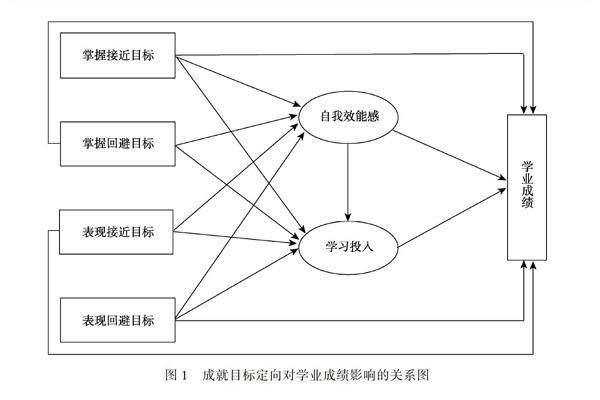
自我效能理論從“結果期望”的視角揭示了自我效能感對學習投入的影響。在學業發展中, 自我效能感影響著個體對其目標行為的選擇, 并以不同方式制約著個體的努力程度, 且自我效能預期越積極, 個體越傾向于做出更大的努力達到目標(Wu et al., 2020)。已有研究發現, 自我效能感會隨著與外界互動時間的持續增加, 正向積極地影響學習投入(Salanova et al., 2011)。綜上, 本研究假設自我效能感和學習投入在成就目標定向與學生成績之間起鏈式中介作用, 假設模型如圖1所示。
3??研究方法
3.1??文獻檢索與篩選
以goal orientation/achievement goal/mastery goal/learning goal/performance goal/ability goal/?approach goal/avoidance goal; academic self-efficacy/?self-efficacy beliefs/perceived self-efficacy/sense self-efficacy/self-efficacy expectancy; student engagement/student involvement/student participation/?learning strategies/learning engagement/academic engagement/academic involvement; academic achievement/academic success/academic performance/?learning achievement/learning performance/learning outcome/learning gains為關鍵詞, 以“主題”為檢索項, 通過編輯檢索式和運用布爾邏輯運算符連接等方式對Web of science、Scopus、ProQuest、ScienceDirect和EBSCO學術數據庫, 以及Google Scholar學術搜索引擎進行廣泛檢索, 依據標準篩選文獻。此外, 為提升納入文獻的全面性, 對篩選后的一次文獻和與主題相關的元分析文獻進行文獻回溯(Baranik et al., 2010; Cellar et al., 2010; Guo et al., 2023; Huang, 2012; Hulleman et al., 2010; Lochbaum & Gottardy, 2015; Noordzij et al., 2021; Payne et al., 2007; Senko & Dawson, 2017; Van Yperen et al., 2014; Van Yperen et al., 2015; Wirthwein et al., 2013), 初步根據摘要篩選量化研究文獻(程陽春, 黃瑾, 2023)。
檢索最初標準:研究內容聚焦成就目標定向與學業成績的關系, 文獻來源為期刊和學位論文, 檢索時間跨度為2001年1月至2023年2月。使用EndNote 20導入文獻并按照如下標準依次進行篩選:1)文獻必須是已發表的實證論文。2)文獻必須探索成就目標定向量表(掌握接近/掌握回避/表現接近/表現回避)中至少一個維度與學業成績之間的相關關系, 且同時涵蓋自我效能感和學習投入中任意一個變量。3)文獻必須提供完整的計算效應量數據, 如樣本量、平均數、標準差、p值、皮爾遜相關系數r, 或是能轉化為r的統計量。4)數據重復發表的僅取其中內容報告較為全面的一篇(靳娟娟?等, 2023)。文獻篩選見圖2。
3.2??文獻質量評估與編碼
參考張亞利等人(2019)編制的相關類元分析文獻質量評估量表進行計算, 包括:(1)被試的抽樣方式(隨機抽樣2分, 非隨機抽樣1分, 未報告0分); (2)樣本有效率(有效率0.9及以上2分, 0.8~0.9之間1分, 0.8以下或未報告0分); (3)測量工具的信度(信度0.8及以上2分, 0.7~0.8之間1分, 0.7以下或未報告0分); (4)刊物級別(SSCI期刊2分, 普通期刊或未公開發表0分)。最終計算每條文獻的總分, 介于0~8之間, 總分越高表明文獻質量越好。文獻質量評估過程由兩名研究者獨立完成, 編碼完成后計算兩名研究者一致性Kappa值為0.893, 根據Kappa值判斷標準(好0.40~0.59; 相當好0.60~0.74; 非常好0.75及以上), 兩名研究者的一致性達到較高水平。
對納入文獻的信息進行編碼:第一作者及年份、樣本量、年齡階段、性別比例、測量工具、變量關系、成績類型和文獻質量。其中成就目標定向的相關結果使用, 以獨立樣本為單位計算效應量, 共計206項。對效應量進行更詳細的編碼:若一篇文獻同時報告了成就目標定向的多個維度, 則分別輸入相應的效應量; 若為同一類別的成績有多個學科的報告, 則取平均值; 若報告了不同樣本的相關系數, 則所有的效應量都相應地進行編碼。該過程由兩名研究者獨立完成, 最終獲得兩份編碼結果, 對于結果中出現不一致的數據, 經過查看原始文獻進行更正, 文獻特征見網絡版附表1。
3.3??數據處理
當前研究選用CMA軟件進行數據轉換, 以皮爾遜相關系數r作為效應量。如若原始文獻僅報告了獨立樣本t檢驗的t值、獨立性檢驗的c2值、單因素方差分析的F值和線性回歸分析的值, 則需要先將統計量通過公式分別轉化為相關系
本可能存在無效數據, 故需要進行異常值檢驗和發表偏倚檢驗。首先異常值檢驗, 隨機效應模型下接受Viechtbauer和Cheung (2010)的建議, 采用學生化剔除殘差值Rstudent來識別異常值, 采用Cook距離值、Dffits值和Covratio值來識別是否存在有潛在威脅的效應量。其次采用漏斗圖、Eggers檢驗和p曲線三種方法檢驗是否存在發表偏倚。其中漏斗圖通過觀察納入文獻是否大致分布在總效應量的兩側來判斷風險性; Eggers線性回歸得到的截距接近0且不顯著, 則不存在發表偏倚; p曲線(p-curve)通過分析納入文獻中效應量所對應的p值分布情況, 以識別是否存在出版偏差和p-hacking現象。p曲線分析從計算pp值開始, pp值代表了在原假設為真(即無顯著影響)的情況下獲得每個p值的概率, 將其相加得出c2值, 以測試p曲線傾斜的顯著性。平坦形態的p曲線表明納入研究缺乏證據價值, 左偏形態的p曲線表明納入研究存在p-hacking現象, 而右偏形態的p曲線表明納入研究的效應可能是真實的。此外, 本研究主要選用Q、I2和T2檢驗效應量的異質性, Q值顯著則表明效應量異質(p?< 0.05); I2為效應量的真實差占總方差的比率, 占比超過75%表明效應量間存在高度異質性; T2是對真實效應的方差估計, 數值顯著則表明效應量異質(Borenstein et?al., 2010)。通過亞組分析和元回歸分析探索潛在的調節變量, 并采用Cheung和Chan (2005)提出的基于相關系數的兩階段結構方程模型檢驗中介效應, 首先需要借助多變量元分析方法獲得聯合相關矩陣, 其次將聯合相關矩陣輸入到結構方程模型來檢驗中介模型(鄧小平?等, 2016)。
4??研究結果
4.1 ?文獻納入和質量評估
最終納入研究67篇英文文獻, 發表年份范圍為2001~2023, 期刊53篇, 博士論文14篇, 包含206個效應量, 38427名被試。其中, 掌握接近目標60個效應量, 31921名被試, 質量均分為5.88; 掌握回避目標24個效應量, 12734名被試, 質量均分為5.33; 表現接近目標60個效應量, 28906名被試, 質量均分為5.73; 表現回避目標62個效應量, 31943名被試, 質量均分為5.68。綜上, 四組研究納入文獻的質量均分明顯高于理論均分4, 整體質量較好。
4.2??異常值檢驗
對效應量異常值和有潛在威脅的效應量進行檢驗, 見圖3。結果表明, 206項獨立研究的殘差均小于2.5, Cook距離值和Dffits值均小于1, Covratio值在[0.99, 1.01]區間浮動, 離數值1較近,?不存在異常值和有潛在威脅的效應量, 均可納入元分析。
4.3??發表偏倚檢驗
4.3.1??漏斗圖
首先采用漏斗圖進行評估, 以效應量Fishers Z為橫坐標, Z值標準誤為縱坐標, 并確定95%的置信區間(兩條斜線覆蓋區域), 見圖4。MAP、MVP、PAP、PVP與AP之間關系的效應量大多都集中在漏斗的中上部, 且基本分布于總效應量的兩側, 大致呈對稱分布, 表明當前數據不存在嚴重的發表偏倚。其次為填補漏斗圖只能從主觀上判斷的不足, 另采用失安全系數和Eggers線性回歸進行更精確的分析。MAP、MVP、PAP、PVP的失安全系數分別為6070、1387、3825、5927, 均大于各自的臨界值310、130、310、320, 即5K+10; Eggers檢驗線性回歸截距分別為0.45、1.69、1.06、0.40, 截距接近于0且檢驗的p值0.50、0.16、0.19、0.58均大于0.05, 沒有統計學意義上的顯著偏倚。
4.3.2??p曲線分析
如圖5所示, 所得到的p曲線均呈顯著右偏態(Binomial test:?p?< 0.0001, Continuous test: Z = ?25.59, p?< 0.0001; Binomial test:?p?< 0.0001, Continuous test: Z = ?6.65, p?< 0.0001; Binomial test:?p?< 0.0001, Continuous test: Z = ?15.34, p?< 0.0001; Binomial test:?p?< 0.0001, Z = ?15.16, p?< 0.0001)。其中MAP與AP的研究, 47個p值有45個p值低于0.025; MVP與AP的研究, 12個p值均低于0.025; PAP與AP的研究, 28個p值有26個p值低于0.025; PVP與AP的研究, 33個p值有31個p值低于0.025。結果表明, 元分析的研究結果反映了成就目標定向與學業成績之間的關系存在真實的效應, 而不是由出版偏倚或p-hacking現象導致。綜上, 說明本研究不存在嚴重的發表偏倚。
4.4??敏感性分析
運用逐步刪除法, 對成就目標定向與學業成績關系的異質性效應量進行敏感性分析, 以此排除極端值對研究結果造成的干擾(Borenstein et al., 2009)。使用“one study removed”功能排除任意一個樣本后, 發現MAP與AP的效應量始終在0.19~0.20之間波動, 與總效應量0.19接近; MVP與AP的效應量始終在?0.09~?0.07之間波動, 與總效應量?0.08接近; PAP與AP的效應量始終在0.10~0.11之間波動, 與總效應量0.10接近; PVP與AP的效應量始終在?0.12~?0.11之間波動, 與總效應量?0.12接近, 進一步說明元分析結果具有較高的穩健性和可靠性。
4.5??異質性檢驗
如表1所示, 所選文章中的效應量均存在異質性(p?< 0.001), 故采用隨機效應模型。由抽樣誤差引起的方差比例均大于75%, 真實效應大小的方差均小于0.01 (T2?= 0.007、0.007、0.009、0.007), 表明效應大小之間存在相當大的異質性, 高異質性表明可能會有調節變量對效應量產生重要的潛在調節作用, 需要進行調節效應檢驗。
4.6??主效應檢驗
成就目標定向各指標(MAP、MVP、PAP、PVP)與學業成績(AP)的平均加權效應分別為0.19、?0.08、0.10、?0.12, 參照Gignac和Szodorai (2016)對相關系數的閾值分類(低r= 0.10, 中r= 0.20, 強r= 0.30), 發現MAP和PAP對學業成績呈積極正向的影響, 而MVP和PVP對學業成績呈消極負向的影響, 均達到低等程度的效應量。成就目標定向各指標與自我效能感(SE)的平均加權效應分別為rMAP= 0.52,rMVP= ?0.13,rPAP= 0.27,rPVP=?0.15;?與學習投入(LE)的平均加權效應分別為rMAP= 0.48,rMVP= ?0.10,rPAP= 0.22,rPVP= ?0.13, 見表2。結果表明, MAP和PAP對自我效能感和學習投入均有顯著的促進作用, 且分別呈高等相關和中等相關; 而MVP和PVP與自我效能感和學習投入呈低等的負相關, 但均高于對學業成績的平均加權效應。
4.7調節效應檢驗
在影響因素的考察上, 檢驗了年齡階段、測量工具、性別比例和成績類型4個變量的調節效應, 其中性別比例屬于連續變量, 采用元回歸分析, 而其他指標為分類變量, 采用亞組分析。
鑒于效應量之間存在相當大的異質性, 進而對分類變量進行亞組分析, 以檢驗成就目標定向與學業成績之間的關系在多大程度上因解釋不一致的潛在調節因素而有所不同, 如表3所示。結果發現, 年齡階段顯著調節成就目標定向與學業成績的關系(QB= 20.93, 9.84, 9.57, 8.45,p< 0.05)。為進一步分析各年齡階段的效應量差異情況, 對其進行了兩兩比較。結果顯示, 小學階段和中學階段之間無顯著差異(QB= 1.08, 0.08, 2.69, 0.82,p> 0.05), 中學階段和大學階段之間存在顯著差異(QB= 13.31, 7.07, 5.38, 6.11,p< 0.05), 小學階段和大學階段之間存在顯著差異(QB= 12.24, 4.30, 9.56, 5.57,p< 0.05), 結合中、小學階段的效應量明顯高于大學階段的效應量, 可知成就目標定向與中、小學生學業成績的相關性強于其與大學生學業成績的相關性。
測量工具的亞組分析結果顯示,Q檢驗達到顯著性水平(QB= 8.72, 6.91, 30.77, 6.13,p< 0.05), 表明測量工具存在調節效應。為進一步分析各測量工具的效應量差異情況, 對其進行了兩兩比較。結果顯示, AGQ量表和PALS量表之間無顯著差異(QB= 0.80, 1.18, 2.48, 2.68,p> 0.05), AGQ量表和AGQ-R量表之間無顯著差異(QB= 3.86, 0.34, 3.42, 0.85,p> 0.05), AGQ-R量表和PALS量表之間存在顯著差異(QB= 8.26, 6.49, 30.31, 5.23,p< 0.05), 結合AGQ-R量表的效應量明顯高于PALS量表的效應量, 可知使用AGQ-R量表得到的關于成就目標定向與學業成績的相關性更強。此外, 成績類型在成就目標定向與學業成績的關系中并未起到調節作用(QB= 0.90, 1.18, 0.53, 1.11,p> 0.05)。
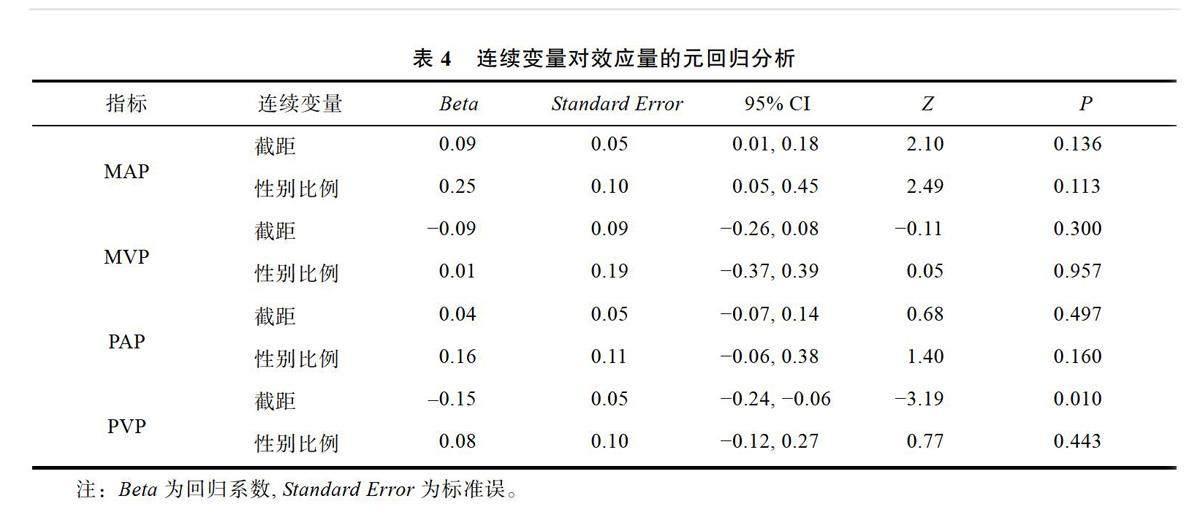
利用元回歸分析檢驗被試性別比例對成就目標定向與學業成績的關系是否有顯著影響, 如表4所示。結果發現, 性別比例的調節效應不顯著(Beta = 0.25,p= 0.113 > 0.05;Beta = 0.01,p= 0.957 > 0.05;Beta = 0.16,p= 0.160 > 0.05;Beta = 0.08,p= 0.443 > 0.05), 表明性別比例在成就目標定向與學業成績的關系中并未起到調節作用。
4.8中介效應檢驗
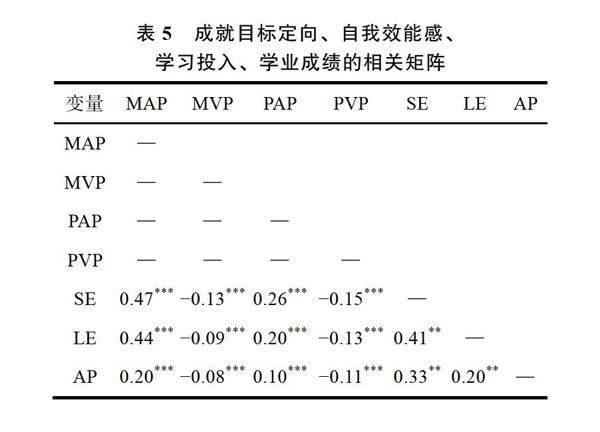
首先, 計算聯合相關矩陣。對成就目標定向與學業成績的關系模型進行異質性檢驗, 發現模型擬合指數不良, χ?MAP (df= 246) = 2010.46,p< 0.001; χ?MVP (df= 159) = 1282.21,p< 0.001; χ?PAP (df= 238) = 1715.45,p< 0.001; χ?PVP (df= 250) = 2048.72,p< 0.001, 均違背了異質性假設, 故接受Cheung和Cheung (2016)的建議, 采用隨機效應模型估計聯合相關矩陣, 見表5。
其次, 利用lavaan工具包進行路徑分析(Jak et al., 2021), 得到了如圖6所示的中介模型。結果顯示, 除成就目標定向對學業成績的直接影響路徑不顯著外, 其余路徑均顯著, 表明成就目標定向主要通過自我效能感和學習投入的中介作用間接影響學業成績。此外, 這一結果解釋了主效應檢驗中成就目標定向對學業成績的效應量小于其對自我效能感和學習投入的效應量, 原因在于成就目標定向到學業成績間存在自我效能感和學習投入中介變量。
如表6所示, 掌握接近目標積極預測了學生的自我效能感(a1= 0.46)和學習投入(a2= 0.32),進而影響了學業成績(b1= 0.29,b2= 0.07)。可見掌握接近目標通過自我效能感的單一中介對學業成績的間接影響是a1b1= 0.13, 通過學習投入的單一中介對學業成績的間接影響是a2b2= 0.02, 根據二者的總影響c= 0.19, 得出自我效能感的單一中介效應占比為68.42%, 得出學習投入的單一中介效應占比為10.53%。因此, 掌握接近目標與學業成績呈現的正向關系約68%由自我效能感的單一中介影響, 約11%由學習投入的單一中介影響。同理, 可得掌握回避目標、表現接近目標和表現回避目標維度自我效能感的單一中介效應占比分別為44.44%、72.73%和40.00%, 學習投入的單一中介效應占比分別為11.11%、9.09%和10.00%。
此外, 估計聯合相關矩陣時發現其存在異質性, 表明可能存在調節變量(鄧小平?等, 2016)。因此, 將年齡階段作為調節變量, 分析中介模型是否會隨著年齡階段而發生變化, 以年齡為單位分組估計聯合相關矩陣后, 中學階段和大學階段達到了異質性要求。異質性檢驗結果顯示, 中學階段χ?MAP (df= 111) = 1174.22,p< 0.001; χ?MVP (df= 72) = 703.30,p< 0.001; χ?PAP (df= 110) = 887.95,p< 0.001; χ?PVP (df= 115) = 1281.82,p< 0.001; 大學階段χ?MAP (df= 105) = 529.99,p< 0.001; χ?MVP (df= 67) = 395.10,p< 0.001; χ?PAP (df= 96) = 567.93,p< 0.001; χ?PVP (df= 105) = 594.91,p< 0.001。根據Cheung (2015)的建議, 只有當分組效應量異質方可進行中介效應模型的群組比較。結果發現, 年齡階段調節的是學習投入與學業成績之間的關系, 即中學階段學習投入與學業成績之間的路徑顯著, 而大學階段學習投入與學業成績之間的路徑不顯著, 這意味著在大學階段, 成就目標定向僅通過自我效能感即可影響學業成績, 不需要借助學習投入的鏈式作用, 見表7。
5??討論
5.1成就目標定向與學業成績關系
本研究對成就目標定向與學業成績之間關系的實證研究進行了元分析, 共納入67項研究, 包括206個效應量。結果顯示, 成就目標定向與學業成績之間存在穩健的弱相關(rMAP= 0.19,rMVP= ?0.08,rPAP= 0.10,rPVP= ?0.12)。其中掌握接近目標、表現接近目標與學業成績的關系要略高于Hulleman等人(2010) (rMAP= 0.11,rPAP= 0.06)、Wirthwein等人(2013) (rMAP= 0.13,rPAP= 0.08)的元分析結果; 而掌握回避目標、表現回避目標與Van Yperen等人(2014) (rMVP= ?0.07,rPVP= ?0.13)、Wirthwein等人(2013) (rMVP= ?0.08,rPVP= ?0.12)的研究結果基本一致, 究其原因可能在于已有元分析對掌握接近目標、表現接近目標提取的效應量偏少。值得注意的是, 本研究與其他元分析都證實了成就目標定向與學業成績之間存在弱相關(Hulleman et al., 2010; Van Yperen et al., 2014; Wirthwein et al., 2013), 說明成就目標定向與學業成績之間雖然存在相關, 但并非直接的預測關系, 需要通過自我效能感和學習投入等過程變量的中介作用。
此外, 元分析發現掌握接近目標、表現接近目標與學業成績呈顯著正相關, 且rMAP>rPAP, 而掌握回避目標、表現回避目標與學業成績呈顯著負相關, 且|rPVP|?> |rMVP|, 表明接近目標(掌握、表現)在學業成績中具有積極作用, 而回避目標(掌握、表現)將導致消極結果, 這與大部分研究結果一致(Bong, 2009; Cao, 2012; Uzuntiryaki-Kondakci?& Senay, 2015)。這是因為持接近目標(掌握、表現)的個體傾向于以積極的態度投身任務, 在積極心態的驅使下, 個體能夠正確認識到學習的益處和樂趣, 并主動應對困難和努力克服, 肩負起自己對學習的責任, 所以往往給大眾呈現出較為優秀的成績(Zhou et al., 2019)。然而, 持回避目標(掌握、表現)的個體傾向于以消極的態度審視任務, 在消極心態的驅使下, 個體容易產生焦慮或不安的情緒, 且無法直面應對挫折和失敗, 通常采用消極回避的方式應對, 所以往往給大眾呈現出較低的學業成績(楊曉超, 2019)。此外, 與掌握目標(接近、回避)相比, 表現目標(接近、回避)與學業成績的相關性較弱。這是因為持掌握目標(接近、回避)的個體著眼于提高自身的能力和價值, 追求的是不比之前的自己差(Senko & Dawson, 2017), 傾向的是深度學習過程, 強調知識之間的聯系和對知識的理解(Mouratidis et al., 2018); 而持表現目標(接近、回避)的個體著眼于借助他人參照來提高自己, 追求的是不比他人差(Senko, 2019), 傾向的是表面學習過程, 強調知識的重復機械學習和死記硬背(Katz-Vago & Benita, 2023)。可見持掌握目標(接近、回避)的個體在學習過程中更善于保持、整合與遷移所學知識, 更易于取得好的學業成績。此外, 持掌握目標(接近、回避)的個體是基于自身需求的主動學習, 在面對失敗時會堅持不懈地完成尚未完成的任務; 而持表現目標(接近、回避)的個體是迫于外在壓力的被動學習, 在面對失敗時會減少自身對任務的努力程度(Alhadabi & Karpinski, 2020), 必然會影響個體的學習效果, 使其學業成績處于較低水平。
5.2被試特征的調節作用
當前元分析觀察到年齡階段會顯著調節成就目標定向與學業成績之間的關系, 且中、小學階段的相關性效應量要明顯高于大學階段, 支持了蔣京川和劉華山(2005)的研究結論。階段—環境適配理論認為社會環境間不斷的相互作用會影響個體的心理發展, 個體自身也會主動適應和調整環境, 環境與個體自身的心理發展階段匹配, 會促使其自主性動機的發展(Eccles & Midgley, 1989)。從發展階段來看, 一方面大學生正值身心發展的劇變期, 成人感和半成熟現狀的矛盾會帶來心理、行為的系列變化, 個體的獨立性與自主性訴求迅速發展, 自我意識的自覺性顯著提高, 常常不滿足于現象的羅列, 而是有意識地調節、支配和論證事物、現象的原因和規律(Müller et al., 2021); 另一方面, 大學生正值人生社會化的準備期, 為應對日趨復雜的社會化環境, 需要形成適應社會的人格并掌握社會認可的行為方式, 這個階段學生對追求獨立自主和形成自我意識的訴求得到進一步發展(Henri et al., 2017)。然而, 大多數高校并不能完全從遵循大學生心理發展特點的角度來進行課程設置, 其自主性訴求難以得到滿足(王一軍, 2015)。此外, 從教學環境來看, 大學階段現行的教學模式多是采取傳統灌輸式結構, 學生始終處于被支配和被學習的狀態(Udosen, 2014), 且由于教師背負的科研等硬性指標壓力, 使其很難顧及到對學生自主性學習的引導和對其自主性的培養, 致使學生在課堂上獲得的自主權和決策權減弱(侯金芹, 2019)。這種矛盾導致了發展階段和環境的不匹配, 致使成就目標定向的學習動機出現下滑, 進而削弱了其與學業成績的關系。
元回歸分析的結果顯示, 性別比例不能顯著調節成就目標定向與學業成績之間的相關關系, 這表明成就目標定向與學業成績的相關效應可能具有跨性別的穩定性, 與現有元分析結果一致(Huang, 2012)。對此有兩種可能的解釋:一是不同性別比例下的效應量無差異, 究其原因可能在于角色特質差異并不足以使得兩性在學習目標傾向、動機等方面的表現產生分化現象。即雖然女性在心理上比男性成熟, 能夠更早地意識到提高能力和精準把握任務是成功的關鍵(Preckel et al., 2008); 但男性往往比女性對成就有更強烈的需求, 更相信自身的能力, 對運用自身能力完成任務充滿自信, 能夠將成就動機直接指向學習任務和學習目標(Cheng & Nguyen, 2023)。二是不同性別比例下的效應量有差異, 但由于元分析納入的多篇文獻使用男女比例基本平衡的被試進行分析, 使得性別差異在統計效力上未達到顯著水平。
當前元分析發現測量工具對成就目標定向和學業成績的相關關系調節顯著, 且AGQ-R量表的效應量要高于PALS量表的效應量。可能有三方面的原因, 其一是測量工具劃分維度有差異。AGQ-R量表涵蓋成就目標定向的四個維度, 而PALS量表僅涵蓋三個維度, 使用AGQ-R測量時相關程度更高與此量表測驗成就目標定向更具針對性有極大的關系。其二是測量工具評估范疇有差異。AGQ-R量表評估的是特定課程成就目標, 而PALS量表更側重評估全局層面的成就目標, 從理論上講, 在全局層面測量的成就目標定向與學業成績的相關性要低于在特定領域水平層面上的測量結果(Marsh & Craven, 2006)。其三可能是因為測量工具項目內容有差異。AGQ-R量表內容以與目標相關的項目為主, 而PALS量表內容中與目標相關的項目和與非目標相關的項目在數量上幾乎相等, 與非目標相關的項目有可能被編碼為無目標, 這或許會低估成就目標定向與學業成績之間的關系(Hulleman et al., 2010)。
當前元分析并未發現成績類型對成就目標定向與學業成績關系的調節作用, 但從效應量來看, 成就目標定向與課程測驗的相關性更強, 與現有研究結論一致(Wolters, 2004)。究其原因主要包括兩個方面:首先, 相較于標準化測驗脫離具體知識來評估學生的高階技能, 課程測驗與學科知識關系更為密切(Tan et al., 2019), 通常借助課堂教學活動中的直接反饋方式、學習情況評價以及表現性任務評價來反應學生的知識掌握程度及應用能力, 且成就目標的確定主要是依據學校特定科目或課程(Niepel et al., 2014), 與課程測驗的評估理念更為契合。其次, 已有元分析表明課程測驗比標準化測驗更容易受到動機變量的影響(M?ller et al., 2009), 這是因為教師對課程測驗的評判會涉及學生積極的行為特征(如勤奮、堅持、努力), 而標準化測驗聚焦學生的綜合能力, 其結果受教師評價影響較小。
5.3自我效能感和學習投入的中介作用
元分析結果顯示, 自我效能感、學習投入在成就目標定向對學業成績的作用機制中發揮著單一中介和鏈式中介作用, 進一步檢驗了成就目標理論、期望價值理論和自我效能理論在教育背景下的有效性。其中掌握接近目標、表現接近目標顯著正向影響自我效能感和學習投入, 而掌握回避目標、表現回避目標與二者呈顯著負相關。這是因為持接近目標(掌握、表現)的個體傾向于竭盡全力的克服困難, 容易獲得較強的成就感和勝任感, 這會在很大程度上提升自身的自我效能感和自信心(Sha, 2010), 同時也能激發自身的學習熱情和興趣, 進而使其將更多的精力和時間投入到學習活動中(Karakus, 2016)。而持回避目標(掌握、表現)的個體更傾向于害怕失敗, 不能正視和積極面對學習上的困難和挑戰, 容易產生自卑感和視學習為負擔的心理, 這種消極態度導致自我效能感處于較低水平(Bj?rnebekk et al., 2013), 同時也會致使個體不愿意為學習付出時間和精力(劉在花, 2022)。值得注意的是, 自我效能感在成就目標定向對學業成績的作用機制中發揮的中介效應明顯高于學習投入。究其原因可能存在以下兩個方面: 其一, 自我效能感處在近端因素位置, 成就目標定向更多的是通過作用自我效能感來影響學生的學業成績。其二, 學習投入可分為情感投入、認知投入和行為投入三個維度, 已有研究證實, 表現回避目標顯著預測認知投入, 對其他類型的學習投入不存在顯著的預測作用(黃慶雙?等, 2019), 意味著成就目標定向對學習投入的作用可能會受到不同投入類型的影響。此外, 已有研究指出情感投入、認知投入、行為投入各維度間存在相互中介和調節關系(尹睿, 徐歡云, 2017),?這都可能會在一定程度上減弱學習投入的中介作用。
5.4研究不足與展望
本研究的不足之處:(1)文獻納入方面。本研究涉及四個預測變量, 且需要同時涵蓋至少一個中介變量, 盡管收集的文獻覆蓋范圍已較為全面, 但多重條件的限制致使四個維度仍難以納入均等數量的文獻。在探析調節變量和檢驗中介效應時出現某些亞組、某條路徑效應量數量稀少的現象, 這會減小元分析結果的精確性和穩定性。未來研究可嘗試收集其他語言發表的文獻或者納入未發表的研究報告。此外, 本研究納入的個別文獻同時涵蓋兩種被試群體, 故報告了多個效應量, 由于來自同一研究, 效應量間可能因研究設計等相似性存在相互依賴性(Moeyaert et al., 2017)。采用傳統元分析方法進行計算忽略了這種相關, 可能會導致總體效應量被高估(孟現鑫 等, 2023)。三水平元分析方法能夠處理來自同一研究效應量之間的依賴性問題, 從而最大化地保留信息, 提高統計檢驗力(Assink & Wibbelink, 2016)。未來研究如若納入的原始文獻大多數都報告了多個效應量,?可采用三水平元分析方法予以解決。(2)調節因素方面。本研究僅基于當前的研究證據選取了四類調節變量, 無法窮盡所有的潛在調節因素, 如國籍、出版特征和研究設計等變量也可能起到調節作用, 未來研究可進行深入探討。(3)中介因素方面。本研究只考慮了自我效能感作為中介變量與成就目標定向之間的單項關系, 但現有研究認為二者之間彼此相互影響。為更加全面地探究自我效能感在成就目標定向和學業成績之間的中介效應, 未來研究可基于交叉滯后模型對三者進行縱向調查。
對于后續研究, 以下方向可作參考:(1)目前學界對掌握回避目標與學業成績機制的研究較少且還不夠充分, 且對學業成績的衡量多是基于大型學業考試成績的橫斷研究, 未來研究建議使用解釋因果關系更有力的實驗研究、干預研究或追蹤研究來揭示二者的作用機制。(2)隨著發展情境論的興起, 越來越多研究者意識到, 成就目標定向與學業成績之間不是單向和靜止的關系模式, 個體所持有的成就目標定向不僅會影響個體的學業成績, 還會受到學業成績的影響(楊舒文?等, 2018), 且上述假設在一定程度上獲得了實證研究支持。即Neubauer等人(2022)通過動態評估方法, 對德國五年級108名學生進行為期四周的縱向日追蹤調查, 探究了日波動狀態下成就目標定向與學業成績之間的相關關系, 并采用結構方程模型方法, 揭示了成就目標定向與學業成績之間的相互影響。此外, 也有綜述文章系統地探討了成就目標定向與學業成績之間的相互影響。即Vu等人(2022)基于理論共性視角綜合概述了現有研究中有關成就目標定向與學業成績相互影響的理論框架, 基于方法共性視角綜合概述了現有研究中有關成就目標定向與學業成績相互影響的實證方法,?并立足現有研究存在的理論缺陷和方法挑戰兩方面對后續開展成就目標定向與學業成績相互影響研究提供了參考與借鑒。值得注意的是, 目前國內外對成就目標定向與學業成績相互影響研究探討的文獻較少且部分研究結論仍存有局限, 后續研究可進行深入探析。
6??結論
本研究得出如下結論:(1)掌握接近目標和表現接近目標與學業成績顯著正相關, 而掌握回避目標和表現回避目標與學業成績呈顯著負相關, 且各指標與學業成績存在穩健的弱相關。(2)成就目標定向與學業成績的關系受到年齡階段、測量工具的影響, 不受性別比例、成績類型的調節。(3)自我效能感和學習投入在成就目標定向對學業成績影響中發揮著中介作用, 但學習投入的中介作用只存在于中學組, 在大學組學習投入的中介作用不顯著。
參考文獻
(*為納入元分析的文獻)
陳陳. (2023). 課堂目標結構對小學生學業發展與心理健康的影響——成就目標中介作用在橫向和縱向研究中的一致性. 南京師大學報(社會科學版), (3), 63–77.
陳松. (2011). 自我調節學習中成就目標的動機效應研究?(博士學位論文). 華東師范大學, 上海.
程陽春, 黃瑾. (2023). 近似數量系統與數學能力的關系:一項元分析. 心理發展與教育, 39(3), 379–390.
黨寶寶, 祁生琴. (2022). 學生成就目標定向的結構維度、理論依據及對學業發展的影響. 當代教育與文化, 14(1), 46–54.
鄧小平, 羅秀文, 鄔雨臻. (2016). 父母卷入在家庭社會經濟地位與學業成就間的中介作用:元分析結構方程模型. 心理科學進展, 24(12), 1844–1853.
高峰, 白學軍, 章鵬, 曹海波. (2023). 中國青少年父母教養方式與自殺意念的元分析. 心理發展與教育, 39(1), 97–108.
侯金芹. (2019). 成就目標定向的發展軌跡及其對中考的影響. 中國臨床心理學雜志, 27(5), 1006–1011.
黃慶雙, 李玉斌, 任永功, 鄭玉敏, 黃悅悅. (2019). 大學生成就目標定向對在線學習投入影響研究:學業拖延的中介作用. 現代遠距離教育, 185(5), 77–85.
蔣京川, 劉華山. (2005). 中學生成就目標定向與學習策略、學業成績的關系研究. 心理發展與教育, 21(2), 56–61.
姜怡. (2022). 高中生學習動機發展模態及其對學業成績的影響. 華東師范大學學報(教育科學版), 40(11), 80–91.
靳娟娟, 邵蕾, 黃瀟瀟, 張亞利, 俞國良. (2023). 社會排斥與攻擊的關系:一項元分析. 心理學報, 55(12), 1–19.
庫爾特·勒溫. (2011). 拓撲心理學原理. 北京:商務印書館.
劉在花. (2022). 成就目標定向對中學生學習滿意度的影響機制——學業自我效能感和學習投入的鏈式中介作用. 教育研究與實驗, (5), 98–103.
劉志國, 齊冰, 李亞平, 王潤洲, 崔佳, 宋耀武. (2023). 成就目標定向在學業自我概念與學業成績關系中的調節作用:基于內/外參照模型. 心理發展與教育, 39(1), 68–76.
孟現鑫, 陳怡靜, 王馨怡, 袁加錦, 俞德霖. (2023). 學校聯結與抑郁的關系:一項三水平元分析. 心理科學進展, 32(2), 246–263.
秦紅芳. (2015). 中國學生成就目標的結構特征與形成機制?(博士學位論文). 東北師范大學, 長春.
王嘉瑩, 姚梅林, 劉紅瑞. (2022). 成就目標與教師效能感、焦慮、工作投入的關系:基于變量中心和個體中心的視角. 心理與行為研究, 20(1), 122–129.
王莉華, 高源月. (2021). 研究型大學研究生成就目標定向與學業拖延——學業自我效能感的中介效應. 研究生教育研究, 63(3), 26–34.
王一軍. (2015). 服務學生自主發展的大學課程. 教育發展研究, 35(17), 40–49.
顏志強, 蘇彥捷. (2018). 共情的性別差異:來自元分析的證據. 心理發展與教育, 34(2), 129–136.
楊舒文, 潘斌, 王婷婷, 司繼偉. (2018). 小學生成就目標定向與學業成績的雙向關系:一項交叉滯后分析. 心理與行為研究, 16(1), 81–87.
楊曉超. (2019). 高師學生成就目標定向與學業成就的關系——一個多重中介模型?(碩士學位論文). 山西師范大學, 太原.
尹睿, 徐歡云. (2017). 在線學習投入結構模型構建——基于結構方程模型的實證分析. 開放教育研究, 23(4), 101–111.
張文新, 陳光輝. (2009). 發展情境論——一種新的發展系統理論. 心理科學進展, 17(4), 736–744.
張亞利, 李森, 俞國良. (2019). 自尊與社交焦慮的關系:基于中國學生群體的元分析. 心理科學進展, 27(6), 1005–1018.
朱麗雅. (2012). 大學生成就動機、成就目標定向、學業自我效能對成績的影響模式探析?(博士學位論文). 吉林大學, 長春.
*Adkins, S. J. (2006).?The relations of self-regulated learning to public speaking anxiety and achievement (Unpublished doctorial dissertation).?University of Houston.
Albert, M. A., & Dahling, J. J. (2016). Learning goal orientation and locus of control interact to predict academic self-concept and academic performance in college students.?Personality and Individual Differences, 97, 245–248.
Alhadabi, A., & Karpinski, A. C. (2020). Grit, self-efficacy, achievement orientation goals, and academic performance in university students. International Journal of Adolescence and Youth, 25(1), 519–535.
Ames, C. (1992). Classrooms: Goals, structures, and student motivation. Journal of Educational Psychology, 84(3), 261–271.
*Antaramian, S. (2017). The importance of very high life satisfaction for students academic success. Cogent Education, 4(1), Article 1307622. https://doi.org/10.1080/?2331186X.2017.1307622
Assink, M., & Wibbelink, C. J. (2016). Fitting three-level meta-analytic models in R: A step-by-step tutorial. The Quantitative Methods for Psychology, 12(3), 154–174.
*Avci, U., & Durak, H. Y. (2023). Innovative thinking skills and creative thinking dispositions in learning environments: Antecedents and consequences. Thinking Skills and Creativity, 47, Article 101225. https://doi.org/10.1016/j.tsc.?2022.101225
Bandura, A. (1977). Self-efficacy: Toward a unifying theory of behavioral change. Psychological Review, 84(2), 191–215.
Baranik, L. E., Stanley, L. J., Bynum, B. H., & Lance, C. E. (2010). Examining the construct validity of mastery-?avoidance achievement goals: A meta-analysis. Human Performance, 23(3), 265–282.
*Barber, M. E. (2010). Students prior knowledge, ability, motivation, test anxiety, and course engagement as predictors of learning in community college psychology courses (Unpublished doctorial dissertation). University of Florida, Gainesville.
Bardach, L., Oczlon, S., Pietschnig, J., & Lüftenegger, M. (2020). Has achievement goal theory been right? A meta-analysis of the relation between goal structures and personal achievement goals. Journal of Educational Psychology, 112(6), 1197–1220.
*Billotti, S. (2009). Achievement goals, engagement and achievement of African American and White middle school students (Unpublished doctorial dissertation). Fordham University, New York.
*Bj?rnebekk, G., Diseth, A., & Ulriksen, R. (2013). Achievement motives, self-efficacy, achievement goals, and academic achievement at multiple stages of education: A longitudinal analysis. Psychological Reports, 112(3), 771–787.
*Blume, F., Irmer, A., Dirk, J., & Schmiedek, F. (2022). Day-to-day variation in students academic success: The role of self-regulation, working memory, and achievement goals. Developmental Science, 25(6), Article 13301. https://doi.org/10.1111/desc.13301
*Bong, M. (2005). Within-grade changes in Korean girls motivation and perceptions of the learning environment across domains and achievement levels. Journal of Educational Psychology, 97(4), 656?672.
*Bong, M. (2009). Age-related differences in achievement goal differentiation. Journal of Educational Psychology, 101(4), 879–896.
*Bong, M., Hwang, A., Noh, A., & Kim, S.-i. (2014). Perfectionism and motivation of adolescents in academic contexts. Journal of Educational Psychology, 106(3), 711–729.
Borenstein, M., Hedges, L. V., Higgins, J. P., & Rothstein, H. R. (2009). Introduction to meta-analysis.?Chichester, Britain:?John Wiley & Sons.
Borenstein, M., Hedges, L. V., Higgins, J. P., & Rothstein, H. R. (2010). A basic introduction to fixed-effect and random-?effects models for meta-analysis. Research Synthesis Methods, 1(2), 97–111.
*Bubic, A., Krile, K., & Kuzman, I. (2015). The importance of achievement goals and attitudes towards education for explaining adolescents career decision self-efficacy. Drustvena Istrazivanja, 24(3), 387–405.
Button, S. B., Mathieu, J. E., & Zajac, D. M. (1996). Goal orientation in organizational research: A conceptual and empirical foundation. Organizational Behavior and Human?Decision Processes, 67(1), 26–48.
*?akir, O. E., & Gazio?lu, A. E. I. (2021). The role of psychological and academic variables in predicting transition from primary to secondary education exam achievement in Turkey. Psychology in the Schools, 58(9), 1858–1876.
*Cao, L. (2012). Examining ‘active procrastination from a self-regulated learning perspective. Educational Psychology, 32(4), 515–545.
*Carter, C. M. (2012). Academic and athletic motivation as predictors of academic performance of division I college student-athletes (Unpublished doctorial dissertation). The University of Oklahoma, Norman.
Cellar, D. F., Stuhlmacher, A. F., Young, S. K., Fisher, D. M., Adair, C. K., Haynes, S., ... Riester, D. (2010). Trait goal orientation, self-regulation, and performance: A meta-analysis. Journal of Business and Psychology, 26(4), 467–483.
*Chan, K.-W., Wong, A. K.-Y., & Lo, E. S.-C. (2012). Relational?analysis of intrinsic motivation, achievement goals, learning strategies and academic achievement for Hong Kong secondary students. The Asia-Pacific Education Researcher, 21(2), 230–243.
*Chen, J. A., & Pajares, F. (2010). Implicit theories of ability of grade 6 science students: Relation to epistemological beliefs and academic motivation and achievement in science. Contemporary Educational Psychology, 35(1), 75–87.
Cheng, W., & Nguyen, P. N. T. (2023). Gender differences in future time perspectives and risk of being not in employment, education, or training: The mediating role of achievement goal motivations. Current Psychology, 42(32), 28180–28190.
Cheung, M. W. L. (2015). Meta-analysis: A structural equation modeling approach. Chichester, Britain: John Wiley & Sons.
Cheung, M. W. L., & Chan, W. (2005). Meta-analytic structural?equation modeling: A two-stage approach. Psychological Methods, 10(1), 40–64.
Cheung, M. W. L., & Cheung, S. F. (2016). Random-effects models for meta-analytic structural equation modeling: Review, issues, and illustrations. Research Synthesis Methods, 7(2), 140–155.
*Christian, M. (2017). Modeling the relationship between students self-perceptions, goals, and achievement motivation?(Unpublished doctorial dissertation). University of California, Riverside.
*Curelaru, V., Muntele-Hendres, D., Diac, G., & Duca, D.-S. (2020). Childrens and mothers achievement goal orientations and self-efficacy: Dyadic contributions to students well-being.?Sustainability, 12(5), Article 1785. https://doi.org/10.?3390/su12051785
*DLima, G. M., Winsler, A., & Kitsantas, A. (2014). Ethnic and gender differences in first-year college students goal orientation, self-efficacy, and extrinsic and intrinsic motivation. Journal of Educational Research, 107(5), 341–356.
Diaconu-Gherasim, L. R., Tepordei, A.-M., M?irean, C., & Rusu, A. (2018). Intelligence beliefs, goal orientations and childrens academic achievement: Does the childrens gender matter? Educational Studies, 45(1), 1–18.
*Diseth, A. (2011). Self-efficacy, goal orientations and learning strategies as mediators between preceding and subsequent academic achievement. Learning and Individual Differences, 21(2), 191–195.
*Diseth, A., & Kobbeltvedt, T. (2010). A mediation analysis of achievement motives, goals, learning strategies, and academic achievement. British Journal of Educational Psychology, 80(4), 671–687.
?uranovi?, M. (2019). Classroom quality in final grades of lower secondary education: Demographic differences and relationship with target learning orientations. Croatian Journal of Education, 21(1), 11–31.
Dweck, C. S. (1986). Motivational processes affecting learning. American Psychologist, 41(10), 1040–1048.
Dweck, C. S., & Leggett, E. L. (1988). A social-cognitive approach to motivation and personality. Psychological Review, 95(2), 256–273.
Eccles, J., & Midgley, C. (1989). Stage-environment fit: Developmentally appropriate classrooms for young adolescents. In R. E. Ames, & C. Ames (Eds.), Research on motivation in education:?Vol. 3: Goals and cognitions?(pp. 139?186). New York, America: Academic Press.
Elliot, A. J., & Church, M. A. (1997). A hierarchical model of approach and avoidance achievement motivation. Journal of Personality and Social Psychology, 72(1), 218–232.
Elliot, A. J., & Harackiewicz, J. M. (1996). Approach and avoidance achievement goals and intrinsic motivation: A mediational analysis. Journal of Personality and Social Psychology, 70(3), 461–475.
Elliot, A. J., & McGregor, H. A. (2001). A 2 × 2 achievement goal framework. Journal of Personality and Social Psychology, 80(3), 501–519.
Elliot, A. J., & Murayama, K. (2008). On the measurement of?achievement goals: Critique, illustration, and application. Journal of Educational Psychology, 100(3), 613–628.
Elliot, A. J., & Thrash, T. M. (2001). Achievement goals and the hierarchical model of achievement motivation. Educational Psychology Review, 13, 139–156.
Elliott, E. S., & Dweck, C. S. (1988). Goals: An approach to motivation and achievement. Journal of Personality and Social Psychology, 54(1), 5–12.
*Fenollar, P., Román, S., & Cuestas, P. J. (2007). University students academic performance: An integrative conceptual framework and empirical analysis.?British Journal of Educational Psychology, 77(4), 873–891.
*Ferla, J., Valcke, M., & Schuyten, G. (2010). Judgments of self-perceived academic competence and their differential impact on students achievement motivation, learning approach, and academic performance. European Journal of Psychology of Education, 25(4), 519–536.
Gignac, G. E., & Szodorai, E. T. (2016). Effect size guidelines for individual differences researchers. Personality and Individual Differences, 102, 74–78.
*Gonida, E. N., & Cortina, K. S. (2014). Parental involvement?in homework: Relations with parent and student achievement-?related motivational beliefs and achievement. British Journal of Educational Psychology, 84(3), 376–396.
Guo, J., Hu, X., Elliot, A. J., Marsh, H. W., Murayama, K., Basarkod, G., ... Dicke, T. (2023). Mastery-approach goals: A large-scale cross-cultural analysis of antecedents and consequences. Journal of Personality and Social Psychology,?125(2), 397–420. https://doi.org/10.1037/pspp0000436
*Guo, M., & Leung, F. K. S. (2021). Achievement goal orientations, learning strategies, and mathematics achievement: A comparison of Chinese Miao and Han students. Psychology in the Schools, 58(1), 107–123.
Harackiewicz, J. M., Barron, K. E., Tauer, J. M., & Elliot, A. J. (2002). Predicting success in college: A longitudinal study of achievement goals and ability measures as predictors of interest and performance from freshman year through graduation. Journal of Educational Psychology, 94(3), 562–575.
Henri, D. C., Morrell, L. J., & Scott, G. W. (2017). Student perceptions of their autonomy at university. Higher Education, 75(3), 507–516.
Huang, C. (2012). Discriminant and criterion-related validity of achievement goals in predicting academic achievement: A meta-analysis. Journal of Educational Psychology, 104(1), 48–73.
Hulleman, C. S., Schrager, S. M., Bodmann, S. M., & Harackiewicz, J. M. (2010). A meta-analytic review of achievement goal measures: Different labels for the same constructs or different constructs with similar labels? Psychological Bulletin, 136(3), 422–449.
*Hunsu, N. J., Olaogun, O. P., Oje, A. V., Carnell, P. H., & Morkos, B. (2023). Investigating students motivational goals and self-efficacy and task beliefs in relationship to course attendance and prior knowledge in an undergraduate?statics course. Journal of Engineering Education, 112(1), 108–124.
Jak, S., Li, H., Kolbe, L., de Jonge, H., & Cheung, M. W. (2021). Meta-analytic structural equation modeling made easy: A tutorial and web application for one-stage MASEM. Research Synthesis Methods, 12(5), 590–606.
*Jiang, Y., Song, J., Lee, M., & Bong, M. (2014). Self-efficacy and achievement goals as motivational links between perceived contexts and achievement. Educational Psychology, 34(1), 92–117.
*J?rgensen Olsen, T. M., & Mehus, I. (2022). Students performance in physical education: The role of differential achievement goals and self-regulated learning. Education Sciences, 12(2), Article 142. https://doi.org/10.3390/?educsci12020142
Kahu, E. R. (2013). Framing student engagement in higher education. Studies in higher education, 38(5), 758–773.
*Kaplan, A., Lichtinger, E., & Gorodetsky, M. (2009). Achievement goal orientations and self-regulation in writing: An integrative perspective. Journal of Educational?Psychology, 101(1), 51–69.
Kaplan, A., & Maehr, M. L. (2006). The contributions and prospects of goal orientation theory. Educational Psychology Review, 19(2), 141–184.
*Karakus, M. (2016). Understanding the mastery-avoidance goals construct: An investigation among middle school students in two domains (Unpublished doctorial dissertation). Temple University, Philadelphia.
*Karlen, Y., Suter, F., Hirt, C., & Merki, K. M. (2019). The role of implicit theories in students grit, achievement goals, intrinsic and extrinsic motivation, and achievement in the context of a long-term challenging task. Learning and Individual Differences, 74, Article 101757. https://doi.org/10.1016/j.lindif.2019.101757
Katz-Vago, I., & Benita, M. (2023). Mastery-approach and performance-approach goals predict distinct outcomes during personal academic goal pursuit. British Journal of Educational Psychology. Advance online publication. https://doi.org/10.1111/bjep.12645
*Kennedy, G. J., & Tuckman, B. W. (2013). An exploration into the influence of academic and social values, procrastination, and perceived school belongingness on academic performance. Social Psychology of Education, 16(3), 435–470.
*King, R. B., & McInerney, D. M. (2014). The work avoidance?goal construct: Examining its structure, antecedents, and consequences. Contemporary Educational Psychology, 39(1), 42–58.
Kitsantas, A., Steen, S., & Huie, F. (2009). The role of self-regulated strategies and goal orientation in predicting achievement of elementary school children. International Electronic Journal of Elementary Education, 2(1), 65–81.
Kumar, S., Agarwal, M., & Agarwal, N. (2021). Defining and measuring academic performance of Hei students-a critical review. Turkish Journal of Computer and Mathematics Education, 12(6), 3091–3105.
*Lau, S., & Nie, Y. (2008). Interplay between personal goals and classroom goal structures in predicting student outcomes:?A multilevel analysis of person-context interactions. Journal of Educational Psychology, 100(1), 15–29.
Lee, J., & Shute, V. J. (2010). Personal and social-contextual factors in K-12 academic performance: An integrative perspective on student learning.?Educational Psychologist, 45(3), 185–202.
Lee, J., & Stankov, L. (2018). Non-cognitive predictors of academic achievement: Evidence from TIMSS and PISA. Learning and Individual Differences, 65, 50–64.
*Liem, A. D., Lau, S., & Nie, Y. (2008). The role of self-efficacy, task value, and achievement goals in predicting learning strategies, task disengagement, peer relationship, and achievement outcome. Contemporary Educational Psychology, 33(4), 486–512.
*Limpo, T., & Alves, R. A. (2017). Relating beliefs in writing skill malleability to writing performance: The mediating role of achievement goals and self-efficacy. Journal of Writing Research, 9(2), 97–125.
*Liu, X., Gao, X., & Ping, S. (2019). Post-1990s college students academic sustainability: The role of negative emotions, achievement goals, and self-efficacy on academic performance. Sustainability, 11(3), Article 775. https://doi.org/10.3390/su11030775
Lochbaum, M., & Gottardy, J. (2015). A meta-analytic review of the approach-avoidance achievement goals and performance relationships in the sport psychology literature. Journal of Sport and Health Science, 4(2), 164–173.
*Los, R., & Schweinle, A. (2019). The interaction between student motivation and the instructional environment on academic outcome: A hierarchical linear model. Social Psychology of Education, 22(2), 471–500.
*Lu, B., Deng, Y., Yao, X., & Li, Z. (2022). Learning goal orientation and academic performance: A dynamic model. Journal of Career Assessment, 30(2), 329–344.
*Lüftenegger, M., Kollmayer, M., Bergsmann, E., J?stl, G., Spiel, C., & Schober, B. (2015). Mathematically gifted students and high achievement: The role of motivation and classroom structure. High Ability Studies, 26(2), 227–243.
*Luo, W., Aye, K. M., Hogan, D., Kaur, B., & Chan, M. C. Y. (2013). Parenting behaviors and learning of Singapore students: The mediational role of achievement goals. Motivation and Emotion, 37(2), 274–285.
*Luo, W., Paris, S. G., Hogan, D., & Luo, Z. (2011). Do performance goals promote learning? A pattern analysis of Singapore students achievement goals. Contemporary Educational Psychology, 36(2), 165–176.
*Luo, Z., & Luo, W. (2022). Discrete achievement emotions as mediators between achievement goals and academic engagement of Singapore students. Educational Psychology, 42(6), 749–766.
Magni, F., Gong, Y., & Chao, M. M. (2021). A longitudinal examination of the reciprocal relationship between goal orientation and performance: The mediating role of self-efficacy. Personality and Individual Differences, 179, Article 110960. https://doi.org/10.1016/j.paid.2021.110960
Marsh, H. W., & Craven, R. G. (2006). Reciprocal effects of self-concept and performance from a multidimensional perspective: Beyond seductive pleasure and unidimensional?perspectives. Perspectives on Psychological Science, 1(2), 133–163.
Meece, J. L., Glienke, B. B., & Burg, S. (2006). Gender and motivation. Journal of School Psychology, 44(5), 351–?373.
*Middleton, M. J., & Midgley, C. (2002). Beyond motivation: Middle school students perceptions of press for understanding in math. Contemporary Educational Psychology, 27(3), 373–391.
Midgley, C., Kaplan, A., Middleton, M., Maehr, M. L., Urdan, T., Anderman, L. H., ... Roeser, R. (1998). The development and validation of scales assessing students achievement goal orientations. Contemporary Educational Psychology, 23(2), 113–131.
M?cklinghoff, S., Rapoport, O., Heckel, C., Messerschmidt-?Grandi, C., & Ringeisen, T. (2023). Relationships between achievement goal orientations, multidimensional test anxiety, and performance-In conclusion, every facet counts. Learning and Individual Differences, 102, Article 102269. https://doi.org/10.1016/j.lindif.2023.102269
Moeyaert, M., Ugille, M., Beretvas, S. N., Ferron, J., Bunuan, R., & Van den Noortgate, W. (2017). Methods for dealing with multiple outcomes in meta-analysis: A comparison between averaging effect sizes, robust variance estimation and multilevel meta-analysis. International Journal of Social Research Methodology, 20(6), 559–572.
M?ller, J., Pohlmann, B., K?ller, O., & Marsh, H. W. (2009). A meta-analytic path analysis of the internal/external frame of reference model of academic achievement and academic self-concept. Review of Educational Research, 79(3), 1129–1167.
Mouratidis, A., Michou, A., Demircio?lu, A. N., & Sayil, M. (2018). Different goals, different pathways to success: Performance-approach goals as direct and mastery-approach goals as indirect predictors of grades in mathematics. Learning and Individual Differences, 61, 127–135.
*Muenks, K., Yang, J. S., & Wigfield, A. (2018). Associations?between grit, motivation, and achievement in high school students. Motivation Science, 4(2), 158–176.
Müller, F. H., Thomas, A. E., Carmignola, M., Dittrich, A. K., Eckes, A., Gro?mann, N., ... Bieg, S. (2021). University students basic psychological needs, motivation, and vitality?before and during COVID-19: A self-determination theory approach. Frontiers in Psychology, 12, Article 775804. https://doi.org/10.3389/fpsyg.2021.775804
Neubauer, A. B., Schmidt, A., Schmiedek, F., & Dirk, J. (2022). Dynamic reciprocal relations of achievement goals with daily experiences of academic success and failure: An ambulatory assessment study. Learning and Instruction, 81, Article 101617. https://doi.org/10.1016/j.learninstruc.2022.?101617
*Ng, C. (2017). Distance learners' multiple goals, learning and achievement in different learning situations. Distance Education, 38(1), 37–58.
Nicholls, J. G. (1984). Achievement motivation: Conceptions of ability, subjective experience, task choice, and performance. Psychological Review, 91(3), 328–346.
Niepel, C., Brunner, M., & Preckel, F. (2014). Achievement goals, academic self-concept, and school grades in mathematics: Longitudinal reciprocal relations in above average ability secondary school students. Contemporary Educational Psychology, 39(4), 301–313.
Noordzij, G., Giel, L., & van Mierlo, H. (2021). A meta-?analysis of induced achievement goals: The moderating effects of goal standard and goal framing. Social Psychology of Education, 24(1), 195–245.
*Ollfors, M., & Andersson, S. I. (2022). Influence of personality traits, goals, academic efficacy, and stressload on final grades in swedish high school students. Scandinavian?Journal of Educational Research, 66(7), 1204–1220.
*Omer Shehzad, M. (2019). Achievement goals and academic achievement: The mediating role of learning strategies. Foundation University Journal of Psychology, 3(1), 1–23.
*Pajares, F. (2010). Toward a positive psychology of academic motivation. Journal of Educational Research, 95(1), 27–35.
*Pajares, F., & Valiante, G. (2001). Gender differences in writing motivation and achievement of middle school students: A function of gender orientation? Contemporary Educational Psychology, 26(3), 366–381.
*Palos, R., Magurean, S., & Petrovici, M. C. (2019). Self-Regulated learning and academic performance: The mediating role of students achievement goals. Revista De Cercetare Si Interventie Sociala, 67, 234–249.
Payne, S. C., Youngcourt, S. S., & Beaubien, J. M. (2007). A meta-analytic examination of the goal orientation nomological net. Journal of Applied Psychology, 92(1), 128–150.
Peterson, R. A., & Brown, S. P. (2005). On the use of beta coefficients in meta-analysis. Journal of Applied Psychology,?90(1), 175–181.
*Phan, H. P. (2009). Relations between goals, self-efficacy, critical thinking and deep processing strategies: A path analysis. Educational Psychology, 29(7), 777–799.
*Phan, H. P. (2010). Students' academic performance and various cognitive processes of learning: An integrative framework and empirical analysis. Educational Psychology, 30(3), 297–322.
Preckel, F., Goetz, T., Pekrun, R., & Kleine, M. (2008). Gender differences in gifted and average-ability students: Comparing girls' and boys' achievement, self-concept, interest, and motivation in mathematics.?Gifted Child Quarterly, 52(2), 146–159.
Qian, Q., & Lau, K. L. (2022). The effects of achievement goals and perceived reading instruction on Chinese student reading performance: Evidence from PISA 2018. Journal of Research in Reading, 45(1), 137–156.
Richardson, M., Abraham, C., & Bond, R. (2012). Psychological correlates of university students academic performance: A systematic review and meta-analysis. Psychological Bulletin, 138(2), 353–387.
*Robison, K. A. (2002). Student perceptions of middle school: relation to academic motivation, learning strategies, and academic achievement in science (Unpublished doctorial dissertation). Tulane University, New Orleans.
Sajedifard, M., & Sajedifard, Z. (2022). High school students achievement goal adoption: Evidence from neglected rural high schools in Iran.?International Journal of Education and Learning, 4(1), 58–64.
Salanova, M., Llorens, S., & Schaufeli, W. B. (2011). “Yes, I can, I feel good, and I just do it!” on gain cycles and spirals of efficacy beliefs, affect, and engagement. Applied Psychology, 60(2), 255–285.
Senko, C. (2019). When do mastery and performance goals facilitate academic achievement? Contemporary Educational?Psychology, 59, Article 101795. https://doi.org/10.1016/?j.cedpsych.2019.101795
Senko, C., & Dawson, B. (2017). Performance-approach goal effects depend on how they are defined: Meta-analytic evidence from multiple educational outcomes. Journal of Educational Psychology, 109(4), 574–598.
*Sha, T. L. (2010). Motivational beliefs, ethnic identity, and sense of belonging: Relations to school engagement and academic achievement (Unpublished doctorial dissertation). University of Houston.
*Singletary, G. (2010). Predicting academic achievement of nontraditional college students (Unpublished doctorial dissertation). University of Kentucky, Lexington.
*Strand, K. H. (2009). Behavioral effects of consideration of future consequences and time perspective on self-regulation?and procrastination in mastery and performance-oriented college students (Unpublished doctorial dissertation). University of Kentucky, Lexington.
Tan, D. A., Cordova, C. C., Saligumba, I. P. B., & Segumpan, L. L. B. (2019). Development of valid and reliable teacher-?made tests for grade 10 mathematics.?International Journal?of English and Education, 8(1), 62–83.
*Tortorici, K. M. (2015).?Examining the role of classroom environment on peer comparisons and academic outcomes among preadolescents (Unpublished doctorial dissertation).?Fordham University, New York.
Udosen, A. E. (2014). Learner autonomy and curriculum delivery in higher education: The case of university of Uyo, Nigeria. International Education Studies, 7(3), 40–50.
Urdan, T., & Schoenfelder, E. (2006). Classroom effects on student motivation: Goal structures, social relationships, and competence beliefs. Journal of School Psychology, 44(5), 331–349.
*Uzuntiryaki-Kondakci, E., & Senay, A. (2015). Predicting chemistry achievement through task value, goal orientations, and self-efficacy: A structural model. Croatian Journal of Education-Hrvatski ?asopis Za Odgoj I Obrazovanje, 17(3), 725–753.
*Valkyrie, K. T. (2006). Self-regulated learning: An examination?of motivational, cognitive, resource management, metacognitive components and academic outcomes with open admissions community college students?(Unpublished doctorial dissertation).?University of Houston.
Van Yperen, N. W., Blaga, M., & Postmes, T. (2014). A meta-?analysis of self-reported achievement goals and nonself-?report performance across three achievement domains (work, sports, and education). Plos One, 9(4), Article e93594. https://doi.org/10.1371/journal.pone.0093594
Van Yperen, N. W., Blaga, M., & Postmes, T. (2015). A meta-analysis of the impact of situationally induced achievement goals on task performance. Human Performance, 28(2), 165–182.
VandeWalle, D., & Cummings, L. L. (1997). A test of the influence of goal orientation on the feedback-seeking process. Journal of Applied Psychology, 82(3), 390–400.
Viechtbauer, W., & Cheung, M. W. (2010). Outlier and influence diagnostics for meta-analysis. Research Synthesis Methods, 1(2), 112–125.
Vu, T., Magis-Weinberg, L., Jansen, B. R., van Atteveldt, N., Janssen, T. W., Lee, N. C., ... Meeter, M. (2022). Motivation-achievement cycles in learning: A literature review and research agenda. Educational Psychology Review, 34(1), 39–71.
*Wang, J., Bai, B., & Nie, Y. (2023). Examining the role of perceived classroom goal structures and parents goals in ESL/EFL learners achievement goals, engagement and achievement. Scandinavian Journal of Educational Research, 67(5), 820–836.
*Wang, M. (2018). The antecedents and implications of different purposes of learning: The case of undergraduates and adolescents in Chinas?Mainland (Unpublished doctorial dissertation). University of Hong Kong.
Wang, Q., & Pomerantz, E. M. (2009). The motivational landscape of early adolescence in the United States and China: A longitudinal investigation. Child Development, 80(4), 1272–1287.
*Wei, J. (2018). Academic contingent self-worth of adolescents in Chinas?Mainland: Distinguishing between success and failure as a basis of self-worth (Unpublished doctorial dissertation). University of Hong Kong.
Wilby, J. (2022). Motivation, self-regulation, and writing achievement on a university foundation programme: A programme evaluation study. Language Teaching Research, 26(5), 1010–1033.
Wirthwein, L., Sparfeldt, J. R., Pinquart, M., Wegerer, J., & Steinmayr, R. (2013). Achievement goals and academic achievement: A closer look at moderating factors. Educational Research Review, 10, 66–89.
*Wolters, C. A. (2004). Advancing achievement goal theory: Using goal structures and goal orientations to predict students motivation, cognition, and achievement. Journal of Educational Psychology, 96(2), 236–250.
*Wolters, C. A., Fan, W., & Daugherty, S. G. (2013). Examining achievement goals and causal attributions together as predictors of academic functioning. Journal of Experimental Education, 81(3), 295–321.
Wu, H., Li, S., Zheng, J., & Guo, J. (2020). Medical students motivation and academic performance: The mediating roles of self-efficacy and learning engagement. Medical Education Online, 25(1), Article 1742964. https://doi.org/10.1080/10872981.2020.1742964
Yusuf, T. A., Onifade, C. A., & Bello, O. S. (2016). Impact of class size on learning, behavioral and general attitudes of students in secondary schools in Abeokuta, Ogun State Nigeria. Journal of Research Initiatives, 2(1), 1–16.
*Zhou, M., Adesope, O. O., Winne, P. H., & Nesbit, J. C. (2019). Relations of multivariate goal profiles to motivation, epistemic beliefs and achievement. Journal of Pacific Rim Psychology, 13(1), 1–11.
*Zychinski, K. E., & Polo, A. J. (2012). Academic achievement and depressive symptoms in low-income Latino youth. Journal of Child and Family Studies, 21(4), 565–577.
A meta-analysis of the relationship between achievement goal orientation and academic achievement: The mediating role of self-efficacy and student engagement
WU Jiahui, FU Hailun
(School of Mathematics and Statistics, Shandong Normal University, Jinan?250358, China)
Abstract: Achievement goal orientation is an important factor influencing students academic performance. Numerous studies have explored the apparent connection between achievement goal orientation and academic performance. However, controversy remains regarding the magnitude of the correlation, as well as the mediating and moderating mechanisms between achievement goal orientation and academic performance. Therefore, the present study conducted a meta-analysis to obtain reliable estimates of effect sizes, the mediating effect of self-efficacy and student engagement, as well as a range of moderating effects. A total of 67 empirical research and 206 effect sizes were included through literature retrieval. The results indicated that: (1) Mastery-approach and performance-approach goals were significantly and positively correlated with academic achievement, while mastery-avoidance and performance-avoidance goals were significantly and negatively correlated with academic achievement; each indicator was robustly and weakly dependent on academic achievement. (2) The relationship between achievement goal orientation and academic achievement?was influenced by age stage and measurement tools, but not by gender ratio or achievement type. (3) Self-?efficacy and student engagement played significant mediating roles in the relationship between achievement goal orientation and academic performance; however, the mediating effect of student engagement was only significant for students in the middle school group and not the university school group.
Keywords:?Achievement goal orientation, self-efficacy, student engagement, academic achievement, meta-analysis
論文資料:
Jak, S., Li, H., Kolbe, L., de Jonge, H., & Cheung, M. W. (2021). Meta-analytic structural equation modeling made easy: A tutorial and web application for one-stage MASEM. Res Synth Methods, 12(5), 590–606.
Cheung, M.W.-L. (2014). Fixed- and random-effects meta-analytic structural equation modeling: Examples and analyses in R. Behavior Research Methods, 46(1), 29–40.
Cheung, M.W.-L. (2015). metaSEM: An R package for meta-analysis using structural equation modeling. Frontiers in Psychology, 5, Article 1521.
Rosseel, Y. (2012). lavaan: An R package for structural equation modeling. Journal of Statistical Software, 48, 1–36.