李小食心蟲在果園的空間分布變化及其最適抽樣數的分析
2024-12-31 00:00:00劉雨萍徐兵強宋博李海強陳浩宇郝敬喆朱曉鋒任金龍
新疆農業科學 2024年7期



摘 要:【目的】研究李小食心蟲(Grapholitha funebrana Treitscheke)幼蟲在果園的空間分布,為李小食心蟲的科學防控及確定最適抽樣數提供理論依據。
【方法】采用聚集指標法、Iwao回歸分析、Taylor冪法則和Iwao最適抽樣模型等方法,研究李小食心蟲空間分布規律及確定其最佳抽樣數。
【結果】李小食心蟲幼蟲空間分布型與種群密度有關,在調查范圍內(蛀果率在0.22%~10.10%),隨著種群密度的增加其空間由均勻分布向聚集分布轉變,蛀果率在0.22%時為均勻分布,蛀果率在1.67%~10.10%時為聚集分布,該變化是其生活習性和環境條件所引起的;確定了不同種群密度和允許誤差下的最適抽樣數。
【結論】隨著李小食心蟲幼蟲種群密度的增加其空間分布亦由均勻分布向聚集分布轉變;對于李小食心蟲聚集分布的果園(蛀果率gt;1.67%的果園),應重點防治為害嚴重株或部位,有效控制該蟲的擴散。
關鍵詞:李小食心蟲;果園;空間分布;抽樣技術
中圖分類號:S43"" 文獻標志碼:A"" 文章編號:1001-4330(2024)07-1772-06
0 引 言
【研究意義】李小食心蟲(Grapholitha funebrana Treitscheke)屬于鱗翅目小卷葉蛾科[1-3],為蛀果害蟲,主要以幼蟲啃食果肉及果樹嫩梢[4]。該蟲在我國已知分布于東北、華北、西北及南方果樹種植區,在1996年以來新疆果樹李小食心蟲的種群數量逐年增多,為害嚴重時,蛀果率可達80%~90%[5];近年來有為害核桃果實的現象。研究李小食心蟲幼蟲的空間分布,對有效控制其為害的發生與蔓延及安全高效防治與監測有實際意義。昆蟲的空間分布型是種群的一個重要特征之一,研究昆蟲的空間分布能夠揭示其種群動態結構和田間發生規律,對其蟲情的預測預報、防治閾值確定、防治策略制定等有重要意義。
【前人研究進展】孫勇等[6]在李小食心蟲的分布、寄主、鑒定等方面總結了李小食心蟲的研究進展,楊磊等[7]通過統計李小食心蟲誘集數量,明確了李小食心蟲成蟲的活動規律。【本研究切入點】有文獻研究了李小食心蟲在寄主植物上的種群特征和消長規律[8-10]。在李小食心蟲空間分布和抽樣技術方面雖然有研究和報道,但是在抽樣法上比較繁瑣,在生產運用中專業性較強,難以被掌握和運用。以往對李小食心蟲的研究多集中于在為害特點、生物學特性及綜合防控措施等方面,其研究尚有許多薄弱環節,需研究快速、有效的對該種群研究數據進行正確判斷,改進抽樣技術方法。【擬解決的關鍵問題】在新疆輪臺縣果園對李小食心蟲幼蟲的空間分布格局和抽樣技術與方法進行研究,分析蛀果率與幼蟲數量的變化規律,為李小食心蟲的科學的預測預報和高效防治提供依據。
1 材料與方法
1.1 材 料
試驗設在新疆巴音郭楞蒙古自治州輪臺縣哈爾巴格鄉哈爾東村杏果園等(84°12′30″E,41°47′2″N)。選取4塊李小食心蟲為害程度不同的果園,每個果園面積3~4 hm2,定植15~16年,樹高5~7m。在李小食心蟲幼蟲為害高峰期,按照平行取樣法,每果園調查3行,每行隨機調查4株,每棵樹分東、西、南、北、中5個方位,上、下2層;每個方位分別選取50個以上的果實,記錄每個方位的李小食心蟲幼蟲蛀果的數量。
1.2 方 法
1.2.1 聚集度指標法
采用聚集度指標法[11-13]判斷李小食心蟲幼蟲的空間分布變化。
(1)擴散系數C,當C<1時為均勻分布,當C=1時為隨機分布,當C>1時為聚集分布(S2為樣本方差,X-為樣本均數,為李小食心蟲平均蟲量)。
(2)叢生指數I,當I<0時為均勻分布,當I>0時為聚集分布,當I=0時為隨機分布。
(3)負二項分布的參數K值,當K<0時為均勻分布,當K→+∞時為隨機分布,當0<K<8時為聚集分布。
(4)聚集度指數CA,當CA<0時為均勻分布,當CA=0為隨機分
布,當CA>0時為聚集分布。
(5)平均擁擠度m*,當m*<1時為均勻分布,當m*=1時為隨機分布,當m*>1時為聚集分布。
(6)聚塊指數m*/X-,即平均擁擠度(m*)與平均值(m)之比值,當m*/m<1時為均勻分布,當m*/m=1時為隨機分布,當m*/m>1時為聚集分布。
1.2.2 線性回歸方程的檢驗
(1)采用Iwao的回歸方程[14, 15]m*=α+βX-,根據α與β的不同組合分析李小食心蟲幼蟲的不同空間分布,當方程式中α<0時,個體間相互排斥,當α=0時分布的基本成分為單個個體,當α>0時個體間相互吸引,分布的基本成分為個體群。式中β為成分的空間分布,當β<1時為均勻分布,當β=1時為隨機分布,當β>1時為聚集分布。
(2)Tatlor冪法[16]則logs2=loga+blogX-對李小食心蟲幼蟲的空間分布進行分析。當b=0時為均勻分布;當b=1時為隨機分布;當bgt;1時為聚集分布。
1.2.3 利用Blackith(1961)[17]種群聚集均數(λ)概念
即λ=X-2K×r.
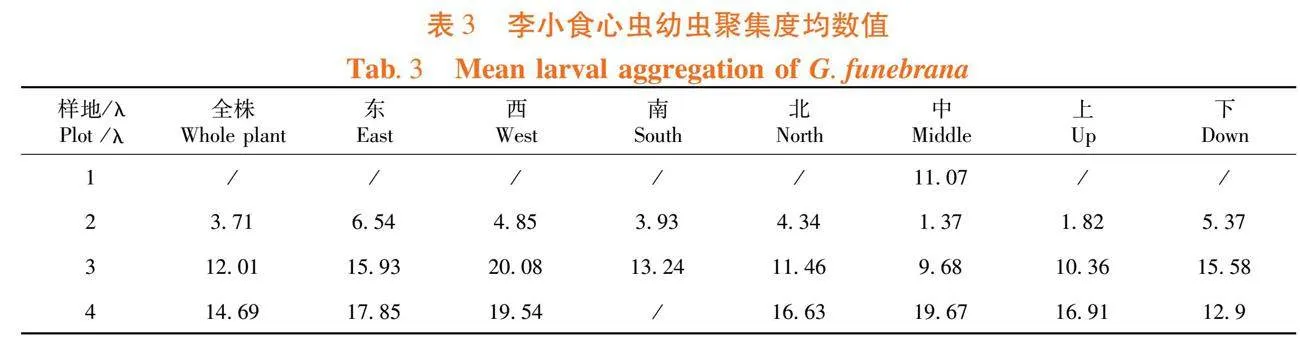
式中,X-為李小食心蟲幼蟲蛀果率的平均數,K為負二項分布k值,γ是自由度等于2K的χ2(卡方)分布函數,即r等于“χ2值表”中自由度等于2K與概率(P=0.5)對應的χ2值。當λ<2時,形成聚集分布主要由環境條件引起,λ≥2時,形成聚集的原因為種群本身的生物學特性與環境條件共同作用或由二者之一所引起。
1.2.4 最適抽樣公式
N=t2[(α+1)/X-+β-1]/D2.
式中,N為所需最適抽樣數,X-為平均蟲口密度,α、β為回歸方程中2個參數,D則為允許誤差值。
2 結果與分析
2.1 聚集指標測定
研究表明,在平均蛀果率為1.67%~10.10%的果園,其擴散系數Cgt;1,叢生指數Igt;0,聚集度指數CAgt;0,負二項分布Kgt;0,平均擁擠度m*gt;1,聚塊指數m*/Xgt;1和擴散型指數Iδgt;1,除樣地1以外,其余3塊樣地的空間分布型均屬于聚集分布,且與種群密度有關,隨著種群密度的增高而減少;且在蛀果率為6.42%時,其聚集程度為最大。在平均蛀果率為0.22%的果園,其擴散系數Clt;1,叢生指數Ilt;0,聚集度指數CAlt;0,負二項分布Klt;0,平均擁擠度M*lt;0,聚塊指數M*/X-lt;0,擴散型指數Iδlt;0,李小食心蟲幼蟲種群密度較小時,其空間分布為均勻分布。表1
2.2 Iwao的回歸
研究表明,平均擁擠度M*與平均蟲口密度X-,李小食心蟲幼蟲的回歸直線方程為M*=1.09 + 1.01X-(R2 = 0.98),其中α=1.09 gt; 0李小食心蟲幼蟲的分布是個體群;β= 1.01gt; 1,當在蛀果率為1.67%~10.10%時,李小食心蟲幼蟲的空間分布型為聚集分布,且個體之間相互吸引。表2
2.3 Tatlor冪法則
研究表明,在Tatlor的回歸方程中lgs2 = 0.27 + 1.08lgX-(R2 = 0.93)檢驗中不同方位的lga= 0.27gt; 0、b= 1.08gt; 1,李小食心蟲幼蟲空間分布為聚集分布,且與種群密度有關,聚集程度隨X-值的增大而增加。表2
2.4 聚集原因
采用Blackith提出種群聚集均數(λ)概念,測定李小食心蟲幼蟲在4塊樣地的杏果上的聚集均數(λ),4塊樣地的λ值均大于2,因此,證明李小食心蟲幼蟲聚集分布的原因由其昆蟲本身聚集習性或環境條件引起。
2.5 李小食心蟲幼蟲的理論抽樣數
研究表明,在相同的蛀果率下,最適抽樣量隨著允許誤差的增加而減少;在相同的允許誤差下,隨著幼蟲蛀果率的增大最適抽樣量也隨之而減少。表4
3 討 論
3.1
研究采用了目前常用的聚集度指標法和兩種回歸模型分析法,確定了李小食心蟲幼蟲的空間分布型主要為聚集型分布或均勻分布,該結果
與劉軍和[8, 18]的李小食心蟲幼蟲在美國杏李上的研究基本一致,但李小食心蟲幼蟲在新疆輪臺縣的空間分布與種群密度有關,種群密度小的為均勻分布與劉軍和的研究有所不同。與陸爽[19]、王慧[20]等對梨小食心蟲的空間分布型的研究中呈聚集分布的結論基本一致。李小食心蟲幼蟲在杏樹上聚集分布的原因與昆蟲的生活環境有關,受環境條件的影響,該結論與李銳等[21]對梨小食心蟲的研究結論基本相同。
3.2
研究選定的4塊樣地中,樹種、樹齡以及栽培管理模式等因素均存在一定的差異性,通過空間分布模型分析和聚集度指標測定看出,其種群密度之間存在明顯差異,隨著種群密度的增大,其空間分布型有均勻-聚集-均勻的趨勢。此外,試驗研究只調查了0.22%~10.10%的蛀果率,蛀果率gt; 10.10%的果園里的李小食心蟲空間分布有待進一步研究。
4 結 論
李小食心蟲的田間空間分布與種群密度相關,隨著種群密度的增加其空間分布由均勻分布向聚集分布轉變,聚集習性和環境條件是其聚集的主要原因;對于李小食心蟲聚集型分布的果園(蛀果率gt;1.67%的果園),應重點防治為害嚴重株或部位,是有效控制該蟲的擴散、為害的關鍵;對于李小食心蟲均勻分布的果園,蟲口密度較小,蛀果率較低(蛀果率lt;1.67%),應以加強全園的預防為主,有效控制其為害與蔓延。
參考文獻(References)
[1]
吳維鈞. 兩種果樹害蟲——旋紋潛葉蛾及李小食心蟲[J]. 昆蟲學報, 1961, 4(S1): 395-400.
WU Weijun. Two kinds of fruit tree pests: Swirling leaf moth and plum small heartworm [J]. Acta Entomologica Sinica, 1961, 4(S1): 395-400.
[2] 楊長群, 王建春, 石永理, 等. 美國杏李果實食心蟲無公害防治技術[J]. 果農之友, 2006, (11): 31.
YANG Changqun, WANG Jianchun, SHI Yongli, et al. Pollution-free control technology of Fruit-eating worm in Apricot and plums in the United States [J]. Fruit Growers’ Friend, 2006, (11): 31.
[3] 李芳東, 孫志強, 杜紅巖, 等. 杏李產區病蟲害發生危害調查及防治[J]. 中國果樹, 2007, (5): 55-57.
LI Fangdong, SUN Zhiqiang, DU Hongyan, et al. Investigation and control of pests and diseases in apricot and plum producing areas [J]. China Fruits, 2007, (5): 55-57.
[4] 王凡, 牛蛉磊, 吉光鵬, 等. 南疆圖木舒克果園三種食心蟲消長動態研究[J]. 新疆農墾科技, 2022, 45(4): 40-42.
WANG Fan, NIU Linglei, JI Guangpeng, et al. Study on the dynamics of three edible worms in Tumushuke orchards in southern Xinjiang [J]. Xinjiang Farm Research of Science and Technology, 2022, 45(4): 40-42.
[5] 王金華, 戴春紅. 寒地果園李小食心蟲危害特點及防治技術[J]. 農業開發與裝備, 2014, (11): 114.
WANG Jinhua, DAI Chunhong. The harm characteristics and control technology of Lycophagia pectoralis in cold orchard [J]. Agricultural Development amp; Equipments, 2014, (11): 114.
[6] 孫勇, 李廣偉, 徐世才. 李小食心蟲的研究進展[J]. 延安大學學報(自然科學版), 2019, 38(2): 92-96, 102.
SUN Yong, LI Guangwei, XU Shicai. Progress in research onGrapholitha funebrana[J]. Journal of Yanan University (Natural Science Edition), 2019, 38(2): 92-96, 102.
[7] 楊磊, 孫惠敏, 林河州, 等. 石河子墾區果樹食心蟲種類及其種群動態[J]. 北方園藝, 2017, (12): 132-135.
YANG Lei, SUN Huimin, LIN Hezhou, et al. Species and population dynamics of fruit borer in Shihezi reclamation zone[J]. Northern Horticulture, 2017, (12): 132-135.
[8] 劉軍和, 禹明甫. 李小食心蟲幼蟲在美國杏李上的空間分布格局[J]. 湖南農業科學, 2008, (5): 111-112, 115.
LIU Junhe, YU Mingfu. Study on Spatial Distribution Pattern ofGrapholitha funebranalarvae on “Meiguoxingli” Plum[J]. Hunan Agricultural Sciences, 2008, (5): 111-112, 115.
[9] 邢楚明, 韓冬銀, 李磊, 等. 薊馬在芒果園田間的時空動態[J]. 環境昆蟲學報, 2017, 39(6): 1258-1265.
XING Chuming, HAN Dongyin, LI Lei, et al. Spatio-temporal dynamics of thrips in mango orchard[J]. Journal of Environmental Entomology, 2017, 39(6): 1258-1265.
[10] 杜浩, 劉學敏, 高梅, 等. 菠蘿蜜園黃翅絹野螟幼蟲的空間分布格局和抽樣技術[J]. 熱帶農業科學, 2020, 40(8): 50-54.
DU Hao, LIU Xuemin, GAO Mei, et al. Spatial distribution pattern and sampling plan ofDiaphania caesalislarvae inArtocarpus heterophyllusplantation[J]. Chinese Journal of Tropical Agriculture, 2020, 40(8): 50-54.
[11] 張孝羲. 昆蟲生態及預測預報[M]. 北京: 中國農業出版社, 2001: 58-69.
ZHANG Xiaoxi. Insect Ecology and Prediction[M]. Beijing: China Agriculture Press, 2001:58-69.
[12] 徐汝梅. 昆蟲種群生態學[M]. 北京: 北京師范大學出版社, 1987.
XU Rumei. Insect Population Ecology[M]. Beijing: Beijing Normal University Press, 1987.
[13] 朱曉鋒, 阿布都克尤木, 徐兵強, 等. 杏樹吐倫球堅蚧空間分布型及抽樣技術研究[J]. 環境昆蟲學報, 2009, 31(2): 102-106.
ZHU Xiaofeng, Abudukeyoumu, XU Bingqiang, et al. Study on the spatial distribution pattern and sampling technique ofRhodococcus turanicusArch. in apricot orchard[J]. Journal of Environmental Entomology, 2009, 31(2): 102-106.
[14] 蘭星平. 關于Iwao m*-m回歸模型在昆蟲種群空間分布型的應用分析[J]. 貴州林業科技, 2007, 35(1): 1-8.
LAN Xingping. Analysis on the application of iwao’s m*-m model on the study of distribution pattern of insect population[J]. Guizhou Forestry Science and Technology, 2007, 35(1): 1-8.
[15] Iwao S. Application of the method to the analysis of spatial patterns by changing the quadrat sizemethod to the analysis of spatial patterns by changing the quadrat size[J]. Population Ecology, 1972, 14(1): 97-128.
[16] Taylor L. Assessing and interpreting the spatial distributions of insect populations[J]. Annual Review of Entomology, 1984, 29: 321-357.
[17] Blackith R E. The water reserves of hatchling locusts[J]. Comparative Biochemistry and Physiology, 1961, 3(2): 99-107.
[18] 劉軍和. 李小食心蟲種群空間格局的地統計學分析[J]. 河南大學學報(自然科學版), 2010, 40(2): 169-174.
LIU Junhe. The geostatistical analysis of population spatial patterns onGrapholita funebrana[J]. Journal of Henan University (Natural Science), 2010, 40(2): 169-174.
[19] 陸爽, 王笑. 梨小食心蟲危害桃梢空間分布型研究[J]. 上海農業科技, 2010, (6): 76-77.
LU Shuang, WANG Xiao. Study on the spatial distribution pattern of peach shoots harmed by small edible worm of pear [J]. Shanghai Agricultural Science and Technology, 2010, (6): 76-77.
[20] 王慧,劉偉. 梨小食心蟲為害桃梢的空間分布型及應用研究[J]. 落葉果樹. 1991, 23(2): 14-15.
WANG Hui, LIU Wei. Study on the spatial distribution pattern and application of pear small food worm to peach shoots [J]. Deciduous Fruits, 1991, 23(2): 14-15.
[21] 李銳, 李喆, 趙志國, 等. 梨小食心蟲幼蟲為害桃梢的空間分布型[J]. 山西農業大學學報(自然科學版), 2010, 30(5): 409-412.
LI Rui, LI Zhe, ZHAO Zhiguo, et al. Study on spatial distribution ofGrapholitha molestalarvae in peach crown[J]. Journal of Shanxi Agricultural University (Natural Science Edition), 2010, 30(5): 409-412.
Study on the spatial distribution and sampling
technique of Grapholitha funebrana
LIU Yuping1,2, XU Bingqiang2, SONG Bo2, LI Haiqiang2,
CHEN Haoyu2, HAO Jingzhe2, ZHU Xiaofeng2, REN Jinlong1
(1.College of Agriculture, Xinjiang Agricultural University, Urumqi 830052, China;2. Key Laboratory of Integrated Pest Management on Crop in Northwestern Oasis/Ministry of Agriculture and Rural Affairs / National Local Joint Engineering Research Center of Special Forestry and Fruit Industry/Institute of Plant Protection,Xinjiang Academy of Agricultural Sciences,Urumqi 830091,China)
Abstract:【Objective】 To clarify the spatial distribution patterns and sampling techniques of Grapholitha funebrana Treitscheke larvae in orchards, so as to provide theoretical basis for scientific control, investigation and sampling of the insect.
【Methods】" The spatial distribution pattern and sampling technique were studied by means of aggregation index method, Iwao regression analysis, Taylor's power law and Iwao optimal sampling model.
【Results】 The spatial distribution pattern of larva was related to population density. With the increase of population density, the spatial distribution of larva changed from uniform distribution to aggregation distribution. The distribution of larva was uniform distribution when the rate of caries was 0.22%, and the distribution of larva was aggregatived when the rate of caries was 1.67%-10.10%. The causes of aggregation were caused by their living habits and environmental conditions. The optimum sampling number under different population densities and allowable errors was determined.
【Conclusion】 With the increase of population density, the spatial distribution of larva larvae changes from uniform distribution to aggregation distribution. For the orchards with aggregation distribution (fruit decay rate gt;1.67%), it is important to control the plant or the parts with serious damage, which is the key measure to effectively control the spread and damage of G. funebrana.
Key words:Grapholitha funebrana; orchard; spatial distribution; sampling technique
Fund projects:Key Ramp;D Program Project of Xinjiang Uygur Autonomous Region (2021B02004-1); Special Fund Project of Xinjiang Apricot Industrial Technology System (XJCYTX-03)
Correspondence author: ZHU Xiaofeng (1979-), male, professor, research direction: Integrated prevention and control of fruit diseases and pests, (E-mail)zxf5117@ 163. com
REN Jinlong,(1989-) male, Ph.D., associate professor, research direction: Insect taxonomy and Phylogeny, Insect-Plant Interaction, Insect diversity and distribution patterns in Steppe, (E-mail)rjlinsect@163.com
收稿日期(Received):
2024-02-03
基金項目:
新疆維吾爾自治區重點研發計劃項目 (2021B02004-1);新疆杏產業技術體系專項資金項目(XJCYTX-03)
作者簡介:
劉雨萍(1999-),女,四川成都人,碩士研究生,研究方向為農業昆蟲與害蟲防治,(E-mail)1342137706@qq.com
通訊作者:
朱曉鋒(1979-),男,河南許昌人,研究員,博士,研究方向為果樹病蟲害綜合防控,(E-mail)zxf5117@ 163. com
任金龍(1989-)男,甘肅人,副教授,博士,研究方向為昆蟲分類和系統進化、昆蟲與植物互作、草原昆蟲多樣性及分布格局機制,(E-mail)rjlinsect@163.com