
Making Use of Waste
2008-10-09 09:50:38HOURUILI
CHINA TODAY 2008年9期
HOU RUILI
IN Ganbai residential courtyard in Beijings Dongcheng District, four dustbins bearing distinctive labels are lined up side by side: “kitchen leftovers,” “recyclable rubbish,” “batteries” and “other waste.” More than half of the capitals residential communities now sort rubbish in this way.
As the Chinese economy grows, garbage disposal becomes an ever more pressing environmental issue. Though the government has invested a huge amount of capital in building new garbage disposal plants, the treatment of refuse still cannot keep up with the amount of waste being generated. As a result, the Chinese people have been compelled to seek new garbage treatment methods.

The sorting of waste allows recycled rubbish to be used as raw material in renewable resource processing plants. Non-recyclable waste is sent to garbage disposal plants, where advanced technology is used to treat it and produce energy. By these means, China is beginning to tackle its immense garbage disposal problem.
Classified Garbage
Collection
Mrs. Zhang Mei lives in Beijings Ganbai residential community. In the corner of her kitchen sits a half-meter-high plastic bin for kitchen leftovers. A large plastic bag hangs on the wall to collect recyclable waste, including paper, plastic, rubber, metal and glass objects. In another corner sits a dustbin for non-recyclable waste such as cigarette butts and dust. Sorting rubbish may seem like a complicated process, but the continued efforts of community workers over the past two years have seen residents slowly falling into the habit. Educational efforts have included handing out leaflets providing guidance on rubbish classification and organizing visits to garbage disposal plants.
Not long ago, Zhang Mei joined one of the excursions organized by her neighborhood committee to several waste processing operations. She kept note of what one of the technicians said: 700 kg of recyclable raw material can be extracted from 1 ton of plastic soft drink bottles; 900 kg of iron can be extracted from 1 ton of waste iron; and 850 kg of recycled paper can be made from one ton of waste paper. This represents a significant reduction in air and water pollution, as well as a saving of resources.
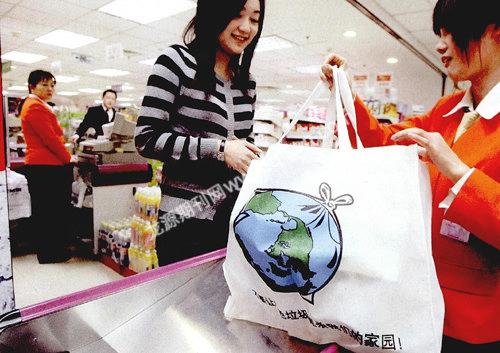
Now in her late 30s, Zhang Mei recalls that there was no refuse treatment in Beijing during her youth. At that time she lived in a one-story house where all rubbish was placed in a basin. Waste then mainly comprised coal ashes, vegetable leaves and dust. Basins were emptied onto open ground each day shortly before dusk, when a man with a dust-cart would come around and collect the refuse. As more and more high-rises were constructed in Chinas cities, rubbish chutes were installed in stairwells, so residents no longer had to troop downstairs to dump their garbage. This was convenient, but the practice saw unsorted waste pile up outside apartment blocks in smelly, unsanitary mounds.
With the issue of garbage disposal standards, some refuse treatment plants began to emerge in Chinese cities in the late 1980s. However, before 1990, less than 2 percent of the nations garbage was treated in any way. The following decade saw 660 refuse treatment plants built across China, with a daily handling capacity of 210,000 tons. In the last 10 years, with advanced technology developed domestically and introduced from abroad, more integrated garbage plants have appeared that can bury, burn and treat rubbish. Increasingly Chinese people are not satisfied with garbage simply being disposed of, and are demanding better recycling facilities. In 2003, all garbage chutes in Beijing apartment buildings were sealed, and large bins for different types of garbage were introduced.
Classified garbage collection has now been implemented in 52 percent of Beijings residential communities, but the national rate is still lower than 10 percent. According to statistics, recycled waste could save RMB 25 billion every year if it were properly collected and reused.
Processing plants have also struggled to keep up with ever increasing demand. Although the daily handling capacity of Chinese plants increased by 46,800 tons from 2000 to 2005, the percentage of total garbage treated actually declined from 61 percent to 54 percent. This reflects the larger amounts of rubbish being generated by Chinas increasingly consumer-driven society.
Recycling
As the consumption habits of Chinese people have changed over the years, so has their garbage. According to the Chinese Urban Garbage Disposing Committee, plastic packaging, for example, now constitutes about 10 percent of urban rubbish. All this packaging is recyclable.
Petroleum is the raw material used in the production of plastic bottles, with six tons of petroleum used to produce every ton of the receptacles. Every year around 150,000 tons of plastic bottles are thrown away in Beijing alone. To protect the environment and save resources, Beijing Yingchuang Regenerated Material Co., Ltd was established, with the largest production line for making recycled bottles in Asia. They can handle 160 tons of used bottles a day. After selection, cleaning, disinfection, crushing and melting, they are turned into creamy-white plastic cubes. These are then transformed into new bottles.
Yingchuang receives and treats 60,000 tons of used plastic bottles annually, representing around 40 percent of the total collected in the capital each year. According to Yingchuang manager Zhao Yan, the plants waste processing equipment and technology have been certified by the U.S. Food and Drug Administration and the International Life Science Institute as safe to produce bottles for use in food and drug packaging. Furthermore, Yingchuangs bottles cost seven percent less than other types. Coca- Cola has already decided to purchase 10,000 tons of Yingchuangs recycled bottles annually to use in soft drink packaging.
Paper is also a common form of waste, and most Beijing offices now have paper recycling boxes. Used office documents, newspapers and packaging are sent to the Beijing No. 7 Paper Mill and other mills to be converted into recycled paper.
Food leftovers are another potentially rich source of recycling. According to statistics, 63 percent of domestic garbage in Beijing is kitchen leftovers. Four waste food treatment plants have been built in Beijing, with a daily handling capacity of 1,200 tons. There are already a few Chinese patents to turn kitchen waste into organic fertilizer. Biochemical machines using physical or biochemical technology to turn leftover food into fertilizers can now be seen in some markets and restaurants, but the cost of maintaining this equipment has limited its widespread adoption.
Generating Energy from Waste
So what happens to Beijings unsorted garbage? First it is transported to dumping stations where it is sorted by workers, before going on to rubbish transfer centers where it is sorted into further categories by machines. Fans are used to extract plastic bags, magnets pull out scrap metal, and sieves of different sizes separate out organic waste to be taken to fertilizing plants. The inorganic waste left at the end of this process is taken away to be buried or burned.
With an massive national annual garbage mountain of 160 million tons, burying is still the most common means of garbage disposal in China. However, as land prices increase, the cost of burying rubbish is also rising. The burning of garbage has thus become more common.
According to Guo Weidong from the Beijing Municipal Administration Commission, five garbage treatment pro-jects were built in Beijing in the mid-1990s with a total investment of over RMB 600 million, which included capital obtained through World Bank loans, and capital and equipment provided by Germany. By the end of 2007, there were 23 refuse treatment facilities in Beijing, including six garbage transfer centers, four integrated garbage treatment plants, and 13 landfills, with a total daily treatment capacity of 10,350 tons. A comprehensive garbage treatment system has been established in the capital, with the portion of domestic garbage being treated increasing from 93.8 percent in 2004 to 99 percent in 2007. In Beijings suburbs, the rates have gone from 33.3 percent to 76 percent over the same period.
The Beijing Asuwei Integrated Garbage Treatment Center is a typical set-up, that includes four main operations: garbage burying, the creation of fertilizer, burning and power generation, and methane power generation. The methane power project was completed and began formal operation in May 2007, using the world-class Deutz methane power-generating sets. The project provides power for 17,000 families annually, reducing coal consumption by some 10,000 tons.
Prior to the introduction of this methane power-generating technology, marsh gas from buried garbage was a big environmental headache for Beijing authorities. The greenhouse effect of this gas is 21 times that of carbon dioxide, and it can set off explosions, cause fires and trigger landslides at garbage dumps if not properly handled. Before the gas was harnessed for power generation, it was simply burned, causing air pollution and creating large amounts of carbon dioxide. The power-generating plant is now listed as a greenhouse control project under the Kyoto Protocol.
Another problem with burying garbage is seeping liquids. This is mainly organic wastewater with a complicated composition, potentially of great harm to the environment and human health. The Nanjing University Pollution Control and Resource Utilization Research Laboratory has developed seeping liquid filtering and treatment technology, which helps remove organic content. In the Asuwei Integrated Garbage Treatment Center, treated seeping liquids are used to water flowers.
These varied technologies are helping to reduce Chinas pressing garbage disposal problem, and recycling precious resources sorely needed to feed the nations booming economy.
Geothermal Resources
The Olympic badminton and rhythmic gymnastics events were held at the Beijing University of Technology Gymnasium. From the very outset, the gymnasiums designers incorporated a “green” air-conditioning system by employing geothermal energy, in keeping with a commitment made by Beijing to the International Olympic Committee (IOC) that all of its sports venues would use geothermal resources for their air-conditioning.
Now, the universitys administration has been happy to learn that the environmentally friendly system, whose initial cost was about the same as it would have been for a conventional air-conditioning system, is much cheaper to operate. Conservative estimates have concluded that the geothermal air-conditioning system will save between RMB 1 and 4 million in annual operating costs compared with a conventional system. Assuming the new systems lifespan to be 15 years, it will have saved a total of RMB 13-58 million over its lifetime. Moreover, it will go far toward ridding the city of its notorious air pollution and the discharges generated by an equivalent amount of conventional energy, not to mention the deleterious effects of intermediary contributors to Beijings smog, such as the black exhaust emanating from tanker trucks transporting conventional fuels, and, of course, traffic jams.
The utilization of geothermal resources is not new in Beijing. Beiyuan Jiayuan, a 400,000-square-meter residential area, completed in 2004 near the Asian Games Village, is the largest residential community in Beijing that uses geothermal energy for its heating and cooling systems.
Compared with other Chinese cities, Beijing is rich in geothermal resources, whose exploitable levels in shallow subsoil strata equals roughly 140 million tons of standard coal, 12 times the 11 million tons of coal consumed by urban Beijing in 2003. However, Beijing has long relied on coal for its energy needs, and its widespread use has been the principal cause ofthe capital citys air pollution. Several years ago, the municipal government began dismantling large boilers that use coal as fuel, and to replace them with clean energy projects.
Preliminary statistics indicate that buildings using geothermal energy for their heating and cooling now exceed six million square meters in Beijing, and that total is increasing rapidly. Apart from Beijing, Guangzhou, Jinan, Shenyang, Shanghai and Chongqing have also built many large geothermal air-conditioning facilities.
By 2010, Beijing will increase the use of new and renewable energy to an amount equivalent to 2 million tons of coal. Over 40 million square meters of residential and office space, or six percent of the citys total, will be heated and cooled using renewable energy. By then, all of the geothermal, solar, wind and bio-energy now being used in the citys Olympic venues may well be going to ordinary homes.
- CHINA TODAY的其它文章
- BASIC CHINESE FOR THE BEIJING 2008 OLYMPIC GAMES
- Discover the Han Heritage in Xuzhou
- Seventy Years Later,James Hilton’s Shangri-la Rediscovered
- Innovation and Excellence:Tianjin University of Finance and Economics
- The Development of an Agricultural City
- The Pig Breeding Industry Benefits Anhui Farmers