Development of a Test Apparatus for Measurem ent of Hydraulic Fluid Efficiency
2011-01-04 07:20:16MattJacksonBrianKoehler
潤滑油 2011年5期
Matt Jackson,Brian Koehler
(Southwest Research Institute,U.S.A.)
Development of a Test Apparatus for Measurem ent of Hydraulic Fluid Efficiency
Matt Jackson,Brian Koehler
(Southwest Research Institute,U.S.A.)
With increasing demand for nonrenewable resources,energy conservation is critical.Efficiency gains allow more work to be performed whilemaintaining or even decreasing the energy expended in the process.Reducing the energy consumed by a system results in favorable economic and environmental impact.An apparatus has been developed tomeasure hydraulic fluid efficiency in a stationary application.The system can be used to developmore efficient fluids,leading to increased work output or decreased energy consumption.
mechanical and volumetric efficiency;test pump;test procedure
0 Introduction
Efficiency in hydraulic systemsmay be expressed in terms of overall efficiency by comparing the power output of the pump to the amountof power required to drive it.Overall efficiency can,in turn,be further analyzed in terms of both mechanical and volumetric efficiency.
High-accuracy measurements of input(driving) torque,pump shaft speed,output flow and pressure are all necessary for the calculation of overall hydraulic efficiency.An inline torque sensor ofappropriate range,alongwith an accurate transducer at the pump outlet provided the torque and pressure data necessary to calculate mechanical efficiency.Pump shaft speed wasmeasured via amagnetic pickup and a Coriolis mass flow meter provided precise measurement of pump output flow.Volumetric efficiency can be derived from the resulting speed and output flow data.
Pump speed was controlled using an electric motor and variable frequency drive.Output pressure was set through the use of a proportionally-controlled relief valve downstream of the pump.Fluid temperature was controlled with a shell-and-tube heat exchanger.
The hydraulic circuit components and instrumentation employed in this study are of key importance.The use of high precision devices to directlymeasure torque and speed formechanical input power calculation and pressure and flow for hydraulic output power calculation represents significant improvement over earliermethods.
The focus of this study was the development of a stationary hydraulic test apparatus that,incorporating precise measurements of speed,torque,pressure,flow,and temperature,can be used to determine efficiencies of hydraulic fluid.Application of this apparatus will allow comparative fluid studies for the optim ization of fluid formulations and the possible prediction of fluid behavior in both stationary andmobile equipment,without the need for costly field trials.
1 Apparatus
The pump selected for developmentof the hydraulic efficiency apparatus was the Eaton 35VQ25A vane pump.This pump,shown in Figure 1,was selected due to itswide use as a fixed displacement test pump for fluid performance testing.To reduce wear-in effects,a unit with over 100 hours of operation at a broad range of conditionswas selected.The pump was inspected before and after testing to ensure proper function and to determine that no mechanical degradation had occurred.
A modified ASTM D6973-08 apparatus was used as the test bench.Input power was p rovided by an electric motor and shaft speed was controlled using a variab le frequency d rive.C losed loop ou tput p res-sure control was accom p lished using an e lectron ically operated proportional valve.Temperatu re was con tro lled by routing the flu id through a she ll-and-tube heat exchanger in a low p ressu re portion o f the c ircuit.A fu ll-flow filter was used to minimize particulate contamination.
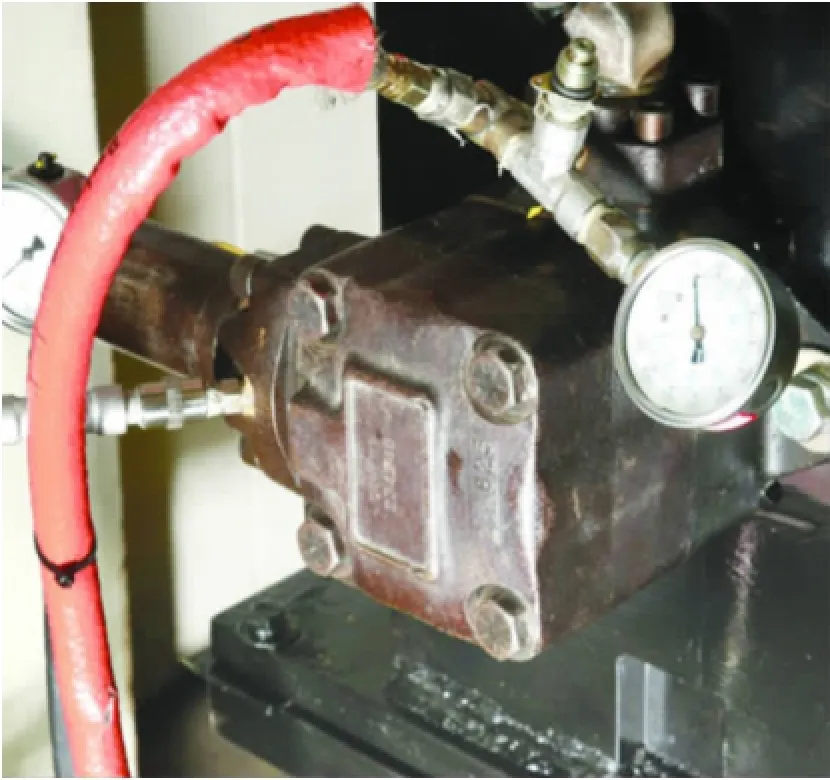
Figure 1 Eaton 35VQ25A test pump
Torquewasmeasured at the pump input shaft using a 0.05%accuracy class digital flange-mounted,non-contact torquemeter.A magnetic pickup on a 60-tooth gear measured shaft speed with a total system accuracy of 0.1%.
A Coriolismass flow meter was used to provide direct measurement ofmass flow and density.The Coriolismeter is immune to flow profile effects and has a volume flow accuracy of±0.10%of rate and repeatability of±0.05% of rate.Electronic transducers were used to measure pressure at the pump inlet and outlet.The outlet transducer has a range of0 to 690 bar and an accuracy of0.1%.The inlet transducer has a range of 0 to 1.7 bar and an accuracy of 0.1%.
A stainless steel K-type thermocouple wasmounted 15 mm from the pump inlet tomeasure inlet temperature.In order to eliminate inlet system and reservoir design variables,the pump inlet pressurewas controlled.The inlet pressure was set at0.21 bar to simulate elevation of the reservoir above the pump in mobile or stationary applications.The system is shown in Figure 2.
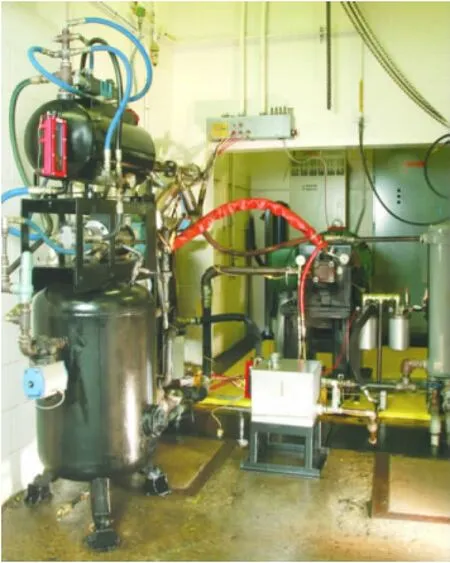
Figu re 2 Sw RIhydraulic e fficiency test rig
2 Test Fluids
Hydraulic efficiency depends largely on fluid viscosity.Higher viscosity fluids tend to produce higher volumetric efficiencies due to reduced internal pump leakage and lowermechanical efficiencies due to the increased power required to pump them.Conversely,lower viscosity fluids give highermechanical efficiencies because they are easier to pump,butalso produce lower volumetric efficiencies due to increased leakage within the pump.
Three fluids were evaluated in developing the hydraulic efficiency testapparatus.Fluids A and B were ISO-32 grade fluids thatwere tested to determine the ability of the apparatus to measure efficiency differences between fluids of the same nominal viscosity.Fluid C was an ISO-46 monograde fluid tested to compare efficiency across viscosity grades.
Fluids A and B exhibited the same nominal kinematic viscosities at40℃and 100℃.However,each fluid had a different high shear rate viscosity,achieved by custom blending two Group IIbase stockswhile using two different types of viscosity index improvers.These two types were a conventional linear molecule Poly Alkyl Methacrylate(PMA)and a star-shaped molecule PMA.These are listed in Table 1 as Fluid A(Polymer A)and Fluid B(Polymer B).
Fluid C used a similar star PMA as Fluid B.Themolecular weight,shear stability,and percent activeswere identical. The monomers differed slightly to improve low temperature performance.
Table 1 provides a summary of the test fluid viscometric characteristics.
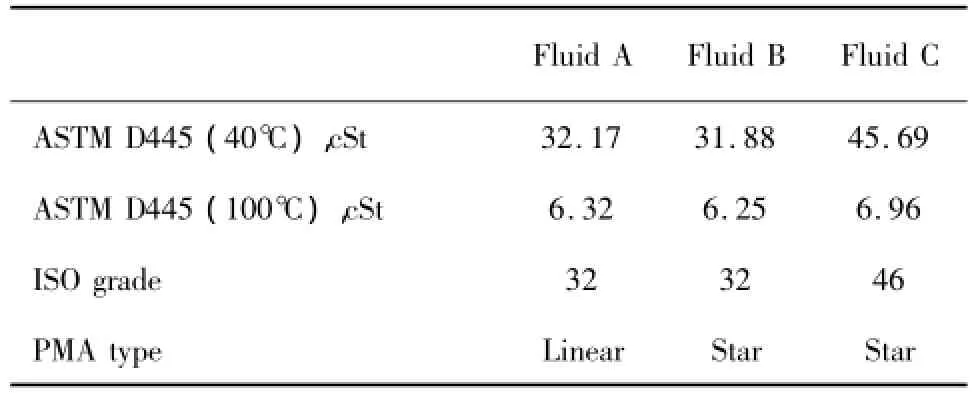
Table 1 Test fluid viscometrics
3 Test Procedure
The test fluidswere evaluated at conditions representative of field operation.Shaft speeds(1200,1800,and 2400 rpm) and output pressures(103,155,and 207 bar)were selected to reflect field conditions near the upper end of equipment ratings.Temperature conditions ranging from 50℃to 90℃represent thewidest practical range for the apparatus.
A summary of the test conditions is presented in Table2.

Table 2 Test conditions
Prior to each test sequence,the test conditions were stabilized for one hour at the maximum speed,pressure,and temperature combination.All shaft speedswere evaluated at a given temperature and pressure before continuing to the next pressure,and all pressures were tested before proceeding to the next temperature.
Test conditions were stabilized before and after the data acquisition period.Data was recorded once perminute following stabilization.The data used for efficiency calculation was an average of the first fiveminutes of stable operation at each condition.Test conditions were maintained for a minimum of oneminute after data acquisition was complete before proceeding to the next combination in order to eliminate the possibility of transients in the data set.
4 Data Analysis
Overall,mechanical,and volumetric efficiencies were calculated for each operating condition according to the following equations:
Overall efficiency[1]:
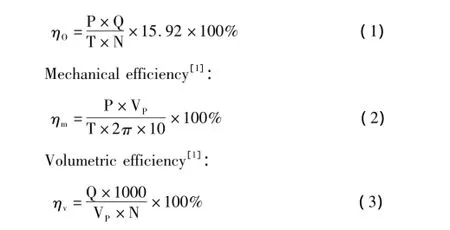
where
P=Pump outlet pressure(bar)
Q=Pump output flow(liters/min)
T=Shaft torque(Nm)
N=Shaft speed(rev/min)
Vp=Pump displacement(81.6 m l/rev)[2]
Based upon the calculated efficiencies,some general trends were observed.Fluids were more volumetrically efficient at higher speeds(Figures 3 through 5)and more mechanically efficientathigher pressures(Figures6 through 8).
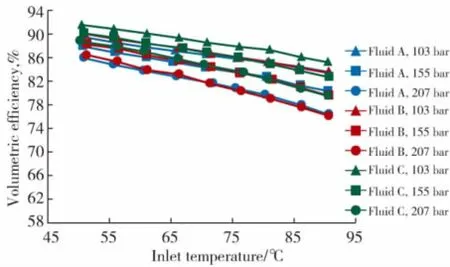
Figure 3 Volumetric efficiency vs.tem perature,2400 rpm
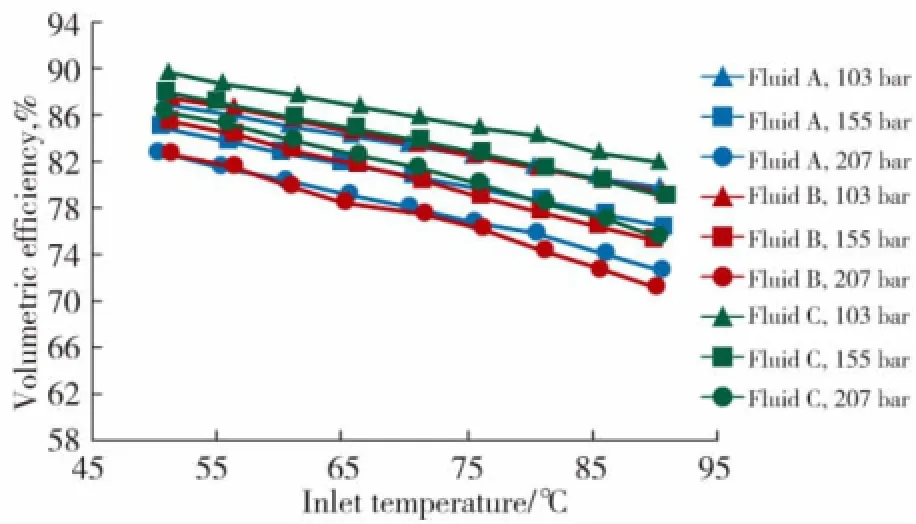
Figure 4 Volumetric efficiency vs.tem perature,1800 rpm

Figure 5 Volumetric efficiency vs.tem perature,1200 rpm
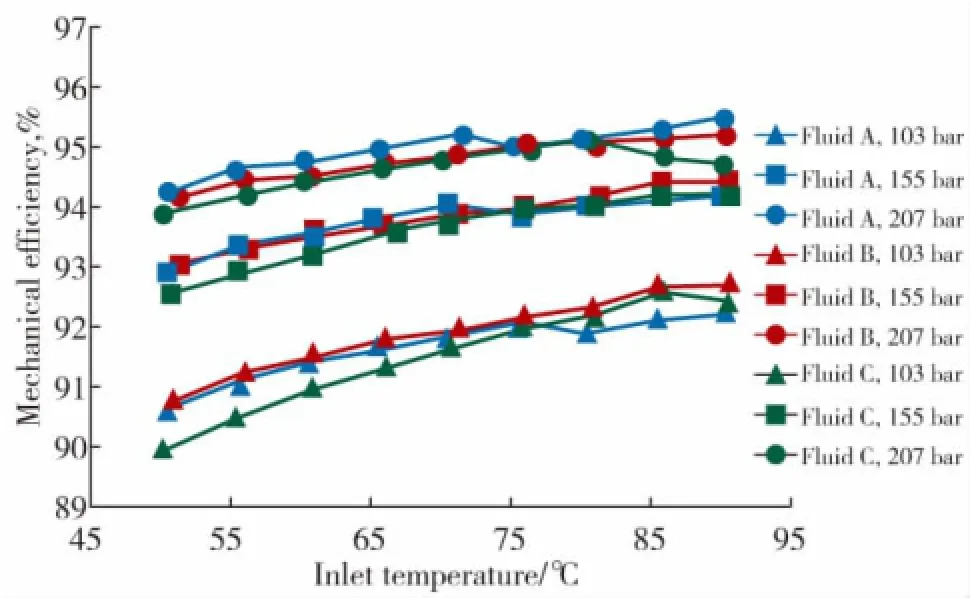
Figure 6 Mechanicale fficiency vs.tem perature,2400 rpm

Figure 7 Mechanicale fficiency vs.tem perature,1800 rpm

Figure 8 Mechanicalefficiency vs.temperature,1200 rpm
Increases in temperature hadmixed results formechanical efficiency.At the lower end of the temperature range,mechanical efficiency increased with temperature.Athigher temperatures,however,the rate of increase becamemore gradual and seemed to indicate thatmechanical efficiencymight stabilize or even decrease athigher temperatures.This phenomenon wasmost pronounced at lower speeds and higher pressures(Figure 8).
Lower temperatures produced higher volumetric and overall efficiency(Figures 3 through 5 and Figures 9 through 11).
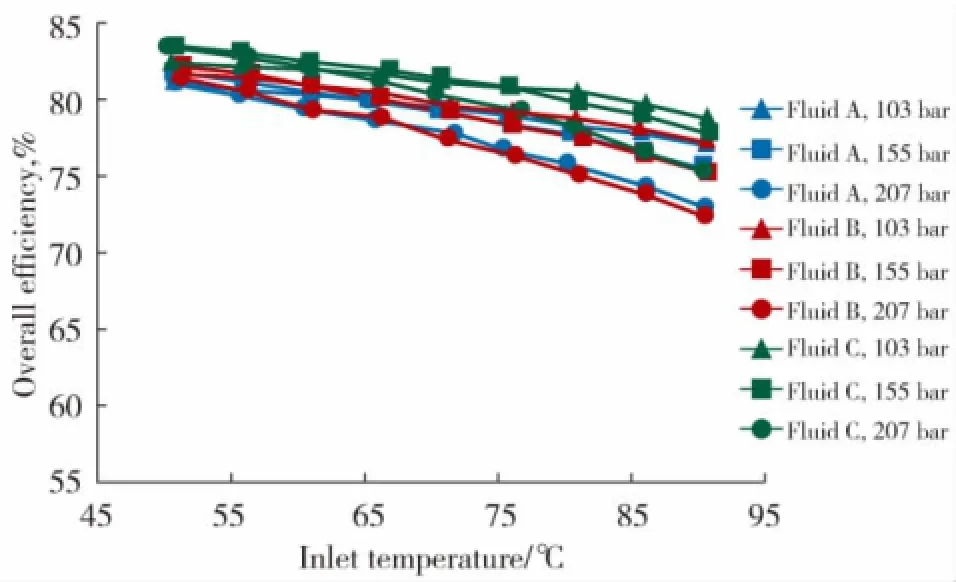
Figure 9 Overall efficiency vs.tem pe rature,2400 rpm
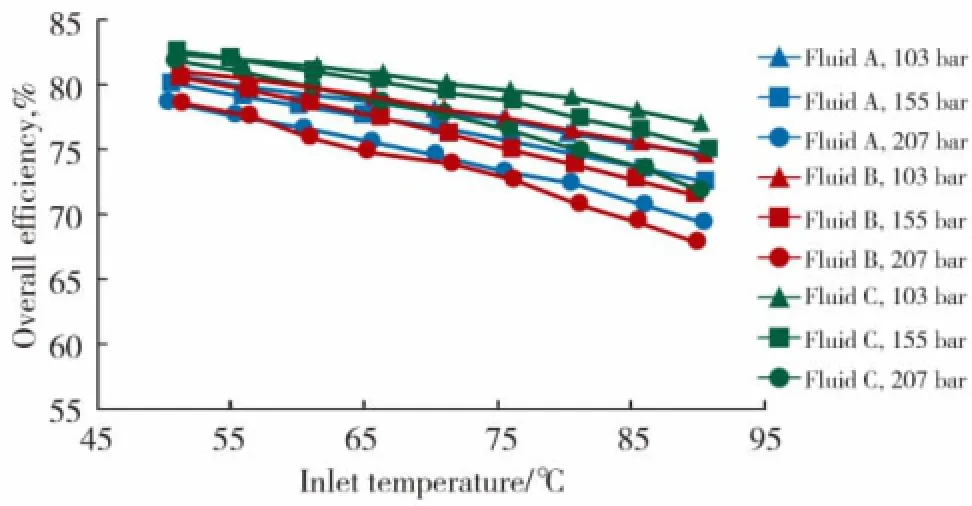
Figure 10 Overa ll efficiency vs.temperature,1800 rpm

Figu re 11 Overalle fficiency vs.tem perature,1200 rpm
Overall efficiency trends followed those exhibited by the volumetric efficiency data,suggesting that volumetric effects have a larger impact on overall efficiency.
Table 3 summarizes the average efficiency differences among the three fluids across all conditions.
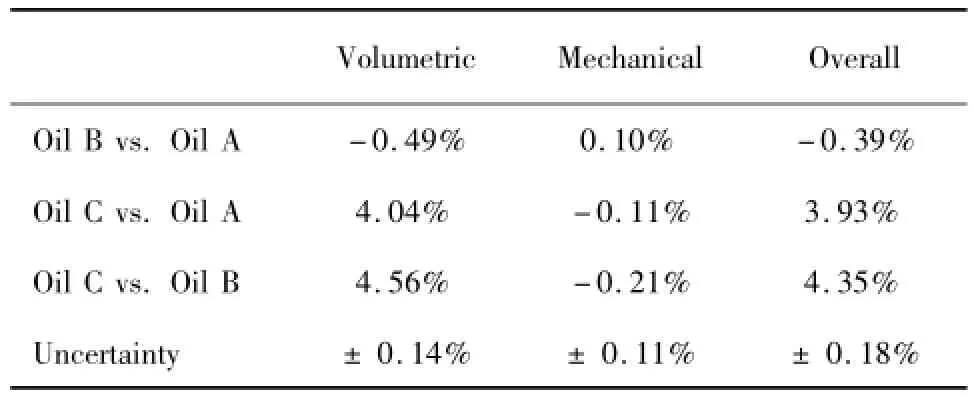
Table 3 Average efficiency differences
Fluids A and B did not exhibit significant differences in efficiency.Fluid C produced the highest volumetric and overall efficiencies of the three fluids(Figures 3 through 5 and Figures 9 through 11).Fluid C exhibited notable separation from Fluids A and B,likely due to the differences in their viscosities(Figures 3 through 5 and Figure 11).
5 Uncertainty and Repeatability
Uncertainties for the results of the efficiency investigationswere quantified using the rootsum of squares rule[3]The published torquemeter accuracywas 0.05%.The accuracy of the flow meter,pressure transducer,and speed sensor was 0.1%for each device.The square rootof the sum of the squares of the accuracy values yields uncertainty values of±0.18% for overall efficiency,±0.11%for mechanical efficiency,and±0.14%for volumetric efficiency.
An example calculation for uncertainty in the overall efficiency values is shown in Equation 4.

Repeatability was determined by recording data multiple times on a single fluid atone setof conditions(1800 rpm,155 bar output pressure,85℃inlet temperature).Four data sets were recorded on two different days with a minimum of three hours of cold soak time between each set.Data was recorded and averaged according to the same procedure used for the full investigation.These repeatability tests resulted in a range of 0.15%for overall efficiency,with the ranges formechanical and volumetric efficiency at0.09%and 0.14%,respectively.
It should be noted thatoverall accuracy will also be influenced by the accuracies of all devices in each signal path.Further quantification of these influences iswarranted.
6 Conclusions
From the data gathered during the developmentof the hydraulic fluid efficiency apparatus,it can be concluded that changes in volumetric efficiency have amuch larger effect on overall efficiency than changes inmechanical efficiency.
Efficiency results for fluids in the same viscosity grade are similar,while differences in efficiency are much more pronounced for fluids of differing viscosity grades.Therewere no appreciable differencesmeasured in terms ofmechanical efficiency.
The hydraulic fluid efficiency apparatus can be a useful tool for comparing efficiency among fluids.As with any new test,additional follow up work is warranted to enhance the method and more fully develop the data set.
Additional fluids of differing characteristics should be evaluated.Data to date was recorded over multiple combinations of temperature,pressure,and speed conditions in order to provide a generaloverview of the performance of the apparatus.Repeated testsof the same fluids ateach condition should be performed in order to establish a confidence interval for the efficiencymeasurements.
Further investigation may involve variable displacement pumps or pumps of other design or manufacture.Testing across awider range of fluid temperatures in order to assess efficiency at extreme operating conditions is another avenueworthy of exploration.Wear measurements of pump components before and after testing will better quantify pump degradation effects.
Acknowledgements
The authors wish to thank Dr.Barton Schober,Fabrice Herrero and Jon Carlson of The Lubrizol Corporation for their support and guidance.Thanks also go to Michael Lochte,Henry Crowder,Mario Dominguez,Jesse Molleda,Brian Bentley,Jacob Hedrick,and Stephen Thompson of Southwest Research Institute for their support in developing the test procedure and in performing the efficiency evaluations.
[1]James A Sullivan.Fluid Power Theory and Applications[M].3rd ed.New Jersey:Prentice Hall,1989:123-128.
[2]EATON Vickers.EATON Vane Pump and Motor De
sign Guide for Mobile Equipment[M].Revised 08/98.47.
[3]H Coleman,W Steele.Experimentation and Uncertainty A-nalysis for Engineers[M].John Wiley&Sons,1989.
TE626.3
A
1002-3119(2011)05-0028-06
2010-10-13。
Matt Jackson,male,following graduation from
Texas A&M University in 1994 with a Bachelor of Science degree in Mechanical Engineering,joined in Southwest Research Institute.He is themanager of the Specialty and Driveline Fluid Evaluations Section in Fuels and Lubricants Research Division.Matt has authored technical papers on elasticmodulus and vibration damping in metalmatrix composites,hydraulic fluid testing,test development for themeasurementof fluid aeration and deaeration,and low speed carbon fiber clutch testing.He is amember of the Society of Automotive Engineers and Tau Beta Pi.