
溫度變化下基于蘭姆波的復合材料結構損傷識別
2011-05-05 22:55:28嚴剛周麗
嚴 剛 周 麗
(南京航空航天大學航空宇航學院,南京,210016,中國)
INTRODUCTION
Composite structures have been widely used in structural components of aerospace vehicles.However,composite structures are vulnerable to damages,especially the invisible low-impact damage,leading to significant reduction of strength and stability.T herefore,it is important and urgent to develop structural health monitoring system to monitor the composite structures online and continuously to detect the internal damages at an early stage to prevent catastrophic failure[1].
Currently,for health monitoring of composite structures,a promising approach is to excite diagnostic Lamb wave into the structures using actuators.By analyzing the transmitting Lamb wave signals,the characteristic information about the hidden damage can be extracted and obtained[2-3].Among Lamb wave-based damage detection and identification approaches,many use the time of flights(T oFs)of the scattered waves to identify the damage.By extracting the time arrival of the Lamb waves scattered by damage,the damage location can be identified using the relation among distances,wave velocities and T oFs of the scattered waves[4-6].T his kind of methods needs to subtract the Lamb wave signals before damage(baseline)from those after damage to obtain the damage-scattered wave signals.However,in real application,the environment,such as temperature,vibration and noise,can greatly influence the Lamb wave propagation in the structure.Under such circumstance,even in the undamaged state,the Lamb wave signals would be significantly different from the baseline signals.Thus it would lead to incorrect judgment and suspicious identification if use the subtracted signals as the scattered signals to identify the damage under environmental effects.
Another kind of Lamb wave-based methods can be categorized as pattern recognition-based methods[7-10].By extracting the damage features from the received Lamb waves in time,frequency or time-frequency domains through signal and information processing techniques,the damages can be classified and identified by pattern recognition.According to the training samples and learning algorithms,the pattern recognition-based methods can be further classified as unsupervised and supervised methods.In unsupervised methods,the training samples are only from the structure under undamaged state,while in the supervised methods,the training samples are from both the undamaged state and the damaged state.Generally,it is difficult to obtain training samples from different damage scenarios beforehand,thus unsupervised methods are more advantageous for low level damage detection in structural health monitoring.
T his paper aims to study the effect of temperature changes on Lamb wave propagation and proposes a two-step method for detection and identification of invisible impact damage in composite structure under temperature changes using Lamb waves.An unsupervised pattern recognition method,statistical outlier analysis,is combined with a probabilistic damage imaging algorithm to detect and identify the damage,while considering the effect of temperature changes.First,the statistical outlier analysis is employed to distinguish whether the changes of Lamb wave signals are induced by damage within the monitoring area or are only affected by temperature changes.If the damage existence is determined,then the probabilistic damage imaging algorithm is adopted to fuse information collected from multiple actuator-sensor paths to form diagnostic image to identify the location of damage.Experimental study on a stiffened composite panel with random temperature changes isperformed to demonstrate the effectiveness of the proposed method.
1 DAMAGE DETECTION AND IDENTIFICATION APPROACH
1.1 Damage index
For damage detection, damage features should be extracted from the sensed signals to indicate the presence and progress of damage.Most of the damage features are represented by damage index comparing the dynamic response parameters in operational state with those in undamaged state.For Lamb wave-based damage detection methods,a useful damage index with simple signal processing is usually defined in the frequency domain as
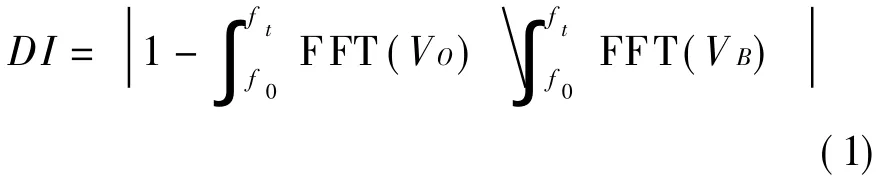
where VB is the referenced Lamb wave signal sensed in undamaged state,and VOthe Lamb wave signal in an arbitrary operational state,FFT the Fourier transform of the signals,and[f0,ft]is the frequency range of the excited Lamb wave signal.
Under ideal condition,the meaning of the damage index defined by Eq.(1)is that,if there is no damage in one actuator-sensor path,VOis exactly the same as VB,DI=0;Else if there is damage in that path,VO is different from VB,DI=X,X∈(0,1),indicating the occurrence of damage.However,in real applications,the operational environment surrounding the structure,such as temperature changes,will greatly influence the Lamb wave propagation in the structure.Under such circumstance,even in the undamaged state,the wave signals at an arbitrary time will be significantly differentfrom the referenced baseline signal,i.e.,DI≠ 0.It is difficult to distinguish if the change of Lamb wave signals is introduced by damage or environment.
T o overcome this drawback,in this paper damage index defined in Eq.(1)is modified from a statistical point to consider the environmental effect.Let VBibe the Lamb wave signal of the ith observation(i=1,…,M)in the undamaged state.One of these measurements(i= 1)is adopted as a baseline reference and the damage index DIBunder undamaged state is evaluated for the remaining(M-1)measurements as
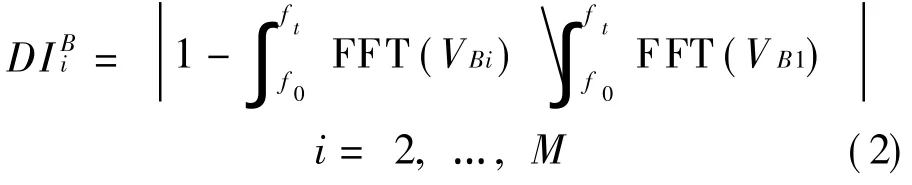
Let VOjbe the Lamb wave signal of j th observation(j=1,…,N)in the operational state.The damage indices under operational state are evaluated for the N measurements as
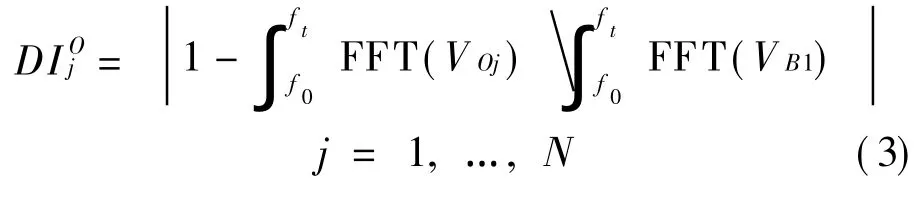
A statistical outlier analysis is performed to compare the damage indices under operational state with those under undamaged state to detect the presence of damage.A Monte Carlo procedure is used to obtain the damage threshold value for the damage indices at the undamaged state.If the damage indices in the operation state exceed the threshold value,the presence of damage is determined.
1.2 Statistical outlier analysis
In statistics,an outlier is an observation that is significantly different from the rest of the population and the outlier is believed to be generated by an alternative mechanism.Outlier analysis can be considered as a special class of pattern recognition,which classifies the abnormal data or state from the normal ones.For structures,outlier is normally related to a damaged state,and outlier analysis has emerged as a robust unsupervised learning pattern recognition tool for damage detection[11].
In this study,for determining whether an observation of damage indices in an operational state is an outlier,namely,the change of Lamb wave signals is induced by damage rather than temperature changes,a proper damage threshold value DIthshould be calculated using the damage indices under undamaged state.In a sensor network,if the calculated damage index in an actuator-sensor path under operational state is less than DIth,it can be considered that the change of sensed Lamb wave signals is introduced by temperature changes;Otherwise,it can be deduced that damage occurs in or near that actuator-sensor path,thus the presence of damage could be detected.
A Monte Carlo procedure is employed with experimentalmeasurements to determine the damage threshold value.Its main steps are as follows[12]:
Step 1 In the undamaged state,randomly apply temperature changes to the structure,and randomly obtain M sets of Lamb wave signals in each actuator-sensor path.Select one measurement as reference,and compute the damage indices of the rest M-1 sets of Lamb wave signals in each actuator-sensor path according to Eq.(2).
Step 2 Save the maximum of the M-1 damage indices in each actuator-sensor path as DImaxto obtain a population of NkDImax,Nkis the number of actuator-sensor paths in a sensor network.
Step 3 Assess that which distribution the maximum damage indices DImaxunder temperature changes come from,and estimate the probability distribution function(PDF)from this NkDImax population.From the estimated PDF,the damage threshold value,DIth,can be established with a certain confidence level(99.9%in this study).
1.3 Probabilistic damage imaging
Because of the complexity of composite structure and impact damage,the interaction between Lamb wave and impact damage in different directions and actuator-sensor paths may different.It is more reasonable to fuse information collected from multiple actuator-sensor paths rather than single path to identify the damage.In this study,after the presence of damage is determined by the statistical outlier analysis,a probabilistic damage imaging algorithm is adopted to use damage-sensitive features of all actuator-sensor paths to identify the location of damage.
For a sensor network with Nkactuator-sen-sor paths in total,the estimation probability value of damage presence P at position(x,y)can be written as[13]
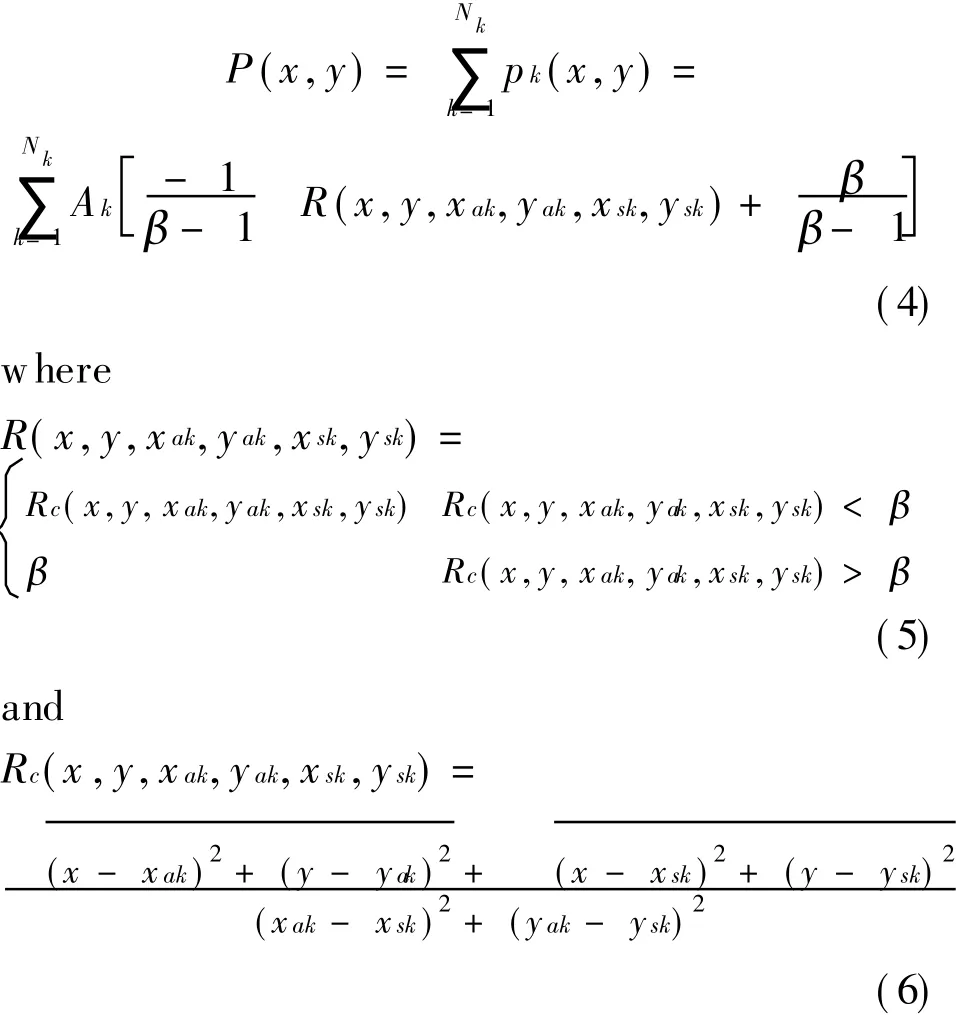
is the ratio of the sum of the distances from the imaging point(x,y)to the actuator(xa,ya)and to the sensor(xs,ys)to the distance between the actuator and sensor.pk(x,y)is the estimation of probability of the presence of damage from the kth actuator-sensor path and Akis the damagesensitive feature in the kth path.βis a scaling parameter which controls the size of the affected zone of the actuator-sensorpaths[14].In this study,β is set as 1.07.
In the original probabilistic damage imaging method proposed by Hay et al[13-14],the presence of damage is assumed to be the exclusive reason for the changes in the Lamb wave signals between the reference and presentoperational states.They used the correlation of Lamb wave signals in two different states(signal difference coefficient)as the damage features.However,as aforementioned,the operational environment surrounding the structure,such as temperature changes,will influence the Lamb wave propagation in the structure.Under such circumstance,even in the undamaged state,the wave signals at an arbitrary time would be significantly different from the baseline signals.The aim of the proposed twostep method is to consider the environmental influences to improve this imaging approach.Only after the presence of damage is determined by the statistical outlier analysis,the imaging algorithm is adopted to display probabilities of the presence of damage within the monitoring area.T he damage indices under damaged state are used as the damage features in Eq.(4)to generate the diagnostic damage image,and the damage is assumed to be presented in the area with the highest probability of presence.
2 EXPERIMENTAL STUDY
2.1 Experiment setup
T o demonstrate and verify the damage detection and identification method proposed in this study,an experimental structural health monitoring system is established to perform experimental studies.The overall test configuration of the experimental system is shown in Fig.1(a).The test setup consists of a stiffened composite panel,a NI PXI-5442 arbitrary function generator,a NI PXI-6115 data acquisition(DAQ)board,and a KH-7600 wideband amplifier.
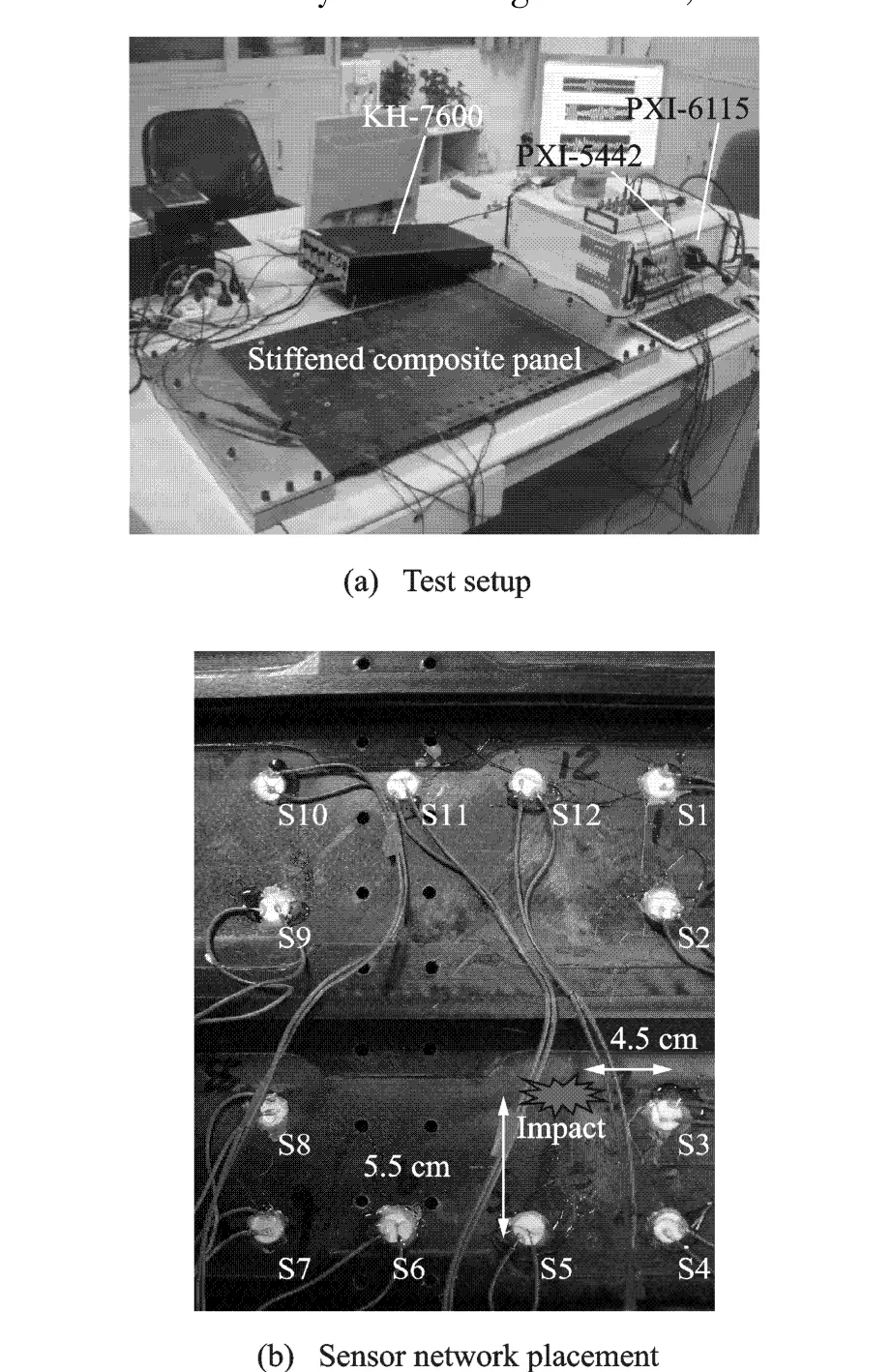
Fig.1 Test setup and sensor network placement
On the back surface of the stiffened composite panel,12 PZT transducers denoted by S1 to S12 are mounted to form a sensor network to monitor the damage in a region with a dimension of 150 mm×180 mm,as illustrated in Fig.1(b).The diameter of the PZT transducer is 12 mm and the thickness is 1 mm.Each PZT transducer can be acted as both actuator and sensor,thus there are totally 66 independent actuator-sensor paths.However,S1 and S3 partially debonded during the following impact test,thus there are only 45 effective actuator-sensor paths.Table 1 lists the path numbers and corresponding actuators and sensors.A LabVIEW-based software is developed to control the waveform generator to generate the excitation signals at a sampling rate of 40 MHz.In the following experiments,the signal amplified by KH-7600 drives one PZT actuator to generate transient Lamb waves into the stiffened composite panel alternatively,and the response wave signals are then received by other PZT sensors,and saved by the NI PXI-6115 DAQ board,whose sampling rate is set at 10 MHz.During the experimental study,limited by the experimental condition,hair dryer is adopted to randomly heat up the monitoring area of the stiffened composite panel to simulate temperature changes.T he temperature range applied by the hair dryer is about 25—80°C in this study.However,the proposed method can be extended to other temperature distribution.
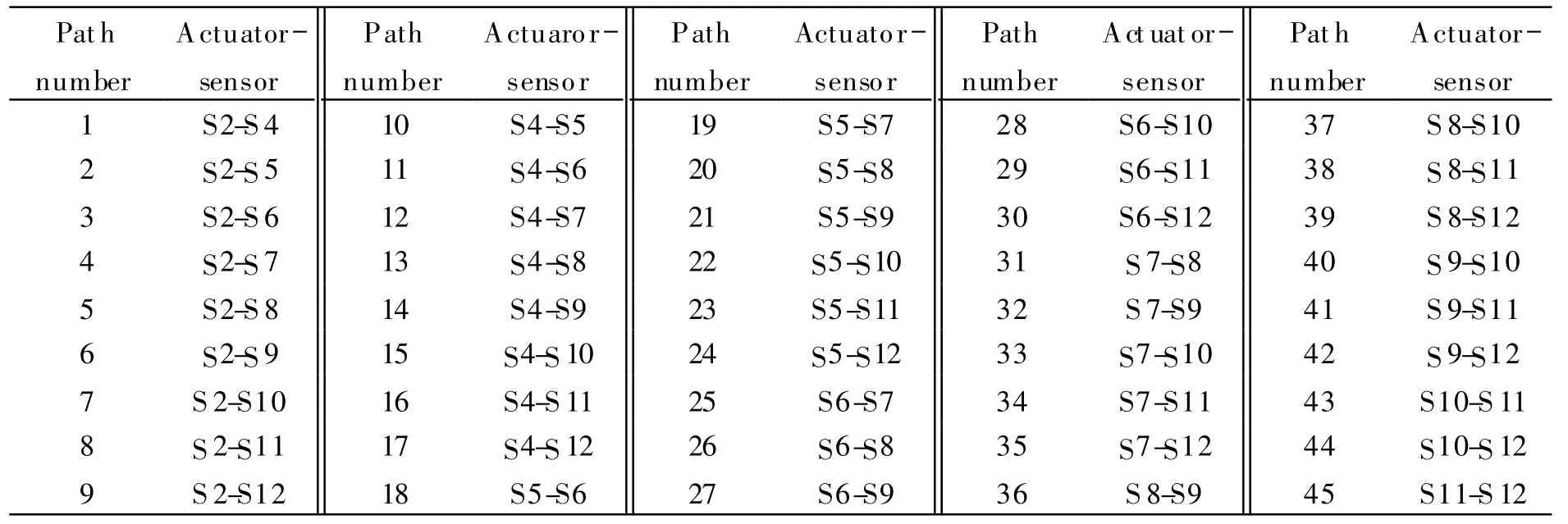
Table1 Path numbers and corresponding actuators and sensors
2.2 Damage detection result
To determine whether there existed damage in the structure during operation,a Monte Carlo method aforementioned is first performed to determine the damage threshold value in the undamaged state.Under the room temperature,a set of Lamb waves at each actuator-sensor path is measured as the baseline reference as VB1described in Eq.(2).T hen hair dryer is adopted to randomly heat up the monitoring area of the stiffened composite panel,meanwhile,10 sets of Lamb waves are obtained at each actuator-sensor path.
In this study,for damage detection and identification,the function generatorgenerates a tone-burst,narrowband modulated sinusoidal input voltage signal and applies it to the PZT sensor according to
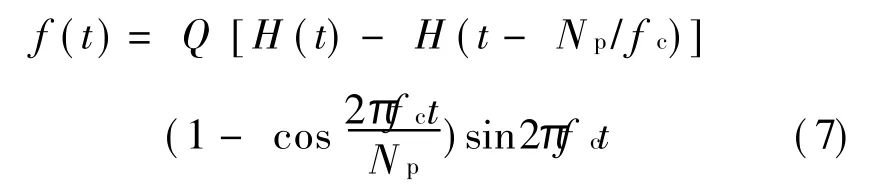
where Q is the amplitude of the excitation signal,Npthe number of peaks in the waveform,fcthe center frequency and H(t)the unit step function.In the experiment,the parameters are selected as:Q=6 V,Np=5 and fc=75 kHz.Fig.2(a)shows two typical measurements and their subtraction from S2 to S5 under two different temperatures in the undamaged state.T heir Fourier transform are shown in Fig.2(b).From Fig.2,it can be clearly seen that temperature changes has an important influence on the propagation of Lamb waves,leading to phase and amplitude changes of the received signals in both time and frequency domains.It would inevitably lead to false judgment and suspicious identification if use the subtracted signal as the damage-scattered signal or use features from these two sets of wave signals directly to detect and identify the damage under temperature changes.
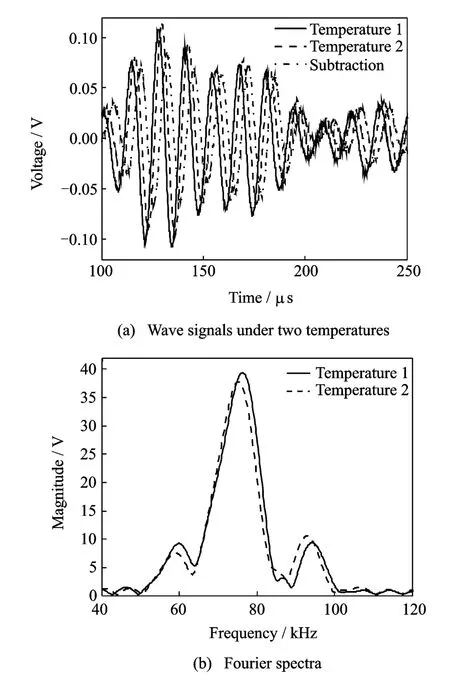
Fig.2 Typical measurements and Fourier transforms underdifferenttemperatures in undamaged state
Then the damage indices of the 10 sets of Lamb waves are calculated according to Eq.(2)and save the maximum DImaxin each actuator-sensor path to obtain a population of 45 DImax.Fig.3 shows the maximum of the damage indices DImax at all 45 actuator sensor paths.Distribution plot is used to assess which distribution the damage indices DImaxcome from.Fig.4(a)shows a normal distribution plot.It can be seen that thedata points fall near the line,demonstrating it is reasonable to assume that the data come from a normal distribution.A Jarque-Beta test is also performed by using MAT LAB function″jbtest″.The test results accept the null hypothesis that the data come from a normal distribution.T he PDF of the normal distribution is then estimated from this 45 DImaxpopulation as illustrated in Fig.4(b).T he threshold value,DIth=0.233,is established with a 99.9%confidence level as illustrated in Fig.3.
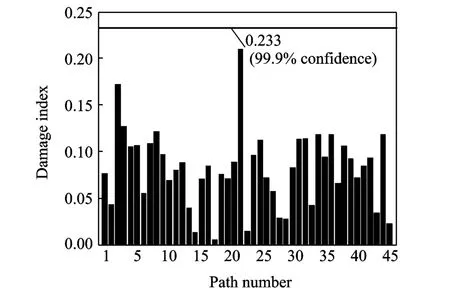
Fig.3 Maximum damage indices at all actuator-sensor paths in undamaged state
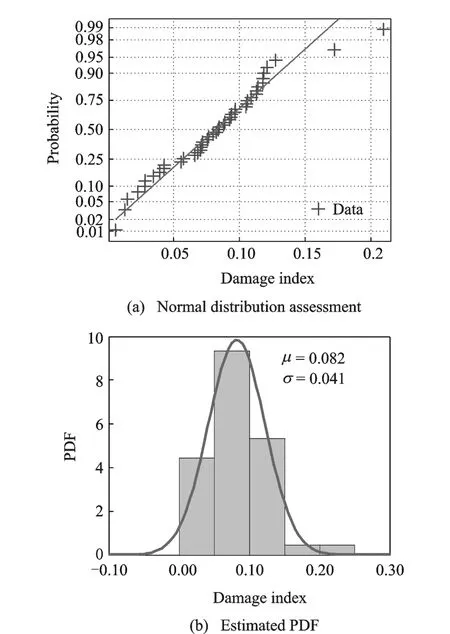
Fig.4 Normal distribution plots
Next,an impact test is performed to introduce low-velocity impact damage in the stiffened composite panel.A drop-weight impacting device with energy of about 20 J is controlled to impact at the position illustrated in Fig.1(b).After impact,the same as the test procedure under undamaged state,10 sets of Lamb waves are obtained at each actuator-sensor path,and hair dryer is used to randomly heat up the monitoring area of the stiffened composite panel.Fig.5 shows a typical measurement and its Fourier transform from S2 to S5 under damaged state compared with the ones under undamaged state.T he damage indices of the 10 sets of Lamb waves under damaged state are calculated according to Eq.(3).To eliminate the difference induced by temperature change,the 10 sets of damage indices is averaged in each actuator-sensor path.Fig.6 shows the averaged damage indices at all 45 actuator-sensor paths.T he damage threshold value with 99.9%confidence is also illustrated in Fig.6.It can be clearly observed that the damage indices in 10 actuator-sensor paths are greater than the damage threshold value,and it can be deduced that damage occurred in the monitoring area.
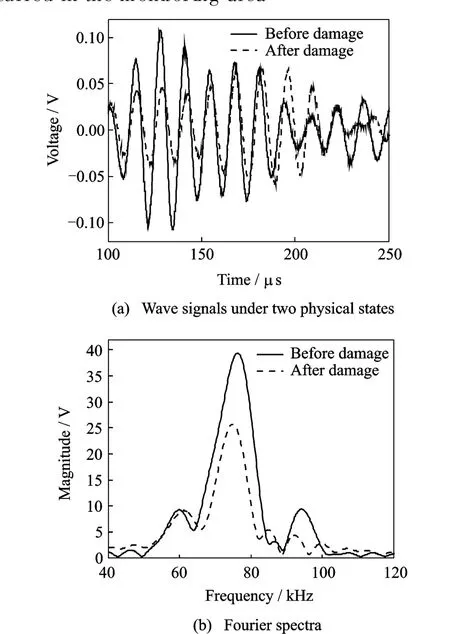
Fig.5 Typical measurements and Fourier transforms under different temperatures in damaged state

Fig.6 Averaged damage indices at all actuator-sensor paths in damaged state
2.3 Damage identification result
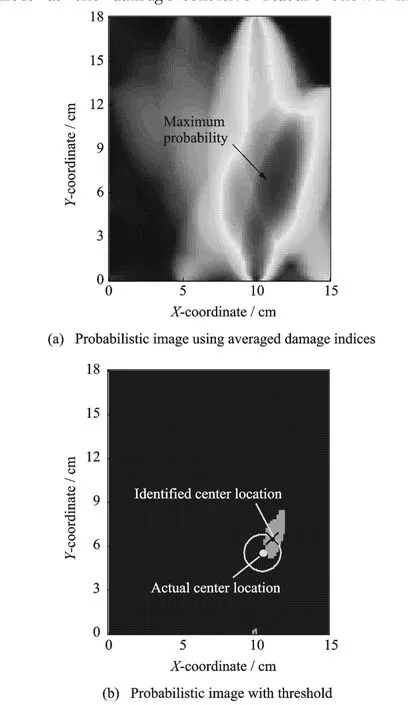
Fig.7 Images for probability of presence of damage
After damage is detected by the statistical outlier analysis,the probabilistic damage imaging algorithm is used to identify the location of damage.Fig.7(a)illustrates the damage image constructed by Eq.(4)using the averaged damage indices as the damage-sensitive feature shown in Fig.6 after the stiffened composite panel is impacted.In the image,the higher the pixel value is,the higher the probability that the damage locates.With a proper threshold value,the estimated damage location is shown in Fig.7(b).T he impact damage is examined by ultrasonic C-scan,the shape of the inside damage is nearly a circle with diameter of about 30 mm.The size of the damage is highlighted by a bold circular line in Fig.7(b)for comparison.The identified center location of damage using the maximum probability is about 1.7 cm from the actual center location of the impact damage.This identification result is within a reasonable range,considering the complexity of the stiffened composite panel,demonstrating the effectiveness of the proposed method.
3 CONCLUSION
This paper proposes a two-step method for detection and identification of invisible impact damage in composite structure under temperature changes using Lamb waves.A statistical outlier analysis is employed to distinguish whether the changes of Lamb wave signals are induced by damage within a monitoring area or are only affected by temperature changes.After the damage is detected,a probabilistic damage imaging algorithm displaying probabilities of the presence of damage within the monitoring area is adopted to fuse information collected from multiple actuatorsensor paths to identify the location of damage.Experimental results demonstrate that the proposed method gives reasonable accuracy for damage detection and identification.The statistical outlier analyses successfully detect the damage existence and provid a useful tool to overcome the effect of temperature changes.T he deviation between the damage location identified by the maximum probability value of the presence of damage and the actual one is within a reasonable range.However,the influence of damage extent is not included in the imaging algorithm.
[1] Boller C.Next generation structural health monitoring and its integration into aircraft design[J].International Journal of Systems Science,2000,31(11):1333-1349.
[2] Su Z,Ye L,Lu Y.Guided Lamb waves for identification of damage in composite structures:a review[J].Journal of Sound and Vibration,2006,295(3/5):753/780.
[3] Giurgiutiu V,Cuc A.Embedded non-destructive evaluation for structural health monitoring,damage detection,and failure prevention[J].The Shock and Vibration Digest,2005,37(2):83-105.
[4] Lemistre M,Balageas D.Structural health monitoring system based on diffracted Lamb waves analysis by multiresolution processing[J].Smart Materials and Structures,2001,10(3):504-511.
[5] Kehlenbach M,Das S.Identifying damage in plates by analyzing Lamb wave propagation characteristics[C]//Proceedings of Smart Nondestructive Evaluation for Health Monitoring of Structural and Biological Systems.San Diego,USA:[s.n.],2002:364-375.
[6] Su Z,Ye L.Fundamental Lamb mode-based delamination detection for CF/EP composite laminates using distributed piezoelectrics[J].Structural Health Monitoring,2004,3(1):43-68.
[7] Sohn H,Park G,Wait J R,et al.Wavelet-based active sensing for delamination detection in composite structures[J].SmartMaterials and Structures,2004,13(1):153-160.
[8] Worden K,Manson G.The application of machine learning to structural health monitoring[J].Philosophical Transactions of the Royal Society A,2007,365(1851):515-537.
[9] Cheung A,Cabrera C,Sarabandi P,et al.The application of statistical pattern recognition methods for damage detection to field data[J].Smart Materials and Structures,2008,17:065023.
[10]Banerjee S,Ricci F,Monaco E,et al.A wave propagation and vibration-based approach for damage identification in structural components[J].Journal of Sound and Vibration,2009,322(1/2):167-183.
[11]Worden K,Manson G,Fieller N R J.Damage detection using outlier analysis[J].Journal of Sound and Vibration,2000,229(3):647-667.
[12]Park S,Inman D J,Yun C B.An outlier analysis of MFC-based impedance sensing dataforwireless structural health monitoring of railroad tracks[J].Engineering Structures,2008,30(10):2792-2799.
[13]Hay T R,Royer R L,Gao H,et al.A comparison of embedded sensor Lamb wave ultrasonic tomography approaches for material loss detection [J].Smart Materials and Structures,2006,15(4):946-951.
[14]Wang D,Ye L,Lu Y,et al.Probability of the presence of damage estimated from an active sensor network in a composite panel of multiple stiffeners[J].Composites Science and Technology,2009,69(13):2054-2063.
猜你喜歡
中國自動識別技術(2023年6期)2024-01-12 08:13:22
環球時報(2022-08-16)2022-08-16 15:13:53
哲學評論(2021年2期)2021-08-22 01:53:34
中華詩詞(2019年7期)2019-11-25 01:43:04
纖維復合材料(2018年3期)2018-04-25 07:22:58
電子測試(2017年11期)2017-12-15 08:57:13
金色年華(2017年8期)2017-06-21 09:35:27
影視與戲劇評論(2016年0期)2016-11-23 05:26:01
中國化肥信息(2016年41期)2016-05-17 04:25:59
現代企業(2015年9期)2015-02-28 18:56:50
 Transactions of Nanjing University of Aeronautics and Astronautics2011年3期
- Transactions of Nanjing University of Aeronautics and Astronautics的其它文章
- 《南京航空航天大學學報(英文版)》征 稿 簡 則
- 基于多GPU的大型線性和非線性方程組的求解
- 基于GIS的機場凈空障礙物評定研究
- 基于遺傳EM 算法的航班延誤狀態空間模型
- 基于OPNET的低軌衛星的點波束確定算法
- 基于因果圖的微小型渦噴發動機安全性分析