
Non-acute effects of different doses of 3, 4-methylenedioxymethamphetamine on spatial memory in the Morris water maze in Sprague-Dawley male rats**☆●
2011-07-19 08:08:22SaraSoleimaniAslMohammadHassanFarhadiNasserNaghdiSamiraChoopaniAlirezaSamzadehKermaniMehdiMehdizadeh
中國神經再生研究(英文版) 2011年22期
Sara Soleimani Asl, Mohammad Hassan Farhadi, Nasser Naghdi, Samira Choopani, Alireza Samzadeh-Kermani, Mehdi Mehdizadeh,
1Anatomical Department, Medicine Faculty, Tehran University of Medical Sciences, Tehran 1449614535, Tehran Province, Iran
2Substance Abuse and Dependence Research Center, University of Social Welfare and Rehabilitation Sciences, Tehran 3834198571,Tehran Province, Iran
3Physiological & Pharmacological Department, Pasture Institute, Tehran 13164, Tehran Province, Iran
4Chemistry Department, Faculty of Sciences, Zabol University, Zabol 9861663335, Sistan Baloochestan Province, Iran
5Cellular & Molecular Research Center, Tehran University of Medical Sciences, Tehran 1449614535, Tehran Province, Iran
lNTRODUCTlON
3, 4-methylendioxymethamphetamine (MDMA;also known as ‘ecstasy’) is a synthetic amphetamine derivate that is used as a recreational drug, and causes elevated mood and a heightened sense of empathy[1]. MDMA has excitatory effects on the central nervous system (CNS), particularly serotonergic,dopaminergic and noradrenergic synaptic endings with the highest affinity for the serotonin transporter (SERT) and 5-hydroxy tryptamine 2 (5-HT2) receptors[2]. MDMA administration has been found to decrease serotonin in the prefrontal cortex, neostriatum and hippocampus, which are important structures known to be involved in learning and memory[3-4]. Furthermore, verbal,prospective and working memory, as well central executive and decision-making skills are reported to be altered in persistent MDMA users[5-7]. Abstaining from MDMA does not ameliorate these effects in rehabilitation[7]. Rat studies have reported that MDMA exposure(10 mg/kg, twice daily) causes decreased novel object recognition[8]and decreased anxiety in the elevated plus maze[9].
Vorhees et al[10]reported that use of different doses of MDMA in rats at postnatal days 11-12 impaired locomotor activity and allocentric learning in the Morris water maze,dose-dependently and acutely. Moreover,Sprague et al[11]reported effects of MDMA treatment (20 mg/kg, twice daily) on escape latency, swim distance in Morris water maze.
However, that study used a 7-day delay between MDMA administration and Morris water maze testing, and did not examine the acute effects of MDMA. Several studies have reported acute effects of single or multiple doses of MDMA on learning and memory[10-12], but to the best of our knowledge, no studies have examined the non-acute effects of repeated administration of various doses of MDMA on learning and memory in the Morris water maze.
The current study sought to determine whether there were any differences in spatial memory impairment, body temperature and mortality after the administration of different doses of MDMA.
RESULTS
Quantitative analysis of experimental animals
A total of 40 adult male Sprague-Dawley rats were initially included in the study, and were equally and randomly assigned to four groups: sham-operated, 5, 10,20 mg/kg MDMA. Rats in these four groups were intraperitoneally administered normal saline, 5, 10,20 mg/kg MDMA, respectively. All rats were included in the final analysis.
MDMA increased escape latency in Morris water maze dose-dependently
The mean escape latency (longer escape latency indicates more severe spatial memory deficit) increased significantly and dose-dependently in the MDMA-treated groups compared with sham-operated group in the Morris water maze with 3 training days (P < 0.001).
This parameter increased significantly in the 20 mg/kg MDMA group compared with the 5 and 10 mg/kg MDMA groups within 7 days after drug exposure (P < 0.01;Figure 1). There were no significant differences in escape latency in the probe and visible trial sessions between the MDMA and sham-operated groups (data not shown).
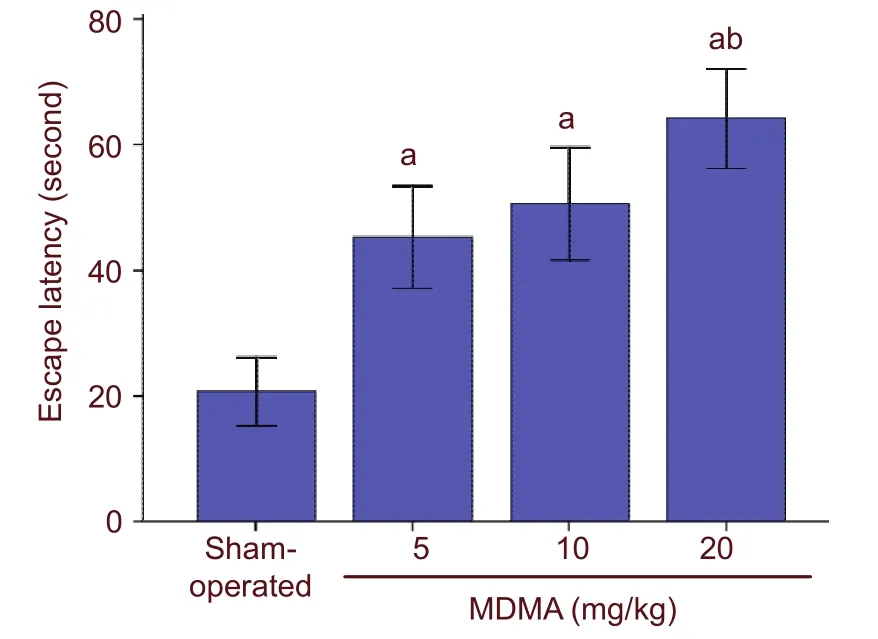
Figure 1 Escape latency to find hidden platform (mean ±SEM) in sham-operated and 3, 4-methylendioxymethamphetamine (MDMA) groups in the training days using the Morris water maze (spatial acquisition). Data were analyzed using one-way analysis of variance followed by Tukey's test for multiple comparisons. MDMA increased escape latency dose-dependently. aP < 0.001, vs. sham-operated group;bP < 0.01 vs. 5 mg/kg MDMA group.
MDMA increased swim distance or path length in the Morris water maze dose-dependently
All MDMA groups demonstrated significant dose-dependent increases in swim distance to the escape platform in 3 training days compared with the sham-operated group (longer swim distance indicates more severe spatial memory deficits (all P < 0.001;Figure 2). Furthermore, the mean swim distance slightly increased in the 20 mg/kg MDMA group compared to the 5 and 10 mg/kg MDMA groups within 7 days after treatment, but this difference did not reach significance. There was no significant difference in swim distances in the probe and visible trial sessions between the MDMA groups and the sham-operated group (data not shown).
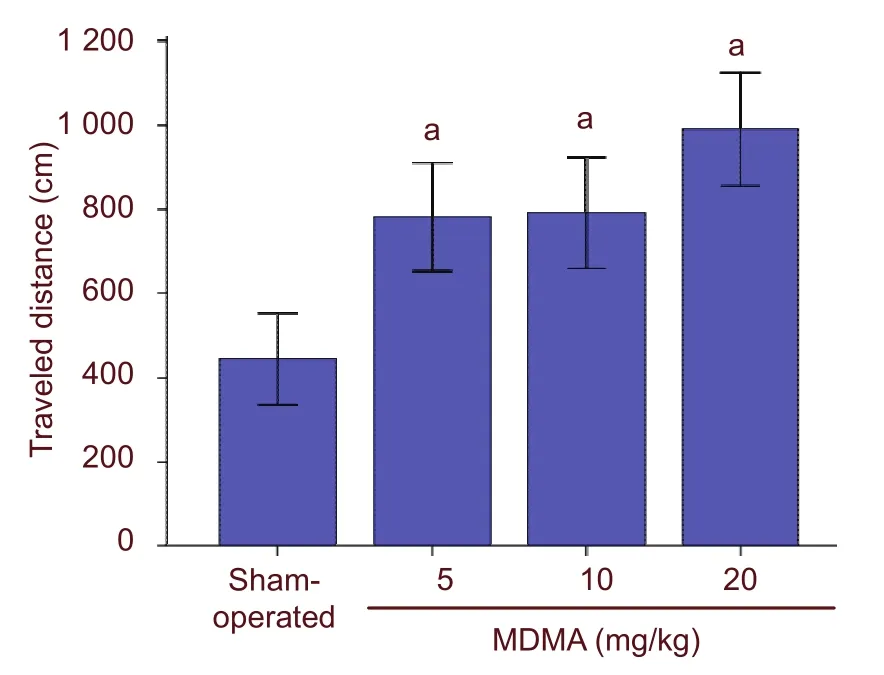
Figure 2 Swim distance to find the hidden platform(mean ± SEM) in sham-operated and 3,4-methylendioxymethamphetamine (MDMA) groups in the training days using Morris water maze. Data was analyzed using one-way analysis of variance followed by Tukey’s test for multiple comparisons. MDMA increased swim distance dose-dependently. aP < 0.001, vs.sham-operated group.
MDMA dose-dependently decreased the proportion of time spent in the target quadrant in the Morris water maze
Rats in the MDMA groups spent a significantly and dose-dependently lower proportion of time in the target quadrant (the quadrant in which the platform was located during the training days; a lower proportion of time spent in target quadrant indicates more severe spatial memory deficit) on the 3rdday of training period compared with the sham-operated group (all P < 0.001; Figure 3).

Figure 3 Time spent in target quadrant (%) (mean ±SEM) in sham-operated and 3, 4-methylendioxymethamphetamine (MDMA) groups in the training days by using Morris water maze. Data were analyzed using one-way analysis of variance followed by Tukey's test for multiple comparisons. MDMA decreased spent time in target quadrant. aP < 0.001, vs.sham-operated group.
Furthermore, the mean percentage of time spent in the target quadrant decreased in the 20 mg/kg MDMA group compared to the 5 and 10 mg/kg MDMA groups within 7 days after treatment, but this difference was not significant. There was no significant difference in the percentage of time spent in the target quadrant in the probe trials and visible trials in the MDMA groups compared with sham-operated group (data not shown).
Higher doses of MDMA caused higher mortality during treatment
Doses of 10 and 20 mg/kg of MDMA caused a significant increase in mortality compared with the sham-operated group [20% (2/10) and 40% (4/10) vs. 0, P < 0.05]. No deaths were observed in the 5 mg/kg MDMA group.
Effect of MDMA on body temperature
Prior to treatment, all groups exhibited an initial temperature of 36-37 °C. No increase in temperature was observed in rats at 1 hour after administration of normal saline. MDMA treatment with three different dosing regimens (5, 10, 20 mg/kg) increased rectal temperature at 1 h after drug exposure, in a dose-dependent manner (P < 0.001; Figure 4). In addition, there were significant differences between the 5 mg/kg MDMA group and the 10 and 20 mg/kg MDMA groups (P < 0.05).
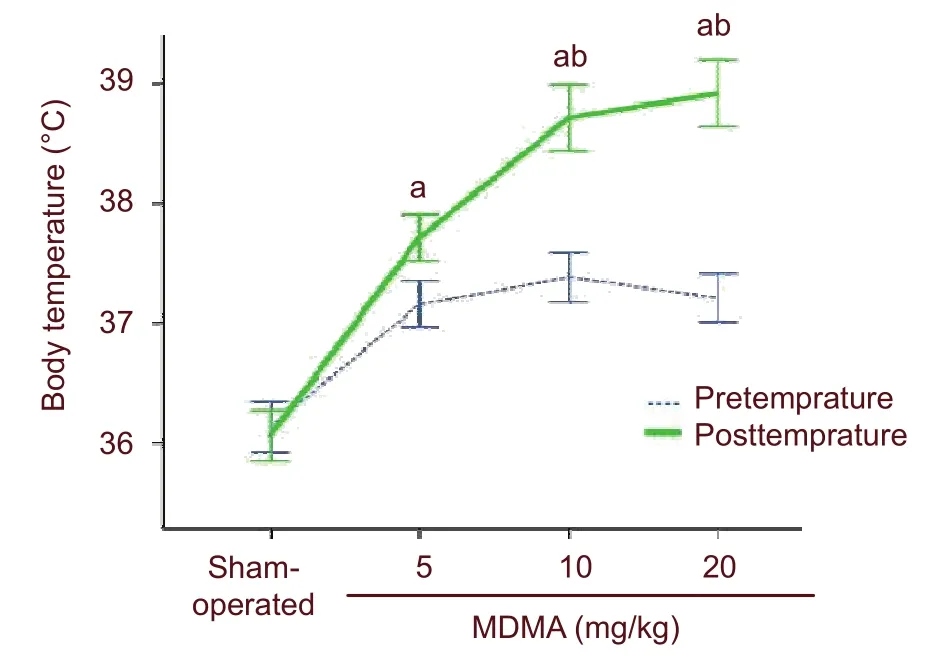
Figure 4 Body temperature (mean ± SEM) during 3,4-methylendioxymethamphetamine (MDMA)administration. MDMA resulted in significantly increased body temperature at 1 hour after dose-independent administration of MDMA. aP < 0.001, vs. sham-operated group; bP < 0.05, vs. 5 mg/kg MDMA group.
DlSCUSSlON
The current results revealed that MDMA administration with three different dosing regimens (5, 10 and 20 mg/kg)caused impairment of spatial memory in the Morris water maze. These results are consistent with those from Vorhess et al[13]that MDMA treatment in rats on postnatal days 11-20 induced spatial learning and reference memory deficits. Moreover, we found that exposure to high doses of MDMA caused stronger changes. This finding is also consistent with previous reports[10-11].
The key brain regions involved in navigation in the Morris water maze task include the striatum, the frontal cortex,and especially the hippocampus[14-15]. These regions are also susceptible to the serotonergic (5-HT) neurotoxicity that has been reported following MDMA administration in rats[16]. Taken together, the spatial processing deficits observed in the Morris water maze in MDMA-exposed rats may be related to 5-HT system impairments.
Melberg et al[17]demonstrated the importance of ambient temperature in the long-term depletion of 5-HT and 5-hydroxyindoleacetic acid following MDMA (20 or 40 mg/kg) exposure in rats. The current results revealed that MDMA administration induced hyperthermia in some rats, which is an important factor in MDMA-induced neurotoxicity. MDMA can result in homeostatic temperature dysregulation, preventing animals from maintaining a constant body temperature[13-18]. The effects of MDMA on body temperature are complex, and several factors have been found to influence the effect of the drug on body temperature in rats[19]. Hyperthermia induced by MDMA treatment was found to exhibit a more rapid onset after the first week of MDMA exposure compared to when the animals were native to the effects of MDMA[20]. In another study, a lower dose of MDMA(3 mg/kg) was reported to cause hypothermia after each subsequent injection, while a high MDMA dose (6 mg/kg)resulted in hyperthermia after the last injection[21]. from the current results indicated that MDMA caused a significant increase in mortality. All mortality in the experiment occurred either during the drug exposure period or shortly after the treatment, consistent with a study by Vorhees et al[10]reporting that MDMA caused a dose-dependent increase in mortality rate. MDMA can cause hyperthermia, which leads to rhabdomyolysis and death.
Overall, the present results revealed that MDMA impaired learning and memory, with higher doses causing more severe impairment. In addition, MDMA was found to cause dose-dependent increases in hyperthermia and mortality rate.
MATERlALS AND METHODS
Design
A randomized, controlled animal study.
Time and setting
All experiments were conducted at the Department of Anatomy, Tehran University of Medical Sciences between January and December 2010.
Materials
Animals
Forty male Sprague-Dawley rats, aged 8-11 months,weighting 200-250 g, were obtained from the Iranian Razi Institute. Rats were allowed to acclimatize to the colony room for 1 week prior to MDMA administration.
Rats were maintained in one colony room at a temperature of 21 ± 1°C (50 ± 10% humidity) on a 12-hour light-dark cycle with access to water and food ad libitum.
Drugs
MDMA was obtained from the Presidency Drug Control Headquarters, and solutions were made in sterile saline at a specific concentration, such that each group received 1 mL/kg drug solution or saline alone.
Methods
MDMA administration
MDMA groups that intraperitoneally received either 5, 10,20 mg/kg MDMA, twice daily for 1 week, with an 8-hour interval between the two administrations. The shamoperated group rats intraperitoneally received 1 mL/kg normal saline, twice daily, for 1 week. After the last administration, rats were maintained in the colony room for 1 week. The Morris water maze test was then conducted.
Morris water maze performance
A Morris water maze apparatus, consisting of a circular pool (136 cm in diameter, 60 cm in height), painted black,filled to a depth of 25 cm with water 22 ± 1°C, was used for assessing spatial memory[18]. The pool was divided into four quadrants with four starting locations, referred to as north (N), east (E), south (S) and west (W) at equal distances along the pool rim.
An invisible platform (10 cm diameter) constructed from Plexiglass was located 1 cm below the water in the center of northern quadrant. The animals were trained for 3 days at approximately the same time (10:00-12:00 a.m.) each day. Each training day included two blocks,with four trials. The time limit on each trial was 90 seconds. There was a 30-second period between two trials, which was spent on the platform. The rats were allowed to rest for 5 minutes between two consecutive blocks.
A video camera (Nikon, Melville, New York, USA) linked to a computer was mounted directly above the water maze pool to record the time taken to reach the hidden platform (the escape latency), the length of swim path(the traveled distances) and percentage of spent time in target quadrant for each rat. The day after the last learning trial, each rat was given a single 60-second probe trial and visible test. In probe trials, no platform was present. In the visible trials, the platform was covered with aluminum foil[15].
Temperature monitoring
Because hyperthermia has been implicated in many previous studies as a significant component of MDMA-induced neurotoxicity[21], animals were hyperthermic before drug administration. Rectal temperature was monitored 30 minutes before and 1 hour after treatment using a digital thermometer (Flex Temp ?, Omeron, Veghel, the Netherland) following the protocol outlined by the manufacturer.
Statistical analysis
The data were presented as mean ± SEM. The escape latency, swim distance and percentage of spent time in target quadrant in Morris water maze and mortality were analyzed by one-way analysis of variance. Post-hoc comparisons were performed using Tukey’s tests. Body temperature was analyzed using two-way analyses of variance and two-way repeated measurements.
P-values ≤ 0.05 were considered statistically significant.
Author contributions:Sara Soleimani Asl participated in study design, conducting the experiment and writing manuscript. Mehdi Mehdizadeh was responsible for funding, and provided technical assistance and manuscript revision. Nasser Naghdi and Samira Choopani conducted the Morris water maze experiments, and participated in data collection and analysis. Mohammad Hosein Farhadi participated in the study design. Alireza Samzadeh-Kermani participated in MDMA preparation.
Conflicts of interest:None declared.
Funding:This research was supported by a grant from the Substance Abuse and Dependence Research Center University of Social Welfare and Rehabilitation Sciences, No. 313-126417 and Tehran University of Medical Sciences, No. P/664.
Ethical approval:The study gained full approval from Animal Ethics Committee of Tehran University of Medical Sciences.
[1]Fcology arre M, Mathuna BO, Roset PN, et al. Repeated doses administration of MDMA in humans: pharmacological effects and pharmacokinetics. Psychopharma (Berl). 2004;173(3-4):364-375.
[2]Simantov R, Tauber M. The abused drug MDMA (Ecstasy)induces programmed death of human serotonergic cells. FASEB J.1997;11(2):141-146.
[3]Kalechstein AD, De La GR, Mahoney JJ, et al. MDMA use and neurocognition: a meta-analytic review. Psychopharmacology(Berl). 2007;189:531-537.
[4]Able JA, Gudelsky GA, Vorhees CV, et al. 3, 4-methylenedioxymethamphetamine in adult rats produces deficits in path integration and spatial reference memory. Biol Psychiatry.2006;59:1219-1226.
[5]Bolla KI, McCann UD, Ricaurte GA. Memory impairment in abstinent MDMA ("Ecstasy ") users. Neurology. 1998;51:1532-1537.
[6]Klugman A, Gruzelier J. Chronic cognitive impairment in users of'ecstasy' and cannabis. World Psychiatry. 2003;2:184-190.
[7]Zakzanis KK, Campbell Z. Memory impairment in now abstinent MDMA users and continued users: a longitudinal follow-up.Neurology. 2006;66:740-741.
[8]Piper BJ, Meyer JS. Memory deficit and reduced anxiety in young adult rats given repeated intermittent MDMA treatment during the periadolescent period. Pharmacol Biochem Behav. 2004;79:723-731.
[9]Piper BJ, Fraiman JB, Meyer JS. Repeated MDMA ("Ecstasy")exposure in adolescent male rats alters temperature regulation,spontaneous motor activity, attention, and serotonin transporter binding. Dev Psychobiol. 2005;47:145-157.
[10]Vorhees CV, Schaefer TL, Skelton MR, et al. (+/-) 3, 4-methylenedioxymethamphetamine (MDMA) dose-dependently impairs spatial learning in the morris water maze after exposure of rats to different five-day intervals from birth to postnatal day twenty. Dev Neurosci. 2009;31:107-120.
[11]Sprague JE, Preston AS, Leifheit M, et al. Hippocampal serotonergic damage induced by MDMA (ecstasy): effects on spatial learning. J Pharmacol Exp Ther. 2003;305:159-166.
[12]Vorhees CV, He E, Skelton MR, et al. Comparison of(+)-methamphetamine, ±-methylenedioxymethamphetamine,(+)-amphetamine and ±-fenfluramine in rats on egocentric learning in the Cincinnati water maze. Synapse. in press.
[13]Vorhees CV, Reed TM, Skelton MR, et al. Exposure to 3, 4-methylenedioxymethamphetamine (MDMA) on postnatal days 11-20 induces reference but not working memory deficits in the Morris water maze in rats: implications of prior learning. Int J Dev Neurosci. 2004;22:247-259.
[14]Mogensen J, Pedersen TK, Holm S, et al. Prefrontal cortical mediation of rats' place learning in a modified water maze. Brain Res Bull. 1995;38:425-434.
[15]Morris RG, Garrud P, Rawlins JN, et al. Place navigation impaired in rats with hippocampal lesions. Nature. 1982;297:681-683.
[16]Sprague JE, Everman SL, Nichols DE. An integrated hypothesis for the serotonergic axonal loss induced by 3, 4-methylenedioxymethamphetamine. Neurotoxicology. 1998;19(3):427-441.
[17]Malberg JE, Seiden LS. Small changes in ambient temperature cause large changes in 3, 4-methylenedioxymethamphetamine(MDMA)-induced serotonin neurotoxicity and core body temperature in the rat. J Neurosci. 1998;18(13):5086-5094.
[18]Navarrete M, Nunez H, Ruiz S, et al. Prenatal undernutrition decreases the sensitivity of the hypothalamo-pituitary-adrenal axis in rat, as revealed by subcutaneous and intra-paraventricular dexamethasone challenges. Neurosci Lett. 2007;419(2):99-103.
[19]Docherty JR, Green AR. The role of monoamines in the changes in body temperature induced by 3, 4-methylenedioxymethamphetamine (MDMA, ecstasy) and its derivatives. Br J Pharmacol. 2010;160(5):1029-1044.
[20]Skelton MR, Able JA, Grace CE, et al. (±)-3, 4-Methylenedioxymethamphetamine treatment in adult rats impairs path integration learning: A comparison of single versus once per week treatment for five weeks. Neuropharmacology. 2008;55(7):1121-1130.
[21]Rodsiri R, Spicer C, Green AR, et al. Acute concomitant effects of MDMA binge dosing on extracellular 5-HT, locomotion and body temperature and the long-term effect on novel object discrimination in rats. Psychopharmacology (Berl). in press.
- 中國神經再生研究(英文版)的其它文章
- Meta-analysis of transcranial magnetic stimulation to treat post-stroke dysfunction○
- Correlation of E-selectin gene polymorphisms with risk of ischemic stroke A meta-analysis☆
- Penehyclidine hydrochloride attenuates cerebral vasospasm after subarachnoid hemorrhage☆
- Hypothermic intervention for 3 hours inhibits apoptosis in neonatal rats with hypoxic-ischemic brain damage★
- Expression of nerve growth factor precursor, mature nerve growth factor and their receptors during cerebral ischemia-reperfusion injury*☆
- Role of the nerve growth factor precursor-neurotrophin receptor p75 and sortilin pathway on apoptosis in the brain of patients with intracerebral hemorrhage*☆