
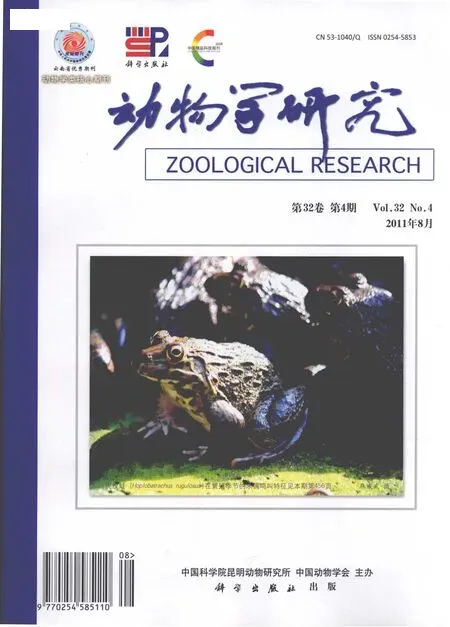
Acoustic characteristics of the tiger frog, Hoplobatrachus rugulosus, during the breeding season
2011-12-25 01:02:48WEILiLINZhiHuaMAXiaoMeiZHAOLiHuaMAXiaoHao
Zoological Research 2011年4期
WEI Li, LIN Zhi-Hua,, MA Xiao-Mei, ZHAO Li-Hua, MA Xiao-Hao
(1. School of Chemistry and Life Sciences, Lishui University, Lishui 323000, China; 2. School of Life and Environmental Sciences, Hangzhou Normal University, Hangzhou 310036, China)
Acoustic characteristics of the tiger frog,Hoplobatrachus rugulosus, during the breeding season
WEI Li1, LIN Zhi-Hua1,*, MA Xiao-Mei2, ZHAO Li-Hua2, MA Xiao-Hao2
(1.School of Chemistry and Life Sciences,Lishui University,Lishui323000,China; 2.School of Life and Environmental Sciences,Hangzhou Normal University,Hangzhou310036,China)
We recorded and described the calls and acoustic characteristics of the male tiger frog,Hoplobatrachus rugulosus, in an artificial pond during mating season. Spectral and temporal call parameters, along with call intensity were analyzed. Three harmonics were distinguishable from the spectrogram. Four patterns of dominant frequency were found in calls produced late at night, i.e, 3 patterns in the first harmonic (located in 500 Hz section, 700 Hz section, and 800 Hz section respectively) and 1 in the second harmonic (located in 1 800 Hz section). Call duration, call duty cycle, call intensity, and pulse rate were highly variable among different patterns of dominant frequency. These call properties could provide valuable evidence for further ecological study of this species.
Anuran; Advertisement call;Hoplobatrachus rugulosus; Mating season
Acoustic signaling is the most important form of communication in anuran amphibians (frogs and toads). This is especially true for males during breeding season as the sounds they emit are sexual advertisement signals (Lingau & Bastos, 2007). Research on the functions of such male anuran calls have concentrated on three main areas: 1) How do calls provide females with information for identifying conspecific males; 2) How do females choose their mate among conspecific males; and 3) How is spatial separation between individual males maintained after a male announces the occupation of a territory to other males (Gerhardt, 1994; Halliday & Tejedo, 1995; Krishna & Bosch, 2007; Ryan & Rand, 1993; Tárano, 2001; Wells, 1977). Male anurans may emit a unique species-specific advertisement call to enable females to identify and select conspecific males (Krishna & Bosch, 2007; Lea et al, 2002; McClelland et al, 1996), and females often decide which male to mate with based onthe quality and structure of the advertisement calls (Gerhardt, 1994; Pr?hl, 2003; Yu & Zheng, 2009). Sexual selection among frogs favors males that display at lower frequencies, higher rates, longer durations, greater intensities, and with greater complexity than other males (Bee et al, 1999; Howard & Young, 1998; Pr?hl, 2003; Wagner, 1989) and optimize call transmission through the environment and enhance call attractiveness to females (Krishna & Bosch, 2007; McClelland et al, 1996). Due to their species-specificity, anuran advertisement calls have been used as a diagnostic tool for clarifying taxonomy of closely related species (Abrunhosa et al, 2005; Jiang et al, 1995; Jiang et al, 2002; Nunes et al, 2007; Xu et al, 2005; Yu & Zheng, 2009). However, call properties of anurans are influenced by factors such as air temperature, body temperature, body size and weight, and interactions among individuals (Giacoma et al, 1997; Howard & Young, 1998; Navas & Bevier, 2001; Pr?hl, 2003; Yu & Zheng, 2009). The acoustic properties of different anuran calls is important in understanding the behavior and evolution of communication and to provide the most comprehensive information on how to separate different call types between species (Krishna & Bosch, 2007).
The tiger frog,Hoplobatrachus rugulosus, is usually found in farmland across South and Southeast Asia. It has been recorded in the Chinese provinces of Hubei, Anhui, Zhejiang, Fujian, Guangdong, Hunan, Guangxi, Guizhou, Jiangxi, Jiangsu, Yunnan, Taiwan, Hainan, Sichuan, Shanghai, Shaanxi, and Henan (Fei et al, 2009). Due to the belief thatH. rugulosushas highly nutritional and medicinal values, a large number of individuals have been captured and killed in the last twenty years, despite its listing as a grade Ⅱ national protection animal in China. The mating season ofH. rugulosusis from April to August (Fei et al, 2009, 2010). Previous studies of the mating behavior ofH. rugulosushave identified sexual dimorphism in morphological traits and diet composition (Lin & Ji, 2005; Shao, 2007), body condition index (Wang et al, 2008), feeding habits and behavior (Geng et al, 2002), and genetic diversity (Liu et al, 2005). However, little is known about the call properties of this species. The aim of this study was to describe the spectral and temporal parameters of the advertisement call ofH. rugulosus.
1 Material and Methods
All work was conducted at the herpetological laboratory of Lishui University, Zhejiang province, August 12thto 17th, 2010. We selected a group of 20 female adults and 20 male adults and placed them in an artificial pond (3 m×2 m×1 m). According to our observations,H. rugulosusmainly produced mating calls at three different times during the day: from 11:00 to 14:00, 16:00 to 19:00, and 01:00 to 04:00. Due to the frogs producing sounds intermittently, it was difficult to monitor calls successfully between 11:00 to 14:00 and 16:00 to 19:00. Consequently, we recorded advertisement calls emitted by the 20 males for five nights (August 12thto 15thand August 17th) between 01:00 – 04:00. An external directional microphone was held at an approximate distance of 1-2 m from the males and calls were recorded by a Sony IC recorder (ICD-SX950). A total of 52 sound files were recorded successfully. Due to the difficulty in recording the calls and body temperatures of individual males simultaneously, , all sound files representing the 20 males were combined. All sound files were digitized and analyzed using Praat, version 5.1.4.3, at a sampling frequency resolution of 44 100 Hz and 16 bit resolution. Call parameters were defined and illustrated based on Pr?hl (2003) and Yu & Zheng (2009). Wide band spectrograms were used to measure dominant frequency (including the first harmonic, second harmonic, and third harmonic frequency). Ten calls in each call sequence within a sound file were analyzed and the following call properties were measured: call duration (ms), call intensity (dB), duty cycle (ms/s), first harmonic frequency (Hz), second harmonic frequency (Hz), third harmonic frequency (Hz), dominant frequency (DF, Hz), and pulse rate (pulses/ms). As amplitude was lower at the beginning than the remaining of the call sequence, the first 10 calls of every call sequence were omitted from the analysis as per Pr?hl (2003).
Statistical analyses were performed with SPSS 11.5 for windows. All data were tested for normality (Kolmogorov-Smirnov test) and homogeneity of variances (F-max test). Data were analyzed with one way ANOVA. All values were presented as mean±1 standard deviation (SD), and the significance level was set atα= 0.05.
2 Results
Oscillograms and spectrograms ofH. rugulosuscalls are shown in Fig. 1 and Fig. 2. The calls recorded during this study were highly variable across nights (Tab. 1). Three harmonics were clearly discernible from the spectrograms. The males mainly produced four call frequency patterns during the mating period: dominant frequencies were located in the 500 Hz section (Type Ⅰ, Fig.2 A), 700 Hz section (Type Ⅱ, Fig.2 B), 800 Hz section (Type Ⅲ, Fig.2 C) of the 1stharmonic and the over 1 800 Hz section of the 2ndharmonic (Type Ⅳ, Fig.2 D). For Type Ⅰ, the call frequency ranged from 521.16 to 686.41 Hz in the 1stharmonic, 1 843.18 to 2 483.53 Hz in the 2ndharmonic, and 2 772.72 to 4 012.11 Hz in the 3rdharmonic, while Type Ⅱ ranged from 707.07 to 748.38 Hz, 1 471.36 to 2 049.74 Hz and 2 359.59 to 3 475.04 Hz. The dominant frequency in Type Ⅲ ranged from 810.35 to 851.66 Hz, 1 388.73 to 2 843.53 Hz and 2380.25 to 3 722.92 Hz, whereas in Type Ⅳ ,it ranged from 500.50 to 975.6 Hz, 1 553.99 to 2 049.74 Hz, and 2937.97 to 3 748.53 Hz (Tab. 1). Among all pairwise comparisons of the four call groups, both frequency of the 1stharmonic and dominant frequency were significantly different (Tab. 1). For frequency of the 2ndharmonic, except for comparisons of between Type Ⅰand Type Ⅱ , Type Ⅱand Type Ⅳ, all other pairwise comparisons were significantly different (Tab. 1). Likewise, except for comparisons of between Type Ⅰand Type Ⅲ, and Type Ⅲ and Type Ⅳ, all other pairwise comparisons were significantly different in frequency of the 3rdharmonic (Tab. 1).

Fig. 1 Oscillogram of Hoplobatrachus rugulosus advertisement calls

Fig. 2 Spectrogram of Hoplobatrachus rugulosus advertisement calls

Tab. 1 Characters of the advertisement calls of Hoplobatrachus rugulosus
Pairwise comparisons of call duration, duty cycle, call intensity, and pulse rate were also different among the four call groups (Tab. 1). Call duration was significantly different between comparisons of Type Ⅱand Type Ⅲ, and Type Ⅱ and Type Ⅳ (Tab. 1). For duty cycle, except for comparisons of between Type Ⅱand Type Ⅲ, Type Ⅱ and Type Ⅳ, all other pairwise comparisons were not significantly different (Tab. 1). For pulse rate, except for comparisons between Type Ⅰand Type Ⅱ, all other pairwise comparisons showed significant differences (Tab. 1). For call intensity, except for comparisons of between Type Ⅰ and Type Ⅲ, TypeⅢ and Type Ⅳ, all other pairwise comparisons showed significant differences (Tab. 1).
3 Discussion
Characteristics of anuran male calls are important for mate attraction, female mate choice, and male mating success (Pr?hl, 2003). Not only do calls and reproductive behavior allow us to understand how selection has shaped (and is shaping) a species’ ecology, but anuran vocalization is also a tool for monitoring and is therefore useful in conservation. Advertisement calls in anurans are distinctive and are used in species-specific acoustic communication (Wells, 1977). In this present work,Hoplobatrachus rugulosusproduced multi-harmonic (comprising of over three harmonics) modulated frequency (FM) calls during the breeding season at night, a type of call commonly seen in anurans (Fig.1). The advertisement calls ofH. rugulosuswere highly variable in dominant frequency. Four patterns of dominant frequency calls occurred during courtship: three in the 1stharmonic frequency (500 Hz, 700 Hz and 800 Hz) with the fourth in the 2ndharmonic. This high variation in dominant frequency late at night may be due to an increase in mating calls. As male-male congregate choruses for attracting females were frequently heard,H. rugulosusmay produce mating calls in a courtship field. As anurans court and mate with females at night (Gerhardt, 1994; Wells, 1977), calls produced during this time may be concentrated on breeding success. This calling behavior requires further study in the field.
For temporal parameters, call duration, call duty cycle, and pulse rate along with call intensity, also showed significant differences among the four types of calls. Individuals produced calls of various temporal features at courtship fields for mate attraction at night. As call duration and call duty cycle are strong predictors of energy expense, this may be an indicator of fitness and therefore play a role in female selectivity (Grafe, 1996; Welch et al, 1998). Other studies have also documented that female frogs prefer to mate with males who emit longer calls with high duty cycles (Navas & Bevier, 2001; Pr?hl, 2003). In this study, pulse rate seemed to be higher in the 1stharmonic frequency than the 2ndharmonic frequency: that is, the lower the dominant frequency, the higher the pulse rate. This suggests that environment variation, as well as the physical condition of male frogs, may be influencing calling behavior. On the other hand, environmental disturbance (such as factitious disturbance and natural enemies) emerged beside the pond and therefore the frogs may have produced more call pulses and more patterns of dominant frequency to detect circumambient complexion. In addition, we found call intensity also showed significant difference among the four patterns of dominant frequency calls. We also recorded various clangorous click calls late at night. This calling behavior also requires further study.
In this present work, we recorded and described the characteristics of advertisement calls ofH. rugulosusin a man-made pond, and obtained ecological information of this species. Further work needs to be carried out to determine the level of call variation in individual males and between males, female preference and mating success.
Acknowledgements:We thank Prof. JI Xiang (Nanjing Normal University) and Jon Flanders (School of Biological Sciences, University of Bristol, UK) for their constructive comments on a previous version of this manuscript.
Abrunhosa PA, Pimenta BVS, Cruz CAG, Haddad CFB. 2005. Advertisement calls of species of theHyla albosignatagroup (Amphibia, Anura, Hylidae) [J].Arq Mus Nac: Rio de Janeiro,62: 275-282.
Bee MA, Perrill SA, Owen PC. 1999. Size assessment in simulated territorial encounters between male green frogs (Rana clamitans) [J].Behav Ecol Sociobiol, 45: 177-184.
Fei L, Hu SQ, Ye CY, Huang YZ. 2009. Fauna Sinica: Amphibia:Vol. 2: Anura [M]. Beijing: Science Press.
Fei L, Ye CY, Jiang JP. 2010. Colored Atlas of Chinese Amphibians [M]. Chengdu: Sichuan Science and Technology Press.
Geng BR, Ke FJ, Liu ZB. 2002. The study of feeding habits and behaviour ofHoplobatrachus rugulosa, [J].J Fujian Teach Univ:Nat Sci Ed, 18: 73-76 (in Chinese).
Gerhardt HC. 1994. The evolution of the vocalization in frogs and toads [J].Annu Rev Ecol Evol S, 25: 293-324.
Giacoma C, Zugolaro C, Beani L. 1997. The advertisement calls of the green toadBufo viridis: Variability and role in mate choice [J].Herpetologica, 53: 454-464.
Grafe TU. 1996. Energetics of vocalization in the African reed frog (Hyperolius marmoratus) [J].Comp Biochem Phys A, 114: 235-243.
Halliday T, Tejedo M. 1995. Intrasexual Selection and Alternative Mating Behavior[M]// Heathole, H & Sullivan BK. Amphibian Biology, Social Behavior: Vol. 2. Chipping Norton: Surrey Beatty & Sons.
Howard RD, Young JR. 1998. Individual variation in male vocal traits and female mating preferences inBufo americanus[J].Anim Behav, 55: 1165-1179.
Jiang JP, Xie F, Fei L, Ye CY, Zheng M, 2002. Mating calls of six forms of pleobatid in Wa Wu Mountain National Forest Park, Sichuan, China (Anura: Pelobatidae) [J].Zool Res, 23: 89-94(in Chinese).
Jiang SR, Ding P, Zhuge Y. 1995. The comparative study on the characteristics of calling songs of three frog species [J].Zool Res, 16: 75-81 (in Chinese).
Krishna SN, Bosch J. 2007. The breeding behaviour and advertisement calls of the tree-hole breeding frogRamanella montana( Microhylidae) in the Western Ghats, S. India [J].Acta Zool Sin, 53: 575-578.
Lea J, Dyson M, Halliday T. 2002. Phonotaxis to advertisement calls by midwife toads is not necessarily related to mating [J].Amphibia-Reptelia, 23: 151-159.
Lin ZH, Ji X. 2005. Sexual dimorphism in morphological traits and food habits in tiger frogs,Hoplobatrachus rugulosusin Lishui, Zhejiang [J].Zool Res, 26: 255-262 (in Chinese).
Lingau R, Bastos RP. 2007. Vocalizations of the Brazilian torrent frogHylodes heyeri(Anura: Hylodidae): Repertoire and influence of air temperature on advertisement call variation [J].J Nat Hist, 41: 1227–1235.
Liu L, Liu CW, Lin D, Liang WF. 2005. Comparison of genetic diversity between frogRana tigrina rugulosaand frogR. tigrina cantor[J].Fish Sci, 24: 31-33 (in Chinese).
McClelland BE, Wilczynski W, Ryan MJ. 1996. Correlations between call characteristics and morphology in male cricket frogsAcris crepitans[J].J Exp Biol, 99: 1907-1919.
Navas C, Bevier CR. 2001. Thermal dependency of calling performance in the eurythermic frogColostethus subpunctatus[J].Herpetologica, 57: 384-395.
Nunes I, Sampaio RS, Junca FA. 2007. Advertisement calls of four Hylid frogs from the state of Bahia, Northeastern Brazil (Amphibia, Anura, Hylidae) [J].S Am J Herpetol, 2: 89-96.
Pr?hl H. 2003. Variation in male calling behaviour and relation to male mating success in the strawberry poison frog (Dendrobates pumilio) [J].Ethology, 109: 273-290.
Ryan MJ, Rand AS. 1993. Species recognition and sexual selection as a unitary problem in animal communication [J].Evolution, 47: 647-657.
Shao C. 2007. Feeding habits and nutritional niche of tiger frog [J].J Zhejiang Norm Univ:Nat Sci Ed, 30: 135-139 (in Chinese).
Tárano Z. 2001. Variation in male advertisement calls in the neotropcial frogPhysalaemus enesefae[J].Copeia, 4: 1064-1072.
Wagner WE. 1989. Graded aggressive signals in Blanchard's cricket frog: vocal responses to opponent proximity and size [J].Anim Behav, 38: 1025-1038.
Wang Y, Shao C, Wang XT. 2008. A study on relative fatness of tiger frog (Hoplobatrachus rugulosus) in Zhejiang Province [J].Ecol Sci, 27: 490-493 (in Chinese).
Welch AM, Semlitsch RD, Gerhardt HC. 1998. Call duration as an indicator of genetic quality in male gray tree frogs [J].Science, 280: 1928-1930.
Wells KD. 1977. The social behavior of anuran amphibians [J].Anim Behav, 25: 666-693.
Xu JX, Xie F, Jiang JP, Mo YM, Zheng ZH. 2005. The acoustic features of the mating call of 12 anuran species [J].Chn J Zool, 40: 12-19 (in Chinese).
Yu BG, Zheng RQ. 2009. The advertisement call of the giant spiny frogPaa spinosa[J].Curr Zool, 55: 411-415.
虎紋蛙繁殖季節(jié)的求偶鳴叫特征
韋 力1, 林植華1,*, 馬小梅2, 趙麗華2, 馬小浩2
(1. 麗水學(xué)院 化學(xué)與生命科學(xué)學(xué)院, 浙江 麗水 323000; 2. 杭州師范大學(xué) 生命與環(huán)境科學(xué)學(xué)院, 浙江 杭州 310036)
對(duì)交配季節(jié)虎紋蛙求偶鳴叫進(jìn)行錄制和特征分析。分析結(jié)果表明, 虎紋蛙求偶鳴叫主要集中在晚上, 求偶鳴叫聲音主要含有3個(gè)鳴叫諧波, 鳴叫主頻率共有4種類(lèi)型, 即在第一諧波上有3個(gè)主頻率段, 分別為500、700和800 Hz段, 在第二諧波上有1個(gè)主頻率段, 即1 800 Hz段。鳴叫時(shí)程(call duration)、能環(huán)率(call duty cycle)、聲強(qiáng)(call intensity)和鳴叫脈沖率(pulse rate)在 4種主頻率中變化很大。這些鳴叫參數(shù)特征的分析將對(duì)虎紋蛙生理生態(tài)學(xué)的進(jìn)一步研究提供有價(jià)值的基礎(chǔ)數(shù)據(jù)。
無(wú)尾類(lèi); 虎紋蛙; 求偶鳴叫; 交配季節(jié)
Q959.53; Q62
A
0254-5853-(2011)04-0456-05
2010-11-05;接受日期:2011-05-10
韋力(1979-),男,博士,主要從事動(dòng)物生態(tài)及種群遺傳學(xué)研究;E-mail: weiliweili2007@163.com
10.3724/SP.J.1141.2011.04456
date: 2010-11-05; Accepted date: 2011-05-10
s: National Natural Science Foundation of China (30770310, 30970435); Zhejiang Provincial Natural Science Foundation of China (Y307453)
*Corresponding author (通信作者), E-mail: zhlin1015@126.com
猜你喜歡
科學(xué)大眾(2023年17期)2023-10-26 07:38:38
幼兒畫(huà)刊(2022年11期)2022-11-16 07:22:36
考試與評(píng)價(jià)·高二版(2021年5期)2021-09-10 07:22:44
中國(guó)交通信息化(2021年4期)2021-07-21 09:23:34
非公有制企業(yè)黨建(2020年9期)2020-09-26 13:22:18
瘋狂英語(yǔ)·新策略(2018年1期)2018-08-20 07:50:38
領(lǐng)導(dǎo)決策信息(2017年12期)2017-05-17 04:49:18
傳媒評(píng)論(2017年12期)2017-03-01 07:04:58
汽車(chē)與安全(2016年5期)2016-12-01 05:21:55
中國(guó)衛(wèi)生(2016年7期)2016-11-13 01:06:44
- Zoological Research的其它文章
- 鄭氏比蜢線粒體基因組全序列的測(cè)定與分析
- Localization of stationary pronuclei during conjugation of Paramecium as indicated by immunofluorescence staining
- 一種有效區(qū)分移植細(xì)胞和宿主細(xì)胞腦損傷模型的建立
- 懸尾應(yīng)激對(duì)小鼠空間記憶及其反轉(zhuǎn)學(xué)習(xí)的損傷效應(yīng)
- Metabolism and thermoregulation between Mrs Hume’s Pheasant (Syrmaticus humiae) and Elliot’s Pheasant (S. ellioti)
- Notch signaling dependent differentiation of cholangiocyte-like cells from rhesus monkey embryonic stem cells