
Determination of the Dose of PAC in Ultrafiltration System for Drinking Water Treatment
2012-02-07 07:46:58LINTaoPANShaolin潘少林CHENWeiLILiang
LIN Tao(林 濤),PAN Shao-lin(潘少林),CHEN Wei(陳 衛),LI Liang(李 亮)
1 Key Laboratory of Integrated Regulation and Resource Development on Shallow Lakes,Ministry of Education,Hohai University,Nanjing 210098,China
2 College of Environment,Hohai University,Nanjing 210098,China
Introduction
Following the deterioration of the drinking water sources,the quality of the feed water gets more and more attention.In this way,the drinking water treatment process of running-water company must be upgraded.The third generation of drinking water treatment process[1]-ultrafiltration(UF)process can meet the requirements.UF membrane filtration is a reliable and accepted means of treating drinking water for producing better quality water,which is effective for the removal of particles,microorganisms,and natural organic matter(NOM)[2-6].Meanwhile,UF membrane filtration technology meets multiple water quality objectives with a smaller footprint than conventional water treatment technologies[7].
However,the low permeabilitycaused by membrane fouling has become one of the central subjects in the wide application of the membrane separation technology.Therefore,scholars have been exploring the pre-treatment methods to alleviate membrane fouling.Pre-treatment of feed water by coagulation,adsorption,ion exchange,and chemical oxidation has been investigated extensively[8,9].
Powdered activated carbon(PAC)in combination with UF was a promising water treatment option,particularly when seeking the safe control of cyanobacteria and associated toxins.UF was a safe barrier against cyanobacteria and PAC was efficient in microcrystal removal[10].PAC was able to compete with the membrane for the NOM compounds and then reduce NOM adsorption on the membrane surface and/or pores.However,some contradictory results are involved in the PAC effect on the membrane fouling.Some literatures reported an improvement of permeate flux,longer filtration or a reduced frequency of chemical washing[11-13].Others presented similar flux behavior[14,15]or exacerbated flux decline[16,17].The PAC affecting on membrane fouling seemed to be a function of the membrane characteristics.The study of Mozia[18]showed that PAC reduced or did not affect the flux decline of hydrophilic membranes,but it was not effective or worsened the flux of the hydrophobic membranes.Raw water diversity was also used to explain the contradictory ofPAC affecting on membrane fouling.In this paper,PAC pretreatment combined with UF was used to analyze the impact of dosing PAC on the organic matter removal. In addition,UF membrane fouling was also considered during the elimination oforganic matter.The Yangtze River was served as water source to optimize the doses of PAC in submerged UF system,and in this way the research would be more significant.
1 Materials and Methods
1.1 Raw water characteristics
The feed water in this study was taken from the Yangtze River,and served as the raw water supplyfor this UF application.A summary of raw water quality was shown in Table 1.
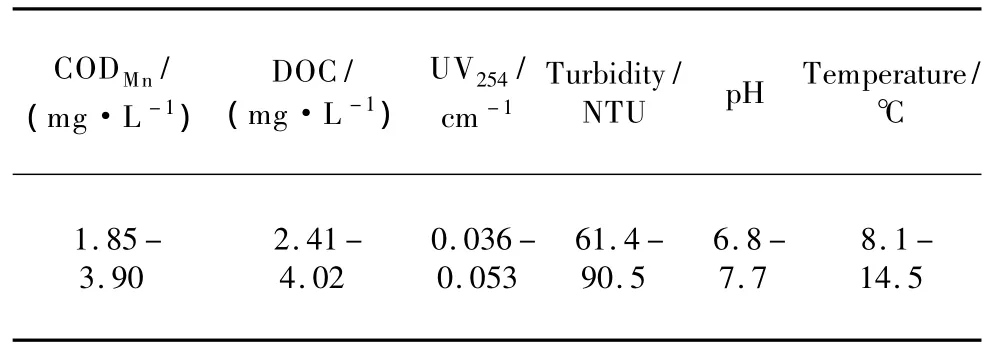
Table 1 The raw water quality
1.2 UF experiments
An explanatory sketch of the UF facility was shown in Fig.1.The raw water was pre-treated by the online coagulation before entering the pool of submerged membrane.The raw water mixed with flocculants and then directly flowed into the membrane tank.The flocculants used in this study are aluminum chlorides and the concentration of dosage is 15 mg/L.UF experiments used a hollow-fiber PVC alloy membrane from LITREE(outside-in configuration).This UF hydrophilic membrane with a nominal pore size of 0.01 μm and a total membrane area of 0.133 m2were employed in the immersed membrane system,which was specified in Table 2.Intermittent aeration was provided at the bottom of the membrane tank to generate strong turbulence for membrane scouring.
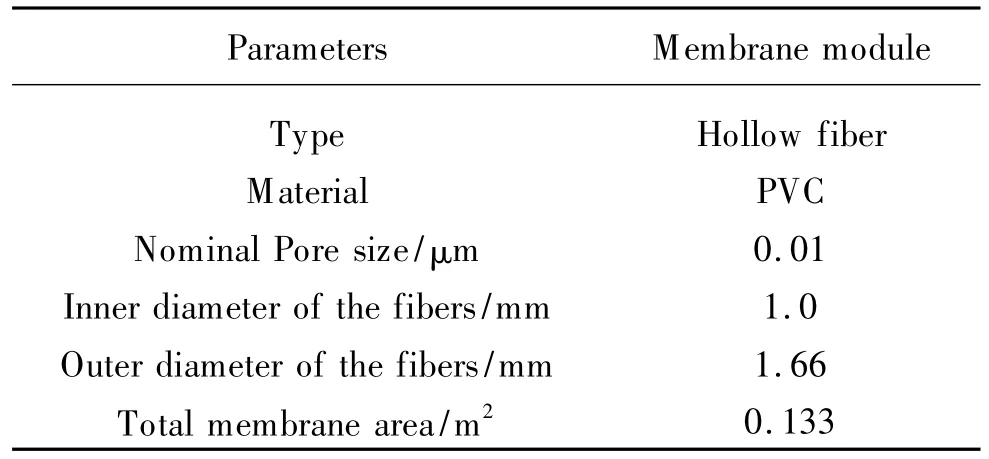
Table 2 The physical characteristics of the UF membrane module
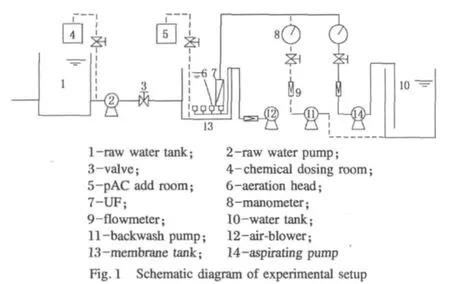
Membrane units were operated at constant flux(30 L/(m2·h))and variable TMP with 12 h backwashing cycle.The effluent suction pump was controlled by a timer based on a time sequence of 45 min and 50 s off for aeration.The air was intermittently supplied at the bottom of the membrane tank through a diffuser with a flow rate of 25 m3/h.PAC was provided by Shanxi Xinhua Chemical Co.,Ltd.,China.The membrane was washed,flushed,and compacted with Deionized water(DI)until achieved a steady permeates flux.
1.3 Analytical method
Waterquality analysis was conducted following the standard methods.pH was determined by using the pH meter(WTW 340pH meter),turbiditywasmonitoredbya turbidimeter(HACH2100P type portable turbidity meter),DOC was measured by TOC-VCPH type,and UV absorbance at 254 nm(UV254)was determined by using the spectrometer(UV-2550 UV visible spectrophotometer,Japan),whenever application depending on the objective of the experimental run.The DOC concentration and the UV absorbance were both measured on filtered samples(0.45 μm acrodisks).
2 Results and Discussion
2.1 Optimization of the PAC dosage in the UF system
2.1.1 The effect of PAC on removing organic matter
PAC was expected to compete with the UF membrane for the adsorption of NOM compounds,which would adsorb on the membrane surface and pores to cause the increase of applied pressure.DOC,UV254,and CODMnin the raw water were 3.07 mg/L,0.043 cm-1,and 2.88 mg/L,respectively during the test.In order to verify the influence of the PAC dose on the rejection performance of the investigated PAC/UF process,the doses were carried out as follows:0,10,20,30,40,50,60,70,80,90,and 100 mg/L;each dosage was operated for two days and then online-chemical clean made the transmembrane pressure back to the initial value.The effluents of DOC,UV254,and CODMnwere determined.The results of NOM rejection obtained with and without PAC addition were depicted in Fig.2.
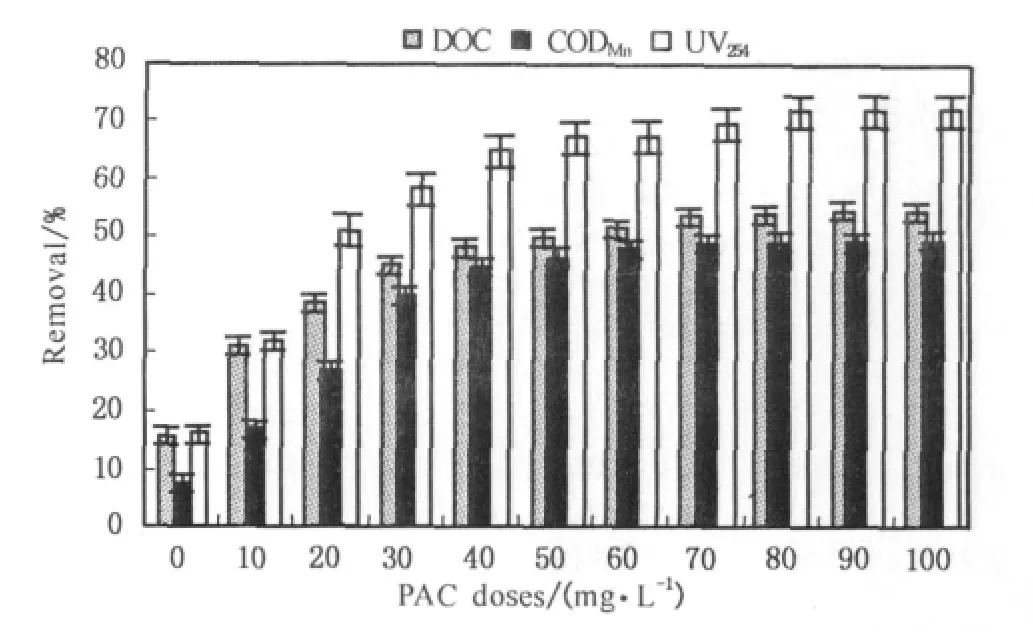
Fig.2 Effects of PAC dosage on the removal of organic matter
The data demonstrated that it could improve organics removal efficiency and adsorption level by increasing PAC dose.The reason was probablyassociated with the PAC absorbing organic matterby itslarge surfacearea.The adsorption of organic matters was represented by UV254,while the removal effect of DOC,CODMnwas not as well as UV254.This result was consistent with previous studies[17,19].UV254was usually charactered as the aromatic hydrocarbons and conjugated double bonds or hydroxy compounds,which were more easily absorbed by PAC.The results also showed that the removal rate was stable at the PAC dosage of 60 mg/L,but the effluent still contained a certain amount of organic matters.The results indicated that these residual organisms could not be easily adsorbed by PAC.From the adding standard of PAC for the organic removal,the dosage could be controlled at 60 mg/L.
2.1.2 Evaluation of dosing PAC on permeation behavior of UF filtration
The influence of PAC doses on the membrane fouling was reflected by TMP in PAC/UF processes,which were conducted on different PAC doses condition.The duration of backwashing was different in each PAC dosage and membrane fouling was determined during every first backwashing with the assumption,in which the initial flux should be recovered.Figure 3 showed the change of TMP in different PAC doses.
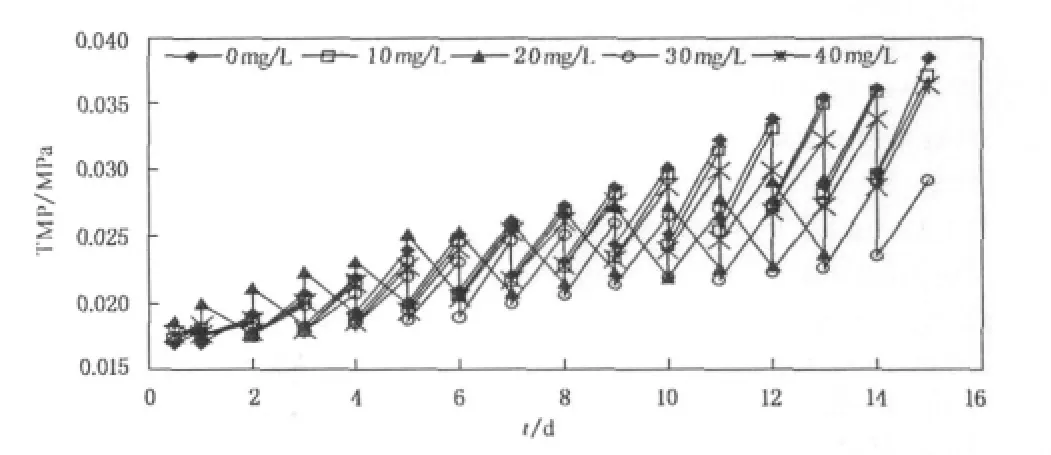
Fig.3 TMP of UF membrane in different pretreatment processes
The data indicated that PAC alleviated the deterioration of TMP.But the increasing PAC dosage did not always attain a corresponding better effect.The TMP slowly increased when the dosage of PAC at 20-30 mg/L,while the TMP quickly grew with more doses of PAC.The results indicated that the added activated carbon affected the membrane filtration performance.It also demonstrated that more PAC may promote the fouling in the PAC/UF system.It could be concluded that the presence of PAC attached to the surface of membrane was limited,in which PAC achieved adsorption balance in the gel layer or membrane surface at a feasible dose.The balance was broken as a result of the increasing doses of PAC,which caused a denser fouling layer to result in an increasing overall resistance to water permeation.In this way,the concentration of PAC should be controlled in order to optimize the alleviation of membrane fouling.Both the property of rejection organic matter and the membrane fouling were considered when operating the combining process of PAC/UF.According to the drinking water quality standard(GB 5749—2006),the index of CODMnshould not be beyond 3 mg/L.If the quality of UF effluent achieved the standard,it should optimize the PAC dosage to control the fouling of membrane.The dose of PAC was confirmed in 20 mg/L according to the experimental results.
2.2 The organic matter removal and membrane fouling mitigation by PAC
2.2.1 The effect of PAC on organic matter removal
The experiment further explored the influence on the removal of organic matter while the PAC was added into the tank of membrane.As a blank control,the UF filtered the feed water without PAC.The procedures and conditions were the same as described in the text above.The dose of PAC was 20 mg/L,which was the optimizing dosage in the experiment.DOC,UV254,and CODMnin the feed water were 3.07 mg/L,0.043 cm-1,and 2.88 mg/L respectively.The effluent DOC,UV254,and CODMnwere 2.53 mg/L,0.027 cm-1,and 2.32 mg/L without PAC.Those were 1.73 mg/L,0.015 cm-1,and 1.67 mg/L with the addition of PAC respectively.The removal effect of the organic matters was shown in Fig.4.
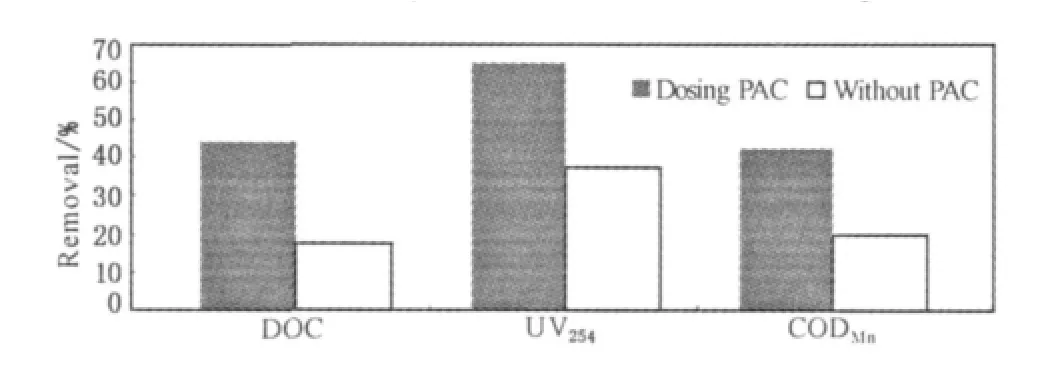
Fig.4 Effects of PAC on the removal of organic matter
The data from Fig.4 reflected that the system rejecting the organic matters was significantly improved by adding 20 mg/L of PAC.The suspended carbon in bulk and deposited carbon on the membrane could significantly reduce the organic foulant from the feed water,resulting in a decrease of organic matter in the boundary layer near the membrane.The results indicated that PAC absorbed organic matter in feed water,especially removed the organic matter indicated by UV254,which mainly were aromatic organic matters.Researches[20,21]have shown that UV254can be used as the precursors ofdisinfection byproducts.The combination process of PAC/UF could reduce the risk of producing disinfection byproducts.In addition,coagulation usually removes macromolecules organic,but 80%organic matters are small molecules in the Yangtze River water.The retention and adsorption of small organic molecules were limited due to membrane pore size restrictions.Therefore,the process of PAC/UF was better than UF only combined with coagulation for organic matter removal.
2.2.2 Estimation of membrane fouling mitigation by PAC
Generally,membrane-fouling behavior could be reflected by the developing rate of TMP as the constant flux mode.In this study,the membrane flux was set at the constant 30 L/(m2·h)for the process.The UF system was operated without PAC for 4 days and then continued running with dosing 20 mg/L of PAC.The membrane was cleaned with chemical dosage(sodium hypochlorite solution made up by 5 mg/L Cl2)before adding PAC.The TMP was 0.017 MPa at the beginning of the process,which increased to 0.033 MPa after 4 days without PAC.The TMP increased from 0.0189 MPa to 0.0275 MPa by adding 20 mg/L of PAC in the next 4 days.The data were shown in Fig.5.
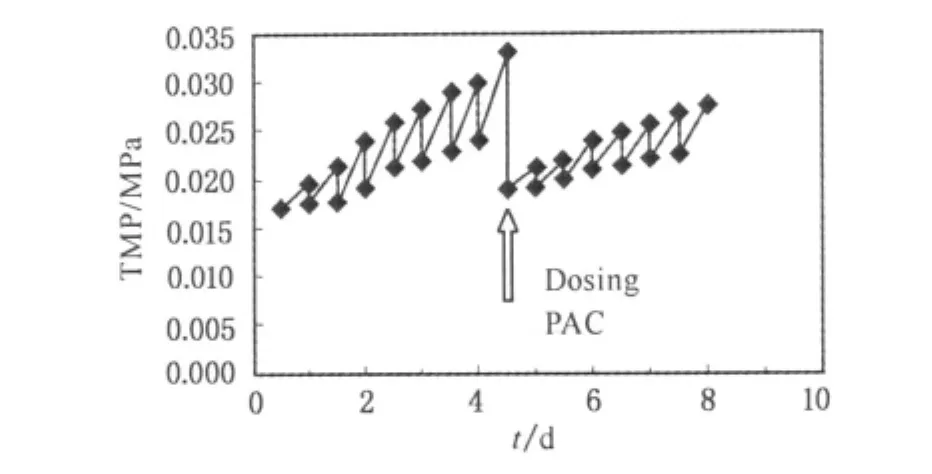
Fig.5 Effects of PAC on TMP of UF membrane
This result indicated that membrane-fouling in the UF coupled with PAC was further alleviated due to better removal of particulates and organic matter in raw water.The PAC particles were large enough(6 μm average diameter)to avoid membrane pore blocking.PAC would deposit on the membrane surface and form a porous layer that allowed the passage of water without an increasing resistance.In this way,the gel layer reduced the organic loads of membrane surface and pore,which eased membrane fouling.An explanation for membrane fouling reducing through the PAC/UF process might be as follows:(1)PAC could adsorb a significant fraction of the organic carbon in the feed water and then reduce fouling;(2)large number of Al(OH)3complexes and precipitates together with PAC might be able to adsorb and sweep the foulant molecules.
3 Conclusions
Combining PAC with submerged UF process not only increased organic matter removal but also mitigated the fouling of UF membrane,which was represented by the slowly growing transmembrane pressure.But more doses of PAC may promote the membrane fouling.It was important to optimize the dosage of PAC in the UF/PAC combined process.UF process coupled with optimal 20 mg/L of PAC attained a better removal for organic matters and the average removal of DOC,UV254,and CODMnwere 42.6%,63.4%,and 45.7%,respectively.
[1]Li G B,Yang Y L.Ultrafiltration-the 3rd Generation Key Water Purification Technology for City[J].Water Technology,2007,1(1):1-3.(in Chinese)
[2]Lovins III W A,Taylor J S,Hong S K.Micro-organism Rejection by Membrane Systems[J].Environmental Engineering Science,2002,19(6):453-465.
[3]Aimar P,Bacchin P.Slow Colloidal Aggregation and Membrane Fouling[J].Journal of Membrane Science,2010,360(1/2):70-76.
[4]Guo H,Wyart Y,Perot J,et al.Low-Pressure Membrane Integrity Tests for Drinking Water Treatment:a Review [J].Water Research,2010,44(1):41-57.
[5]Kabsch-Korbutowicz M.Impact of Pre-coagulation on Ultrafiltration Process Performance[J].Desalination,2006,194(1/2/3):232-238.
[6]Rojas J C,Pérez J,Garralón G.Humic Acids Removal by Aerated Spiral-Wound Ultrafiltration Membrane Combined with Coagulation-Hydraulic Flocculation[J].Desalination,2011,266(1/2/3):128-133.
[7]KoniecznyK,Sakolb D,PlonkaJ,etal. Coagulation-Ultrafiltration System for River Water Treatment [J].Desalination,2009,240(1/2/3):151-159.
[8]Kweon J H,Hur H W,Seo G T,et al.Evaluation of Coagulation and PAC Adsorption Pretreatments on Membrane Filtration for a Surface Water in Korea:a Pilot Study[J].Desalination,2009,249(1):212-216.
[9]Katsoufidou K S,Sioutopoulos D C,Yiantsios S G,et al.UF Membrane Fouling by Mixtures of Humic Acids and Sodium Alginate:Fouling Mechanisms and Reversibility [J].Desalination,2010,264(3):220-227.
[10]Campinas M M P.Removal of Cyanobacteria and Cyanotoxins from Drinking Water by Powdered Activated Carbon Adsorption/Ultrafiltration[D].Portuga:University of Algarve,2009:25-31.
[11]Konieczny K,Klomfas G.Using Activated Carbon to Improve Natural Water Treatment by Porous Membranes [J].Desalination,2006,147(1/2/3):109-116.
[12]Lee C W,Bae SD,Han SW,et al. Application of Ultrafiltration Hybrid Membrane Processes for Reuse of Secondary Effluent[J].Desalination,2007,202(1/2/3):239-246.
[13]Yiantsios S G,Karabelas A J.An Experimental Study of Humic Acid and Powdered Activated Carbon Deposition on UF Membranes and Their Removal by Backwashing [J].Desalination,2001,140(2):195-209.
[14]Tomaszewska M,Mozia S.Removal of Organic Matter from Water by PAC/UF System [J].Water Research,2002,36(16):4137-4143.
[15]Jermann D,Pronk W,Weylan S,et al.Interplay of Different NOM Fouling Mechanisms during Ultrafiltration for Drinking Water Production[J].Water Research,2007,41(8):1713-1722.
[16]Matsui Y,Sanogawa T,Aoki N,et al.Evaluating Submicron-Sized Activated Carbon Adsorption for Microfiltration Pretreatment[J].Water Science and Technology,2006,6(1):149-155.
[17]Zularisam A W,Ismail A F,Salim M R,et al.The Effects of NaturalOrganic Matter (NOM)Fractions on Fouling Characteristics and Flux Recovery of Ultrafiltration Membranes[J].Desalination,2007,212(1/2/3):191-208.
[18]Mozia S,Tomaszewaska M,Morawski A W.Studies on the Effect of Humic Acids and Phenol on Adsorption-Ultrafiltration Process Performance[J].Water Research,2005,39(2/3):501-509.
[19]Zhang Y,Tian J Y,Nan J,et al.Effect of PAC Addition on Immersed Ultrafiltration for the Treatment of Algal-Rich Water[J].Journal of Hazardous Materials,2011,186(2/3):1415-1424.
[20]Lin X J,Yang H F,Song C Y.The Application of UV254in the Water Quality Monitoring [J].Energy and Environment,2006,20(1):22-24.(in Chinese)
[21]Campinas M,Rosa M J.Assessing PAC Contribution to the NOM Fouling Control in PAC/UF Systems [J].Water Research,2010,44(5):1636-1644.
登錄APP查看全文
 Journal of Donghua University(English Edition)
2012年3期
Journal of Donghua University(English Edition)
2012年3期
- Journal of Donghua University(English Edition)的其它文章
- Frost Resistance and Damage Velocity of Compressively Preloaded Concrete
- Vehicle OHT DispatchingPerformance Analysis ofan AMHS in 300mm Semiconductor FABs
- Research on Cooperation Mechanism ofChina'sFinancialRegulation and Supervision System
- Hydrophobic TixOy-CmHnNanoparticle Film Prepared by Plasma Enhanced Chemical Vapor Deposition
- Comparison and Analysis of Fabric Deodorization Test Methods
- Sorption Kinetics and Capacity of Composite Materials Made up of Polymeric Fabric and Expanded Perlite for Oil in Water