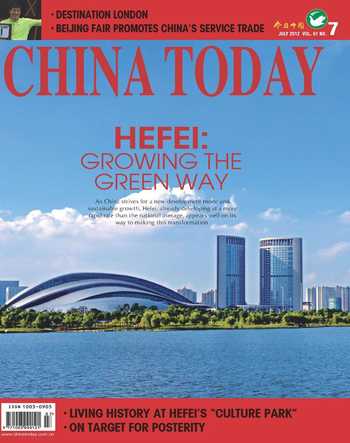
hefei: rising star of China’s tourism
2012-04-29 00:44:03ByVERENAMENZEL
CHINA TODAY 2012年7期
By VERENA MENZEL
China has a huge tourism market, and scenic areas throughout the country are vying for a piece of the action in hopes of boosting tourism revenue and developing service industry. Hefei, capital of central Chinas Anhui Province, is no exception. Picturesque Yellow Mountain has always been a main attraction for visitors to Anhui, but the province now has much more to offer.
hand-in-hand with environmental protection,” Li said, adding that ecological restoration of the lake is at the core of development plans. Both the water quality and flora and fauna need to recover and so endow new life on the wetlands near the shore.
The city also plans to establish new nature reserves and expand existing ones, and has indeed achieved initial success in the field of environmental protection. The quality of water in Chaohu has improved significantly: compared with 2006 levels, manganese content has fallen by 28.4 percent, ammonia has decreased 32.1 percent, nitrogen by 17.5 percent and phosphorus by 50.3 percent. The volume of treated wastewater in Chaohu City (county-level), named after the lake, which is under the jurisdiction of Hefei, has also risen from 60 to 95 percent.
The next step is to improve infrastructure around the waters, both on land and on the rivers in the area. The availability of public transport from the city center is to be upgraded to connect tourist attractions in surrounding counties and districts, Li said. A key element here is expansion of the 155-kilometer panoramic circular road around the lake that will link surrounding tourist attractions. “Our goal is to combine existing tourism resources,” Li said. The lake will eventually become the citys calling card – a hallmark of recreation, tourism, fitness and water sports.
Besides water scenery, the lake has many surrounding natural attractions, including hot springs, forest parks and karst caves. The city of Chaohu is incorporating modern amenities into its natural wonders to enhance the experience of visitors to these sites. Its catering services, hotel facilities and entertainment industry are under steady expansion, and the local hot springs are also site of spas offering a broad range of healthcare and beauty services.
tradition and Modernity
The Ancient Town of Sanhe (literally “three rivers”) is another famous tourist attraction near Hefei. The waterside town is about 20 kilometers from Hefei and only nine kilometers from Chaohu, located in the delta of the Fengle, Hangbu and Xiaonan rivers, and has a 2,500-year-long history. The ancient town is distinct for its winding streets, old stone bridges and romantic canals that attract thousands of tourists every year. Today it is home to more than 20,000 residents.
In addition to welcoming visitors to places of historic interest and scenic beauty, Hefei is also promoting its indigenous culture, customs and arts & crafts. China (Hefei) Intangible Cultural Heritage Park, which combines an architectural museum, circus paradise and theme park, is situated in Changfeng County, about 1.5 kilometers from downtown Hefei. Its construction began in 2009, and the core area of the site, which accounts for about one-fourth of the total area of 2.3 square kilometers, is now open to the public.
During our visit, we saw many houses in traditional Anhui style that feature snow-white facades and elaborately curved roofs. Built with recycled materials, the houses reflect one of the parks main guiding principles – that of protecting tangible and intangible cultural heritage.
“Our goal is to preserve cultural traditions and raise awareness of the value and necessity of protecting cultural assets,”said Wang Ruisong, vice president of Anhui Huajiao Group, which provided a large part of the RMB 2 billion invested in this mammoth tourist project. Whether the artificial park will draw the same volume of visitors as that to the Ancient Town of Sanhe is yet to be seen. It will undoubtedly need more content and innovation to cater to international tastes.
Another of the countys new tourist attractions is the Changfeng Blue Treasure Rose Co., Ltd rose farm, which Hong Kong company Roushikeer set up in November 2011. With an investment of RMB 300 million, Roushikeer is building a rosethemed resort on a four-square-kilometer area.
“August will see the first roses bloom here,” said Zhu Yingchun, spokesman of Duji Township, where the park is located.“When the resort is complete in three to four years time we expect it to bring even more tourists to the region,” Zhu said. The plan is then to split the resort into various rose-themed gardens that will double as local excursion and recreational destinations and an outdoor base for the booming wedding photography industry. There are also plans to build romantic rose-themed restaurants and hotels for lovers and newlyweds. Grand halls in the garden will be venues for wedding and anniversary parties, and trade fairs will house displays of rose-based cosmetics and products.
Hefei is not yet a shining star in Chinas tourism universe, but the city has rich natural and cultural resources that are well developed and promoted. Making Chaohu a center of tourism development is certainly a wise decision. During her visit to Hefei last year Li Bin, governor of Anhui Province, described the lake as “a treasure.” The time has now come to highlight the lakes natural beauty. “We should transform Chaohu Lake into a larger West Lake,” Li said. West Lake is a famous beauty spot at the center of historical Hangzhou, Zhejiang Province, Chinas pride. In comparison Chaohu is a rough diamond. Only time will tell if efforts to polish it can bear fruit. The competition in tourism industry at home and abroad grows fiercer as all contenders rise to the challenge of attracting the most visitors. But no matter what position the Chaohu brand occupies in Chinas tourism industry, developing tourism will play a significant role in environmental and cultural protection and in improving local residents lives.