Tales from the Zhaxika grassland
2012-04-29 00:44:03
CHINA TODAY 2012年3期
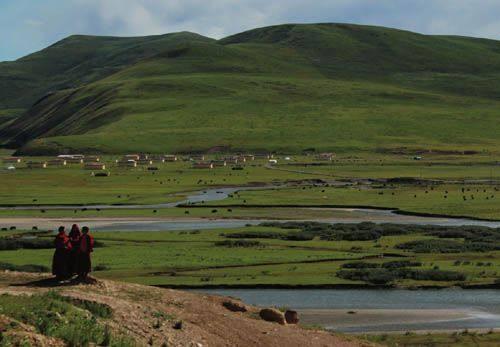
THE stretch of steppe on the Qinghai-Tibet Plateau known as Zhaxika – Tibetan for “tribe at the headstream of Yalong River,” straddles Sichuan and Qinghai provinces as well as Tibet Autonomous Region. It was the casual mention in conversation of this area of grassland in Serxu County, Garze Tibetan Autonomous Prefecture, Sichuan Province, that brought me to Zhaxika.
Serxu County is the largest and most outlying county in Sichuan, situated at the northernmost tip and highest altitude of the province. It borders the southern slope of the Bayan Har Mountain Range to its north, the Mola section of the Shaluli Mountain Range to its south and Yushu Prefecture of Qinghai Province to the northwest. The Jinsha River to the southwest flows between Serxu and Jomda County of Tibet Autonomous Region. Southeast Serxu is close to Sertar and Dege counties. Just 1,070 kilome- ters from Chengdu, capital of Sichuan, Serxu County has an average altitude of 4,000 meters above sea level and covers an area of 25,141 square kilometers, 90 percent of it grassland. As there are few roads, our journey was in three stages. We started out from Beijing for Xian, capital of Shaanxi Province, took a flight from there to Yushu, and then drove the remaining 100 kilometers at an altitude of 4,700 meters to Nixia Town, seat of the Serxu County government.
Unadorned Happiness
Transportation, electricity and communications are scant in this remote area. As its economy is undeveloped, it receives few tourists.
Residents of Zhaxika are mainly herders and farmers. They live at the edge of the county, where their yaks and sheep graze on patches of wetlands by a tributary of the Yalong River. Prayer banners flutter in every household yard. We stopped in at one household, where the parents of the family were washing fleece as their children played. They were all very friendly and could speak some Mandarin. The children entertained us with a Tibetan dance.
We also met a young monk sunning himself on the grass. We presumed he must be the eldest son of the family taking care of his younger brothers and sisters. He did not speak Mandarin, so the other children translated for us. When we were about to leave I asked if he would exchange his prayer beads for mine. He smiled and agreed. Back in Beijing, I looked more closely at his beads and saw that he must have worn them for more than a decade, during which time he would have chanted thousands of prayers. This makes them extremely precious to me.
The Hope Primary School in Zhaxika was built on donations, but more money is needed before construction can be completed. It has nonetheless brought hope to Zhaxika residents. Locals celebrated our visit in festival fashion, and were delighted when we took a photo of each pupil. They all hope that one day they will, like urban students, sit in a classroom with desks and blackboards.
Prayer Banners
One of the legends of the Zhaxika Grassland tells of how, long ago, a holy yak was frozen in ice and snow on Geladandong Snow Mountain, source of the Yangtze River. A group of Khampa men bravely climbed the peak, lit kindling from the sun and melted the snow and ice. When the sacred yak awoke, a stream of melted snow oozed from its nostrils and became the clear river that nurtures flocks of sheep and herds of yak. Sun and fire thus became the totem of this tribe which is why Zhaxika is also known as the “Sun Tribe.”
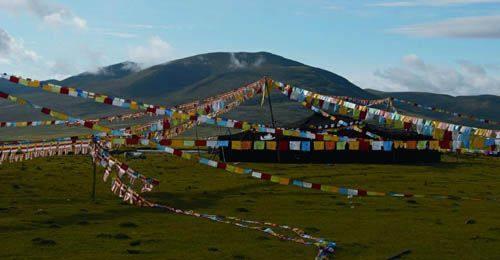
Zhaxika residents live against a backdrop of blue sky, fluffy clouds, grassland and pale green mountains. Flowers are few as the thin air makes it difficult for plants to thrive, but the prayer banners of all hues flying in every household more than compensate.
The prayer banners are just one aspect of how local residents religious beliefs, also apparent in local architecture, paintings and statues, are interwoven into life on the Zhaxika Grassland. One legend about their origins tells of how Buddha was reading a folder of scriptures under a banyan tree one day when a gust of wind caught and scattered the pages. Anyone who found a page had a happy life. People have since written scriptures on pieces of cloth and hung them in the wind as prayers for happiness and safety.
Larger numbers of visitors have entered Tibetan-inhabited areas in recent years, introducing aspects of modern life and commerce.Tourists preoccupied with hunting out well-known scenic spots regard the prayer banners as little more than a decorative feature. The spiritual strength and belief emanating from these sutras is best appreciated in the calmness of remote mountains or river valleys. There it seems possible to hold a dialogue with heaven and earth via the wind.
songge Mani Wall
Zhaxika Grassland scenery is most impressive in August, when the grassland is dotted with tiny, tenacious flowers. Driving along the road is similar to sailing on a boundless sea. You sometimes feel you have reached the end of the earth until turning another bend, when the seemingly endless horizon appears once more. Winter dominates under this plateau environment, making for harsh natural surroundings and living conditions.
The Barge Mani Wall and the Songge Mani Wall are two highly recommended travel destinations in Zhaxika. The term“Mani” is part of their name because both walls are made of rocks carved with the famous six-syllable mantra “om ma ni padme hum.”
The rectangular, south-facing Songge Mani Wall is in Ariza Township, 90 kilometers from the county seat. It is 73 meters long from east to west and 47 meters wide from south to north. The exterior wall is 10 meters high and the central main section 15 meters high. It is said that the Mani walls originated during the reign of King Gesar (1038-1119)– a heroic figure who saved the Tibetan people from monsters and spread among them the Buddha-dharma. The Epic King Gesar, still sung by folk artisans in Sichuan, Qinghai, and Tibet, is regarded as the “Iliad of the East” and represents the highest achievement of ancient Tibetan culture. King Gesar laid Mani walls as memorials to soldiers killed in war. Later, in memory of King Gesar himself, local residents on pilgrimages lay Mani stones that over time grew into the immense Mani Walls that now stand in Serxu.
The wall constitutes a castle made of stones and gobbets carved with Buddhist scriptures, the six-syllable mantra and Buddhist figures. The local historical relics administration has found Mani stones carved in Sanskrit. Their content implies that the walls were first built from the 11th to 12th centuries. As the walls have no framework or binding materials, that they have stood firm for so many centuriesis is miraculous.
Love on the Grassland
Mani stone carvings are a distinct part of folk culture in Tibetan-inhabited areas. Pilgrims in Serxu County chiseled scriptures on these stones and piled them up to form Mani walls. The Barge Mani Stone Wall originated in 1640 at the time of the first Barge Living Buddha. Although an undeniable tourist attraction, Mani stones mainly function as a medium for farmers and herders living in this harsh environment to express their faith.
A legend from the third Barge Living Buddha period tells of the love between a poor herdsman and a girl from a noble family living on the Zhaxika Grassland. As the girls family forbade them to marry, the lovers eloped. While crossing the Yalong River on horseback, a torrent swept the girl off her horse and drowned her. The herdsman jumped into the river to die with her, but the Barge Living Buddha happened to be passing by and saved his life. The herdsman later converted to Buddhism and cultivated himself according to its doctrine for a lifetime of prayer for his lost love. The legend inspired pilgrims to lay Mani stones to express their good wishes. The walls hence extended day after day, year in and year out to their present immense extent.