moRE DIVERSE REpRESENTaTIoN
2012-09-12 06:30:04ByLiLi
Beijing Review 2012年45期
By Li Li
moRE DIVERSE REpRESENTaTIoN
By Li Li
A broad range of Party delegates offers hope for new voices to be heard at the CPC congress

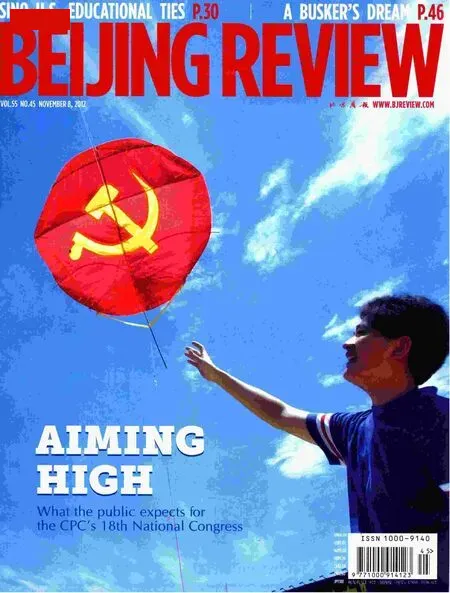
several migrant workers and rural doctors, and an Olympic gold medalist, are representing 82 million members of the Communist Party of China (CPC) at the Party’s 18th National Congress set to open on November 8. The 2,270 delegates were elected by 40 electoral units between October 2011 and July 2012. Compared with previous congresses, more young faces and professionals will serve as delegates.
The national congress will craft Party principles and policies, as well as elect the Party’s new leadership. As part of the country’s efforts to build a wealthier society, deepen reforms of the country’s economy and transform its model of economic development, the 18th congress is expected to release important policies to guide the country’s development in the next fve years.
Party members who joined the CPC after the reform and opening up in the late 1970s constitute the majority of the delegates, said Wang Jingqing, Vice Minister of the Organization Department of the CPC Central Committee, at a press conference in Beijing on August 14.
A total of 1,640 delegates joined the Party after November 1976, accounting for 72.2 percent of the total, 20.5 percentage points higher than that of the congress in 2007, he said.
The average age of the delegates is 52, and 64.8 percent of them are under age 55. There are 114 delegates under 35, accounting for 5 percent of the total, 1.9 percentage points higher than the previous congress. Moreover, 2,122 delegates, or 93.5 percent of the total, have a junior college diploma or above.

The youngest delegate is Jiao Liuyang, an Olympic champion swimmer. She was born in March 1990 and joined the Party in 2008. The oldest is former mayor of Beijing Jiao Ruoyu, who was born in December 1915 and joined the CPC in 1936.
According to the criteria set by the CPC Central Committee, delegates to the Party’s national congress must have an exemplary track record in their line of work, Wang said.
Scholars pay close attention to the delegates’ capacity to fulfill their duties. Chen Xuewei, a professor at the Party School of the CPC Central Committee, told the China Newsweek magazine that every delegate should be aware of the role he plays.
“The delegates for the upcoming Party congress should shoulder more responsibilities in promoting reforms,” Ma Yong, a senior research fellow of Chinese history at the Chinese Academy of Social Sciences, told China Newsweek. He suggested that these delegates spearhead a new round of reforms within the Party by, for instance, declaring their personal assets.
Better represented groups
Among all the delegates to the 18th CPC National Congress, there are 169 workers, a sharp increase from 51 in the previous congress. They include 26 migrant workers who moved from the countryside to work in cities.
About 30.5 percent of the delegates are from the grassroots level, up 2.1 percentage points from the previous congress in 2007, Wang said.
Talking about the election of more grassroots delegates, Bai Zhili, a professor at the School of Government of Peking University, said that on the one hand, the CPC wants to strengthen the role of grassroots organizations in Party affairs; on the other hand, conflicts and problems at the grassroots level have been rising in recent years and grassroots delegates are expected to convey public concerns directly to the Party leadership.
Chen said that more grassroots CPC members attending the Party’s national congress could enhance the communication between the CPC Central Committee and grassroots Party organizations and promote intra-Party democracy.
A new group of four delegates are college graduates serving as village officials from Jiangxi, Heilongjiang and Jiangsu provinces and Chongqing Municipality respectively.
In recent years, China has selected volunteer college graduates to work as village offcials for the country’s rural grassroots administrations.
As of the end of 2011, the number of college graduates serving as village officials in China’s rural areas topped 210,000, according to the People’s Daily.
There is also a substantial increase of delegates from the business community. According to the China Enterprise News, 131 delegates work for Central Governmentowned companies, accounting for 5.77 percent of the total number and 26 more than the number at the previous congress.
The representation of the private sector has further grown. Twenty-seven private enterprise owners will attend the 18th CPC National Congress. The number of the delegates from this group to the previous two Party congresses was seven in 2002 and 17 in 2007.
Professor Chen said that the rise in the number of entrepreneur delegates at the national congresses could help consolidate the Party’s ruling base, broaden the Party’s knowledge of social situations and improve the Party’s leadership capacity.
Another group of delegates garnering media attention are scholars. More than 20 academics with the Chinese Academy of Sciences (CAS) and the Chinese Academy of Engineering will attend this year’s Party congress as delegates. Most of these scientists and engineers have studied or worked abroad and are leading experts in China in their respective fields, including Bai Chunli, President of the CAS and a leading scientist in nanoscience; Zhan Wenlong, Vice President of the CAS and a nuclear physicist; Zhou Ji, President of the Chinese Academy of Engineering; Li Jiayang, President of the Chinese Academy of Agricultural Sciences; and Zhao Xiangeng, President of the Chinese Academy of Engineering Physics.
When the CPC Central Committee decided in June to give Beijing two more seats at the upcoming Party congress, Hu Angang, a renowned economist and professor at the prestigious Tsinghua University, and Zhang Xueji, a biological sensor expert who had worked in the United States for a decade, were elected as delegates.

HANDS-ON TRAINING: He Xiangmei, a 31-year-old elite sniper and army offcer, lectures his soldiers on sniping skills

A CARING SOUL: Chen Fenglian (left), Director of Ciyou Community in Xining City, northwest China’s Qinghai Province, visits 80-year-old Ma Yumei, who lives alone in the community

FIELD TRAINING: Bi Shihua Village in Zhenkang County, fellow villagers on preventing
Female delegates account for 23 percent of the total and ethnic minorities account for 11 percent.
According to established practices, the CPC Central Committee will also invite some Party members who have retired from their leadership posts as special delegates to the congress, Wang said.
Intra-party democracy
To ensure the election of more outstanding delegates, the CPC has, for the first time, carried out a multi-candidate survey on the preliminary candidates of the delegates to the upcoming Party congress.
The loss margins in electing delegates to the 18th CPC National Congress were required to be 15 percent or above nationwide, according to the Organization Department of the CPC Central Committee. The required loss margin was also above 15 percent for the 17th CPC National Congress and above 10 percent for the 16th CPC National Congress.

KNOWLEDGE ACKNOWLEDGED: Wu Jiang, chief IT security scientist at Beijing-based Datang Telecom Technology & Industry Group, speaks to his lab colleagues

(left), Secretary of the Party Committee of Hongyan southwest China’s Yunnan Province, trains his g coffee tree pests

A MASTER TECHNICIAN: Song Dianchen, an awardwinning lathe operator from north China’s Inner Mongolia Autonomous Region, is a national-level model worker
Both Chen and Bai believe that the right to vote is key for Party members, which was better materialized in multi-candidate elections. Compared with single-candidate elections, multi-candidate elections are competitive, where winners often really care about intra-Party affairs and can more effectively express their opinions on political issues. They believe that the introduction of more competitive elections for national congress delegates is out of respect for public opinion and helps to promote intra-Party democracy.
Wang Changjiang, a professor at the Party School of the CPC Central Committee, said the introduction of the multi-candidate survey on the preliminary delegate candidates is a positive change. “More competitive election campaigns must be introduced,” he said, adding that regulations need to be drafted to make these kinds of elections regular.
The election process was “open and transparent,” with each Party member having access to election information, said Deng Shengming, a spokesman for the Organization Department of the CPC Central Committee. He also revealed that up to 98 percent of Party members participated in the election.
CPC members participated in and supervised the election through party member meetings, published notices and text messages sent to their cell phones, Deng said, adding that the media have covered the entire process.
The CPC Central Committee imposed strict discipline on the election to ensure a sound and healthy process and forbid bribery and pulling strings to draw votes.
Discipline agencies, organization departments as well as the electoral units closely monitored the process of the election. The CPC Central Commission for Discipline Inspection and the Organization Department of the CPC Central Committee sent inspectors to supervise and check the elections at the local level.
Some local Party committees had, for the frst time, publicized delegate candidates’personal information via the mass media, in a bid to mobilize the participation of and solicit feedback from Party members. In previous elections, such a list was only circulated among those in the Party.
Chen said that such efforts brought the election process under public supervision.
According to a survey by the Organization Department of the CPC Central Committee, about 97 percent of the Party members were satisfed with the election, said Wang, the department’s deputy head.
“The CPC will continue its efforts to promote intra-Party democracy by improving the Party congress system and promoting intra-Party elections and supervision,” Wang said.
lili@bjreview.com