倫敦(2012奧林匹克城)排水隧道工程
2012-10-10 09:04:32MartinKnights
隧道建設(shè)(中英文) 2012年4期
關(guān)鍵詞:工程
Martin C.Knights
(Halcrows集團(tuán)有限公司,倫敦)
0 引言
倫敦是一個(gè)被人口增長(zhǎng)和氣候變化所影響的國際化都市,這使得倫敦的交通網(wǎng)和排水網(wǎng)承受了較大的壓力。為滿足日益增長(zhǎng)的交通需求,倫敦的地鐵系統(tǒng)正在逐步升級(jí),一條東西向的地鐵線也在修建中。由于19世紀(jì)70年代修建的排水系統(tǒng)已經(jīng)無法滿足大暴雨和強(qiáng)降雨情況下的排水要求,為防止污水流入著名的泰晤士河,倫敦正在建設(shè)一個(gè)新的暴雨排污和儲(chǔ)水隧道。
最近在上海舉行的橋梁和隧道大會(huì)上,Knights先生介紹了倫敦最近當(dāng)前最主要的隧道工程計(jì)劃,闡述了一些值得關(guān)注的并已在這些工程中應(yīng)用的技術(shù)創(chuàng)新。他的介紹是對(duì)刊登在會(huì)刊中的整個(gè)PPT的總結(jié)。
在本刊中,總結(jié)出該隧道工程的重點(diǎn)在于在倫敦強(qiáng)降雨時(shí),如何防止泰晤士河被污染。
1 倫敦Tideway工程
見圖1。
1.1 工程概況
1)由于倫敦的城市化進(jìn)程,下水道和排水管網(wǎng)都無法滿足暴雨時(shí)的排水需要。
2)Joseph Bazalgette先生是原(維多利亞時(shí)期)排水管網(wǎng)的設(shè)計(jì)師,他設(shè)計(jì)了一套污水處理系統(tǒng),該系統(tǒng)由57個(gè)沿泰晤士河行潮段布置的合流下水道排水口(CSOs)組成。
3)設(shè)計(jì)此系統(tǒng)是為了防止建筑和街道被洪水淹沒。
4)平水年,估計(jì)會(huì)排出3 900萬m3的未處理污水,豐水年達(dá)平水年的3倍以上。
5)小到2 mm的降雨都會(huì)觸發(fā)該系統(tǒng)排水。
6)由于人口的增長(zhǎng)、城市化進(jìn)程的推進(jìn)以及氣候的變化,糟糕的排水情況更是每況愈下。
7)在整個(gè)暴雨過程中,隧道都扮演著污水吸納、運(yùn)輸和儲(chǔ)存的角色。一般來說,污水會(huì)在48 h內(nèi)被處理。因此,該工程實(shí)際上是污水處理廠(位于此隧道工程?hào)|端的Beckton)的擴(kuò)展。
1.2 該工程的關(guān)鍵性挑戰(zhàn)
1)地質(zhì)情況復(fù)雜多變——黏土、混合地層、砂土、白堊系土層,而且地下水位高。
2)在惡劣污水環(huán)境下,設(shè)計(jì)壽命可達(dá)120 a。
3)采用渦輪式豎管消能,并盡量減少空氣的夾雜。
4)采取實(shí)時(shí)控制來應(yīng)對(duì)涌水。
5)為保持隧道環(huán)境清新并降低臭氣釋放到地面的風(fēng)險(xiǎn),需進(jìn)行機(jī)械通風(fēng)和臭氣處理。
6)液壓方面的挑戰(zhàn):為減小滯留空氣的影響,需要精細(xì)化管理,處理大量進(jìn)入大型隧道的體積可變氣流;在不影響現(xiàn)有系統(tǒng)正常運(yùn)行的前提下,調(diào)節(jié)被動(dòng)系統(tǒng)以實(shí)現(xiàn)適當(dāng)?shù)目刂扑健?/p>
2 新工程
新工程分為2期。
2.1 一期隧道(Lee隧道)
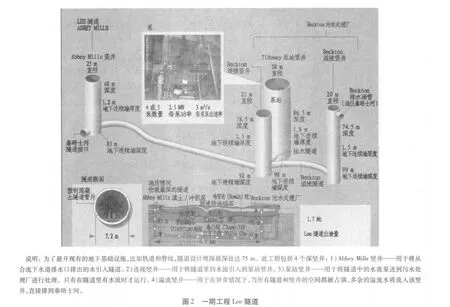
一期工程正在建設(shè)中,見圖2。施工期為3 a。
2.1.1 一期隧道必須現(xiàn)在就著手的原因
1)此隧道將解決倫敦污染最嚴(yán)重的合流下水道排水口問題。
2)目前,從Abbey Mills合流下水道排水口排出的污水占流入泰晤士河行潮段的未處理污水總量的40%。
3)此隧道平均每年要攔截1 600萬t目前排入泰晤士河的未處理污水。
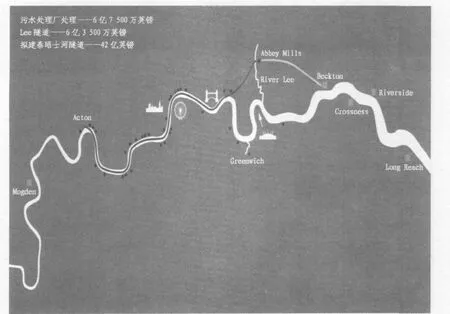
圖1 倫敦Tideway工程
2.1.2 一期隧道的特征
1)從Abbey Mills到Beckton污水處理廠,隧道全長(zhǎng) 6.9 km。
2)隧道具有貯存和運(yùn)輸污水的功能。
3)隧道和豎井的總儲(chǔ)存空間達(dá)到38.2萬m3。
4)隧道埋深達(dá)75 m,內(nèi)徑7.2 m。
5)設(shè)置有4個(gè)最大直徑為38 m的深豎井。
2.1.3 一期工程合同的內(nèi)容
一期工程合同在2010年簽訂,內(nèi)容如下。
1)該工程合同總額為6億3 500萬英鎊——為英國水務(wù)史上數(shù)額最大的承包合同(此前,最大的項(xiàng)目合同額為4億2 000萬英鎊)。
2)由 Morgan Sindall、萬喜大型建筑工程公司(Vinci Construction Grands Projets)和法國地基建筑有限公司(Bachy Soletanche)共同組成英法項(xiàng)目聯(lián)合體(MVB)。
3)施工高峰期需要500個(gè)員工(包括工人)。
4)是目標(biāo)成本合同。
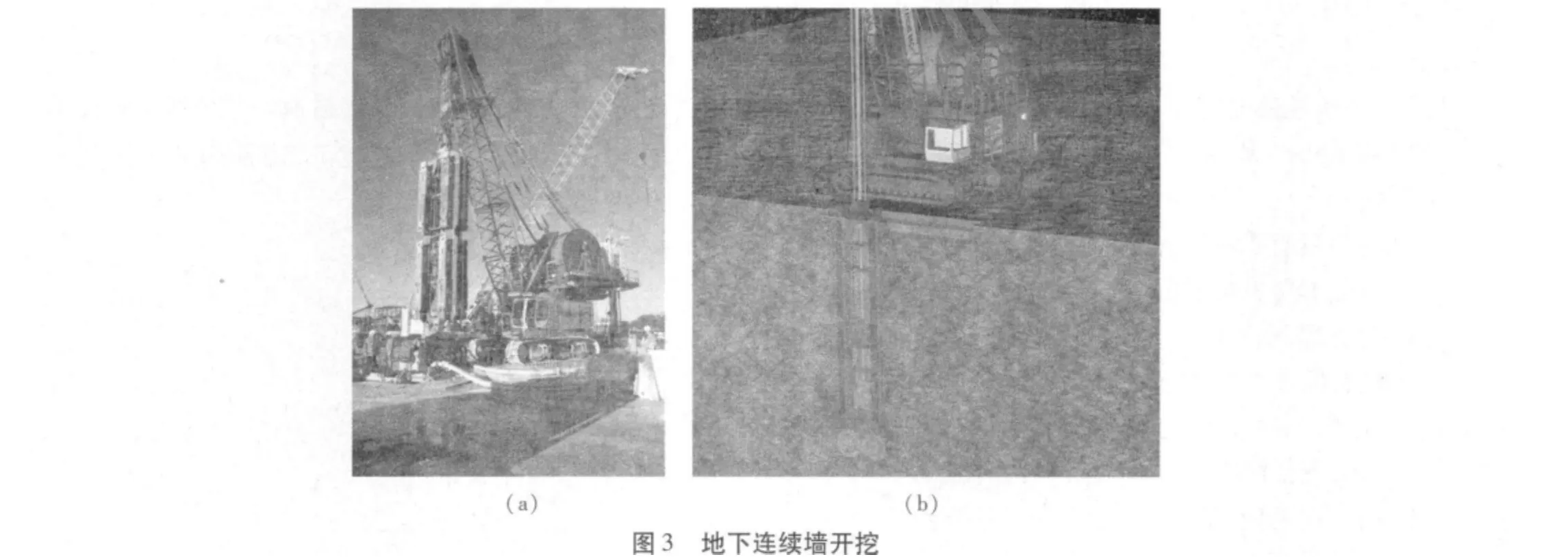
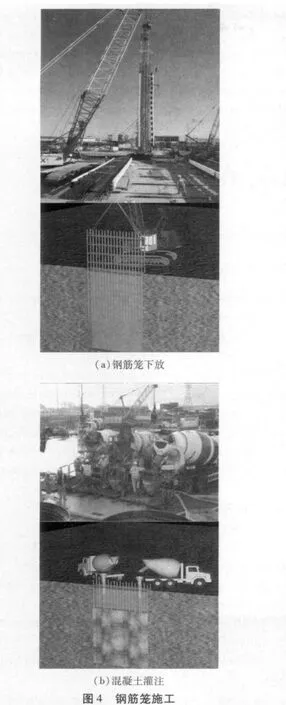
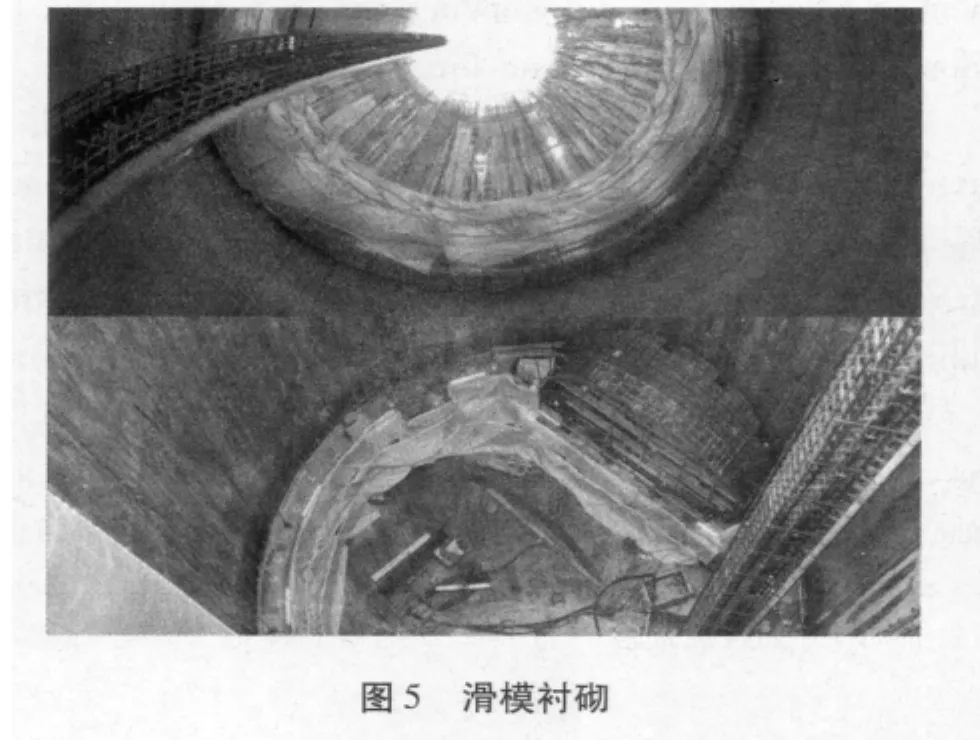
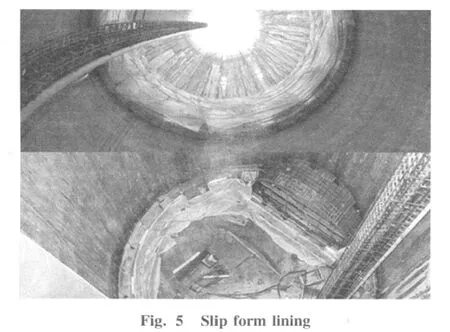
一期工程包括4個(gè)深豎井(見圖2),用深達(dá)98 m的地下連續(xù)墻(見圖3和圖4)作為豎井的初期支護(hù),用滑模襯砌(見圖5)作為二次襯砌。該6.9 km長(zhǎng)的隧道用土壓平衡盾構(gòu)(EPB)施工,用預(yù)制纖維混凝土管片作為二次襯砌。
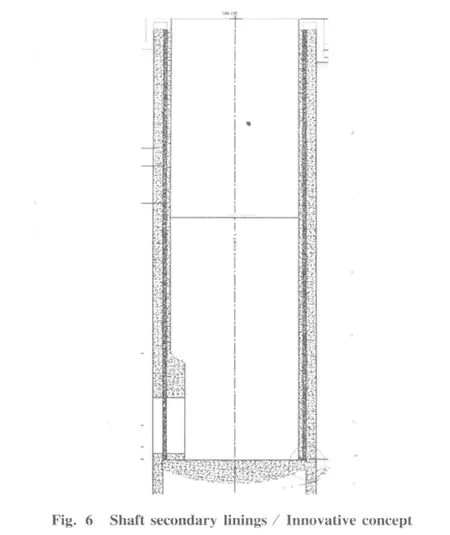
2.1.4 豎井二次襯砌的新理念
基于創(chuàng)新理念(見圖6)進(jìn)行豎井二次襯砌施工。
1)形似混凝土煙囪。
2)外圈為高流動(dòng)性混凝土。
3)防止收縮裂縫。
4)防止張力上升。
5)防止將來彈性壓縮。
6)設(shè)計(jì)用素混凝土。
7)可實(shí)現(xiàn)滑模施工。
8)用鋼纖維來增強(qiáng)耐久性。
9)建造每個(gè)豎井大約節(jié)約700 t鋼筋。
2.2 二期工程(倫敦泰晤士河Tideway隧道)
2.2.1 二期工程的主要特征
二期工程的主要特征見圖1。
1)規(guī)模:20 km,直徑 7.2 m;5 km,直徑 6 m;4 km,直徑5 m。
2)深度:起點(diǎn)深度大約30 m,終點(diǎn)Abbey Mills泵站深度為67 m。每790 m隧道埋深降低1 m,因此隧道可以實(shí)現(xiàn)自清洗。
3)寬度:內(nèi)徑為7.2 m。
4)容量:48 h內(nèi),可貯存150萬m3(包括Lee隧道)。
5)線路:主要沿著泰晤士河。
6)合流下水道排水口控制:21個(gè)出口通往隧道;可控制13條水流。
7)通過Lee隧道和泰晤士河Tideway隧道,保證英國能夠遵守歐盟城市污水處理指令。
2.2.2 二期隧道建設(shè)的分包模式和范圍
3個(gè)地理分包區(qū)域與主隧道掘進(jìn)方向在一條線上(西部、中部和東部)。分包區(qū)域覆蓋了掘進(jìn)豎井、攔截豎井和聯(lián)絡(luò)通道。合同將盡量減少承包商之間的接口。
主要工程合同包括:
1)3個(gè)按地理位置和地質(zhì)情況劃分的隧道和豎井合同。
2)污水處理廠需承擔(dān)復(fù)合接口,包括現(xiàn)有排水道的處理工作;其他由隧道和豎井的承包商來負(fù)責(zé)處理。
3)由方案設(shè)計(jì)得出的設(shè)計(jì)/建筑合同。
4)在其分包的地理范圍內(nèi),承包商全面負(fù)責(zé)項(xiàng)目的各個(gè)方面。包括:①由方案設(shè)計(jì)和最低標(biāo)準(zhǔn)規(guī)范得出的設(shè)計(jì)/建筑方案;②TBM的設(shè)計(jì)和采購及隧道襯砌和豎井的施工;③所有材料及渣土的河流、公路及鐵路運(yùn)輸。
2.2.3 二期工程建設(shè)計(jì)劃
1)設(shè)計(jì):2015年完成。
2)土地收購:掘進(jìn)地段2013年;所有其他地段2015或2016年。
3)二期工程招投標(biāo)(ITT-Q2):2013年。
4)發(fā)包:2015年。
5)現(xiàn)場(chǎng)開工:2016年。
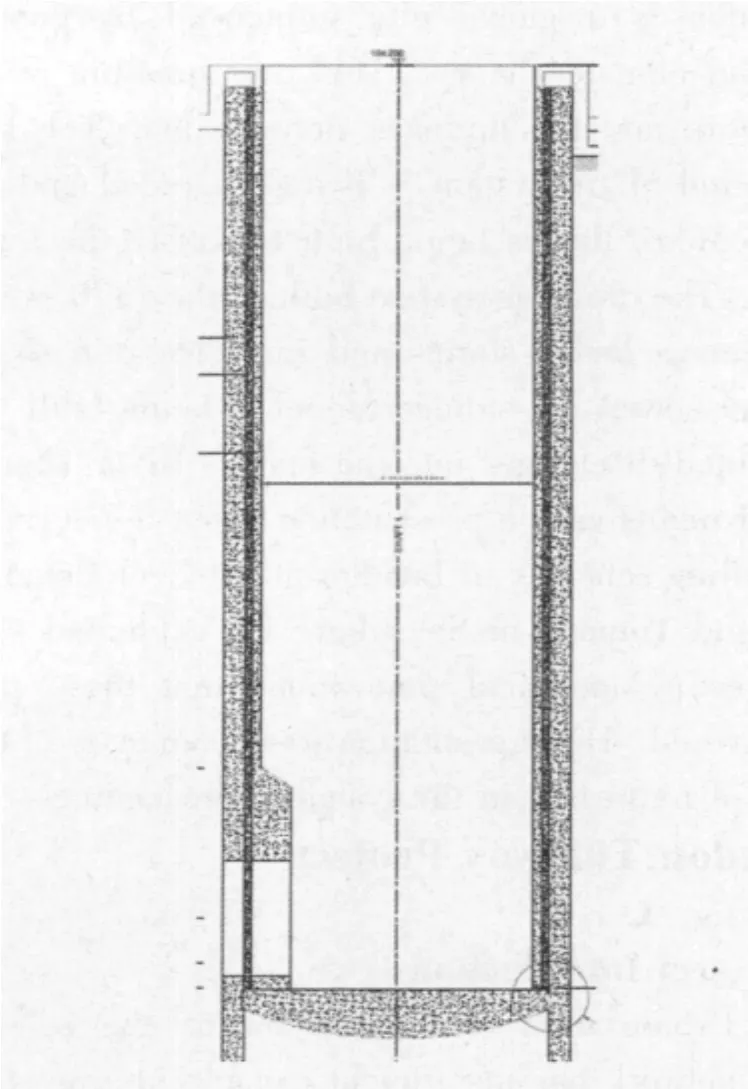
圖6 豎井二次襯砌新理念
3 說明
作為業(yè)主,泰晤士水務(wù)公司(Thameswater)正在全球?qū)で蟾信d趣的承包商。許多歐洲建筑公司表示出了興趣。對(duì)于在施工難度與倫敦Tideway隧道工程類似的復(fù)雜軟弱地層條件下的重大城市隧道工程方面有經(jīng)驗(yàn)的亞洲承包商/供應(yīng)商,業(yè)主很有興趣與他們合作并期望他們對(duì)本項(xiàng)目感興趣。
如對(duì)本項(xiàng)目感興趣,請(qǐng)聯(lián)系泰晤士水務(wù)公司的Keith Farley(Keith.Farley@tidewaytunnels.co.uk),以獲取更多的信息。
(本文由《隧道建設(shè)》編輯部譯,英文原文由Martin C.Knights供稿,見本期第608—612頁)
Editor’s comment:The heavy rain on July 21,2012 has led to great damage to Beijing.The major cause for the disaster might be the water drainage system.Flood often occurs in cities in China in resent years.Martin C.Knights,former president of International Tunneling Association,is asked to give a presentation on underground drainage systems in London,including drainage systems constructed in Victorian period,drainage systems under construction and drainage systems to be constructed,so as to provide reference for city construction in China.Meanwhile,Martin C.Knights said that the owner,Thameswater,is seeking international interest from Contractors,and is interested to learn about Contractor/Supplier from Asian counties who have experience in major urban tunnel projects in complex soft ground conditions,where the construction challenges have been similar to those in London Tideway Tunnel Project.
Correrponding author:Martin C.Knights,International Tunneling Asoociation 2007—2010,Halcrows Global Tunnel and Geotechnical Practice Leader,has hearly 40 years erperience in the Eiril engineering indaitny pati calonly with anderground projects in urban and sabaqueous eavironmenes.He has worked on tunnel,hydro,transport and water projects in the U.K.,USA,South Africa,Switzerland,and Saudia Arabia.He has recently undertaken peer reciew for Engineering and Tunnelling aspects of the Thameswater London Tideway Tunnels Project.He is the expert panel member for tunnels/shafts/stations for London Crossrial project for Government and City Transport Sponsor.
0 Introduction
London is a global city influenced by population growth and climate change.This puts pressure on transport network and the drainage network too.The London Underground Metro system is being upgraded and a new west-east Metro line is being built to satisfy the transport demand.The drainage system built in the 1870’s is unable to manage heavy storms and intensive rain so a new stormwater sewer and storage tunnel is being built to prevent polluted discharges into the famous River Thames.
Mr Knights gave a presentation about the current major tunnelling schemes in London at a recent Congress on Bridges and Tunnels in Shanghai.He explained some of the interesting technical innovations that these projects have delivered.His presentation was a summary of the extensive ppt published in the congress proceedings.
1 London Tideway Project
See fig.1.
1.1 Project Introduction
1)Urbanisation of London means the sewer and drainage network has insufficient capacity during storm events.
2)The original network designer was Sir Joseph Bazalgette who planned a sewerage system was constructed with 57 Combined Sewer Outfalls(CSOs)along the tidal River Thames.
3)It was designed to prevent flooding to buildings and streets.
4)In an average year,39 million cubic metres of untreated sewage is estimated to be discharged;up to three times more in wet years.
5)As little as 2 mm of rainfall can trigger a discharge.
6)It’s a bad situation getting worse,due to population growth,increased urbanisation and climate change.
7)Tunnel operates as collector,transporter and storer of sewage until storm has passed.Generally treated within 48 hours.Effectively therefore an extension of the sewage works(at Beckton at the east end of the tunnel project).
1.2 The key challenges of the project
The key challenges are as follows:
1)Variable ground conditions- Clay,mixed ground,Sands and Chalk and a high water table.
2)To provide a 120 year design life for an aggressive sewage environment.
3)Dissipate energy and minimise air entrainment by use of a vortex drop pipe.
4)Implement real time control to deal with hydraulic surges.
5)Provide mechanical ventilation and odour treatment to keep tunnel environment fresh and reduce risk of odorous air release at ground level.
6)Hydraulic challenge,including:Dealing with a large number of variable volume flows into a large tunnel has required careful management to reduce the impacts of air entrapment;Adapting a passive system to enable the appropriate levels of control without disrupting the operation of the legacy system.
2 New Project
The new project is in two phases and phase1 is underway see fig.2 .Construction will take 3 years.
2.1 Phase 1 Tunnel(The Lee Tunnel)
2.1.1 Reasons for this phase of tunnelling has to be undertaken now
1)The tunnel resolves the single worst polluting CSO in London.
2)Abbey Mills CSO is responsible 40%of the total volume of untreated sewage currently entering the tidal River Thames.
3)It will intercept 16 million tonnes of untreated sewage currently discharged into the River Thames each year on average,via the River Lee.
2.1.2 Features that phase 1 consists of
1)A 6.9 km long tunnel from Abbey Mills to Beckton STW.
2)Storage and transfer tunnel.
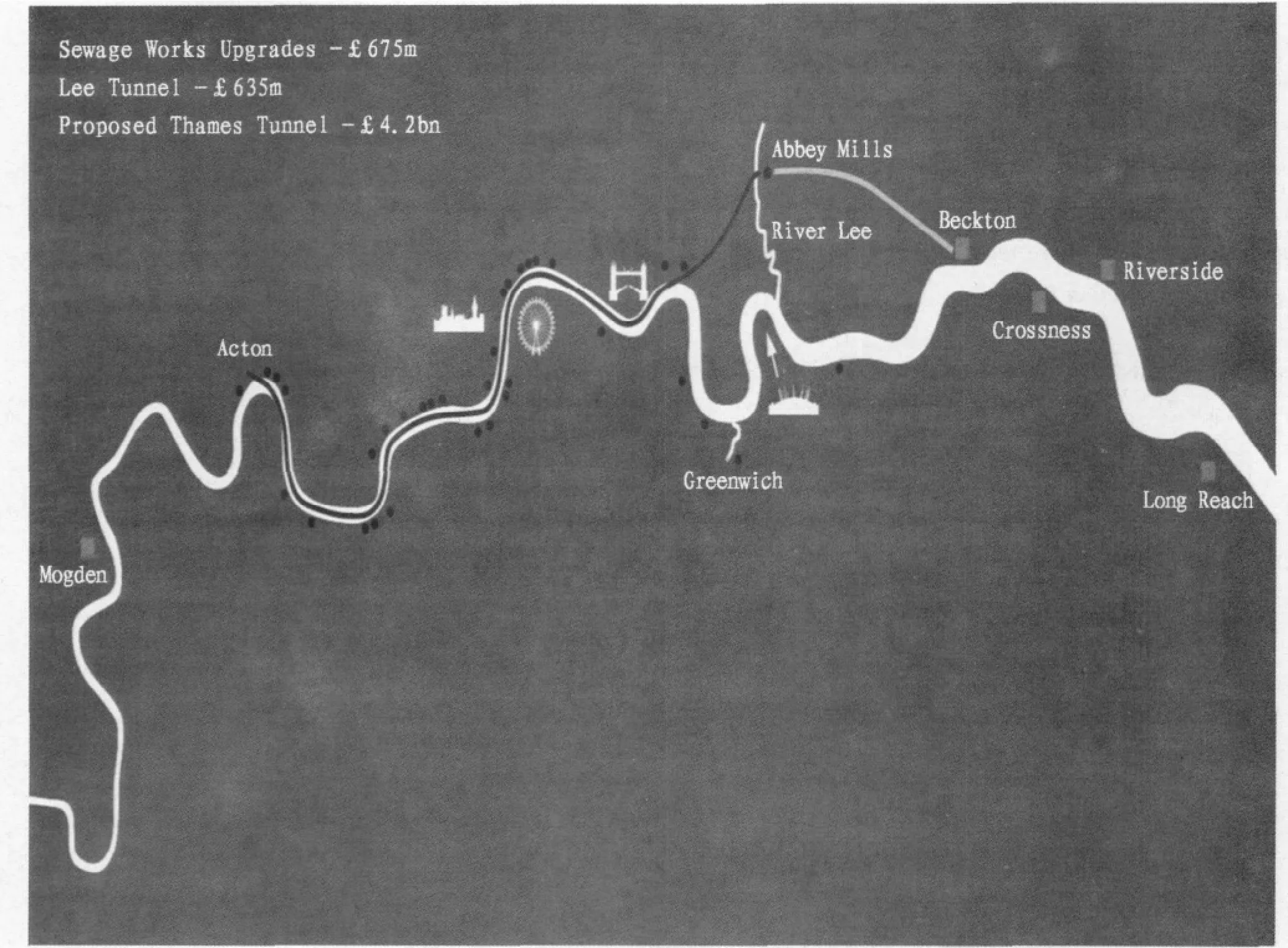
Fig.1 London Tideway Project
3)Entire storage space of 382 000 m3provided by both the tunnel and shafts.
4)Up to 75 m underground with an internal diameter of 7.2 m.
5)4 no deep shafts up to 38 m in diameter.2.1.3 Contents of Phase 1 Contract
The Phase 1 Contract was let in 2010 as follows:
1)635 million project-largest contract the UK water industry has ever awarded(£ 420 million).
2)French UK Joint venture comprising Morgan Sindall,Vinci Construction Grands Projets and Bachy Soletanche(MVB).
3)500 staff(including labour)at peak construction.
4)Target Cost Contract.
The Phase 1 project has 4 deep shafts(see fig.2)and are constructed using a primary shaft lining of diaphragm walls up to 98 m deep(see fig.3 and fig.4)and then a slip form lining as a secondary lining(see fig.5).The 6.9 km long tunnel will be built using an EPBM and precast concrete fibre reinforced lining segments with a secondary protection lining…
2.1.4 An innovative concept of shaft secondary lining
The Shaft Secondary Lining of the shafts used an innovative concept(see fig.6)as follows:
1)Formed as a concrete chimney.
2)External annulus of high flow concrete.
3)Avoids shrinkage cracking.
4)Avoids tension development.
5)Avoids future elastic shortening.
6)Design as plain concrete.
7)Slipforming possible.
8)Steel fibres to increase durability.
9)Saved approx.700 tonnes rebar per shaft.
2.2 Phase 2(London Tideway Tunnels)
2.2.1 Key featares of Phase 2
The key features of phase 2(London Thames Tideway Tunnel)are - -:see fig.1:
1)Size:20 km,7.2m diameter;5 km,6m diameter;4 km,5m diameter.
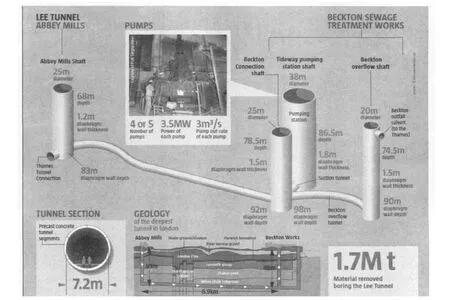
Fig.2 Phase 1 Tunnel(The Lee Tunnel)
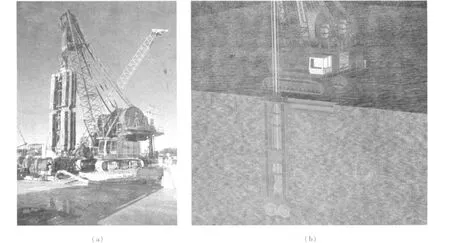
Fig.3 Excavation of diaphragm walls
2)Depth:Starts at around 30 metres,it will finish at 67 metres deep at Abbey.Mills Pumping Station.Falls one metre every 790 metres so it can be self-cleansing.
3)Width:7.2 metres internal diameter.
4)Capacity:1.5 million cubic metres(including Lee Tunnel)giving 48 hours storage.
5)Route:primarily follows the River Thames.
6)CSO control:21 connections to tunnel;13 flow controlled.
7)The Lee and ThamesTideway Tunnels will ensure that the UK can comply with the European Union’s Urban Waste Water Treatment Directive.
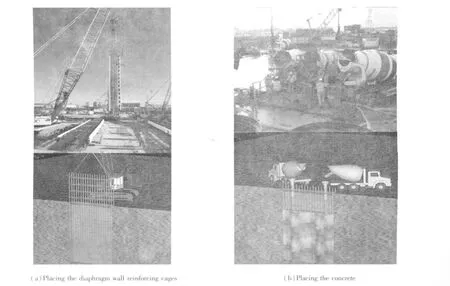
Fig.4 Diaphragm wall construction
2.2.2 Phase 2 Tunnel construction packaging strategy and scope
Three geographic delivery areas are aligned to main tunnel drives,western,central and eastern.Delivery areas will include drive shafts,interception shafts and connecting tunnels.Contracts will minimise interfaces between contractors.
The scope of the main works contracts will include:
1)3 tunnel&shafts contracts separated by geography and geology.
2)Complex interface with existing sewers to be undertaken by TW;all others by the tunnels&shafts contractors.
3)D & B contracts from scheme design.
4)Contractors fully responsible for all aspects of project within their geography.Including:① Design&build from a scheme design and minimum standards specification.② Design and procurement of the TBMs,tunnel linings,shaft construction.③ All logistics including river/road/rail transport of materials and excavated construction material.
2.2.3 Construction Programme for Phase 2
1)Planning process-complete 2015.
2)Land procurement-drive sites 2013.All other land 2015/16.
3)ITT-Q2 2013.
4)Contract award-2015.
5)Commence on site 2016.
3 Note
The owner,Thameswater,is seeking international interest from Contractors.Many European construction companies have expressed interest.The owner is interested to learn about Contractor/Supplier interest from Asian counties who have experience of major urban tunnel projects in complex soft ground conditions where the construction challenges have been similar to the London Tideway Tunnels Project.
For those interested in more information contact Keith Farley of Thameswater[Keith.Farley@tidewaytunnels.co.uk].
猜你喜歡
工程爆破(2022年3期)2022-07-26 01:58:56
工程爆破(2022年2期)2022-06-17 14:13:56
太空探索(2016年6期)2016-07-10 12:09:06
筑路機(jī)械與施工機(jī)械化(2015年11期)2015-07-01 16:28:43
筑路機(jī)械與施工機(jī)械化(2015年8期)2015-01-11 09:24:54
筑路機(jī)械與施工機(jī)械化(2014年10期)2014-03-01 03:01:59
筑路機(jī)械與施工機(jī)械化(2014年8期)2014-03-01 03:00:52
筑路機(jī)械與施工機(jī)械化(2014年7期)2014-03-01 03:00:16
筑路機(jī)械與施工機(jī)械化(2014年5期)2014-03-01 02:59:07
筑路機(jī)械與施工機(jī)械化(2014年4期)2014-03-01 02:58:34