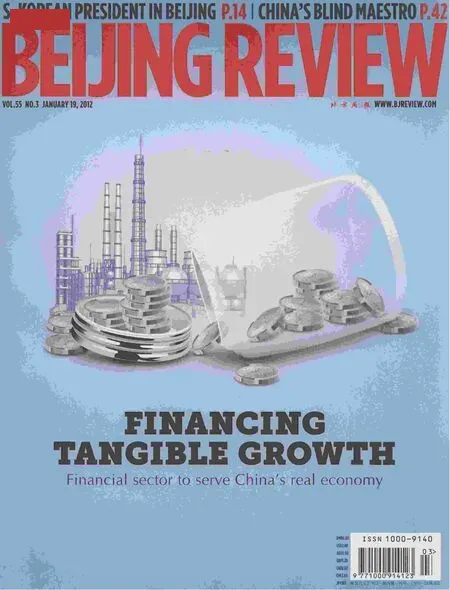
SETTING FINANCIAL TONES
2012-10-16 07:44:16ChinafinancialindustryfocusesonservingtherealeconomyByLanXinzhen
Beijing Review 2012年3期
China’s financial industry focuses on serving the real economy By Lan Xinzhen
COVER STORY
SETTING FINANCIAL TONES
China’s financial industry focuses on serving the real economy By Lan Xinzhen
The painful meltdown of Wall Street’s virtual economy has taught China a valuable lesson: Overexpansion of the virtual economy can have serious consequences.At the fourth National Financial Work Conference on January 6-7, Premier Wen Jiabao noted that the country should direct its capital into the real economy, clamp down on rampant speculation and avoid reckless expansion in the virtual economy.
This was the first time Chinese policymakers issued their concerns for the virtual economy. This warning is expected to help spare the country from a possible financial crisis like the United States experienced in 2008. The overwhelming financial disaster has taken a heavy toll on the world’s economy and its ripple effect remains a bottleneck choking growth of the world economy.
The National Financial Work Conference,held every five years, is China’s top-level financial meeting. It usually sets the tone for the country’s fi nancial policies and maps out major reform measures for relevant institutions.
China has hosted the conference three times since 1997. But this time, both domestic and overseas financial landscapes have changed significantly. The European debt crisis is unlikely to be fixed any time soon,though it is less likely to deteriorate. That means China needs to put up defenses against external risks. Domestically, the country’s fi nancial safety faces several looming threats,such as default risks of local government’s fi nancing vehicles, regional property bubbles,waning external demands and abrupt cross-border capital fl ows.

FAST ROLLING: A worker at the Zhejiang Yongxin Group plant, a leading textile manufacturer in China
Obviously, those risks have been the top concern for policymakers. How to ensure financial stability and safety became a hot issue at the conference.
Zhao Xijun, Deputy Director of the Financial and Securities Institute at the Renmin University of China, praised the government’s call for closer links with the real economy.
“The experiences of advanced economies have showed that risks would escalate if fi nancial institutions only focused on speculative trading and product design, instead of services for the real economy,” he said.
Guo Tianyong, Director of the Research Center of China’s Banking Industry under the Central University of Finance and Economics,said the conference sent out a strong signal that the top priority of the fi nancial industry is to better serve the real economy.
“Another focus is how to lift the ef fi ciency and service level of the fi nancial industry without igniting risks,” he said.
“To achieve that, policymakers must encourage private investors to play a bigger role in the sector,” added Guo. “But financial institutions must not decouple from the real economy.”
Marketization of interest rates and bond market reform were not discussed at the conference, despite expectations that these issues would come up in talks.
Zhou Xiaochuan, Governor of the People’s Bank of China, the central bank, told Xinhua News Agency that China has been pushing marketization of interest rates, but the sequence of the steps should be aligned in line with domestic of our economy,” said Zhao Qingming,a researcher with the China Construction Bank.

A HELPING HAND: Business owners in Nantong, Jiangsu Province, talk to employees of guarantee companies at a government-held monthly meeting aimed at providing better services to fi nancially strained small businesses
Major commercial banks are already taking steps to optimize services for the real economy. Shang Fulin, Chairman of the China Banking Regulatory Commission(CBRC) told Xinhua News Agency that the real economy and banking industry cannot prosper without support from each other.
“Looking ahead, the CBRC will require banks to optimize their credit structure, bolster service quality and ensure credit capital goes into the real economy,” he added.
Yang Kaisheng, President of the Industrial and Commercial Bank of China,said the bank will strengthen efforts to better shore up the weak links of the national economy.
Unsolved problems
As the lingering effect of the financial crisis clouds the world economy, China’s financial industry is also facing growing uncertainties. Expectations abounded that and overseas economic situations.
“First of all, we have to deepen reforms to make fi nancial institutions meet the required accounting standards,” he said.
“China’s large commercial banks have completed shareholding reforms and listed their stocks, paving way for interest rate marketization,” added Zhou. “But now is not a good timing to actually push through the marketization reform.”
“In response to the fi nancial crisis, some developed countries have kept their interest rates at zero level. So if China now allows its interest rates to freely float, that will cause some acute problems such as dramatic capital fl ows,” he said.
Growing demands
China is currently at a stage of rapid industrialization and urbanization, which requires heavy investments from enterprises. That partly explains why many Chinese fi rms have been reeling from debt.Adding fuel to their woes is a weak ability to fi nancing.
Last year, newspapers were flooded with reports about serious credit contagion of private firms in Wenzhou, Zhejiang Province, a boomtown of China’s private economy. The incident raised worries over the survival of small businesses and economists have been calling for greater capital support for them.
The question has become: How can these fi nancially strained enterprises be helped?
Since Chinese regulators have tightened rules for stock issuance, it is harder for fi rms to raise capital from the stock markets.Meanwhile, the companies have limited access to market fi nancing tools, such as private equity funds, industry investment funds, insurance funds and trust funds.
Without doubt, banks remain the most reliable source of fi nancing for enterprises.Between 1997 and 2007, Chinese banks extended more than 3 trillion yuan ($473.93 billion) to state-owned enterprises (SOEs),accounting for around 25 percent of the total increased capital of SOEs, according to data from the central bank.
As a result, the banks are expected to shoulder the responsibility of providing capital to the real economy.
“Requiring the fi nancial industry, especially the banking sector, to service the real economy is a decision based on past experiences of Western countries and actual needs the country will deepen financial reforms in response to the simmering risks. Some economists even suggested the government establish a powerful commission that supervises and manages fi nancial assets of the country.
But the latest National Financial Work Conference did not put emphasis on reforms as expected and the proposal of establishing a financial assets supervision and administration commission was not discussed,either.
Meanwhile, problems of the banking system are coming under the spotlight. In the past few years, China’s banks helped lift the economy out of a downturn by staging a significant lending spree. They dodged external shocks thanks to the government’s controls on capital accounts. But risks of local government debts are looming large,raising concerns over assets quality of the banking system. In terms of credit allocation, commercial banks prefer large SOEs to private ones. But that preference will obviously produce a negative impact on longterm growth of the economy.
“To address those issues, China needs to press ahead with fi nancial reforms,” said Zhao Xijun. “But the reforms may encounter oppositions from vested interest groups, including SOEs, which have easily obtained bank loans at lower interest rates. The reforms may even lead to a tussle between supervision departments,” he said.
In addition, China’s fi nancial sector is far from perfect. Corporate governance and risk management of financial institutions need further improvement. Meanwhile, sluggish development of rural finance and small and medium-sized financial institutions remains an acute concern. The country also has a lot to do to better coordinate fi nancial policies with industry policies.
China may have to wait until the next National Financial Work Conference to take heavier measures to tackle those problems.