神經元壽命不受原有宿主壽命限制
2013-01-31 09:06:24
中國科技信息 2013年8期
神經元壽命不受原有宿主壽命限制
最近,意大利帕維亞大學和都靈大學的科學家通過實驗證明,神經元的壽命不受生物最大壽命極限的限制,但它必須被移植到一個壽命更長的宿主身上,此時它的壽命能超過原來生物的壽命持續下去。相關論文發表在美國《國家科學院學報》上。
帕維亞大學的洛倫佐·馬格雷希和同事利用一種腦細胞移植技術,在胸腺發育完成之前就把小鼠胚胎的小腦前體移植到另一種壽命更長的大鼠腦中,大鼠腦部正處于發育期。結果發現,移植到大鼠腦中的小鼠神經元能存活3年之久,這是小鼠平均壽命的兩倍。
小腦神經元的樹突、樹突棘和突觸會隨正常老化而大量損失。馬格雷希說:“我們移植了小鼠的浦肯野細胞(Purkinje Cell),以確定樹突棘密度降低的速率究竟是跟小鼠還是大鼠自身的浦肯野細胞一樣。”浦肯野細胞是從小腦皮質發出的唯一能傳出沖動的神經元,有許多擴展分支。“結果表明,移植細胞的老化性樹突棘損失速度變得更慢,和壽命更長的大鼠一樣,相比于小鼠的老化而言,這達到了一種不受限制的水平。”
研究人員指出,這表明神經元的存活和老化是同時發生的,但卻是各自獨立的過程,延長機體壽命未必會導致大腦的最終耗竭。這為通過飲食、運動和藥物干預等措施來延長生物壽命帶來了更多希望。
馬格雷希說,即使考慮了明顯的種間差異,實驗結果也能推廣到人類和其他壽命更長的物種身上。通過延長平均生物壽命的方法來延長生命,不一定會出現生物在其壽命還很長時,腦中神經元就已所剩無幾的情況。
研究小組還打算從蛋白質組水平實施宿主和移植細胞的顯微切割,以研究是什么原因導致了樹突棘損失變慢。馬格雷希指出:“如果能發現某個或某些因素導致了這些變化,就有希望開發出更有效的藥物,治療所有病理性神經組織退化。這種退化開始于突觸連接減少,在生物壽命結束前神經元就已經死了。”他們還在用不同種系的轉基因小鼠實驗異種移植,這些小鼠的老化路徑已經被改變。
Separate lives: Neuronal and organismal lifespans decoupled
Replicati ve aging (also known as replicative senescence) causes mammalian cells to undergo a process of growth arrest dependent on telomeres (the shortening of repeated sequences at the ends of chromosomes). Neurons, on the other hand, are exempt from aging,and so the questi on of their actual lifespan has remained unanswered.Recently, however, scientists at the University of Pavia and the University of Turin demonstrated that neuronal lifespan is not limited by the organism's maximum lifespan but, remarkably, conti nues when transplanted in a longer-living host. The researchers accomplished this by transplanting embryonic mouse cerebellar precursors into the developing brain of longer-living rats, in which the grafted mouse neurons survived for up to three years – twice the average lifespan of the donor mice.
Dr. Lorenzo Magrassi discussed the challenges he and his colleagues, Dr. Ketty Leto and Dr. Ferdinando Rossi,encountered in their research."Cell transplantation into the developing rat brain is a technique that was originally developed by us and other research groups in the early nineties of the last century,"Magrassi tells Medical Xpress. "In recent years, we improved the protocol that, now standardized,allows reliable implantation rates with good survival rates." While not all implanted embryos develop into adult animals carrying a viable transplant, Magrassi adds,the percentage of those that do is sufficient to plan a long-term survival experiment involving roughly 100 such successfully-born animals.
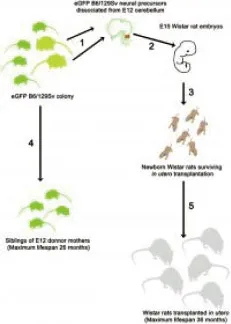
In addressing these challenges, Magrassi says that together with the intrinsic bonus of studying cells inside the nervous system, which is immunoprivileged,they transplanted cells before development of the thymus (a specialized organ of the immune system) was complete. The latter can help induce immunological tolerance in the host to the engraft ed cells.
One remaining question is if their research can potentially be extended to determine whether or not a maximum lifespan exists for any postmitotic mammalian cells – Including neurons. "Similar techniques can, in principle,be extended to other organs containing perennial cells,"Magrassi notes, "but we don't have direct experience with injecting cells into organs outside of the central nervous system." Since the central nervous system is privileged compared to other organs that are more prone to immunological surveillance and attack, a major problem when transferring their experimental paradigm to other organs, he explains, could be an increase in immunological problems.
The scientists say their results suggest that neuronal survival and aging are coincidental but separable processes, thus increasing the hope that extending organismal lifespan by dietary,behavioral, and pharmacologic interventions will not necessarily result in a neuronally depleted brain. "Even after taking into account the obvious species differences, our results in rodents can be extrapolated by analogy to humans and other longerliving species where this sort of experiment is impossible," Magrassi explains. "Our fi ndings suggest that extending life by extending average organismal lifespan – a hallmark of all technologically advanced societi es – will not necessarily result in neuron-impoverished brains well before the longer-living individual dies." This bodes well for those studying life extension: Their eff orts are not intrinsically futi le, Magrassi notes, because in the absence of pathology, prolonging life span does not necessarily mean dementia due to widespread loss of neurons,as many people sti ll think.
猜你喜歡
興趣閱讀·興趣作文與閱讀(低年級)(2025年8期)2025-08-18 00:00:00
天天愛科學(2022年9期)2022-09-15 01:12:54
天天愛科學(2022年4期)2022-05-23 12:41:48
當代水產(2022年3期)2022-04-26 14:26:56
科學大眾(2021年9期)2021-07-16 07:02:54
軍事文摘(2020年20期)2020-11-28 11:42:50
學苑創造·A版(2020年9期)2020-10-13 09:41:02
航空世界(2020年10期)2020-01-19 14:36:20
小學生學習指導(低年級)(2017年10期)2017-10-10 01:00:05
云南中醫學院學報(2014年3期)2014-07-31 18:57:34