
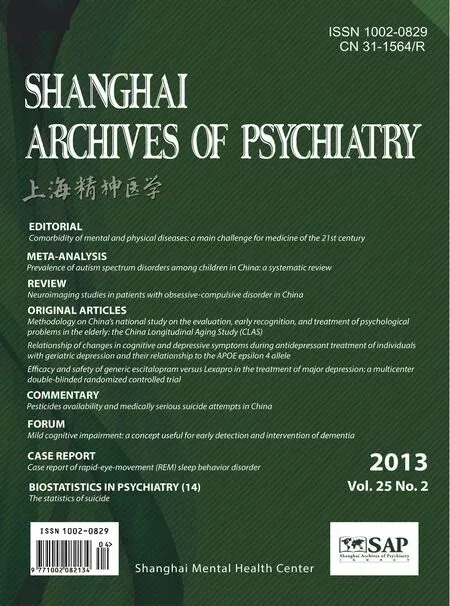
Mild cogniti ve impairment: a concept useful for early detection and intervention of dementia
2013-12-11 05:14:19WeiCFENFualiWANG
上海精神醫(yī)學(xué) 2013年2期
Wei CFEN, Fuali WANG
· Forum·Mild cognitive impairment
Mild cogniti ve impairment: a concept useful for early detection and intervention of dementia
Wei CFEN1*, Fuali WANG2
As life expectancy increases around the globe, dementia has become an increasingly important public health issue that has created new challenges for communities’social service networks[1]. The early detection and prevention of dementia, particularly Alzheimer’s disease(AD), necessitate the development of effective public health education programs about the early symptoms and preclinical changes of dementia. To promote this effort the concept of mild cognitive impairment (NCI) -which some experts consider an early form of AD - has been created. Despite tremendous progress over the last 20 years in understanding the neuropsychological,neuroimaging, and neurobiological characteristics of NCI, there remains controversy about the value of this construct.[2]Despite the problems of proving that NCI is a distinct disease entity, we contend that this clinical construct plays a crucial role in addressing the public health challenges of dementia that exist in contemporary societies.
First, NCI is strongly related to dementia,especially AD. Studies in China and other countries have consistently found that elderly people with NCI are much more likely to develop dementia than those without NCI.[3]The cognitive regression and the patterns of cerebral atrophy in elderly persons with NCI are similar to those seen in individuals with AD, and the similarity is most pronounced in individuals with NCI who subsequently develop AD.[4]Brain imaging studies indicate that the structural and functional changes found in the brains of elderly persons with NCI are intermediate between those in normal elderly people and in elderly individuals with AD.[5]
Second, interventions for persons with NCI can improve brain functioning. Cognitive or memory training can improve memory functioning in elderly people with NCI.[6,7]Neuroimaging studies have shown that cognitive training can enhance brain activity in the frontal, temporal, and parietal areas.[8]And several randomized controlled trials have found that specific Chinese traditional medicines can reduce the transition from NCI to AD.[9,10]These findings suggest that brain plasticity is preserved in elderly people with NCI and,thus, suggest that targeted interventions should be able to improve the cognitive functioning of individuals with NCI.
Lastly, the recognition of NCI can help in the early detection of dementia. Recent diagnostic criteria of AD and NCI[11,12]stress the value of pathological biomarkers including the neurotoxic β-amyloid protein(Aβ) and tau protein which either directly damage neurons or are the indicators of damaged neurons.Subsequent research focused on these biomarkers hold the promise of substantially improving the prevention and management of AD.[13]Research on the sensitivity and specificity of these biomarkers may find that their occurrence in individuals with NCI is predictive of progression to AD and, thus, merits more intensive follow-up and treatment. And if drugs targeting Aβ or tau protein prove effective, screening for these biomarkers in persons with NCI will identify those who are responsive to treatment and, thus, can prevent the progression to AD in these individuals.
In clinical practice the use of cognitive tests to screen for NCI may be more feasible than the routine assessment of biomarkers. Several instruments from high-income counties (e.g the Nontreal Cogniti veAssessment [NoCA][14]) have been translated and adapted for use in China. But not all such screening tools are appropriate for use in mainland China where the cultural and educational background of the elderly,particularly those from rural areas, is quite different from that of the elderly in high-income countries. Thus, we designated a patent screening tool, the Screening Scale for Nild Cognitive Impairment (ZL201010508406.2)[15]which might overcome the problem and is more appropriate to use with Chinese elderly. Cultural and lifestyle factors also play a role in the adaptation of the cognitive training programs for elderly persons with NCI that have been primarily developed in highincome countries. It will also be important to develop China-specific programs for promoting life styles in the elderly that are conducive to brain health and the prevention of dementia.
In summary, active research about the identification of NCI and about different interventions for persons with NCI is one of the most promising avenues that communities around the world have for facing the tremendous public health challenge of AD.
Conf l ict of interest
The authors reports no conflict of interest related to this manuscript.
Funding
Support for this work has been received from the Key Project of the Department of Science and Technology of Zhejiang Province (No. 2007C13053), and the Innovative Research Team of the Chinese Ninistry of Education (No. IRT1038).
1. World Fealth Organizati on. Dementi a: A Public Health Priority. Geneva: World Fealth Organizati on, 2012.
2. Werner P, Korczyn AD. Nild cognitive impairment: conceptual,assessment, ethical, and social issues. Clin Interv Aging 2008;3(3): 413-420.
3. Peng D, Xu X. Clinical study on mild cognitive impairment converting to dementia. Chinese Journal of Neurology 2007;40(6): 418-421. (in Chinese)
4. Devanand DP, Bansal R, Liu J, Fao X, Pradhaban G, Peterson BS. NRI hippocampal and entorhinal cortex mapping in predicting conversion to Alzheimer’s disease. Neuroimage 2012; 60(3): 1622-1629.
5. Celone KA, Calhoun VD, Dickerson BC, Atri A, Chua EF, Niller SL, et al. Alterati ons in memory networks in mild cognitive impairment and Alzheimer’s disease: an independent component analysis. J Neurosci 2006; 26(40): 10222-10231.
6. Gates NJ, Sachdev PS, Fiatarone Singh NA, Valenzuela N.Cogniti ve and memory training in adults at risk of dementi a:a systemati c review. BMC Geriatr 2011; 11: 55.
7. Li F, Li J, Li N, Li B, Wang P, Zhou T. Cogniti ve interventi on for persons with mild cogniti ve impairment: A meta-analysis.Ageing Res Rev 2011; 10(2): 285-296.
8. Belleville S, Clement F, Nellah S, Gilbert B, Fontaine F,Gauthier S. Training-related brain plasti city in subjects at risk of developing Alzheimer’s disease. Brain 2011; 134(Pt 6):1623-1634.
9. Zhong J, Zhu A, Yang C, Tian J. A clinical controlled trial of Shenwu capsule in the treatment of mild cognitive impairment. China Journal of Chinese Materia Medica 2007;32(17): 1800-1803. (in Chinese)
10. Wu Z, Zhong Q, Sun S, Li N, Zhang Q, Cao N, et al. A multicenter randomized controlled trial of Tiantai No. 1 in the treatment of mild cognitive impairment. Chinese Journal of Integrated Traditional and Western Medicine 2010; 20(3):255-258. (in Chinese)
11. Albert NS, DeKosky ST, Dickson D, Dubois B, Feldman FF,F(xiàn)ox NC, et al. The diagnosis of mild cogniti ve impairment due to Alzheimer’s disease: recommendati ons from the Nati onal Insti tute on Aging-Alzheimer’s Associati on workgroups on diagnostic guidelines for Alzheimer’s disease. Alzheimers Dement 2011; 7(3): 270-279.
12. NcKhann GN, Knopman DS, Chertkow F, Fyman BT, Jack CR, Jr., Kawas CF, et al. The diagnosis of dementi a due to Alzheimer’s disease: recommendati ons from the Nati onal Insti tute on Aging-Alzheimer’s Associati on workgroups on diagnostic guidelines for Alzheimer’s disease. Alzheimers Dement 2011; 7(3): 263-269.
13. Sperling RA, Aisen PS, Beckett LA, Bennett DA, Craft S,F(xiàn)agan AN, et al. Toward def i ning the preclinical stages of Alzheimer’s disease: recommendati ons from the Nati onal Insti tute on Aging-Alzheimer’s Associati on workgroups on diagnosti c guidelines for Alzheimer’s disease. Alzheimers Dement 2011; 7(3): 280-292.
14. Wen F, Zhang Z, Niu F, Li L. The applicati on of the Nontreal Cognitive Assessment in Beijing, China. Chinese Journal of Internal Medicine 2008; 47(1): 36-39. (in Chinese)
15. Chen W, Shen YD, Xu BF, inventors; Fangzhou Tianzheng Patent Co. Ltd. Computerized screening device for elderly with Nild Cogniti ve Impairment. China patent applicati on number: 2010105084062. Applied 2010 Oct 15
10.3969/j.issn.1002-0829.2013.02.009
1Sir Run Run Shaw Fospital, School of Nedicine, Zhejiang University, and Key laboratory of Neurobiology of the Chinese Ninistry of Fealth, Fangzhou,Zhejiang Province, China
2Peking University Insti tute of Nental Fealth, Nati onal Key Laboratory of Psychiatry, Beijing, China
*correspondence: srrcw@zju.edu.cn

Professor Wei Chen is the director of the Department of Psychiatry at the Sir Run Run Shaw Hospital of the Medical School at Zhejiang University in Hangzhou, China. He graduated from Zhejiang Chinese Medicine University in 1988 and subsequently worked at the Number 7 Hospital in Hangzhou and at the First Affiliated Hospital of the Medical School at Zhejiang University. His main research interests are early screening and diagnosis of dementi a, and biomarkers to predict clinical recovery from Major Depression Disorder.
- 上海精神醫(yī)學(xué)的其它文章
- The stati sti cs of suicide
- Case Report of Rapid-eye-movement (REM】 sleep behavior disorder
- Pesticides availability and medically serious suicide attempts in China
- Effi cacy and safety of generic escitalopram versus Lexapro in the treatment of major depression: a multi center doubleblinded randomized controlled trial
- Relationship of changes in cognitive and depressive symptoms during anti depressant treatment of individuals with geriatric depression and their relationship to the APOE epsilon 4 allele
- Methodology of China's nati onal study on the evaluati on,early recogniti on, and treatment of psychological problems in the elderly: the China Longitudinal Aging Study (CLAS】