
A Speedier Era
2013-12-29 00:00:00ByZhouXiaoyan
Beijing Review 2013年43期
Imagine this: At a blink of an eye you can download a song. In several seconds an episode of your favorite TV show. In less than a minute a high-definition movie. No, you are not dreaming. You can do all those with a cellphone in hand, with budding ultra-fast 4G mobile Internet services throughout China.
When it comes to mobile Internet speed, there’s no such thing as too fast. As subscribers continue to have high expectations for faster speeds, China’s major telecom operators—China Mobile, China Unicom and China Telecom—are scrambling against time to roll out trial 4G services, as the country’s telecom supervisory authority pledged to issue official 4G licenses to operators by the end of the year. Foreign and domestic telecom equipment providers and smartphone vendors are also preparing for the upcoming 4G era in a bid to grab a wider market share in the world’s largest mobile market.
4G fever
4G, or the fourth generation of mobile networks, promises mobile technology for faster Internet speeds. According to a definition by the International Telecommunication Union (ITU), any wireless data network with a speed above 100 megabytes per second can be called 4G.
4G mobile network services have stirred a frenzy globally. According to the Global mobile Suppliers Association (GSA), an organization aimed at promoting mobile Internet standards, 175 commercial Long-Term Evolution (LTE) networks had been launched in 70 countries as of May 2013. LTE is the mainstream technology used for 4G mobile network services. The number of countries with commercial LTE services almost doubled from May 2012 to May 2013. The GSA also forecasts 248 commercial LTE networks in 87 countries by the end of 2013.
China’s three telecom operators are all actively laying out their strategies for LTE 4G technology, as Minister of Industry and Information Technology Miao Wei said the country is expected to award 4G licenses to domestic telecom operators by the year’s end. China Mobile, the world’s biggest telecom operator by subscribers, has always been an aggressive promoter of Time-Division LTE (TD-LTE), a homegrown 4G technology.
China Unicom and China Telecom, the two smaller operators, have expressed their willingness to adopt Frequency-Division Duplex LTE(FDD-LTE) technology, or at least to build a converged network under both standards.
Unlike the wide-range adoption of FDD-LTE technology, the deployment of homegrown TD-LTE commercial networks is still limited.
The vast majority of network deployments use the FDD-LTE standard in an unpaired spectrum. Among the total 175 commercial LTE networks that have been launched, only 16 use TD-LTE systems, including six that have been deployed within combined TD-LTE and FDDLTE operations, according to the GSA.
China, however, favors TD-LTE because the network’s core technologies are developed by Chinese companies and sees TD-LTE as a success in technology innovation. It has pledged preferential policies for its further development. The move is understandable in a country that is focused on creating its own technology—and therefore its own independence—from social media to search engines, from space technology to grain production.
A race for all
The major telecom players in China are all proactively engaged in pre-commercial LTE pilot trials, tests or studies, in the hunt for a share in the world’s largest 4G market with more than 10 billion mobile phone subscribers. The pending 4G market is bound to ignite hot competition among telecom operators, telecom equipment providers and smartphone vendors.
China Mobile has rolled out large-scale 4G TD-LTE trials in cities including Beijing, Shanghai, Guangzhou of Guangdong Province and Qingdao of Shandong Province. The company, which boasts more than 726 million users, will increase spending by 50 percent this year on the construction of 4G networks to reach 100 cities by the end of the year, with 200,000 base stations covering 500 million people. It is set to acquire more than 1 million TD-LTE terminals in 2013, according to Xi Guohua, Chairman of China Mobile.
During the pilot 4G rollout, China Mobile is charging less for its 4G service than its 3G one, in an effort to gain more subscribers and tempt current 3G users to make the switch. The number of China Mobile 4G subscribers is forecast to reach 228.8 million in 2017, representing 52 percent of China’s 439.9 million total 4G users, according to estimates by market research firm IHS iSuppli.
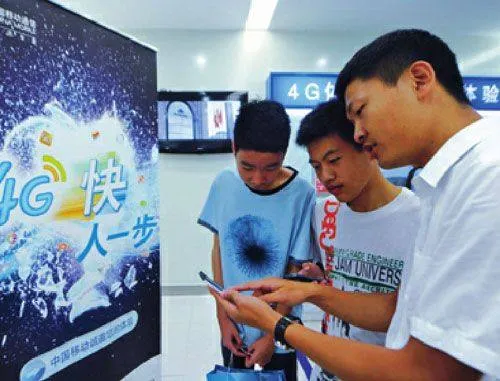
The enthusiasm of China Mobile to promote 4G has been partly fueled by the fact that its market share has been chipped away by its two rivals since 3G licenses were issued in 2009. China Mobile’s market share plunged because it adopted a homegrown TD-SCDMA (time division-synchronous code division multiple access) 3G network, which is less commercially mature compared with the other two Western standards adopted by China Telecom and China Unicom.
China Mobile’s total user base of 726 million is far ahead of China Unicom (251 million subscribers) and China Telecom (168 million). But the gap is narrowed regarding 3G users with Mobile holding 115 million compared to Unicom’s 88 million and Telecom’s 78 million.
High-level executives from China Unicom and China Telecom also revealed they are conducting 4G trials to prepare for a likely business war.
China Unicom has started testing a TD-LTE 4G network, which it will use if the government doesn’t grant it a license for its favored FDDLTE technology. China Unicom’s infrastructure mainly supports FDD-LTE, the world’s dominant 4G technology.
China Telecom said it prefers an FDD-LTE license and would rent China Mobile’s TD-LTE infrastructure if necessary.
Global telecom equipment giants, including Huawei, ZTE, Ericsson AB, Nokia Siemens Networks and Alcatel-Lucent SA, as well as the world’s leading chipset and device manufacturers such as U.S.-based Qualcomm Inc. and South Korean company Samsung Electronics Co., are preparing to do battle in China over the 4G market as well.
4G mobile phone vendors are eagerly rubbing their hands too. Foreign smartphone vendors, such as Samsung and Sony, and domestic smartphone makers, such as ZTE, Coolpad, Lenovo and Huawei, have all launched 4G smartphone models catering to the LTE 4G standard.
Analysts say global smartphone makers like Samsung and Apple have accumulated much 4G experience because they have launched many 4G models in foreign markets. Their edge in technology will make it easier to launch new 4G models in China. Domestic smartphone vendors, on the other hand, are playing catch up.
Chen Zhigang, an expert in telecommunications, said the 4G era is just around the corner.
“The commercial use of 4G mobile Internet services is about to happen, signaling a business reshuffle in the telecom market. All industry players, including operators, equipment providers and smartphone vendors, have to think ahead and conduct their business plans accordingly.
“Otherwise, they will be wiped out of the market in no time.”
