
Commentary on: “Facilitating transparency in spinal cord injury studies using data standards and ontologies”
2014-01-21 21:45:18DianeSnow
中國神經再生研究(英文版) 2014年1期
Diane M. Snow
Spinal Cord and Brain Injury Research Center (SCoBIRC), Department of Anatomy and Neurobiology, The University of Kentucky, Lexington, KY, USA
Commentary on: “Facilitating transparency in spinal cord injury studies using data standards and ontologies”
Diane M. Snow
Spinal Cord and Brain Injury Research Center (SCoBIRC), Department of Anatomy and Neurobiology, The University of Kentucky, Lexington, KY, USA
Commentary
Most would agree that providing comprehensive detail in scienti fi c reporting is critical for the development of meaningful therapies and treatments for diseases. Such stellar practices 1) allow for reproduction of experiments to confirm results, 2) promote thorough analyses of data, and 3) foster the incremental advancement of valid approaches. Unfortunately, most would also agree we have far to go to reach this vital goal (Hackam and Redelmeier, 2006; Prinz et al., 2011; Baker et al., 2014).
The clinical community has been held to a high standard (e.g., common data elements (CDE), see http://www.commondataelements.ninds.nih.gov; also see Moher et al, 2001 and updated in Moher 2010; and Anderson et al, 2005). Slow to follow, there has been a momentum more recently toward improving the rigor applied to the conducting and reporting of basic science research. A major goal has been to demand improved experimental design, to apply more rigorous methodology standards, to use best practices throughout, and to apply a more thorough and precise reporting of not only positive results, but negative data as well. For example, in 2012, the National Institute of Neurological Disorders and Stroke (NINDS) brought together a group of 36 “academic researchers and educators, reviewers, journal editors and representatives from funding agencies, disease advocacy communities and the pharmaceutical industry” to formulate and publish a recommendation concerning the methodological reporting of animal studies (Landis et al., 2012). This extensive and diverse team concluded that “sample-size estimation, whether and how animals were randomized, whether investigators were blind to the treatment, and the handling of data” were required, at a minimum. They encapsulated their recommendations as a “core set of reporting standards for rigorous study design”, the goal of which was to improve the quality of research as well as the predictive capacity of such studies for clinical trials. For successful translation of scienti fi c discoveries to clinical applications based on animal research, this type of effort must apply to all scienti fi c documentation.
As one means of achieving this over-arching goal, there has been a call for professional societies to highlight the issue in their various scienti fi c communities – a sort of “grass roots effort”. Important projects that arose from such endeavors and serve as future models are the MIBBI (Taylor et al., 2008) and the MIAME (Brazma et al., 2001).
One community that has wholly embraced this sweeping effort is related to nervous system injuries, i.e., traumatic brain injury (TBI), spinal cord injury (SCI), and peripheral nerve injury. For example, in 2003, a major project was adopted by the NINDS to replicate a number of leading SCI studies. Researchers from three leading SCI research centers performed replication experiments to validate results from original studies and showed an alarmingly high failure of con fi rmation. Explanations centered on inadequate reporting of details, such as issues related to animal use, injury methods, and reagents (Steward et al., 2012).
Given the movements described above and to build on these innovative and important efforts, Lemmon, Bixby and Visser report on a project they are leading, the Minimal Information About a Spinal Cord Injury project (MIASCI), designed to improve reporting standards for SCI animal studies. MIASCI began in 2011 with 35 scientists from the US and Japan (Growth Cones and Axon Regeneration: Entering The Age of Informatics.) One outcome of this effort was a table of > 250 data elements for consideration. The authors conclude that adherence to such a metadata report by SCI researchers could successfully address many of the recommendations called for by Landis et al. (2012).
Insights from this effort led Lemmon and colleagues to a series of logical predictions: as detailed and transparent reporting improves, as it must, such a change will foster the adoption of more rigorous approaches to research in general, which will in turn lead to a drastically increased amount of SCI-related information being published each year. Such increased reports will bring a necessity for even greater data mining and better methods of bioinformatic analyses.
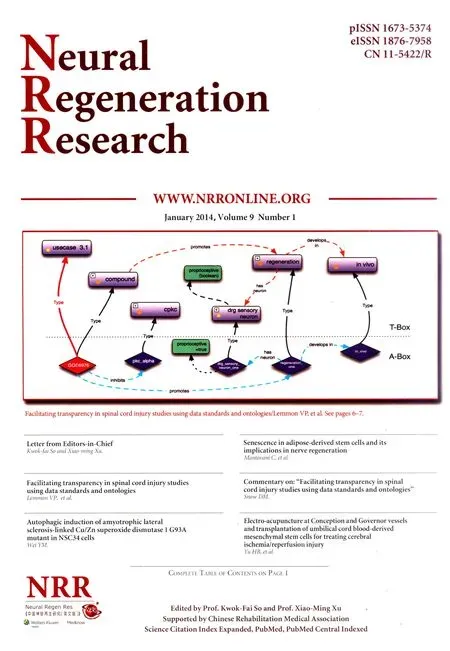
To address this “SCI data fl ood”, Lemmon and colleagues are embarking upon an ontology engineering project called the RegenBase Ontology, which seeks “to develop an information framework and knowledge base to facilitate research about nervous system regeneration.” According to their current report, the long-term goal of the RegenBase Ontology is to “connect information about SCI experiments to information about biological processes, molecular networks and high-throughput screening data to speed the identi fi cation and testing of novel therapeutics.” As evidence of the usefulness of the system, as well as the need for an abundance of user input and feedback, the authors cite an example of discovery using this ontology. They have successfully queried the knowledge base for PKC inhibitors that promote regeneration of sensory neurons (see Figure 1 on page 15 in this issue), and obtained an answer to the speci fi c question:“What compounds that inhibit cPKC promote regeneration of proprioceptive DRG neurons in vivo?” Using a descriptive logic (DL) reasoning engine, they found that a compound called G?6976 satisfied this query. This is just one of the exciting demonstrations of how this engine can rapidly provide useful data from an otherwise overwhelming and unmanageable set of factors.
As a testament to the importance of this work, the 2013 National Neurotrauma Society conference in Nashville, TN, held a special symposium as part of its annual meeting entitled, “High Throughput Technologies”. Presenters in this session included Dr. Barbara Grimpe from the Heinrich Heine University, Düsseldorf, Germany (“Knowledge Database: The Path to Understand Regeneration Failure”), Dr. Nigam Shah of Stanford University (“Speeding Translational Research Using Bio-ontologies”), and Dr. Vance Lemmon of the Univ. of Miami, Miller School of Medicine (“Regen-Base: A Searchable Knowledgebase to Organize Regeneration Knowledge via Ontologies”). This session generated what was undoubtedly the greatest audience participation of the conference, pointing to the support and interest this topic elicits. Dr. Lemmon has been invited recently to share this and similar reports worldwide.
Conclusion
There is clearly a major impediment to achieving advancement from “bench to bedside” in both the SCI community, and beyond. Efforts to rectify the situation will require perhaps Herculean efforts on numerous fronts - from researchers, to reviewers, to publishers, to leaders in the execution of clinical trials (Landis et al., 2012). While these efforts are paramount and should go forth with gusto and full-scale cooperation from the scientific community, there is still some doubt as to whether the level of detail and compliance to standardization required for success will be possible. For example, although the data elements recommended by Lemmon and colleagues include animal model and strain used, Basso et al. (2006) showed a differential motor recovery response to SCI in inbred or genetically engineered mouse strains and cautioned that inherent genetic factors significantly impact motor recovery and must be fully considered to accurately interpret results. It is dif fi cult to imagine that numerous individual strains of each experimental animal will be accounted for in experimental design and taken into consideration in each set of analyses. However, such caveats with standing, we should strive to come as close as possible to the goal of standardization, and to adhere to minimal information standards in SCI research, as suggested by Lemmon et al. in “Facilitating transparency in spinal cord injury studies using data standards and ontologies”. Such compliances will likely take us miles closer to comprehending the complex biochemical interactions that are involved in regeneration failure.
Anderson DK, Beattie M, Blesch A, Bresnahan J, Bunge M, Dietrich D, Dietz V, Dobkin B, Fawcett J, Fehlings M, Fischer I, Grossman R, Guest J, Hagg T, Hall ED, Houle J, Kleitman N, McDonald J, Murray M, Privat A, et al. (2005) Recommended guidelines for studies of human subjects with spinal cord injury. Spinal Cord 43:453-458.
Baker D, Lidster K, Sottomayor A, Amor S (2014) Two Years Later: Journals Are Not Yet Enforcing theARRIVE Guidelines on Reporting Standards for Pre-Clinical Animal Studies. PLoSBiol 12:e1001756.
Basso DM, Fisher LC, Anderson AJ, Jakeman LB, McTigue DM, Popovich PG (2006) Basso Mouse Scale for locomotion detects differences in recovery after spinal cord injury in fi ve common mouse strains. J Neurotrauma 23:635-659.
Brazma A, Hingamp P, Quackenbush J, Sherlock G, Spellman P, Stoeckert C, Aach J, Ansorge W, Ball CA, Causton HC, Gaasterland T, Glenisson P, Holstege FC, Kim IF, Markowitz V, Matese JC, Parkinson H, Robinson A, Sarkans U, Schulze-Kremer S, et al. (2001) Minimum information about a microarray experiment (MIAME)-toward standards for microarray data. Nat Genet 29:365-371.
Hackam DG, Redelmeier DA (2006) Translation of research evidence from animals to humans. JAMA 296:1731-1732.
Landis SC, Amara SG, Asadullah K, Austin CP, Blumenstein R, Bradley EW, Crystal RG, Darnell RB, Ferrante RJ, Fillit H, Finkelstein R, Fisher M, Gendelman HE, Golub RM, Goudreau JL, Gross RA, Gubitz AK, Hesterlee SE, Howells DW, Huguenard J, et al. (2012) A call for transparent reporting to optimize the predictive value of preclinical research. Nature 490:187-191.
Moher D, Hopewell S, Schulz KF, Montori V, G?tzsche PC, Devereaux PJ, Elbourne D, Egger M, Altman DG (2010) CONSORT 2010 explanation and elaboration: updated guidelines for reporting parallel group randomised trials. BMJ 340:c869.
Moher D, Schulz KF, Altman DG (2001) The CONSORT statement: revised recommendations for improving the quality of reports of parallel-group randomised trials. Lancet 357:1191-1194.
Prinz F, Schlange T, Asadullah K (2011) Believe it or not: how much can we rely on published data on potential drug targets? Nat Rev Drug Discov 10:712.
Steward O, Popovich PG, Dietrich WD, Kleitman N (2012) Replication and reproducibility in spinal cord injury research. Exp Neurol 233:597-605.
Taylor CF, Field D, Sansone SA, Aerts J, Apweiler R, Ashburner M, Ball CA, Binz PA, Bogue M, Booth T, Brazma A, Brinkman RR, Michael Clark A, Deutsch EW, Fiehn O, Fostel J, Ghazal P, Gibson F, Gray T, Grimes G, et al. (2008) Promoting coherent minimum reporting guidelines for biological and biomedical investigations: the MIBBI project. Nat Biotechnol 26:889-896.
Copyedited by Li CH, Song LP, Liu WJ, Zhao M
Diane M. Snow, Spinal Cord and Brain Injury Research Center (SCoBIRC), Department of Anatomy and Neurobiology, The University of Kentucky, Lexington, KY, USA.
10.4103/1673-5374.125323 http://www.nrronline.org/
Accepted: 2014-01-04
Snow DM. Commentary on: “Facilitating transparency in spinal cord injury studies using data standards and ontologies”. Neural Regen Res. 2014;9(1):8-9.
- 中國神經再生研究(英文版)的其它文章
- Critical illness polyneuropathy and myopathy: a systematic review
- Lipid rafts participate in aberrant degradative autophagic-lysosomal pathway of amyloid-beta peptide in Alzheimer’s disease
- Electro-acupuncture at Conception and Governor vessels and transplantation of umbilical cord bloodderived mesenchymal stem cells for treating cerebral ischemia/reperfusion injury
- Hippocampal gene expression in a rat model of depression after electroacupuncture at the Baihui and Yintang acupoints
- A non-invasive, rapid method to genotype late-onset Alzheimer’s disease-related apolipoprotein E gene polymorphisms
- Mechanism underlying the protective effect of Kaixin Jieyu Fang on vascular depression following cerebral white matter damage