
永凍層排水處理的案例研究
2014-03-19 03:43:44ViktorShepelevSemenGotovtsev
黑龍江大學工程學報 2014年3期
關鍵詞:案例
Viktor V.Shepelev,Semen P.Gotovtsev
(俄羅斯科學院西伯利亞分院麥爾尼科夫凍土研究所,雅庫茨克677010,俄羅斯)
0 Introduction
In the early 1990s,open pit mining of kimberlite pipes in western Yakutia was confronted with the dewatering problem as mining progressed deeper.Groundwater that flows into the pits consists of natural sodium or calcium chloride brines having total dissolved solid contents of up to 400 g/L.In some diamond deposits, the brines contain bromine,boron,lithium,strontium and other toxic trace elements far in excess of the acceptable limits.Discharge of such brines into terrestrial ecosystems should be avoided.
Several brine disposal methods were tested initially,including storage in surface excavations,subsurface injection,and even direct discharge into river systems during spring floods.After a series of full-scale experiments,injection into perennially frozen ground was a-dopted as a brine disposal method[1-5].
The study area is located in the continuous permafrost zone with ground temperatures rangingfrom-2.5°to -8.5℃.The permafrost,defined as ground with a temperature perennially below 0℃,is 700 to 1 000 m in thickness and has a three-layered structure[6-11].The upper layer,180 to 200 m in thickness,is perennially frozen ground sensu stricto,which contains ice in its fissures and veins[12].To the depth of about 480~500 m,the source of water inflow into the mine pits is from the Upper Cambrian low yield aquifer complex,occurring immediately beneath the layer of perennially frozen ground.Below 500~550 m,water inflow increases significantly due to the groundwater discharged from the Middle Cambrian aquifer complex characterized by high yields.
Subsurface disposal works were begun in 1985 at the Oktyabrsky site located 3.5 km west of the Udachny pipe open pit,on the upland between the Sytykan and Daldyn rivers.The frozen ground at the site consists of interbedded dense,fine-grained limestone and dolomite of Cambrian age.Several subvertical zones of rock fracturing,200 m or more in width,were identified by hydrogeological and geophysical studies.Rocks within these zones are highly fissured.The fissures,0.5 to 15 cm wide,are vertical or inclined and mostly filled with either pure ice or ice-cemented rock debris[12-15].
Geological and hydrogeological studies identified five to six potential receiving horizons at the site within the depths from 40 to 200 m.The higher horizons were found to have better collecting properties than those lying at greater depths.This led to the preferred use of the receiving intervals located within the layer of frozen ground.
The Oktyabrsky site was operated from 1985 to 2002.About 10 640 000 mЗof drainage water was injected into the perennially frozen ground during this period[5,15].When the usable storage volume of the Oktyabrsky site was filled,a new site,the Kienga,was established 5~10 km south-east of the Udachny pipe open pit.The perennially frozen ground here is composed of Upper Cambrian-Lower Ordovician carbonate rocks,locally broken by a mafic intrusion.
Thus,for the first time in the world,permafrost has been used in practice as a disposal medium for subfreezing-temperature drainage brines.
1 Research methods
An extensive research program,including geophysical surveying,aquifer testing and geothermal measurements,was undertaken in support of the fullscale experimentation.Perennially frozen ground used for disposal of toxic brines is a thermodynamically unstable system.Its confining properties depend on temperature;therefore,borehole temperature observations were an essential component of the research program.
At the Oktyabrsky site,geothermal observations were conducted by the Permafrost Institute since August 1986.Temperature anomalies were found to develop in the interval of receiving horizons depending on the brine disposal regime(Fig.1).The dynamics and stabilization of such anomalies depended on the injection regime,as well as on the permafrost and hydrogeologicalcharacteristics ofthe subsurface environment[16-17].This led to the suggestion that injected brine migration conditions could be qualitatively assessed from the nature of changes in the temperature regime of the receiving ground.
2 Results and discussion
Several water collecting intervals were identified within the layer of perennially frozen ground,lying below 40 m from the ground surface.The intervals located closer to the surface have better collecting properties.Analysis of the data from observation boreholes located at different distances from the center of disposal indicated that temperature anomalies frequently occurred at higher levels.This is because during injection the brines migrate through the collecting intervals of complex morphology and can move upward to the higher intervals with better collecting properties due to the induced high hydraulic pressure.Such movement of injected brines increased the possibility of escape onto the ground surface.As is known,permafrost is a highly dynamic system with variable parameters and uncontrolled disposal of liquid industrial wastes in frozen ground may result in adverse consequences associated with their discharge into river systems.

Fig.1 Borehole temperature variation,Oktyabrsky disposal site,western Yakutia
Based on the analysis of temperature observation data,three cryohydrogeothermal zones were discriminated(Fig.2).
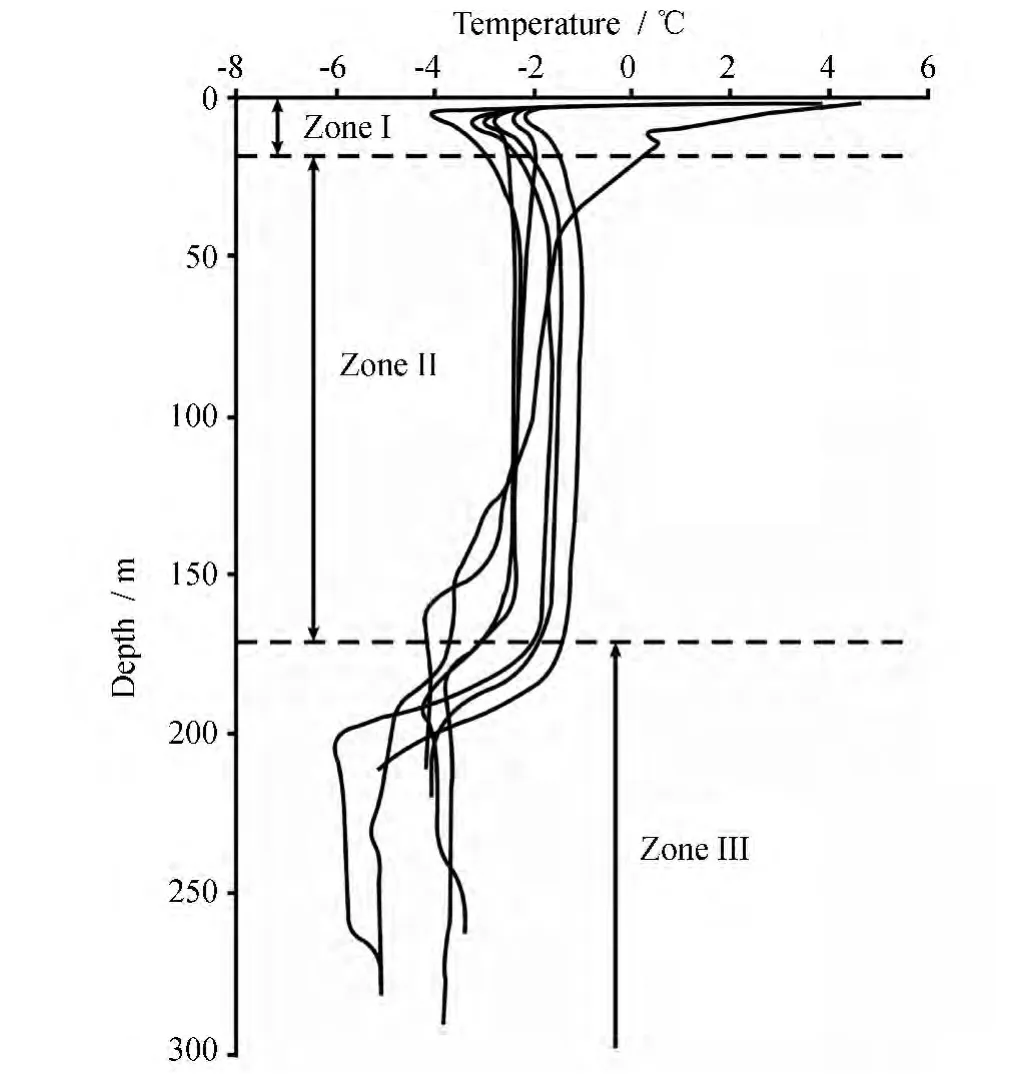
Fig.2 Cryohydrogeothermal zones at the Kienga disposal site,western Yakutia
The first cryohydrogeothermal zone occupies the uppermost part of permafrost.The lower limit of this zone coincides,in fact,with the depth of zero annual amplitude.Temperature variations in this zone indicate the response of permafrost to surface disturbance.Temperature observations within this zone should be performed in boreholes equipped with thermistor cables and data loggers.
The base of the second cryohydrogeothermal zone should lie 20~25 m below the low-flow level of the nearest stream.Care must be taken to prevent injected brine from entering this zone,in other words,its temperature field must remain stable.However,our monitoring observations at the disposal sites frequently detected significant temperature fluctuations within this zone,suggesting the escape of brines into the horizons lying above the environmentally safe depths.Unfortunately,no attempts were made to determine the volume of brines that moved up to these horizons.Additional hydrogeological studies should be undertaken now to do this.
The third cryohydrogeothermal zone is the injection zone.The ground temperature regime within this zone depends on the brine injection regime.Based on the dynamics of the ground temperature regime in this zone,the operation regime of the entire disposal site system should be corrected.In particular,frozen ground temperature can be controlled by changing injection volumes in winter and summer periods.
3 Conclusions
Geothermal investigations conducted at the drainage water disposal sites of the Udachny Mine have demonstrated thatthe method ofinjecting toxic wastewater into a subsurface stratum is not well elaborated.The identification of cryohydrogeothermal zones in the perennially frozen ground used for mineralized wastewater injection may be helpful in improving hydrogeological and geothermal monitoring at subsurface disposal sites in permafrost regions.
[1] Porokhnyak A M,Rassudov A V.Disposal of Liquid Wastes in Permafrost(Zahoronenie zhidkih othodov v kriolitozone)[M].Moscow:Nedra,1993.
[2] Serdyukov L I,Artem'eva E L,Strogova E V et al.On the nature of the absorbing property of perennially frozen ground for disposal of drainage brines[J].Gornyj Zhurnal.1996,7(8):5-12.
[3] Alexeev S V,Drozdov A V,Drozdova T I,et al.The first experience of burial of saline drainage waters of Udachnaya pipe quarry into permafrost[J].Kriosfera Zemli,2002,(2):61-65.
[4] Gotovtsev S P.Frozen ground temperature field at the Kienga drainage water disposal site,Udachny Mine[J].Kundel,2003,5:19-26.
[5] Drozdov A V.Disposal of Drainage Brines in Perennially Frozen Ground(with Reference to the Siberian Platform Permafrost).[M].Irkutsk:Irkutsk State Technical University,2007.
[6] Fotiev S M.Hydrogeothermal Characteristics of the USSR Permafrost Region(Gidrogeotermicheskie osobennosti kriogennoj oblasti SSSR)[M].Moscow:Nauka,1978.
[7] Bodunov E I,Beleckij V L,Fradkin G S.Petroleum Geology,Hydrogeology and Geochemistry of the Southern Slope of the Anabar High(Geologija,gidrogeologija i geohimija nefti i gaza juzhnogo sklona Anabarskoj anteklizy)[M].Yakutsk:JaF SO AN SSSR Press,1986.
[8] Klimovskii I V,Gotovtsev S P.Permafrost in the Yakutian Diamond Province(Kriolitozona Jakutskoj almazonosnoj provincii)[M].Novosibirsk:Nauka,1994.
[9] Shepelev V V.On the Concept of Earth's Cryolithosphere(K ponjatiju o kriolitosfere Zemli)[M].Yakutsk:Permafrost Institute Press,1997.
[10]Klimovskii I V,Gotovtsev S P,Shepelev V V.Hydrogeocryological conditions of the polygon of the underground disposal of the drainage water of the“Udachnaya”diamond pipe[J].Kriosfera Zemli,2002,(3):45-50.
[11]Drozdov A V,Iost N A,Lobanov V V.Cryohydrogeology of Diamond Deposits in Western Yakutia(Kriogidrogeologija almaznyh mestorozhdenij Zapadnoj Jakutii)[M].Irkutsk:Irkutsk State Technical University,2008.
[12]Alexeev S V.The Cryogenesis of Groundwaters and Rocks(On an Example of the Daldyn-Alakit Region of Western Yakutia)[M][Kriogenez podzemnyh vod i gornyh porod(na primere Daldyno-Alakitskogo rajona Zapadnoj Jakutii)].Novosibirsk:SB RAS Press,2000.
[13]Drozdov A V,Gotovtsev S P.Migration of injected brines in permafrost.In:Piguzova VM(ed.).Formation of Groundwater in Permafrost[Formirovanie podzemnykh vod kriolitozony][M].Yakutsk:Permafrost Institute Press,1992:31-48.
[14]Alexeev S V.Cryohydrogeological Systems of the Yakutian Diamond Province Kriogidrogeologicheskie sistemy Jakutskoj almazonosnoj provincii[M].Novosibirsk:Geo,2009.
[15]Drozdov A V.Natural and Techno-Natural Reservoirs for Industrial Wastewater in Permafrost Regions(with Reference to the Yakutian Part of the Siberian Platform)[M].Yakutsk:North-Eastern Federal University,2011.
[16]Gotovtsev S P,Klimovskii I V.Effect of drainage water injection on frozen ground temperature.In:Piguzova VM(ed.)Formation of Groundwater in Permafrost(Formirovanie podzemnykh vod kriolitozony)[M].Yakutsk:Permafrost Institute Press,1992:93-108.
[17]Gotovtsev S P,Klimovskii I V,Zabolotnik P S.Importance of geothermal monitoring studies for cryopeg disposal in frozen ground.In:Borisov VN et al.(eds.).Proceedings of Russian Workshop on Groundwater of the Russian East(Materialy Vseross.soveshh.po podz.vodam Vostoka Rossii)[M].Irkutsk:Institute of Earth Crust SB RAS,1994.
猜你喜歡
幼兒100(2023年36期)2023-10-23 11:41:48
家庭影院技術(2021年2期)2021-03-29 07:18:58
家庭影院技術(2021年2期)2021-03-29 07:18:56
少先隊活動(2021年2期)2021-03-29 05:40:48
家庭影院技術(2021年1期)2021-03-19 05:14:56
家庭影院技術(2020年8期)2020-09-11 06:45:20
家庭影院技術(2020年8期)2020-09-11 06:45:18
中學生數理化(高中版.高二數學)(2019年6期)2019-06-24 03:37:50
中國公路(2017年7期)2017-07-24 13:56:38
中學生數理化(高中版.高二數學)(2016年4期)2016-03-01 03:46:18

- 黑龍江大學工程學報的其它文章
- The harm of perennial frozen soil to the pipeline exporting the crude oil from Mohe county to Daqing city
- Overview of research methods of frozen soil hydrology in Heilongjiang Province
- Environmental geochemistry of urban areas in Yakutia
- A permafrost factor in the development of deformations on the Amur Highway
- The problem of project statement of construction principles of buildings and facilities in permafrost
- The forecast of a temperature regime of soils containing the pile foundation of a pithead on diamond-mining mines of cryolithic zone