
Applications and Study on Organophosphate Acids (Salts) for Oil Well Cement Retarder
2014-03-21 02:35:26QIZhiGang;ZHUXiaoming;CAOHuilian
Energy Science and Technology 2013年4期
QI ZhiGang; ZHU Xiaoming; CAO Huilian

Abstract
A synthetic cement retarder SDH-2 which provides excellent retardation and compressive strength development has been synthesized to be used in deep oil well cementation. The response properties, temperatureresistant and anti-salt properties, additive distribution and compressive strength have been evaluated. It is showed SDH-2 has good retarding ability to oil well cement slurries at 40 to 204 ℃. It is compatible with dispersant, fluid loss additive and other additives to grade G oilwell cement of various manufactures and can be used in cementing process in the temperature of various depths in oil well.
Key words: Retarder; Thickening time; Compatibility; Compressive strength; Additives
INTRODUCTION
In recent years, as well depths become greater retarder becomes more and more significant and the bottom hole temperature and pressure have rised markedly. Precise retarder response is difficult to attain at high temperatures and many cementing slurries end up with thickening times far in excess of what is considered good practice. So it is increasingly difficult to deep well cementation. Meanwhile high temperature causes significant changes of physical and chemical properties of cement. So study on additives of cement is imperative and the higher requirement about retardant properties is requested (Huang, Xie, & Cai, 2003; Wu, 2006).
The function of cement set retarder is to effectively increase the time the cement slurry remains fluid and pumpable. When mixed at the recommended water to cement ratio, an unretarded slurry containing API Class H or G cement may be safely placed at a depth of 4,000 mm where the bottom hole circulating temperature is less than about 130 ℃. However, at depths and temperatures in excess of these limits, it is necessary to add chemicals to prevent the slurry from setting prematurely. These additives are especially important in deeper wells where circulating temperatures can exceed 200 ℃.
Currently, domestic and international oil well cement retarder includes tannin derivatives, lignite agents, carbohydrates, boric acid and its salts, lignin sulfonate and modified products, hydroxyethyl cellulose, carboxymethyl hydroxyethyl cellulose, organic acids, synthetic organic polymer, and so on (Liu, etc. 2001). But these retarders either are only applied at low temperature, or at high temperature; or the retarders are sensitive-usage, easy foamy, side-effect. To make up for these deficiencies, an excellent high temperature oil well cement retarder SDH-2 has been synthesized with formaldehyde, fatty amine and subphosphoric acid according to the Die Mannich Reaction (Wan, 1986; Crump, et al, USP 4466836, USP 4468252, USP 4468252; Song, 1997). This retarder in theory can be applied in 40-204℃ temperature range, it can be used at a high temperature of 170 ℃ under indoorevaluation. SDH-2 can effectively retard thickening time of slurry, with good adjustability and adaptability for oil well cement, ideal thickening curve, and good compatibility with additives present in the slurry. In addition, SDH-2 has advantages of less usage, salt-tolerant and high-temperature resistance. So it is an excellent hightemperature oil well cement retarder.
1. REACTION PRINCIPLE
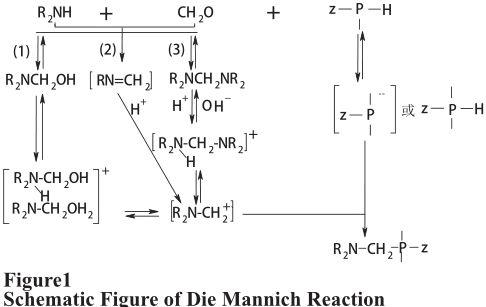
Mannich reaction, also known as methyl amine reaction, is the asymmetric condensation process of three components, the following is the Mannich reaction diagram.
Figure1 is a schematic figure of Die Manich Reaction, but actual situation is much more complex than the above-said the reaction process. SDH-2 is a Mannich base, a product of Manich Reaction. It is synthetised by different reactants in different pH environments through different processes.
2. EXPERIMENT
2.1 Experimental Material
Amine (analytical reagent), phosphate (50%, analytical reagent), formaldehyde (37%, analytical reagent), hydrochloric acid(chemical pure), electroregulator, electric blender, reaction vessel, thermometer, 0-5pH test paper.
OWC-9360 slurry agitator, ZNN-D6 rotary viscometer, OWC-9850
2.2 Synthetic Methods
The new retarder is a alkylenephosphonic acids (salts) of amine, formaldehyde and phosphate in a certain molar ratio.
A certain amount of amine and formaldehyde was reacted in a reaction kettle equipped with a condenser, thermocouple, magnetic stirrer, heating mantle and a dropping funnel. The pH of the solution was reduced to a value of 1 by the dropwise addition of hydrochloric acid to the aqueous polymer solution. While nitrogen was bubbled through the mixture to eliminate any dissolved oxygen therein. A certain amount of a 50% by weight aqueous phosphate solution was dropped into the reaction mixture over a period of 45 minutes. The reaction was then allowed to proceed for three or four hours.
2.3 Evaluation Methods
(a) Slurry performance was tested in accordance with API Specification 10A “oil well cement norms”.
(b) The high temperature retarder evaluation was conducted in accordance with oil and gas industry standards “SYT5504-1996”.
3. DISCUSSION
3.1 Retardation
The data in Table 1 illustrate the excellent retardation which can be achieved with the new retarder. One of the most attractive properties is that this retarder can be used from approximately 40 to 204 ℃ in theory, which is unusual to say the least. Most high temperature retarders(>148 ℃) are much too sensitive to be used around 93℃. In addition, many retarders which function well around 140℃ may require excessively large amounts (5% or more by weight of cement) when used at temperatures approaching 170℃, if they will work at all.
We can see that the high-temperature oil well cement retarder SDH-2 has better adaptability from 90 to 170 ℃without the use of an intensifier. In a certain temperature, property of cement retarder SDH-2 is reproducible increases in thickening times as the lever of retarder is increased.
From Table 1, we can see that the organic phosphate retarder remarkablly retardes the thickening time of cement slurry and the transition time is short. SDH-2 has a reasonable set time and right angle thickening. Another property of the cement retarder SDH-2 is reproducible increases in thickening time as the level of retarder is increased. It is desirable. With the rise of temperature, SDH-2 shows a good retardation and heat resistance.
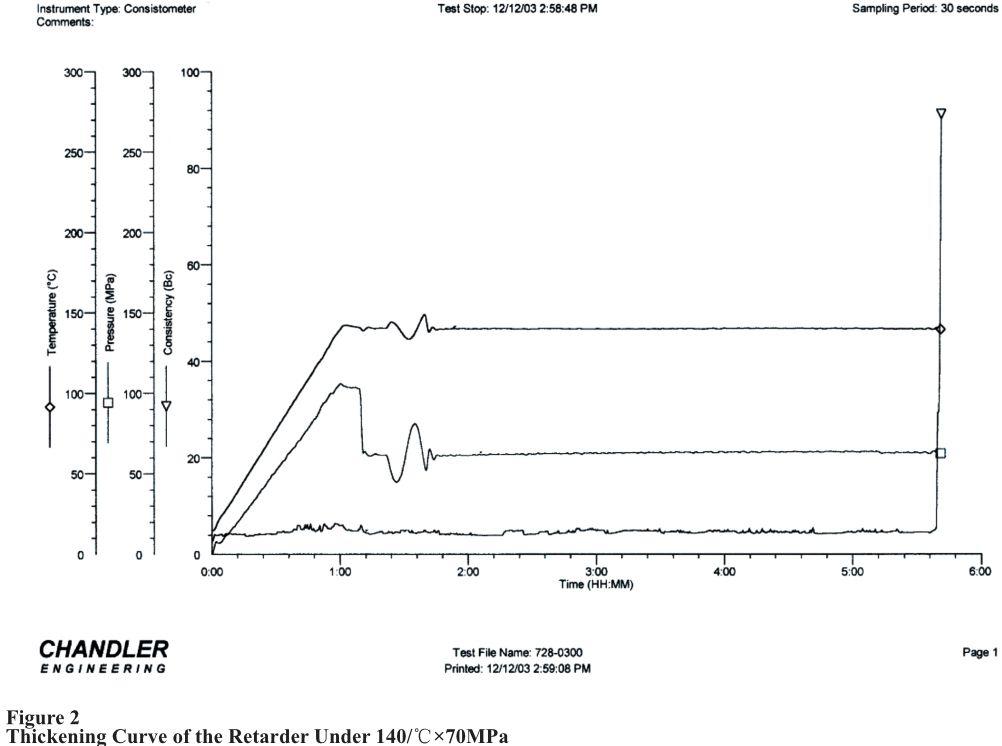
Figure 2 shows result for thickening curve of SDH-2. The curve has a low initial consistency and “right angle thickening” phenomena. Because cement slurry has a short transition time, probability of occurrence gas migration is decreased and this will be conducive to raise interface quality of well cementing.
3.2 Salt-Resisting Study
As the reservoir formation is very complex, which contains a large number of inorganic salts; these salts will cause changes in the properties of cement in cement process and are disadvantageous to the construction process. Therefore, we need to consider salt-tolerant retarder. The property of this retarder is studied in the different salt quantity (Figure7).
Figure 3 clearly demonstrates (1) the strong synergism in retardation between salt and SDH-2 .As is known to all, NaCl of greater than 20% (BWOW) has retardation function, but NaCl of less than 10% (BWOW) has no retardation and accelerating effect. Figure 7 shows that the retarder can effectively reduce NaCls accelerating effect on cement slurry. With the increase of NaCl amount, thickening time has only little change, which shows that the retarder have a good salt-tolerant property.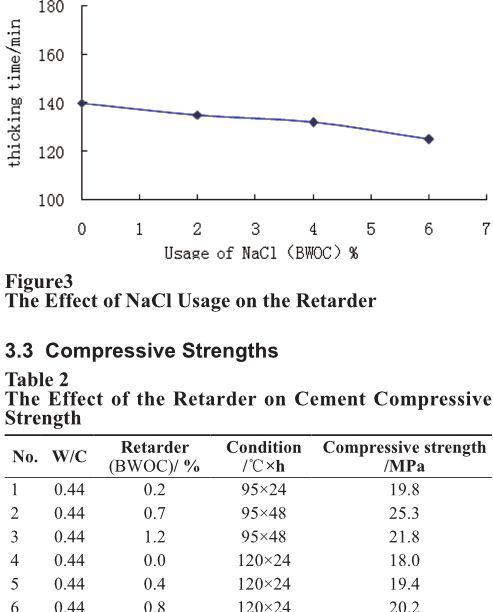
Table 3 gives data for compressive strengths. These excellent strengths at BHCT, combined with adequate thickening times, were a major factor in encouraging development of alkylenephosphonic acids from a laboratory chemical into a valuable product. This retarder nearly doesnt impact on the compressive strength. Table 5 shows slightly increased strengths at 120 ℃ in 24 hours to be comparable with clean cement slurry. This is because C-P-O bond of the retarder has a strong sequestration with Ca2+ , Al3+ of cement slurry. It is difficult to make chelate key fracture. And we do gain strength rapidly to a good value in 24 hours. It is of great significance to increase cementing quality.
3.4 Compatibility
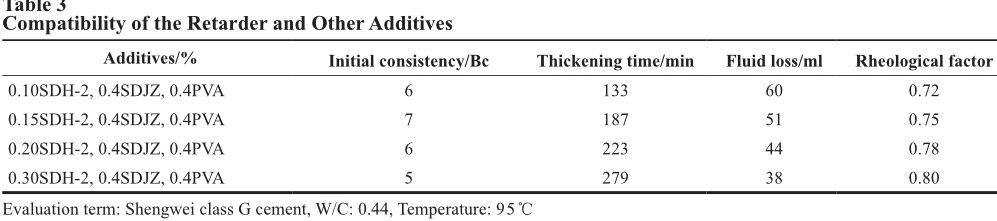
In oil and gas well cementing operation, not only cement slurry is required to have adequate thickening time, but also to reduce the loss of water filtrating formation, in order to protect pay formation and improve the quality of cementing. Meanwhile, most retarder can improve slurrys rheological property, but in order to have better slurrys rheological property, investigator must utilise dispersant, which requires retarder to have good compatibility with other additives .Therefore, the author studies synthetic cement retarders compatibility with PVA-reducing agent and the dispersing agent FHJZ.
Table 3 displays rheology and fluid loss data on this same basic slurry and on the effects of substitution of two other additives. Note the reasonable rheologies combined with moderate to very low fluid loss behavior, particularly with the synthetic polymer fluid loss additive“PVA”. On the other hand, at 95 ℃, retardation response is quite uniform with respect to SDH-2 concentration. Lignosulfonate retarders are well-known to show very non-linear response.
Phosphate retarder produces strong absorption groups around cement particles through adsorption and nucleation reacted with Ca2+ or OH- in aqueous phase of cement slurry to form an insoluble non-permeability layer. Retarder, adsorbing in crystal nucleus of hydrates, inhibits its further growth. Meanwhile retarder also strengthened the bind between PVA latex and particles of cement, strengthened the three-dimensional network structure and reduced the water filtration.
3.5 Comparison With Other Retarders
Table 7 gives data for performance comparison with SDH-2 and other retarders. At the same temperature, SDH-2 has a smaller dosage, lower initial consistency, good rheological property than the comparison goods. In the same experimental program, SDH-2 increases the compressive strength of cement than A1.
3.6 Field Application
By laboratory evaluation, alkylenephosphonic acids(salts) retarder is up with an excellent high-temperature performance, salt-tolerant and good overall performance. And this retarder has been applied in ShengLi oil field, such as Tuo76 Well, Fengshen Well and so on. Fengshen Well belonges to a bad hole, with high temperature, high pressure, gypsolith features. Gypsolith formation exists between 3200~3800m. Fengshen1 is a prospecting well, depth 4790m, well deviation 7.77 degree, cement point 2530m, geothermal gradient 3 ℃/100m,B.H. temperature 169 ℃. The deep well cement system consists of alkylenephosphonic acids (salts), fluid loss additive, dispersant and other additives, as follows:
600g cement+200g SiO2+1.5%SDH-2+1.5%SDJ100 fluid loss additive+0.6% dispersant+0.1% defoaming agent.
The deep well cement system can adapt to gypsolith formation and high temperature surroundings, job implementation can be successfully carried on, and cement job quality is also satisfactory. In addition, the deep well cement system has been applied in oil field and has taken a good cementing effect (Table 5).
Field applied data shows: The deep well cement system which is made up of synthetic alkylenephosphonic acids retarder resolves many problems, such as thickening time is difficult to be controlled, or cement slurry retardant is not consistent, etc. This system has a reasonable rheologies and good salt- tolerant property. And cement slurry can gain strength rapidly to a good value in 24 hours.
CONCLUSION
Unique synthetic cement set retarder is described which provides reproducible, uniform thickening time behavior. The alkylenephosphonic acids can be used at temperature from approximately 90 to 170 ℃ without the use of an intensifier. This unique characteristic makes the design of high temperature slurries much simpler than for retarders which require intensifiers. This new retarder allows rapid compressive strength development compared to conventional retarders.
Thickening time is not linearly but normally exponentially dependent upon retarder concentration. The cement slurries have not only good rheologies but also low water-loss.
The deep well cement system which is made up of synthetic alkylenephosphonic acids retarder can adapt to gypsolith formation and high temperature surroundings, cementing operation can be successfully carried on.
REFERENCES
Huang, B. Z., Xie, C. B., & Cai, J. N. (2003). Some problems in deep well cementing. Drilling Fluid & Completion Fluid, 20, 48-51.
Liu, C. J., Huang B. Z., Xu, T. T., & Liu, X. L., et al. (2001). Oil and gas well cementing theory and applications (pp.84-90). Petroleum Industry Press.
Song, B. (1997). Alkylenephosphonic acids (salts) of oil well cement retarder. Chemical Engineering of Oil and Gas, 3(10), 116-118.
United States Patent 4466836. Set retarding compounds for use in cement slurries.
United States Patent 4468252. Set retarding additives for cement from amino methylene phosphonic acid derivatives.
Wan, D. Z. (1986). Mannich reaction and alkali chemistry(pp.17-24). Science Press.
Wu, B. (2006). Application of cement system for deep well with high temperature to xuwen X1 well. Oil Drilling & Production Technology, 3(28), 34-36.
 Energy Science and Technology2013年4期
- Energy Science and Technology的其它文章
- Nitrogen Foam Profile Control for Heavy Oil Reservoir
- Role of Hydrogen in Variation of Electrical, Optical and Magnetic Properties of ZnSe-Fe Bilayer Thin Films Structure
- Development of a Model Wind and Solar Power Installation Comprising High Temperature Superconductors
- Feasibility of Recharging Electric Vehicles With Photovoltaic Solar Panels
- Energy Analysis of a Concentrating Photovoltaic Thermal (CPV/T) System
- Mathematical Modeling of a Solar Passive Cooling System Using a Parabolic Concentrator