
In this issue
2014-04-03 09:23:23
上海精神醫(yī)學(xué) 2014年3期
In this issue
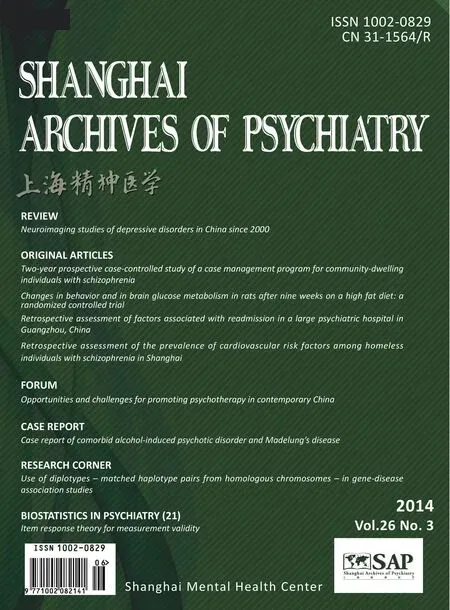
The review by Yin and Yuan[1]that starts this issue considers the current state of research about the neuroimaging of depressive disorders in China. China has come rather late to this field so the currently available research is plagued by a lack of standardizaon of methods, small sample sizes, failure to integrate structural and functional methodologies, and an overemphasis on cross-seconal instead of longitudinal designs. Nevertheless, there have been some important contribuons to the internaonal literature by Chinese authors, including the observations that a) the decreased volumes in the prefrontal cortex, orbital frontal cortex and hippocampus observed in depressed patients are more obvious among females and b) the increased volume of the medial prefrontal cortex among individuals with depression is associated with cognive decline. There are also some issues in which the Chinese research directly contradicts fi ndings from high-income countries: Chinese researchers report that elderly depressed paents with depression have increased (not decreased) volume of the anterior cingulated cortex; and Chinese researchers consider dysfunconal connecvity in the default-mode network more important in the relapse of depression than the abnormalities in the cerebellum that have been reported by Western researchers. To increase the international footprint of Chinese research in this important area there needs to be a re-focusing of the research e ff ort on fewer studies with larger samples that use longitudinal designs to assess the temporal relaonships between episodes of depression and changes in the structure and funconing of the brain.
The first original research article by Chen and colleagues[2]is about a large (n=730) prospecve casecontrolled study about the use of a case-management model for patients with schizophrenia living in the community. Case management included a once-amonth training and management intervention for patients and their family members which provided drug adherence training, daily skills training, and psychological support and training for family members. The two-year follow-up of this case-management model showed substantial improvements in the intervention group compared to the treatment-as-usual group: the patients had significantly less prominent negative symptoms and significantly lower rates of medication discontinuation, relapse, and rehospitalization. Other factors independently related to discontinuation of medication – the strongest predictor of relapse –includedhighereducational level, self-supervision (vs. family-supervision) of medication, higher dosages of medication, and greater self-reports of medicationrelated discomfort. This study clearly demonstrates the feasibility and effectiveness of case management strategies in urban China and highlights the need to encourage family involvement in the management of medication, to use the least effective dosage of medication, and to aggressively manage side-effects. These are impressive results, but before moving to upscale the model to other urban centers in China and adapting it for use in rural parts of the country, the study needs to be replicated using a random assignment of individuals to the intervenon and control condions, a fully blinded evaluation of the primary outcome measures, and an assessment of the cost-bene fi t of the intervenon.
The second original research article by Hu and colleagues[3]is a randomized controlled trial in rats about the relaonship of a high-fat diet to depressionlike behavioral changes and to the level of glucose metabolism in specific regions of interest in the brain. Twenty rats were randomly assigned to a high-fat diet or a standard diet for 9 weeks (10 rats in each group), and before-versus-after changes in blood chemistry, in the sucrose preference test (an indicator of interest in pleasurable activities) and in the open field test (a measure of overall stress) were compared between the two groups. The rate of brain glucose metabolism in di ff erent brain regions at the end of the 9-week trial was assessed in both groups using micro-positron emission tomography (micro-PET). The expected changes in weight and serum lipids after 9 weeks on a high fat diet were associated with a decreased preference for sucrose (a possible indicator of anhedonia) and a significant decrease in the activation of the right thalamus and right striatum. However, the findings of the open fi eld test were equivocal, possibly due to the small sample. Overall, the fi ndings support hypotheses about the relaonship of a high-fat diet and depressive symptoms and suggest that eating behaviors and depressive symptoms are in fl uenced by the interacon between diet and the limbic system-striatum-thalamus circuit. Subsequent studies with larger samples will need to assess theme relaonships between the iniaon and terminaon of a high-fat diet and the emergence or disappearance of changes in brain acvity.
The last original article by Chen and colleagues[7]is another retrospective chart review study that compares the prevalence of cardiovascular risk factors in individuals with schizophrenia or schizophreniform disorder who are homeless and not homeless. Several lines of research from high-income countries indicate the importance of working with this growing but difficultto-locate cohort of homeless mentally ill in China: substanally reduced longevity in persons with mental illnesses,[8]higher rates of cardiovascular risk factors in homeless individuals[9]and rising rates of the metabolic syndrome among individuals taking antipsychotic medications for prolonged periods.[10]The authors compare the prevalence of four important cardiovascular risk factors -- hypertension, hyperglycemia, hyperlipidemia and smoking – and the characteristics associated with the presence of one or more of these risk factors in 181 persons with schizophrenia or schizophreniform disorder who were homeless at the time of admission to that of 181 individuals with schizophrenia or schizophreniform disorder who were not homeless at theme of admission. The prevalence of hypertension in both groups was similar to that in the general population (19-20%), and the rate of smoking in men was quite high in both groups (82% in homeless males and 78% in non-homeless males), but there were no signi fi cant di ff erences in the prevalence of these risk factors between the two groups so, unlike the situation in high-income countries, homelessness was not associated with increased risk of cardiovascular disease in individuals with mental disorders. As is true of the general population, the characteristics most closely associated with the presence of cardiovascular risk factors were male gender, increasing age and urban residence. The authors conclude that prospective studies will be needed to determine the best ways to provide health care to the growing numbers of homeless individuals in urban China who are mentally ill.
The Forum by Zhao[11]discusses another component of China’s comprehensive mental health law[5]: the role and function of psychotherapy. There are many psychological counsellors in China who have a wide range of training (from a couple of weeks to several years), but there are very few trained (i.e., PhD-level) clinical psychologists, partly because very few of the emerging departments of psychology have competent clinical supervisors and partly because the current health care system does not have positions for nonmedical psychotherapists. The new mental health law discusses the importance of integrating clinical psychologists into the mental health care system, but it limits the practice of psychotherapy to medical institutions in which the therapists must work directly under a medical professional and it does not provide a career pathway for clinical psychologists that would attract young professionals. Another problem with the law is that it empowers psychiatrists to work as psychotherapists but it does not require them to receive training in how to do this, incorrectly assuming that psychiatrists automatically learn this as part of their psychiatric training. Dr. Zhao provides several recommendations about how to change policies and atudes in ways that would help promote the provision of psychotherapeuc services in the country.
The case report by Sun and Li[12]discusses an interesting case of Madelung’s Disease – a condition of multiple symmetric lipomas in the neck and upper back – related to chronic alcohol abuse. In this 51-yearold male the fay accumulaons in his neck that were eventually diagnosed as Madelung’s Disease did not occur unl more than 25 years aer the onset of alcohol abuse. The exact etiology of the condition and the mechanism of its relaonship to alcohol abuse remain unclear, but it is usually benign unless the fay masses compress the trachea, esophagus, or regional nerves.In most cases, as occurred in this case, surgical removal is curave, though there can be recurrences. The case highlights the need for psychiatrists to be aware of uncommon medical condions that may co-occur with psychiatric and substance abuse disorders.
The Research Corner article by Zuo and colleagues[13]discusses four different types of genedisease association studies (allele-based, haplotypebased, genotype-based and diplotype-based) with an emphasis on the use of diplotypes, that is, matched haplotype pairs from homologous chromosomes. The article explains that when criteria of Hardy-Weinberg Equilibrium are met and there are no significant interactions between markers, allele-based or haplotype-based analyses are more powerful, but when these conditions are not met it is better to use genotype-based or haplotype-based analyses (which require much larger samples).
The issue concludes with a Biostascs in Psychiatry piece by Yang and Kao[14]about the use of item response theory (IRT) to assess the funconing of items within a scale. IRT has been widely used in educaonal sengs for the development of standardized tests, but it is not often used in the development of mental health measures. The paper introduces the basic assumpons and methods of IRT. The advantage of IRT over the more well-known Classical Test Theory is that it is based on the characteristics of the items in the testnoton the characteristics of the sample in which the scale is developed, an advantage that is particularly useful when using translated scales. Several characteristics of items and respondents can be assessed using IRT: the latent trait (theta), item characteristic curve, item discrimination, item difficulty, and the item and test informaon curves. The results of IRT analysis can help clinicians and scale developers identify the items that are best achieving the speci fi c goals of the scale, those that best discriminate different levels of the latent variable of interest within the required range of intensity of the variable of interest.
1. Yin YY, Yuan YG. Neuroimaging studies of depressive disorders in China since 2000.Shanghai Archives of Psychiatry.2014; 26(3): 113-118. doi: http://dx.doi. org/10.3969/j.issn.1002-0829.2014.03.002
2. Chen MJ, Wu GJ, Wang ZW, Yan J, Zhou JF, Ding Y, et al. Two-year prospective case-controlled study of a case management program for community-dwelling individuals with schizophrenia.Shanghai Archives of Psychiatry.2014; 26(3): 119-128. doi: http://dx.doi.org/10.3969/ j.issn.1002-0829.2014.03.003
3. Hu H, Xu YQ, Liu CF, Zhao HQ, Zhang H, Wang LW. Changes in behavior and in brain glucose metabolism in rats after nine weeks on a high fat diet: a randomized controlled trial.Shanghai Archives of Psychiatry.2014; 26(3): 129-137. doi: hp://dx.doi.org/10.3969/j.issn.1002-0829.2014.03.004
4. Zhou YL, Rosenheck RA, Mohamed S, Fan N, Ning YP, He HB. Retrospective assessment of factors associated with readmission in a large psychiatric hospital in Guangzhou, China.Shanghai Archives of Psychiatry.2014; 26(3): 138-148. doi: http://dx.doi.org/10.3969/ j.issn.1002-0829.2014.03.005
5. Chen HH, Phillips MR, Cheng H, Chen QQ, Chen XD, Fralick D, et al. Mental health law of the People’s Republic of China (English translation with annotations).Shanghai Archives of Psychiatry. 2012; 24(6): 305-321. doi:10.3969/ j.issn.1002-0829.2012.06.001
6. Mechanic D, McAlpine DD, Olfson M. Changing paerns of psychiatric inpatient care in the United States, 1988-1994.Arch Gen Psychiatry. 1998; 55(9): 785-791. doi: http:// dx.doi.org/10.1001/archpsyc.55.9.785
7. Chen Q, Wan M, Ban CX, Gao YF. Retrospecve assessment of the prevalence of cardiovascular risk factors among homeless individuals with schizophrenia in Shanghai.Shanghai Archives of Psychiatry.2014; 26(3): 149-156. doi: hp://dx.doi.org/10.3969/j.issn.1002-0829.2014.03.006
8. Druss BG, Zhao L, Von Esenwein S, Morrato EH, Marcus SC. Understanding excess mortality in persons with mental illness: 17-year follow up of a naonally representave US survey.Med Care. 2011; 49(6): 599-604.
9. Lee TC, Hanlon JG, Ben-David J, Booth GL, Cantor WJ, Connelly PW, et al. Risk factors for cardiovascular disease in homeless adults.. 2005; 111(20): 2629-2635. doi: hp://dx.doi.org/10.1161/ CIRCULATIONAHA.104.510826
10. Liu JB, Wu JH. [Effects of chlorpromazine, clozapine, risperidone on glucose metabolism in patients with firstepisode schizophrenia, lipids and body weight].Zhongguo Shen Jing Jing Shen Ji Bing Za Zhi. 2004; 30(4): 294-295. Chinese. doi: http://doi.med.fanfangdata.com.cn/10.3969/ j.issn.1002-0152.2004.04.019
11. Zhao XD. Opportunities and challenges for promoting psychotherapy in contemporary China.Shanghai Archives of Psychiatry.2014; 26(3): 157-159. doi: http://dx.doi. org/10.3969/j.issn.1002-0829.2014.03.007
12. Sun ZX, Li HJ. Case report of comorbid alcohol-induced psychotic disorder and Madelung’s disease.Shanghai Archives of Psychiatry.2014; 26(3): 160-164. doi: http:// dx.doi.org/10.3969/j.issn.1002-0829.2014.03.008
13. Zuo LJ, Wang KS, Lu XG. Use of diplotypes – matched haplotype pairs from homologous chromosomes – in genedisease associaon studies.Shanghai Archives of Psychiatry.2014; 26(3): 165-170. doi: http://dx.doi.org/10.3969/ j.issn.1002-0829.2014.03.009
14. Yang FM, Kao ST. Item response theory for measurement validity.Shanghai Archives of Psychiatry.2014; 26(3): 171-177. doi: http://dx.doi.org/10.3969/ j.issn.1002-0829.2014.03.010
hp://dx.doi.org/10.3969/j.issn.1002-0829.2014.03.001
A full-text Chinese translaon of this arcle will be available atwww.saponline.orgon July 25, 2014.
- 上海精神醫(yī)學(xué)的其它文章
- Item response theory for measurement validity
- Use of diplotypes – matched haplotype pairs from homologous chromosomes – in gene-disease association studies
- Case report of comorbid alcohol-induced psychotic disorder and Madelung’s disease
- Opportunities and challenges for promoting psychotherapy in contemporary China
- Retrospective assessment of the prevalence of cardiovascular risk factors among homeless individuals with schizophrenia in Shanghai
- Retrospective assessment of factors associated with readmission in a large psychiatric hospital in Guangzhou, China