
Wireless Body Area Networks for Pervasive Healthcare and Smart Environments
2014-07-19 12:24:13VictorC.M.Leung,HongkeZhang
ZTE Communications 2014年3期
Wireless Body Area Networks for Pervasive Healthcare and Smart Environments
?Victor C.M.Leung

Victor C.M.Leung is a professor of electrical and computer engineering andTELUSMobilityResearch Chair at the University of British Co?lumbia,Canada.He researches wire?less networks and mobile systems and has has co?authored more than 700 technical papers in journals and refereedconferenceproceedings. Several of these papers have won best?paper awards.Dr.Leung is a fellow of the IEEE,Roy?al Society of Canada,Canadian Academy of Engineering,and Engineering Institute of Canada.He has served on the editorial boards ofIEEE Journal on Selected Areas in Com?munications,IEEE Transactions on Computers,IEEE Transactions on Wireless Communications,IEEE Transac?tions on Vehicular Technology,Wireless Communications Letters,and several other journals.He has led the techni?cal program committees and organizing committees of nu?merous international conferences and workshops.Dr. Leung was awarded the APEBC Gold Medal in 1977.He received NSERC postgraduate scholarships from 1977?1981 and was awarded the IEEE Vancouver Section Cen?tennial Award in 2011.He received the UBC Killam Re?search Prize in 2012.
?Hongke Zhang

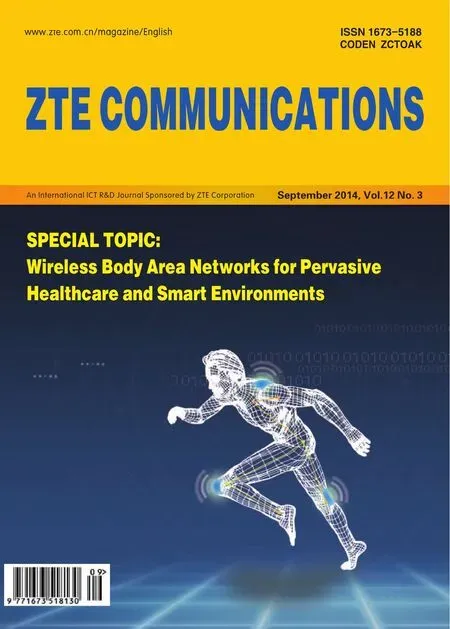
W ireless body area networks(WBANs)use RF communication for in?terconnection of tiny sensor nodes located in,on,or in close prox?imity to the human body.A WBAN enables physiological signals,physical activity,and body position to be continuously monitored. Designing a WBAN is challenging because of the limited energy that a WBAN can consume and the limited processing capabilities of sensor nodes.Also,the radio communication environment is highly variable and prone to interference.Recent ad?vances in wearable and implantable biosensors,short?range wireless communica?tion,and low?power embedded processors are contributing to an increase in WBAN R&D aimed at addressing these issues.WBANs usually function as signal sources in larger,more intelligent systems used in applications that have the potential for great social and economic good.These larger systems are formed by connecting WBANs with external communication and computing infrastructure,e.g.,cloud?computing services accessed through a smartphone that connects to the Internet via a wireless WAN.There is strong interest among researchers and medical practitio?ners in the development of intelligent systems based on WBAN.These systems en?able pervasive e?healthcare applications,such as ambulatory monitoring of outpa?tients,as well as smarter environments that support context?aware applications,as?pects of video gaming,monitoring of sports training regimes,and monitoring of emergency personnel and mission?critical workers.The purpose of this special issue is to survey WBAN in terms of state state?of?the?art technologies,latest develop?ments,and useful applications.Original papers were solicited from experts on WBAN,and six of these papers were selected for peer?review and publication.Each paper covers a different aspect of WBAN.
The first paper,“Sensing,Signal Processing,and Communication for WBANs,”by S.H.Fouladi,R.Chávez?Santiago,P.A.Floor,I.Balasingham,and Tor A. Ramstad,is a survey of recent research on signal processing related to sensor mea?surements in WBAN.The paper describes aspects of communication based on the IEEE 802.15.6 standard.The paper also describes state?of?the?art modeling for WBAN channels in all frequency bands specified in IEEE 802.15.6.The authors discuss the need for channel models for new frequency bands.
The second paper,“MAC Layer Resource Allocation for Wireless Body Area Net?works,”by Q.Shen,X.Shen,T.H.Luan,and J.Liu,describes a centralized MAC layer resource?allocation scheme for WBAN.The authors focus on mitigating inter?ference between WBANs and reducing the amount of power consumed by sensors. This scheme involves a central controller that optimizes channel resource allocation according to channel and buffer state reported by smartphones.Temporal correla?tions of body area channels are exploited to minimize channel state reporting.A my?opic policy is developed to solve the network design formulated as a partly observ?able optimization problem.
The third paper,“Selective Cluster?Based Temperature Monitoring System for Homogeneous Wireless Sensor Net?works,”by S.Tyagi,S.Tanwar,S.K.Gupta,N.Kumar,and J. J.P.C.Rodrigues,describes a health monitoring system for critically ill patients as a case study for temperature?monitor?ing based on Enhanced LEACH Selective Cluster(E?LEACH?SC)routing protocol.E?LEACH?SC uses direct and selective cluster?based data transmission for short?range and long?range collection of data from ill patients.Simulations show that E?LEACH?SC significantly increases network lifetime compared to traditional LEACH and LEACH?SC protocols.
The fourth paper,“Prototype of Integrating Internet of Things and Emergency Service in an IP Multimedia Subsystem for Wireless Body Area Networks,”by K.?D.Chang,J.?L. Chen,and H.?C.Chao,describes a common fabric for integrat?ing the Internet of Things into the Internet and supporting emergency call processing so that critical WBAN data can be transferred.The paper describes a simulated bootstrap plat?form using 3GPP IP Multimedia Subsystem services as well as a prototype implementation.Experimental and simulation re?sults show that the system is suitable for providing emergency services.
The fifth paper,“Smart Body Sensor Object Networking,”by B.Khasnabish,describes the networking and internetwork?ing of smart body sensor objects.The author proposes making body sensor objects smarter by giving them virtualization,pre?dictive analytic,and proactive computing and communications capabilities.The author also describes use cases that include the relevant privacy and protocol requirements.General usage and deployment etiquette and relevant regulatory implications are also discussed.
The sixth paper,“E?Healthcare Supported by Big Data,”by J.Liu,J.Wan,S.He,and Y.Zhang,describes how e?health?care has increased transparency by making decades of stored health data searchable and usable.The authors give an over?view of the architecture of e?healthcare,including four layers: data collection,data transport,data storage,and data analysis. Challenges in data security,data privacy,real?time delivery,and open standard interface are also discussed.
In closing,we would like to thank all the authors for their contributions and all the reviewers for their efforts in helping to improve the quality of the papers.We are grateful to the edi?torial office of ZTE Communications for their support in bring?ing this special issue to press.
Internet of Things has received much attention over the past de?cade.With the rapid increase in the use of smart devices,we are now able to collect big data on a daily basis.The data we are gather?ing and related problems are becoming more complex and uncer?tain.Researchers have therefore turned to AI as an efficient way of dealing with the problems created by big data.
This special issue ofZTE Communicationswill be dedicated to development,trends,challenges,and current practices in artificial intelligence for the Internet of Things.Position papers,technology overviews,and case studies are all welcome.
Appropriate topics include but are not limited to:
?Information technologies for IoT
?Architecture and Layers of IoT
?AI technologies for supporting IoT
?Image and Speech Signal Processing for IoT
?Affective Computing for IoT
?Information Fusion for IoT
?Artificial Consciousness and Integrated Intelligence for IoT
ZTE Communications(http://www.zte.com.cn/magazine/English) is a quarterly peer-reviewed technical journal ISSN(1673-5188) and CODEN(ZCTOAK).It is edited,published and distributed by ZTE Corporation(http://www.zte.com.cn),a leading global provider of telecommunications equipment and network solutions.The jour?nal focuses on hot topics and cutting edge technologies in the tele?com industry.The journal has been listed in Inspec,the Ulrich‘s Periodicals Directory,Index of Copernicus(IC)and Cambridge Sci?entific Abstracts(CSA).ZTE Communicationswas founded in 2003 and has a readership of 6000.It is distributed to telecom operators,science and technology research institutes,and colleges and univer?sities in more than 140 countries.
Final submission due:Feb.5,2015
Publication date:Jun.1,2015
Please email the guest editor a brief description of the article you plan to submit by Jan.15,2015.
Submission Guideline:
Submission should be made electronically by email in WORD for?mat.
Guest Editors:
Prof.Fuji Ren
Univ.of Tokushima,Japan,ren@is.tokushima-u.ac.jp
Prof.Yu Gu
Hefei University of Technology,China,yugu.bruce@gmail.com
ZTE CommunicationsCall for Papers
Special Issue on
Using Artificial Intelligence in Internet of Things
Guest Editors:Fuji Ren,Yu Gu
ang
his MS de?gree and PhD degree in electrical and communication systems from the University of Electronic Science and Technology,China,in 1988 and 1992.From 1992 to 1994,he was a postdoctoral researcher at Beijing Ji?aotong University.In July 1994,he began working in the School of Elec?tronics and Information Engineer?ing,Beijing Jiaotong University,and is now a professor in that school.He is the director of the National Engineering Lab for Next?Generation Internet Interconnection Devices,and her is the chief scientist on the Basic Research on The?ories of Smart and Cooperative Networks project,which was founded by the National Basic Research Program of China(“973”Program).He is a member of the IEEE and chairman of IEEE 1888.2 Work Group.
- ZTE Communications的其它文章
- Sensing,Signal Processing,and Communication for WBANs
- Event Normalization Through Dynamic Log Format Detection
- E-Healthcare Supported by Big Data
- Smart Body Sensor Object Networking
- Selective Cluster?Based Temperature Monitoring System for Homogeneous Wireless Sensor Networks
- Prototype for Integrating Internet of Things and Emergency Service in an IP Multimedia Subsystem for Wireless Body Area Networks