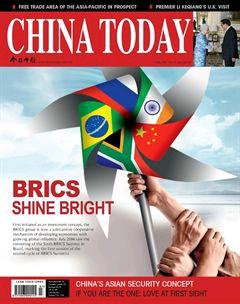
BRICS Adds New Dynamism to International Relations
2014-09-27 21:09:55BystaffreporterLI
CHINA TODAY 2014年7期
By+staff+reporter+LI+WUZHOU
THE BRICS cooperation has drawn world attention since its inauguration in 2006. The Sixth BRICS Summit, to be held in Brazil on July 15-16, is one of the most important international events in the second half of this year. What role is BRICS playing in defining the international configuration? How may BRICS be equipped to deliver on its mandate? And what is BRICSvision for the future? With these questions in mind, China Today took the opportunity to interview Amb. Zhang Jun, Sous-Sherpa for BRICS Affairs and DirectorGeneral of the Department of International Economic Affairs of the Ministry of Foreign Affairs.
A Mechanism Bounding Five Countries
China Today: As a senior official deeply involved in BRICS affairs, could you share with us your understanding of the role played by BRICS in fostering friendship and cooperation among member countries and in contributing to international affairs?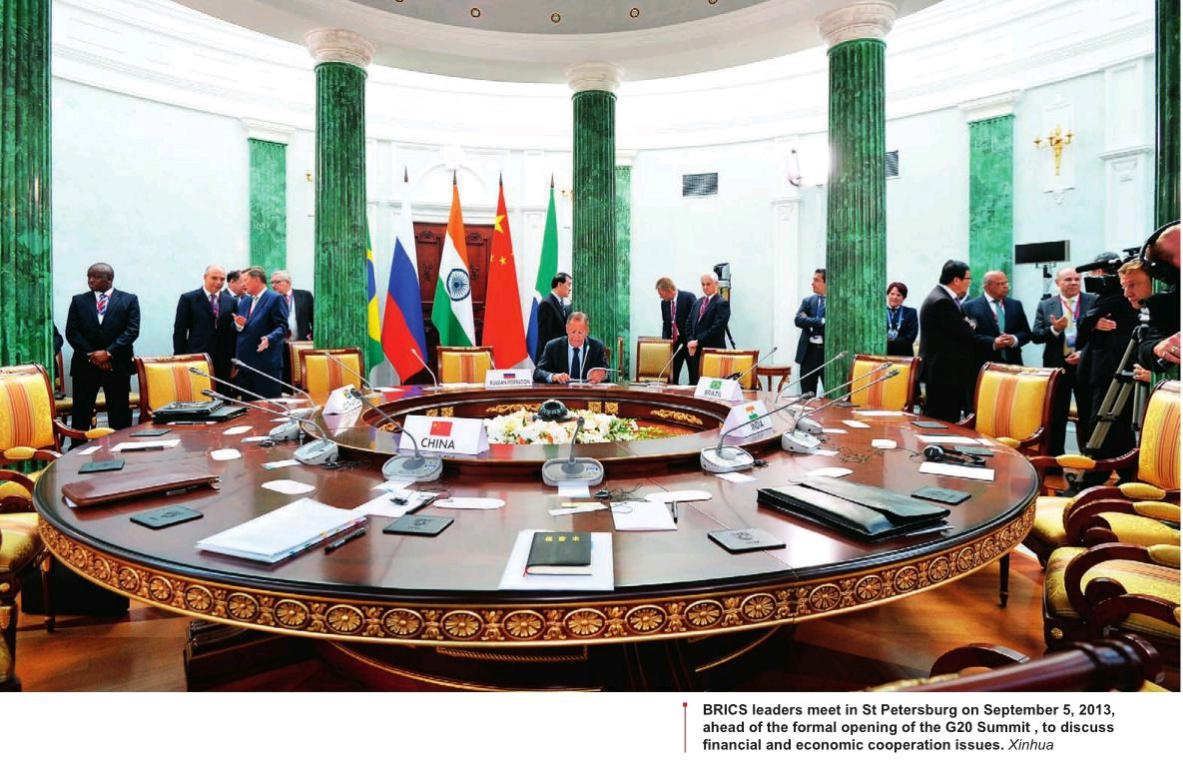
Zhang Jun: Cooperation among BRICS countries started in 2006 when their foreign ministers convened for the first time on the margins of the UN General Assembly. This practice kept evolving and culminated in 2009 in the first BRICS summit held in Yekaterinburg of Russia, in the context of global financial crisis. Since then, BRICS has been gradually institutionalized into a multi-level mechanism for building partnership among member countries in international politics and global economy. With the guidance of BRICS Summits, and support of BRICS National Security Advisors meetings and other ministerial meetings, intra-BRICS cooperation has born fruits in various areas, summarized as follows:
First, safeguarding world peace and security with shared positions and constructive approaches on major international issues. Over past years, BRICS members have been speaking in one voice on both traditional security issues, such as counter-terrorism, the Middle East and Afghanistan, and newly emerging issues like Syria and Ukraine. As a result, BRICS have become an advocate for international fairness and justice.
Second, improving global economic governance by pushing forward the IMF quota and governance reform, strengthening the multilateral trading system and advancing Doha Round negotiations. As a result, the voice and representation of BRICS and other emerging markets and developing countries have increased.
Third, enhancing global partnership for development in poverty alleviation, sustainable development, climate change and energy security, while respecting and safeguarding the common interests of emerging markets and developing countries. As a result, BRICS ensures a right path to address all issues of human concern.
Fourth, engaging with non-members for common prosperity. With the great success of the BRICS and African Leaders Dialogue last year, a similar practice will follow between BRICS leaders and their South American counterparts this July. As a result, BRICS wins growing support and interest in cooperation from non-members.
Last but not least, advancing prag- matic cooperation among BRICS. The best example is possible establishment of the BRICS New Development Bank(NDB) and the Contingent Reserve Arrangement (CRA), two initiatives respectively designed to facilitate infrastructure investment and prevent external shocks. Besides, therere over 20 more areas of cooperation, ranging from finance, trade, science & technology, to public health, agriculture, culture and people-to-people contact. As a result, the linkage that binds BRICS countries together has been significantly tightened, which will in turn unleash the collective potential of the five countries and equally benefit their people.
In sum, efforts made by BRICS countries to further their cooperation do pay off. Years ago, BRICS was nothing more than a mere investment concept, referred to as “a cluster of unstrung pearls.” Today, the five countries have turned the investment concept into an excellent example of a new type of cooperation among emerging economies, which has significantly raised their collective status in the international arena. The five pearls are no longer scattered; instead, they have become one shimmering bracelet.
Role in International Relations
China Today: In the global context, what kind of special role does BRICS play, or what added-value can BRICS offer?
Zhang Jun: BRICS can be regarded as a new paradigm of inter-governmental cooperation featuring openness, inclusiveness and common development. A good example was last years dialogue between BRICS and African leaders. Some African leaders hailed the event as the first of its kind allowing them to conduct dialogues with big countries out of their region, on the basis of equality and genuine partnership. Thats totally different from the dialogues they used to have with former colonial powers.
BRICS is an ongoing process compatible with the historical trend of peace, development and cooperation, and represents a progressive force in international relations. BRICS countries account for 29.6 percent of the worlds territory and 42.3 percent of the worlds population. Their GDP last year amounted to 21.3 percent of the worlds total. The economic vitality and social stability of these countries constitute a solid foundation and driving force for international peace and stability. Pragmatic and efficient cooperation among BRICS leads to more balanced global economy, more democratic international relations and more effective global governance.
Driving Force for Global Economic Growth and Financial Stability
China Today: In the past decade, more than 50 percent of global economic growth came from BRICS countries. Especially in the darkest days of the international financial crisis, BRICS was widely regarded as a lighthouse to uphold peoples hope for the future global economy. How would you comment on this great achievement made by BRICS?
Zhang Jun: Indeed, the past decade has witnessed profound changes made by BRICS to the worlds landscape in terms of wealth generation and distribution. Through their excellent economic performances, BRICS members have built a reputation for addressing international financial crisis and boosting global economic growth. Instead of giving numbers and figures, I prefer three phrases to outline how BRICS members have contributed to the global economy.
The first is boosting confidence. When the global economy was bogged down in the financial crisis, with excess volatility of markets, frozen capital flows and plummeting international trade, it was BRICS members stable economic growth that prevented the global economy from falling apart. In stark contrast to the developed countries that floundered in financial turmoil, BRICS kept steadily marching ahead, thus conveying a message to the market that there was still hope for the world economy.
The second is strengthening cooperation. BRICS members are not just pursuing their own interests, they are also committed to the worlds common good. To manage the financial crisis and save the global market, BRICS countries en- hanced macroeconomic policy coordination with other economies. Despite limited resources that were greatly needed for their own economy, BRICS contributed a total sum of US $180 billion to the International Monetary Fund (IMF) in two rounds, helping other countries in trouble to weather the storm. Now the crisis is fading away, but BRICS members are committed to maintaining the momentum of macroeconomic policy coordination and strengthening cooperation to safeguard international financial stability.
The third is proceeding with reforms. BRICS members are firmly committed to global economic governance reforms to reflect changes of the world economic configuration apparent in the growing weight of emerging and developing countries. Motivated by BRICS, the IMF and World Bank have both decided to reform their governance. The Financial Stability Forum, once dominated by the G7 industrialized countries, has been reconfigured to the Financial Stability Board with broad and equal participation of emerging economies, and has evolved into a more representative institution of international financial standard setting.
Prejudices towards BRICS
China Today: With the recent slowing down of BRICSeconomic growth, some observers are playing down BRICS, projecting a gloomy outlook. What is your view in this regard?
Zhang Jun: I would say these views reflect certain prejudices and discriminative views on BRICS. The recent weaker economic growth in BRICS is mainly due to unfavorable external conditions, and is also a result of internal structural reform to build more resilience and explore more endogenous growth. Therefore, it fundamentally differs from the sluggish economic situation of developed economies that were pestered by problems like poor liquidity, debt crises and weak domestic demand. In spite of this, BRICS overall economic growth rate is still expected to exceed the global average this year, which is twice that of the advanced economies. On the whole, BRICS members still enjoy sound economic fundamentals with sufficient macroeconomic policy space and huge development potential. Its advisable to observe BRICSperformance from a dynamic, objective and balanced perspective. Hence, I have every reason to believe that BRICS will continue its good story.
Firm Supporters of and Active Participants in BRICS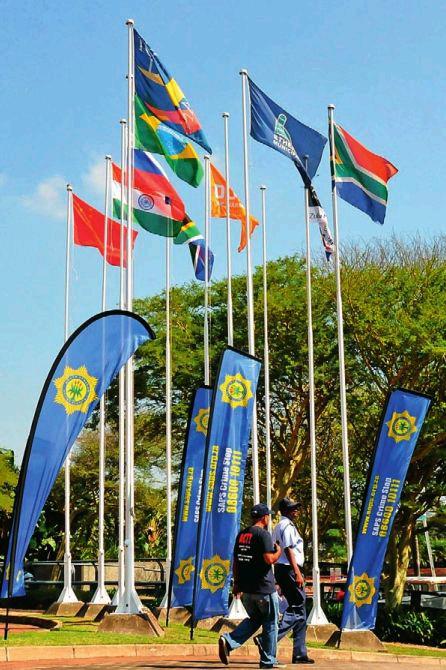
China Today: How are China and Brazil collaborating within BRICS? What kind of contributions have the two countries made to this mechanism?
Zhang Jun: As good friends and strategic partners, China and Brazil are both firm supporters of and active participants in the BRICS process, with close communication and cooperation. We both support BRICS countries to further build partnerships and establish closer ties.
At the Third BRICS Summit in Sanya, China, in March 2011, leaders determined to establish a partnership for common development, under the principles of openness, solidarity and mutual assistance. BRICS aims to build a more equitable and fair world based on peace, security, development and cooperation. In addition, the Sanya Summit set down, for the first time, an action plan for future cooperation in key areas covering trade, finance, health, science and technology, culture, agriculture and statistics, which laid a solid foundation for BRICS broader and deeper collaborations.
Likewise, Brazil successfully hosted the Second BRICS Summit in 2010, an important milestone in the BRICS summitry history. During its chairmanship, Brazil accomplished a historic mission of strengthening the BRICS mechanism, consolidating cooperation momentum and increasing BRICS influence worldwide. The Sixth Summit will take place in Fortaleza this July. The first meeting of the second summit cycle, it is expected to map out future plans based on well established progress. China highly appreciates Brazils effective work in preparing for the summit, and supports Brazil in organizing a successful summit that will intensify solidarity, mutual trust and benefits among BRICS members.
A Highlight of Pragmatic Cooperation
China Today: Could you introduce the progress BRICS has made in pragmatic cooperation? Which major projects have been launched? What are their features and achievements?
Zhang Jun: BRICS is highlighted by pragmatic cooperation in major projects, with the following three characteristics:
First, efficiency. Though BRICS is only five years old, its cooperation has covered dozens of economic and social areas – a rare achievement in international cooperation.
Second, result-oriented. BRICS members stress a pragmatic approach to raising the peoples well-being.
Third, equality. No BRICS country has ever imposed its views and positions on others. They respect one another while keeping in mind individual concerns.
Some major cooperation projects have drawn worldwide attention, such as the NDB, CRA, Business Council and Think Tanks Council. The NDB and CRA are expected to finance infrastructure projects in emerging markets and developing countries, as well as assist them to better withstand the risks ensuing from international financial turbulence. The Business Council promotes communication and exchanges among the business communities and strengthens trade and investment ties. The Think Tanks Council, a platform for the exchange of academics, provides intellectual support for BRICS cooperation.
At present, member countries are formulating new blueprints for cooperation and pooling efforts to expand cooperation. We are confident that BRICS pragmatic cooperation, through concerted and unremitting efforts, deserves a bright future.
Maintain Vitality
China Today: As BRICS cooperation improves, there are concerns as to whether the cooperation mechanism can maintain its vitality in the future. Some observers are not optimistic, in view of the huge differences among BRICS countries. What are your insights into the mechanisms prospects?
Zhang Jun: Diversifying national circumstances, development patterns and cultural traditions among BRICS countries may sometimes bring different views on certain issues. However, diversity does not preclude cooperation. On the contrary, it could turn out to be a driving force for BRICS countries to learn from one another and realize inclusive cooperation.
The success of the BRICS cooperation process has demonstrated that it serves the common interests of all members, and is conducive to world peace and development. Therefore, it enjoys great vitality. All BRICS countries place high value on developing industry, advancing education and technology, investing in human resources and improving peoples livelihoods, which will continue to create enormous opportunities for future cooperation. Trade and investment volume will significantly increase as a result of the strong complementarity of BRICS countries economy. Furthermore, BRICS countries will continue to work together to promote democracy in international relations, improve global economic governance, maintain international fairness and justice, and safeguard the common interests of emerging economies and developing countries.
Last year, at the Fifth BRICS Summit in Durban, President Xi Jinping suggested that BRICS march towards the goals of establishing a market linkage, financial network, better connectivity as well as closer people-to-people contacts. These proposals embody the strategic vision and ambitious goals of BRICS. The cooperation in these fields will become the centerpiece of future BRICS economic cooperation and constitute a major contribution to closer BRICS economic partnership.
Having said that, arduous work still lies ahead, due to internal and external uncertainties, challenges to maintain sound growth momentum, and the fast changing international political and economic situation. As an old saying goes, if you want to go fast, go alone; if you want to go far, go together. Its my firm belief that with strengthened partnership, better coordination in international politics and deeper cooperation in global economic affairs, a promising future awaits.