
Consensus and Solidarity Will Promote Consistent Asia-Pacific Economic Prosperity
2014-09-27 21:38:52ByZHOUWENZHONG
CHINA TODAY 2014年5期
By+ZHOU+WENZHONG
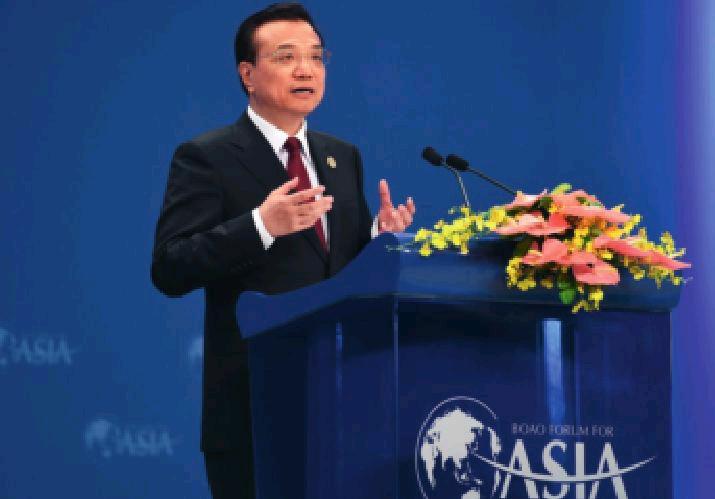
THE Boao Forum for Asia(BFA) Annual Conference 2014 took place in Boao, South Chinas southern Hainan Province, from April 8 to 11. Chinese Premier Li Keqiang, a dozen leaders of other countries and more than 40 heads of international organizations and ministerial level officials were present at the opening ceremony. Other BFA attendees included 50 chairmen and CEOs, 30 executive vice-presidents and Asia-Pacific re- gional presidents, and 70 China regional presidents of 150 companies listed among the Fortune 500.
A retrospective look at the themes of the BFA Annual Conference, from the first in 2002 – “New Century, New Challenge, A New Asia” – to that of 2014– “Asias New Future: Identifying New Growth Drivers” – reflects the pulse of development and economic trends in Asia and related regions over the past 12 years.
Over the past few decades, the matchless rapidity of Asias economic development has rendered it the worlds most dynamic region. Since the outbreak in 2008 of the global financial crisis, the continent has become a main engine driving world economic recovery. Statistics show that Asia has contributed more than 50 percent to world economic growth.
The contributions that Chinas economy has made to this process are plain to see. The countrys rapid economic development has undoubtedly benefited from the openness and inclusiveness of economic globalization, but it has also advanced due to in-depth domestic economic reforms and endeavors.
The changes in China and in other Asian emerging economies will inevitably exert far-reaching global influence. Asian countries, including China, are going through vital economic rebalancing. They all face the dilemma of sustaining economic growth while making structural reforms. The way in which these Asian economies handle such challenges will signal the reform direction of the entire continent.
Accelerate Regional Integration
Most Asian countries are bringing opening up policies into effect through expanded trade and investment and bilateral, regional, sub-regional and crossregional cooperation. These are apparent in stepped up industrial, commercial, financial, scientific and technological, transportation and cultural cooperation and exchanges. Those between ASEAN and China, Japan and South Korea(10+3) have entered a substantive phase. ASEAN economic integration, Greater Mekong Sub-regional Cooperation, the Union of Regional Cooperation for South Asia and other sub-regional cooperation are in process. The Asia-Pacific Economic Cooperation (APEC), the AsiaEurope Meeting (ASEM), the Forum for East Asia-Latin America Cooperation(FEALAC) and other cross-regional cooperation are also pushing ahead.
By 2050, Asias GDP will make up 51 percent of the global total, according to Asian Development Bank (ADB) predictive analyses. These projections also show that regional cooperation and integration are integral to prosperity in Asia.
Different from Europes path to inte-gration via its promotion within the political dimension, in the past three decades it is the market that has mainly motivated Asias integrative process. The immensely negative influence of trade barriers has resulted in the shared desire of Asian economies to eliminate them. The consequent series of bilateral free trade agreements has hastened economic cooperation.
In 1993 there were only 14 free trade agreements in Asia. By the end of 2013 the number had jumped to more than 100. Burgeoning trade has been the key to making Asia the worlds most dynamic region.
Nobel Laureate in Economic Sciences Ronald Coase once wrote that it was the absence in Asia of a common market, like the EU or NAFTA (North American Free Trade Area), that was at the root of the relatively low turnover of capital and labor within it. He also pointed out that dramatically reducing circulation costs within Asia would provide powerful impetus for its long lasting progress.
Coases analysis points out the disparities in building an Asian community, and confirms the importance of integration polices covering all dimensions and regions in the Asia-Pacific economy. Although various parties may have their own views on Asian regional integration, the focus of policies in Asia and in related economies is nevertheless on conformation of this integration process through free trade agreements.
Although controversies still exist, consensus has progressively been reached. Meaningful free trade agreements should reduce tariffs and regulate trade in investments, services and intellectual property, among other facets, and guarantee adherence to high-level international trade rules. The scope and comprehensiveness of free trade agreements will determine their ability to generate profits for Asian economies.
Extensive participation in the integration process, including institutionalized cooperation arrangements, will be Chinas vital responsibility in its future regional economic cooperation.
Escalating Regional Connectivity within Asia
Adam Smith wrote in his seminal work, The Wealth of Nations, that wellbuilt roads, canals and navigation waterways could promote outlying regional economies, by reducing transport costs and boosting development to around the same level as that in urban areas. More than two centuries on, this theory on the positive impact of high connectivity on economic development still holds true. It is manifest in two aspects: the high efficiency, high price-performance ratio circulation of resources, and the alleviation of inner- and inter-country inequality.
No Asian country can at this time be complacent about its infrastructures, whether in quality or quantity, particularly those relating to transport and energy transmission. Public sector spending on infrastructures in most Asian countries is less than three percent of GDP. That from private sectors is below one percent of GDP. Poor infrastructure, therefore, remains a bottleneck to regional integration. Zeng Peiyan, vice chairman of the Boao Forum for Asia, has called on all Asian economies to exchange and collaborate on infrastructure planning. The aim is to splice their respective national plans towards the broader goal of better regional connectivity and intercommunication. Zeng believes it imperative for Asian countries to discuss the prospect of building a complete trans-national, trans-regional and cross-basin infrastructure network. After reaching a consensus, blueprints for specific sectors should be drawn. The countries should then carry out accordingly their respective long- and mediumterm planning and arrangements. These endeavors will stimulate open and smooth personnel, economic and cultural exchanges across the continent.
Increasing investment in infrastructure and expanding domestic demand can fuel economic growth and mend the national economy fault line wrought by breakneck growth over the past years. Better infrastructure is instrumental to economic restructuring and development of certain emerging industries. It hence contributes to stable economic growth and employment.
Aware of the great wealth that good infrastructure may unlock, the Boao Forum for Asia held last October in Bali the Seminar on Connectivity and Inclusive Growth in the Asia-Pacific. The half-day event brought this topic to multilateral dialogues in various fields at different levels.
Funding is a major obstacle to infrastructure development in Asia. Bringing local infrastructures to the world average level would require a US $8 trillion investment from Asian countries within their borders; a further US $300 billion would be needed for trans-regional projects, according to Asian Development Bank estimates. There is a substantial funding shortfall in this regard. President Xi Jinping accordingly said in his keynote speech at the 2013 Boao Forum opening ceremony that China would step up efforts to strengthen connectivity and inclusive growth with other countries on the continent. China will moreover make proactive explorations into the possibility of setting up a regional financing platform to promote economic integration and collective competitiveness in Asia.
The needed upgrading of local infrastructures opens new growth space for Asias emerging economies. China, with its remarkable advances in transport, urban development and other infrastructures over the past 30-odd years, can give other developing countries in the region the benefit of its experience. Whats more, the growing financial and technical might of Chinese companies gives them the means to assist in other countries infrastructure construction.
China has made overtures towards establishing an Asian infrastructure investment bank. It has also pledged financial support to Asian developing countries in their infrastructure construction, in efforts to boost regional interconnectivity and economic integration. The proposed bank, which would work through a regional financial platform, is expected to close the infrastructure construction funding gap in developing Asian countries. This will stem the outflow of local capital, which can instead be steered towards inner-regional investment to promote vitality and growth of the Asian economy. The resultant benefits will spill over from Asia to the whole world, so buttressing the recovery of global economy.
Boao Eyes Common Development
Economic globalization and regionalization have both proceeded since the turn of the millennium. They are trends that demand expanded exchanges and cooperation among Asian countries as well as between Asia and the rest of the world. Maintaining healthy economic development and reinforcing mutual coordination and collaboration under the weight of growing globalization is a challenge that all Asian countries face.
President Xi Jinping quoted in his speech at the 2013 Boao Forum opening ceremony the Chinese saying, “Neighbors, just as loved ones, wish each other well.” Chinas development brings more opportunities to Asia as a whole and to the world at large. The reform measures that China rolled out in the wake of the 18th CPC National Congress consequently polarized world attention.
The development of Asian economies and the continents economic integration are critical to the world economic landscape. Few dispute that Asia constitutes a global economic bonanza in the 21st century.
The year 2014 will witness continuing reforms in Asian economies. China, Japan, India and Indonesia, among others, are all pressing ahead with their reform agendas. Awareness exists that external factors are no longer sufficient for economic growth, and that endogenous power must be tapped. To foster this power, Asian countries need to step up communication, cooperation and mutual support among themselves.
The first organization in history to be founded and operated by Asian people, the Boao Forum for Asia discusses regional affairs from the perspective of and in the interests of Asia. It is committed to communication and collaboration among Asian countries as well as between Asia and the rest of the world. The Boao Forum serves Asian countries, but is also open to the larger world. With concerns in both regional and international issues, the forum has become a widely recognized venue for political, business and academic communities across Asia. Through the forum they can conduct dialogues, learn more about one another and build stronger mutual trust. The forum thus significantly contributes to regional cooperation.
The Boao Forum also provides an expressway for opinions and expertise among Asian countries. It allows them to congregate, compete and eventually exert positive impact on economic activities.
There is a dire need in Asia, China included, for such a bridge of understanding on which to build consensus and promote common prosperity in the region.
- CHINA TODAY的其它文章
- Chinese Enterprises Plow Ahead in Africa’s Farm Machinery Market
- Waste Recycling the Green Way
- The Return of the King?
- A Specific Dream in a Diversified World
- On the 35th Anniversary of China-U.S. Diplomatic Relations
- The Iceland-China Free Trade Agreement: A Milestone for Strengthening Good Relations Between Iceland and China