
兩個基于四氮唑衍生物的配位聚合物的合成
2015-04-01 06:16:55黃登登陳立莊
無機化學(xué)學(xué)報 2015年2期
黃登登 陳立莊
(江蘇科技大學(xué)環(huán)境與化學(xué)工程學(xué)院,鎮(zhèn)江212003)
兩個基于四氮唑衍生物的配位聚合物的合成
黃登登 陳立莊*
(江蘇科技大學(xué)環(huán)境與化學(xué)工程學(xué)院,鎮(zhèn)江212003)
在水熱條件下,5-(4-吡啶基)四氮唑(4-PTZ)分別與氯化鋅和氯化鎘反應(yīng),得到2個基于此配體的配位聚合物,它們的分子式分別為{[Zn(4-PTZ)2Cl2]·4H2O}n(1)和{[Cd3(4-PTZ)2(H2O)2Cl6]·3H2O}n(2),且表現(xiàn)出不同的配位模式。這2個化合物均結(jié)晶在單斜晶系,化合物1的晶胞參數(shù)分別為:a=0.691 75(8)nm;b=2.668 8(3)nm;c=1.122 66(12)nm;β=93.535 0(10)°;V=2.068 7(4)nm3;Z=4;R1=0.031 8(I>2σ(I));wR2=0.082 9;空間群為P21/n。化合物2的晶胞參數(shù)分別為:a=1.897 13(13)nm;b=1.055 79(7)nm;c= 1.446 49(10)nm;β=102.489 0(10)°;V=2.828 7(3)nm3;Z=4;R1=0.026 2(I>2σ(I));wR2=0.134 3;空間群為C2/c。通過元素分析、紅外光譜分析和熱重分析對該化合物進行了表征,另外熒光測定結(jié)果顯示化合物1和2的固態(tài)粉末在室溫下均表現(xiàn)出較強的紫外熒光發(fā)射特性。
配位聚合物;一維鏈;水熱反應(yīng);四唑;熒光
0 Introduction
In recent years,great deal of efforts have been invested in the rational design and synthesis of metalorganic coordination polymers in the field of crystal engineering with the driving force of various structural characteristicsandhighversatilitysuchasion exchange,photoluminescent,sensingoftargetmolecules,magnetism,nonlinearoptics,catalysis, etc[1-8].Extensive investigations have demonstrated that the metal ions,the geometries,and the coordination sites of organic ligands play significant roles in directing the final structures that are formed via selfassembly processes[9-11].Without a doubt,among these factors,the rational design and reasonable use of the characteristic ligands occupies the capital,because changes in the flexibility,length,and symmetry of the organic ligands can result in a remarkable class of coordination polymers bearing diverse architectures and functions[12-13].Among various organic ligands,the tetrazolyl functional group has found a wide range of applications incoordinationchemistryasligands because of the multiple N-donor atoms of tetrazole group.Ligands containing tetrazole groups could serve as excellent multidentate or bridging building blocks for the construction of polymeric structures[14-17].The combination of nitrogen donor ligands and pyridine ring as connecting ligands is widely used for the construction of coordination polymers,among which a series of cadmium and zinc coordination polymers containing5-(4-pyridyl)tetrazolate(4-PTZ)ligands have been reported[18-20].Taking all these into consideration,as a continuation of our systematic studies of tetrazolyl ligands[21-22],we choose 5-(4-pyridyl)tetrazolate as an organic building block in an attempt to construct metal-organicpolymerswithvariousstructural features.Herein,we report the synthesis,crystal structures and luminescent properties of two coordination polymers based on 5-(4-pyridyl)tetrazolate,namely {[Zn(4-PTZ)2Cl2]·4H2O}n(1)and{[Cd3(4-PTZ)2(H2O)2Cl6]·3H2O}n(2).
1 Experimental
1.1 Materials and methods
Allthematerialsexceptthe5-(4-pyridyl) tetrazolate ligand are of analytical reagent grade and used as received without further purification.The ligand 5-(4-pyridyl)tetrazolate was prepared by the method reported in the literature[23].Infrared spectra are recorded on a SHIMADZU IRprestige-21 FTIR-8400S spectrometer in the spectral range of 4 000~ 500 cm-1.The solid-state fluorescence spectra were recorded on a SHIMADZU RF-5301PC.Elemental analyses were taken on a Perkin-Elmer 240C elemental analyzer.Thermo gravimetric analyses(TGA)were conductedonaNetszchTGA209F3thermo gravimeter with a heating rate of 10 K·min-1in an N2atmosphere.
1.2 Synthesis of the compounds
{[Zn(4-PTZ)2Cl2]·4H2O}n(1):A mixture of ZnCl2(13.6 mg,0.1 mmol),5-(4-pyridyl)tetrazolate)(14.7 mg, 0.1 mmol)and 14 mL H2O was placed in a 25 mL Teflon-lined stainless steel vessel,and heated to 140℃for 3 days,then cooled to room temperature at a rate of 5℃·h-1.Colorless rod-like crystals of 1 were obtained.The yield of complex 1 was 52%.IR(KBr pellet,cm-1):3 481(m),3 092(m),2 670(m),2 119 (w),1 645(vs),1 530(vs),1 434(vs),1 386(w),1 232 (m),835(vs),750(vs),710(w),522(w).Anal.Calcd. for C12H18Cl2N10O4Zn(%):C,28.68;H,3.61;N,27.87; Found:C,28.71;H,3.55;N,27.92.
{[Cd3(4-PTZ)2(H2O)2Cl6]·3H2O}n(2):Thesame synthetic procedure as for 1 was used except that ZnCl2was replaced by CdCl2·2.5H2O.Colorless block crystals were obtained in 48%yield(based on Cd).IR data(KBr pellet,cm-1):3 472(m),3 236(s),3 154(s), 3 095(s),1 637(vs),1 595(s),1 511(s),1 443(w),1 380 (m),1 240(m),1 197(w),1 130(w),1 088(w),1 054 (w),1 012(w),942(m),891(m),846(m),793(s),733(vs), 699(m),526(w).Anal.Calcd.for C12H20Cd3Cl6N10O5(%): C,15.43;H,2.16;N,14.99;Found:C,15.39;H, 2.12;N,14.93.
1.2 X-ray crystallography
Single crystals of complexes 1 and 2 with appropriate dimensions were chosen under anoptical microscope,data of them were collected on a Bruker SMART-APEX II CCD with Mo Kα radiation(λ= 0.071 073 nm)at 296 K.The structures were solved by direct methods and refined with full-matrix leastsquarestechniqueusingSHELXTL-97software package[24-25].All non-hydrogen atoms were refined with independent anisotropic displacement parameters,and hydrogen atoms were located and included at their geometrically idealized positions.Hydrogen atoms ofwater molecules were located in difference Fourier maps and rened using a riding model,with Uiso(H)= 1.2Ueq(C,N,O).Data collection and structure refinementparametersandcrystallographicdataforcomplexes 1 and 2 were given in Table 1.Selected coordination bond lengths and bond angles of1 and 2 are summarized in Table 2 and 3,respectively.
CCDC:984430,1;984429,2.

Table 1Crystal data collection and parameters for 1 and 2

Table 2Selected bond lengths(nm)and lond angles(°)of 1

Table 3Selected bond lengths(nm)and bond angles(°)of 2

Continued Table 2
2 Results and discussion
2.1 Single-crystal structures of complexes 1 and 2
X-ray single crystal structure determination of 1 shows that complex 1 is packing with a discrete Zn(Ⅱ)molecule with the formula C12H10Cl2N10Zn and four uncoordinated water molecules.It also reveals that complex 1 crystallized in the monoclinic,space group P21/n.The Zn(Ⅱ)atom has a distorted tetrahedral coordinationenvironment,coordinatedbytwoCl atoms and two N atoms of the tetrazole group(Fig.1). The metal-ligand bond distance in complex 1 provides a direct comparison of the variation of metal to chlorine and metal to tetrazole bonding to those similar coordination polymers based on Zinc[26-27].The metal-chlorine bond distance is relatively constant in the complex.The largest difference in this bond length is 0.000 72 nm.In comparison with the Zn(1)-N(2)bond distance of 0.202 92(18)nm,the Zn(1)-N(6) bond distance of 0.201 79(17)nm is slightly shorter than that in complex 1.Furthermore,the bond angles of Cl(2)-Zn(1)-N(2)and Cl(2)-Zn(1)-N(6)are 112.37(6)° and 109.77(5)°respectively.Comparably,the bond angles of Cl(3)-Zn(1)-N(2)and Cl(3)-Zn(1)-N(6)are 108.85(6)°and 108.28(6)°,which are a little smaller. Moreover,thebondangle ofCl(2)-Zn(1)-Cl(3)is 112.13(3)°.The two dihedral angles between the leastsquares pyridine ring and the least-squares plane of the tetrazole ring in complex 1 are 2.952(82)°and 1.665(74)°respectively.The molecular packing of 1 is further stabilized by intermolecular H-bond between N atoms of tetrazole ligands and Cl atoms of the neighboring molecule and the lattice water molecules. Moreover,weak hydrogen bonding interactions also exist in 1,which are C(4)-H(4)…Cl(2)vii(0.359 0(2) nm),C(5)-H(5)…Cl(3)iii(0.347 3(3)nm),C(9)-H(9)…Cl(2)ix(0.340 8(3)nm)and C(5)-H(5)…O(4)(0.324 7(4) nm)respectively.These hydrogen bonding interactions help to stabilize the crystal structure of 1 and form a 2D supramolecular structure(Table 4 and Fig.2).

Fig.1View of the coordination environment of Zn(Ⅱ)in complex 1 with displacement ellipsoids drawn at the 15%probability level
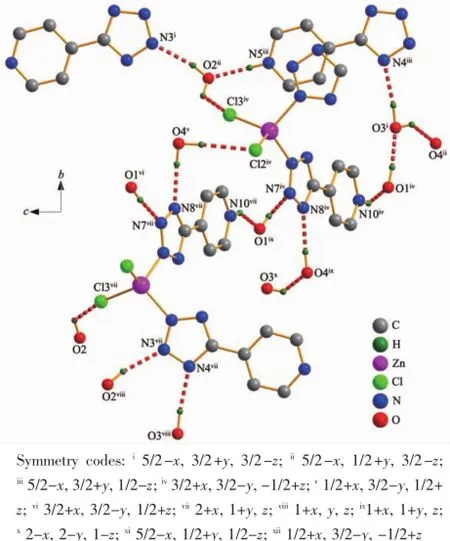
Fig.2Perspective views of the 2D network of 1 through H-bonding along the a axis

Table 4Hydrogen bond lengths(nm)and bond angles(°)of 1
The single crystallographic analysis reveals that the title compound{[Cd3(4-PTZ)2(H2O)2Cl6]·3H2O}n(2) crystallizes in the monoclinic system,space group C2/ c.Complex 2 exhibits a zigzag 1D chain,the chain can be considered as constructed by the basic unit, which is composed of linear trinuclear cadmium cations,μ2-Cl atom bridges and water molecules.In the fundamental unit,neighboring Cd(Ⅱ)ions of the trinuclear species are linked by one bridged tetrazole ligand and two chloride atoms.The neighboring Cd2+centers are connected by two ways to generate Cd…Cd interactions:(i)The μ2-Cl-adopts asymmetry mode to bind two neighboring Cd2+centers with different bond lengths of Cd(2)-Cl(1)and Cd(2)-Cl(3).With the linkage of μ2-Cl-,an inorganic skeleton chain[CdCl2]nformed;(ii)tetrazole ligands bind neighboring Cd2+with its 2-and 3-positioned nitrogen atoms anchoring on the both sides of the inorganic skeleton like wing (Fig.3).Four chloride atoms are coordinated to the central cadmium atom and form a square plane,with the octahedron of the central ion compressed along the N(4)-Cd(2)-N(4)iaxis.The distances of Cd(2)-N(4) (0.234 6(3)nm),Cd(2)-Cl(1)(0.262 08(8)nm),and Cd(2)-Cl(3)(0.264 56(9)nm)are consistent with the bond length that has the similar coordination mode in Cd(Ⅱ)compound[28].Two chloride anions and one water molecule complete the octahedral coordination sphere of the terminal Cd(Ⅱ)ions in the unit,and the Cd(1)-Cl(2)distances of 0.257 71(8)nm and 0.260 31(9)nmrespectively,are essentially different from the Cd(1)-N (tetrazole)and Cd(1)-Cl distances(dCd(1)-N(3)=0.244 60(3) nm,dCd(1)-Cl(1)=0.259 40(8)nm,and dCd(1)-Cl(3)=0.263 71(9) nm).In addition,the bridging angles of Cd(1)-Cl(1)-Cd(2)and Cd(1)-Cl(3)-Cd(2)are 86.294°and 84.920° respectively,and the Cd…Cd distance in the trinuclear unit is 0.356 63(3)nm.These distances and angles are indicative of a distorted octahedron around Cd(1). The terminal chloride atoms in the fundamental unit adopt a double bridging mode to connect with other units.On the basis of this connection mode,all trinuclear Cd clusters giving rise to infinite onedimensional chains along b axis as shown in Fig.4. Furthermore,theadjacentchainsareconnected together through hydrogen bonding interactions,which occur among the lattice water molecules,the chloride atoms,and the-NH groups of the 5-(4-pyridyl) tetrazolate molecules.Thus,a 3D supramolecular network is formed via both coordinating and hydrogenbond interaction(Fig.5 and Table 5).

Fig.3Coordination environment of cadmium-chloride and cadmium-tetrazole in 2 with displacement ellipsoids drawn at the 15%probability level

Fig.4Coordination 1D chain along the b axis in 2
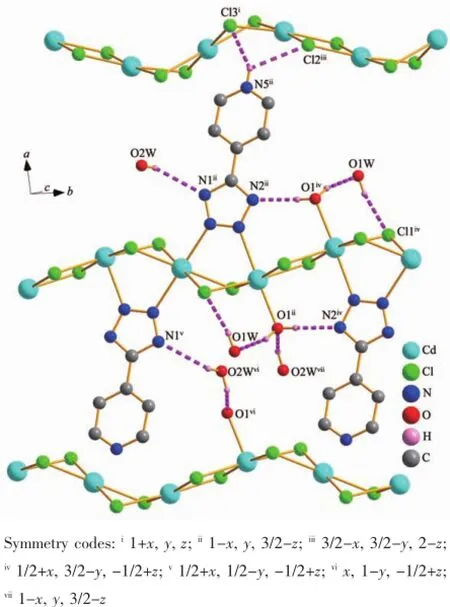
Fig.5Hydrogen-bonded network of the supramolecular structure in 2
2.2 Fluorescence
Aromatic organic molecules,organic polymers, andmixedinorganic-organichybridcoordination polymers have been applied as fluorescence-emitting materials[29].Organic materials affect emission wavelengths,so it is of great significance to select proper organic spacers and metal centers(Zn,Cd,Pb,Ca,B, etc.)for the syntheses of inorganic-organic coordination polymers[30-32].The solid-state fluorescence spectraof powdered 1 at room temperature(Fig.6)show maximal emission peaks at 360 nm(with λex=320 nm), suggesting that 1 may be a good ultraviolet-lightemitting material.Similarly,as evidenced by the maximal emission peaks at 375 nm(with λex=350 nm) of solid-state 2 at room temperature(Fig.7),2 may also be an eligible ultraviolet-light-emitting material. Thephotoluminescentmechanismistentatively attributed to ligand-to-ligand transitions,being in reasonableagreementwiththisclassofmetal complexes reported previously[33-34].

Table 5Hydrogen bond lengths(nm)and bond angles(°)of 2

Fig.6Fluorescent emission spectrum of 1 in the solid state at room temperature

Fig.7Fluorescent emission spectrum of 2 in the solid state at room temperature
2.3 TGA
To study the thermal stability of 1 and 2 and to further confirm their molecular formula,thermogravimetric(TG)analysis was performed in N2atmosphere on samples of complexes 1 and 2(Fig.8).The TGA curves of 1 and 2 both show two identifiable weight loss steps respectively.For 1,the first weight loss from 60 to 280℃is attributed to the loss of four lattice water molecules(Obsd.15.2%,Calcd.14.3%). The second weight loss of 1 between 300 and 630℃perhaps correspond to the release of Cl atoms(Obsd. 15.5%,Calcd.14.1%).Upon temperature increase, the structure of 1 begins to collapse.For 2,the first weight loss in the temperature range of 50~200℃is consistent with the removal of the uncoordinated water molecules(Obsd.6.4%,Calcd.5.8%).The second weight loss of 2 between 240 and 540℃,corresponds to the release of Cl atoms and the coordinated water molecules(Obsd.27.5%,Calcd.26.7%).Upon temperature increase,the structure of 2 begins to collapse.
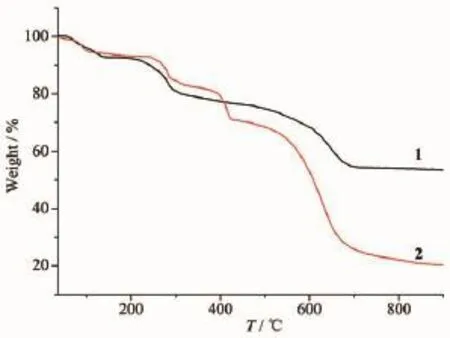
Fig.8TGA curves of compounds 1 and 2
3 Conclusions
In summary,two coordination polymers 1 and 2 based on 5-(4-pyridyl)tetrazolate ligands have been synthesizedunderhydrothermalconditionsand structurallycharacterized.It′sworthmentioning complex 2 is a polymer chain constructed via the trinuclear metal cation units,which are bridged by tetrazolyl ligands.In addition,1 and 2 display strong ultraviolet fluorescence emissions in the solid state at room temperature,suggesting that they may be good ultraviolet-light-emitting materials.Furthermore,this work may provide a useful approach for the design andconstructionofotherstructuralcrystalline materials,which further helps us to understand the relationships between structures and properties.
[1]Zhang J P,Horike S,Kitagawa S.Angew.Chem.Int.Ed., 2007,46:889-892
[2]Zhang W,Xiong R G.Chem.Rev.,2012,112:1163-1195
[3]Yoon M,Srirambalaji R,Kim K.Chem.Rev.,2012,112:1196 -1231
[4]Zhang Y,Luo X B,Yang Z L,Li G.CrystEngComm,2012, 14:7382-7397
[5]Zhao H,Qu Z R,Ye H Y,et al.Chem.Soc.Rev.,2008,37: 84-100
[6]Xu G C,Zhang W,Ma X M,et al.J.Am.Chem.Soc.,2011, 133:14948-14951
[7]Liu S J,Zhao J P,Song W C,et al.Inorg.Chem.,2013,52: 2103-2109
[8]Chen L Z,Huang D D,Ge J Z,et al.CrystEngComm,2014, 16:2944-2949
[9]Bu X H,Chen W,Hou W F,et al.Inorg.Chem.,2002,41: 3477-3482
[10]Chen M,Chen S S,Okamura T,et al.Cryst.Growth Des., 2011,11:1901-1912
[11]Long L S.CrystEngComm,2010,12:1354-1365
[12]Cui J H,Yang Q X,Li Y Z,et al.Chem.Commun.,2013, 49:555-557
[13]Chen L Z,Huang D D,Ge J Z,et al.Inorg.Chem.Commun., 2014,45:5-9
[14]Luo T T,Tsai H L,Yang S L,et al.Angew.Chem.,Int.Ed., 2005,44:6063-6067
[15]Wang F,Yu R,Zhang Q S,et al.J.Solid State Chem.,2009, 182:2555-2559
[16]Wang F,Zhang J,Chen S M,et al.CrystEngComm,2009, 11:1526-1528
[17]Mautner F A,Gspan C,Gatterer K,et al.Polyhedron,2004, 23:1217-1224
[18]Chang C C,Huang Y C,Huang S M,et al.Cryst.Growth Des.,2012,12:3825-3828
[19]Wang L Z,Qu Z R,Zhao H,et al.Inorg.Chem.,2003,42: 3969-3971
[20]Xue X,Wang X S,Wang L Z,et al.Inorg.Chem.,2002,41: 6544-6546
[21]Chen L Z,Zou J,Gao Y M,et al.J.Coord.Chem.,2011,64: 715-724
[22]CHEN Li-Zhuang(陳立莊),CAO Xing-Xing(曹星星),WANG Fang-Ming(汪芳明),et al.Chinese J.Inorg.Chem.(無機化學(xué)學(xué)報),2012,28(6):1291-1297
[23]Detert H,Schollmeier D.Synthesis,1999:999-1004
[24]Sheldrick G M.SHELXS-97,Program for Crystal Structure Solution,University of G?ttingen,Germany,1997.
[25]Sheldrick G M.SHELXL-97,Program for Crystal Structure Refinement,University of G?ttingen,Germany,1997.
[26]Xiong R G,Xue X,Zhao H,et al.Angew.Chem.Int.Ed., 2002,41:3800-3803
[27]Yang Y T,Zhang F H,Che Y X,et al.Inorg.Chem.Comm., 2011,14:1855-1859
[28]Yi L,Ding B,Zhao B,et al.Inorg.Chem.,2004,43:33-43
[29]Bunz U H F.Chem.Rev.,2000,100:1605-1644
[30]Dong Y B,Wang P,Huan R Q,et al.Inorg.Chem.,2004, 43:4727-4739
[31]Cariati E,Bu X,Ford P C.Chem.Mater.,2000,12:3385-3391
[32]Ciurtin D M,Pschirer N G,Smith M D,et al.Chem.Mater., 2001,13:2743-2745
[33]Tong M L,Chen X M,Ye B H,et al.Angew.Chem.Int. Ed.,1999,38:2237-2240
[34]Wang X S,Tang Y Z,Huang X F,et al.Inorg.Chem.,2005, 44:5278-5285
Assembly of Two Coordination Polymers Based on Tetrazole Derivatives
HUANG Deng-DengCHEN Li-Zhuang*
(School of Environmental and Chemical Engineering,Jiangsu University of Science and Technology,Zhenjiang,Jiangsu 212003,China)
Two mixed metal-organic coordination polymers,namely{[Zn(4-PTZ)2Cl2]·4H2O}n(1)and{[Cd3(4-PTZ)2(H2O)2Cl6]·3H2O}n(2),were synthesized under hydrothermal condition using 5-(4-pyridyl)tetrazolate(4-PTZ),which exhibited diverse coordination modes in two complexes.The two compounds are both crystallized in a monoclinic system.Compound 1:a=0.691 75(8)nm;b=2.668 8(3)nm;c=1.122 66(12)nm;β=93.535 0(10)°;V=2.068 7(4)nm3; Z=4;R1=0.031 8 for I>2σ(I);wR2=0.082 9;space group P21/n.Compound 2:a=1.897 13(13)nm;b=1.055 79(7) nm;c=1.446 49(10)nm;β=102.489 0(10)°;V=2.828 7(3)nm3;Z=4;R1=0.026 2 for I>2σ(I);wR2=0.134 3;space group C2/c.They are characterized by elemental analysis,IR spectroscopy and TGA.In addition,1 and 2 have ultraviolet fluorescence emissions in the solid state at room temperature.CCDC:984430,1;984429,2.
coordination polymer;1D chain;hydrothermal reaction;tetrazole;fluorescence
O614.24+1;O614.24+2
A
1001-4861(2015)02-0377-08
10.11862/CJIC.2015.047
2014-09-06。收修改稿日期:2014-11-13。
國家自然科學(xué)基金(No.21201087);江蘇省自然科學(xué)基金(No.BK20131244);江蘇省教育廳基金(No.11KJB150004)資助項目;江蘇省青藍工程項目;江蘇省高校研究生實踐創(chuàng)新計劃項目(No.SJZZ_0142)資助項目。
*通訊聯(lián)系人。E-mail:clz1977@sina.com
