
Adaptive modulation in MIMO optical wireless communication systems
2015-05-08 02:32:22WuBinWuLiangZouCairong
Wu Bin Wu Liang Zou Cairong
(School of Information Science and Engineering, Southeast University, Nanjing 210096, China)
?
Adaptive modulation in MIMO optical wireless communication systems
Wu Bin Wu Liang Zou Cairong
(School of Information Science and Engineering, Southeast University, Nanjing 210096, China)
In the intensity modulation and direct detection (IM/DD) multiple-input multiple-output (MIMO) optical wireless communication systems, a direct-current-biased adaptive modulation scheme is proposed to guarantee the nonnegative property of transmitted signals, and the MIMO channel is converted to a parallel channel by using a singular value decomposition. Besides, a QR decomposition and successive interference cancellation based adaptive modulation scheme is proposed, and the MIMO channel can be simplified to a parallel channel under the bit error ratio (BER) target constraint. The power is optimally allocated to each sub-channel to maximize the data rate. Simulation results show that the proposed adaptive modulation schemes can effectively improve the transmission rate of the systems under the BER target and constant optical power constraints. The proposed adaptive modulation schemes make use of the multiplexing gain of the MIMO techniques, and can further improve the spectrum efficiency of optical wireless systems.
optical wireless communication; multiple input and multiple output (MIMO); adaptive modulation
In the multiple-input and multiple-output (MIMO) radio frequency wireless communication system[1-2], precoding and successive interference cancellation are two of the most commonly used techniques to curb the inter-symbol interference. When applying precoding techniques[3], the transmitter needs to know the channel status information through the feedback of the receiver. In a practical system, the channel status information must be quantified by a limited number of bits in order to be sent back to the transmitter[4]. A practical method based on the QR decomposition and successive interference cancellation can be easily realized and applied in many areas[5].
The system spectrum efficiency can be enhanced by adaptive modulation and power allocation schemes[6]. The adaptive technique also requires the feedback information. In an adaptive modulation system based on precoding, channel state information which includes the precoding matrix must be sent back to the transmitter. In a practical system, the perfect channel state information cannot be acquired, an adaptive algorithm based on the error channel state information[7]is analyzed. Zhou et al.[8]studied the adaptive technique based on the mean value feedback. In Ref.[9], a method using the outdated channel state information was proposed. Park et al.[10]proposed an enhanced precoding scheme with limited-rate imperfect feedback.
By utilizing MIMO techniques, the anti-fading characteristics and spectrum efficiency of a system can be enhanced, and adaptive modulation can further improve the spectrum efficiency while still ensuring system performance. However, adaptive techniques in radio frequency wireless communications cannot be directly applied to optical wireless communication systems because of the intensity modulation and direct detection (IM/DD), which means that the transmitted signal must be nonnegative. Besides, few studies have been conducted on the adaptive modulation techniques in MIMO optical wireless communication systems. In this paper, we focus on the adaptive modulation techniques applicable to the IM/DD MIMO optical wireless communication system. Two adaptive modulation schemes are proposed for the IM/DD optical wireless communication system in flat fading channels. DC bias and singular value decomposition (SVD) are applied in the first proposed scheme, and the second scheme is based on successive interference cancellation. Simulation results show that the proposed schemes work well under the bit error ratio (BER) target and constant transmit power constraints.
1 System Model of MIMO Optical Wireless Communications
A point to point un-imaged MIMO optical wireless communication system is considered in this paper[11]. It is assumed that a transmitter consists ofntlight-emitting diodes (LEDs) and a receiver consists ofnrphotodiodes (PDs). The block diagram of the MIMO optical wireless system is shown in Fig.1. The channel of MIMO optical wireless communication can be expressed by anr×ntmatrixH, where the (i,j)-th component ofHishi,j, which is the channel coefficient from thej-th LED to thei-th PD. In line of sight (LOS) links,hi,jcan be expressed as[12]
(1)
wheremis the order of Lambertian emission,m=-ln2/ln(cosΦ1/2);Φ1/2is the semiangle at half-power of the transmitting LED;Aris the receiving area of PD;Di,jandφi,jare the distance and angle of incidence from thej-th LED to thei-th PD, respectively;Ψc,iis the field of view (FOV) of thei-th PD.
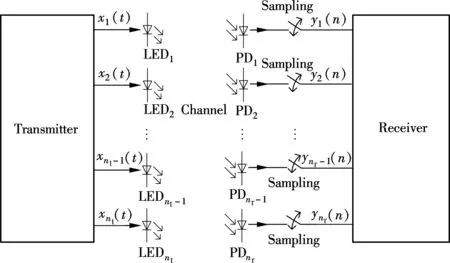
Fig.1 Block diagram of a MIMO optical wireless communication system
The received signal takes the form as
y=Hx+n
(2)

2 Adaptive Modulation Scheme based on DC-Bias and SVD
In radio frequency (RF) MIMO communication systems, the optimal precoding matrix is
UP=UH
(3)
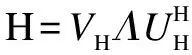
t=UPs
(4)
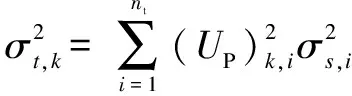

Pr(v+2σν>0)≈97.8%
(5)
which is very close to 1.
Define a vectorκand itsk-th component isκk=2σt,k. By adding a DC bias, the transmitted signal can be expressed as
x=UPs+κ
(6)

(7)
After subtracting the DC bias component, the signal becomes
(8)
In the practical communication system, each component of information vectorsemploys a traditional pulse amplitude modulation (PAM) scheme, and the modulation order is chosen adaptively. It is assumed that the maximum value of thek-th spatial subchannel isZk. Therefore, thek-th component of the DC bias vectorκis
(9)
When the average transmit optical power ispa, the corresponding constraint is
(10)
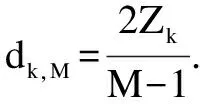
(11)

(12)
whereQ-1( ·) is the inverse function of theQ-function, and it has
Thk,1≤Thk,2≤…≤Thk,6
(13)
The modulation order can be decided according to the following criteria:
(14)
The transmission rate of thek-th data stream is
(15)
whereU( ·)is the step function. Under the constant power and BER target constraints, the adaptive modulation scheme can be expressed as the following optimization problem:
(16)
s.t.
(17)
To optimize the power allocation, The maximum valueZkof thek-th data stream should satisfy
Zk∈{ThPk,i=Thk,iσn,i=1,2,…,6}
(18)
Define the incremental power as
(19)
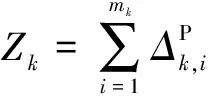
(20)
s.t.
(21)
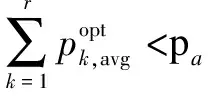
Theproblemcanbesolvedbythefollowingtwosteps[15]:
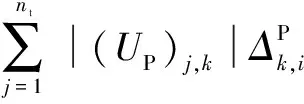
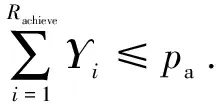
If the optimal modulation scheme of thek-th spatial sub-stream is 2mk,opt-PAM, the power allocation is
(22)
3 Adaptive Modulation Scheme based on QR Decomposition and Successive Interference Cancellation
3.1 The principle of QR decomposition and successive interference cancellation
It is assumed that the QR decomposition of channel matrixHis
H=UQG
(23)
whereUQis an unitary matrix andGis an upper triangle matrix. At the receiver, the received signal is multiplied by the conjugate and transpose of matrixUQ, such that the signal can be expressed as
(24)
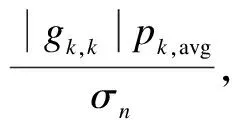
The proof is as follows: The BER target in the uncoded adaptive modulation system is usually less than 10-3. In the optical domain, SNR is defined as
(25)
wherepais the optical power.
Therefore, the average SNR of thek-th spatial sub-channel is

(26)
where ?k,iis the SNR of thek-th spatial sub-stream when suffering the interference fromidata streams, and it is assumed that ?k,iare in the same order with the samei. Besides, in the practical environment, it hasnt<10 andnr<10. Therefore,
(27)
The QR decomposition and successive interference cancellation based adaptively modulated optical wireless communication system can be viewed as adaptive modulation in parallel channels.
3.2 QR decomposition and successive interference cancellation based adaptive modulation scheme
In the MIMO optical wireless system, the DC-bias PAM scheme is employed for each sub-channel. The BER performance of the DC bias PAM scheme takes the form as[14]
(28)
where SNR is in the optical domain as Eq.(25). The SNR threshold is defined as
(29)
where ThO1≤ThO2≤…≤ThO6.
When the transmit power is a constant and the BER target is set, the power is optimally allocated such that the achieved data rate is maximized. The optimization problem can be expressed as
(30)
s.t.
(31)
According to the SNR threshold, the power allocated to thek-th spatial sub-stream needs to satisfy
(32)
which can achieve the maximum spectrum.
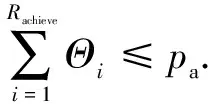
The incremental optical power is defined as
(33)
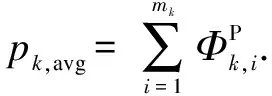
(34)
s.t.
(35)
The problem can be solved by the following two steps[15]:

If the optimal modulation scheme of thek-th spatial sub-stream is 2mk,opt-PAM, the power allocation is
(36)
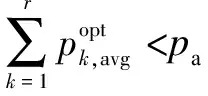
(37)
The achieved data rate of the proposed adaptive modulation is
(38)
Ifqbits are used to quantize the proportion of the power allocated for each spatial sub-stream to the total transmitted power, the total number of feedback bits are (q+3)r, where 3rbits are used to send the modulation order.
4 Simulation Results

Figs.2 and 3 depict the performance of the DC bias and SVD-based adaptive modulation scheme. Fig.2 shows the achieved data rate with different LED and PD configurations. It can be seen from Fig.2 that the achieved data rate is linearly proportional tontwhennt=nr. Fig.3 shows the simulated BER performance. It can be seen that the BER target is satisfied in all the conditions. The trend of the BER performance changes when SNR becomes great, that is because the remaining power, which can further improve the BER performance, changes with a different SNR. For example, whennt=nr=8, the BER at SNR=8 dB is worse than that at SNR=6 dB. The achieved data rate at SNR=8 dB is higher than that at SNR=6 dB, which means that the modulation order at SNR=8 dB is higher than that at SNR=6 dB. Besides, according to Eq.(37), the remaining power at SNR=8 dB may be less than that at SNR=6 dB. Therefore, BER at SNR=8 dB is worse than that at SNR=6 dB, even if the transmit power at SNR=8 dB is higher than that at SNR=6 dB. But the BER is below the BER target in all SNR regions.
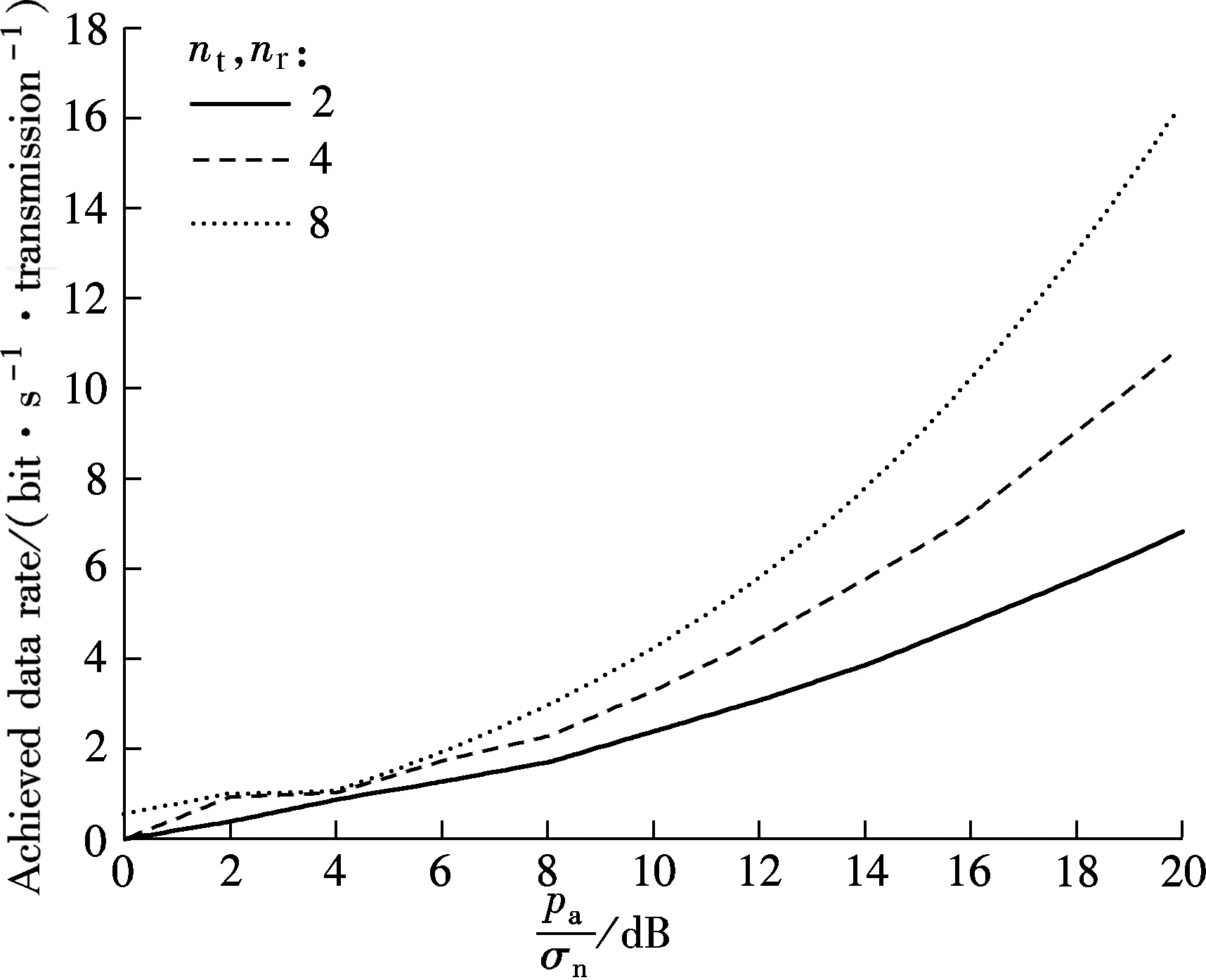
Fig.2 Achieved data rate of the DC bias and SVD based adaptive modulation scheme with different LED and PD configurations
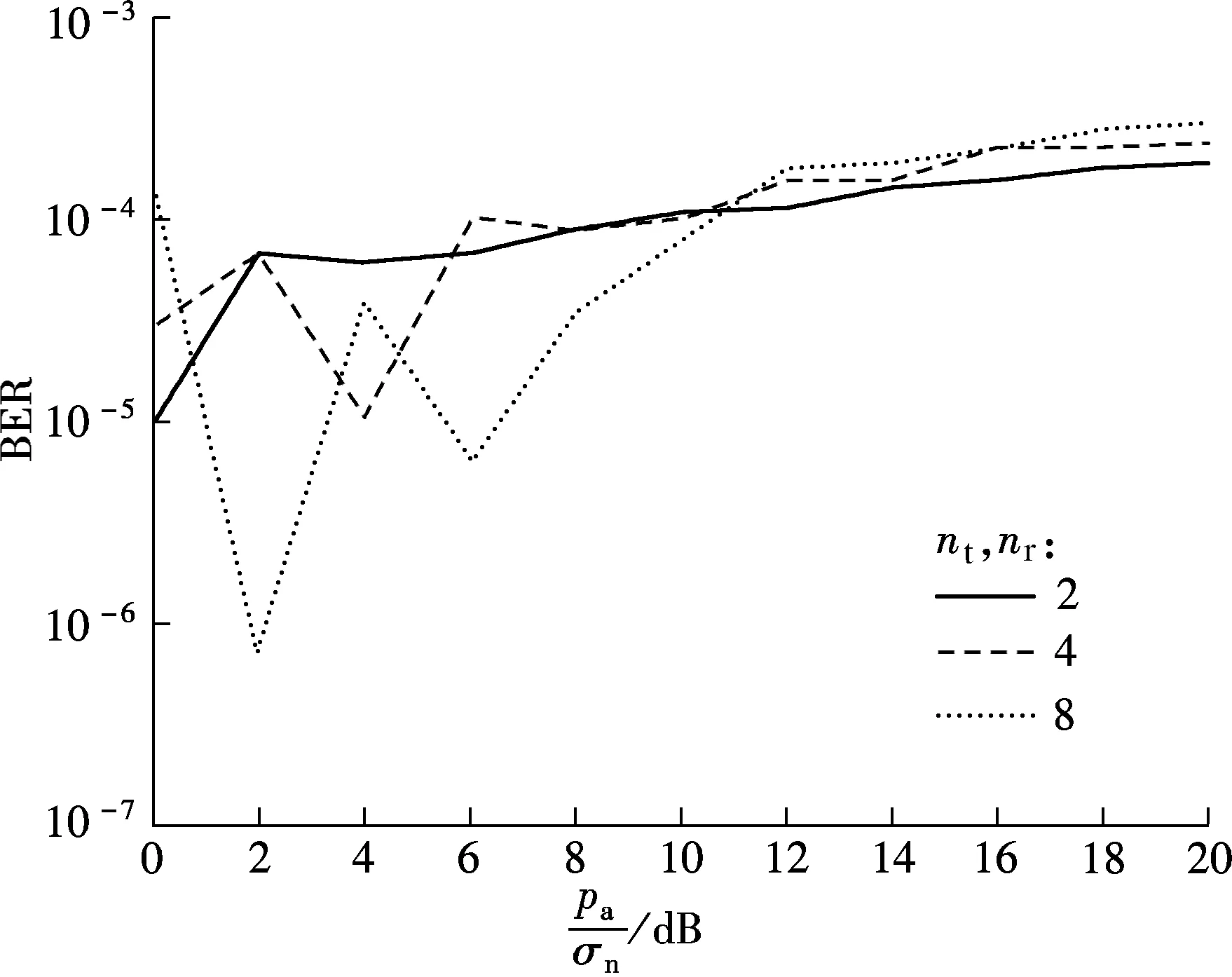
Fig.3 Simulated BER performance of DC-bias and SVD based adaptive modulation scheme with different LED and PD configurations
Fig.4 shows the achieved data rate of the QR decomposition and successive interference cancellation based adaptive modulation scheme with different quantization
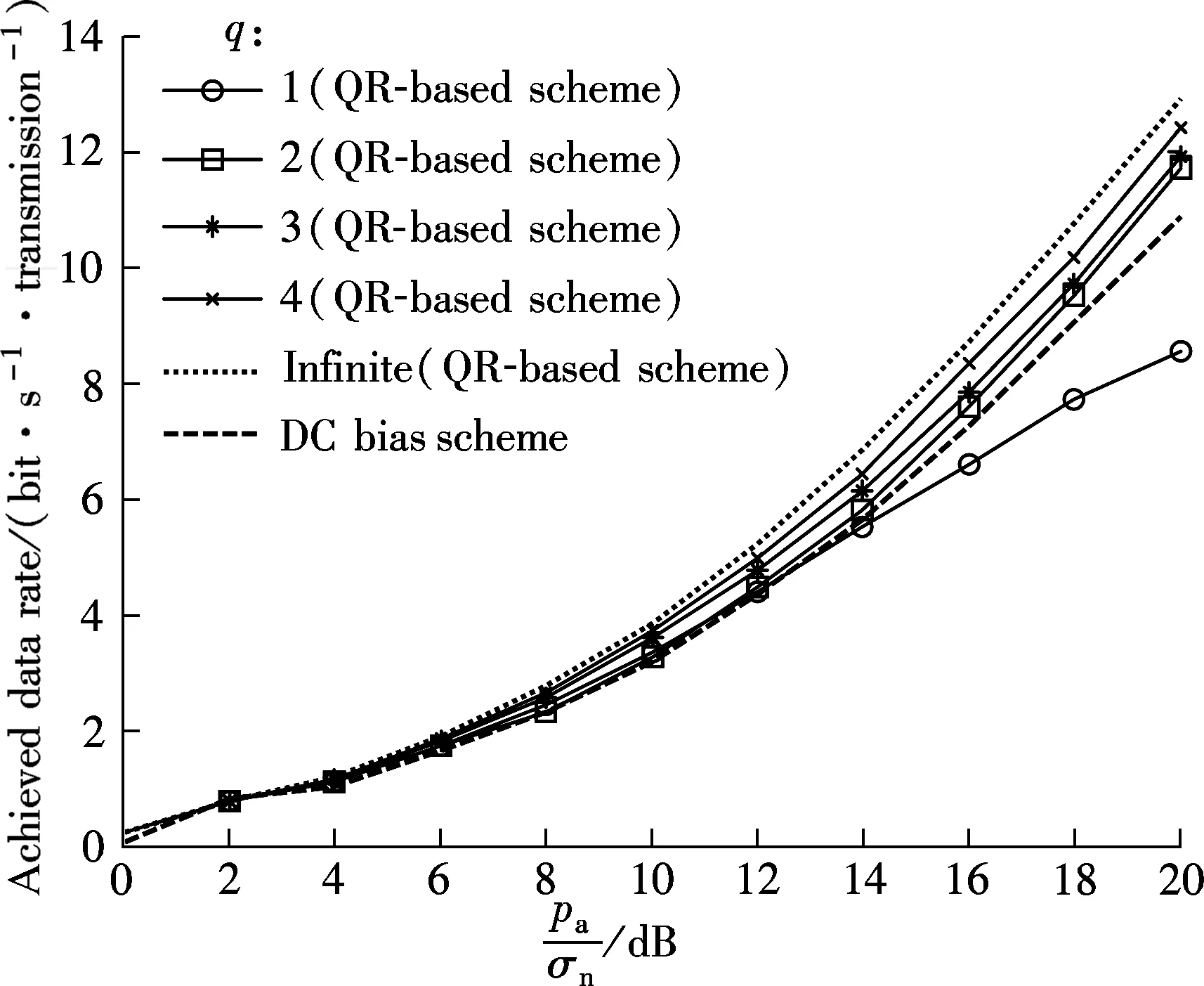
Fig.4 Achieved data rate of QR decomposition and successive interference cancellation based adaptive modulation scheme with different quantization bits and nt=nr=4
bits, wherent=nr=4. It can be seen from Fig.4 that the effect of quantization bits is small in the low SNR region; when SNR is larger than 14 dB, the effect of quantization bits becomes large. Besides, the gap betweenq=4 andq=∞ is very small, which mean that 4 bits are enough to quantize the power allocation strategy. For comparison, the achieved data rate of the DC bias adaptive modulation scheme withnt=nr=4 is also plotted. It can be seen that the achieved data rate of the QR based scheme is improved, when the number of quantization bits is no less than 2.
Fig.5 depicts the BER performance. It can be seen that BER performances with different quantization bits are below the BER target. When the SNR becomes high, the trend of BER performance changes as shown in Fig.3, and it is caused by the same reason.
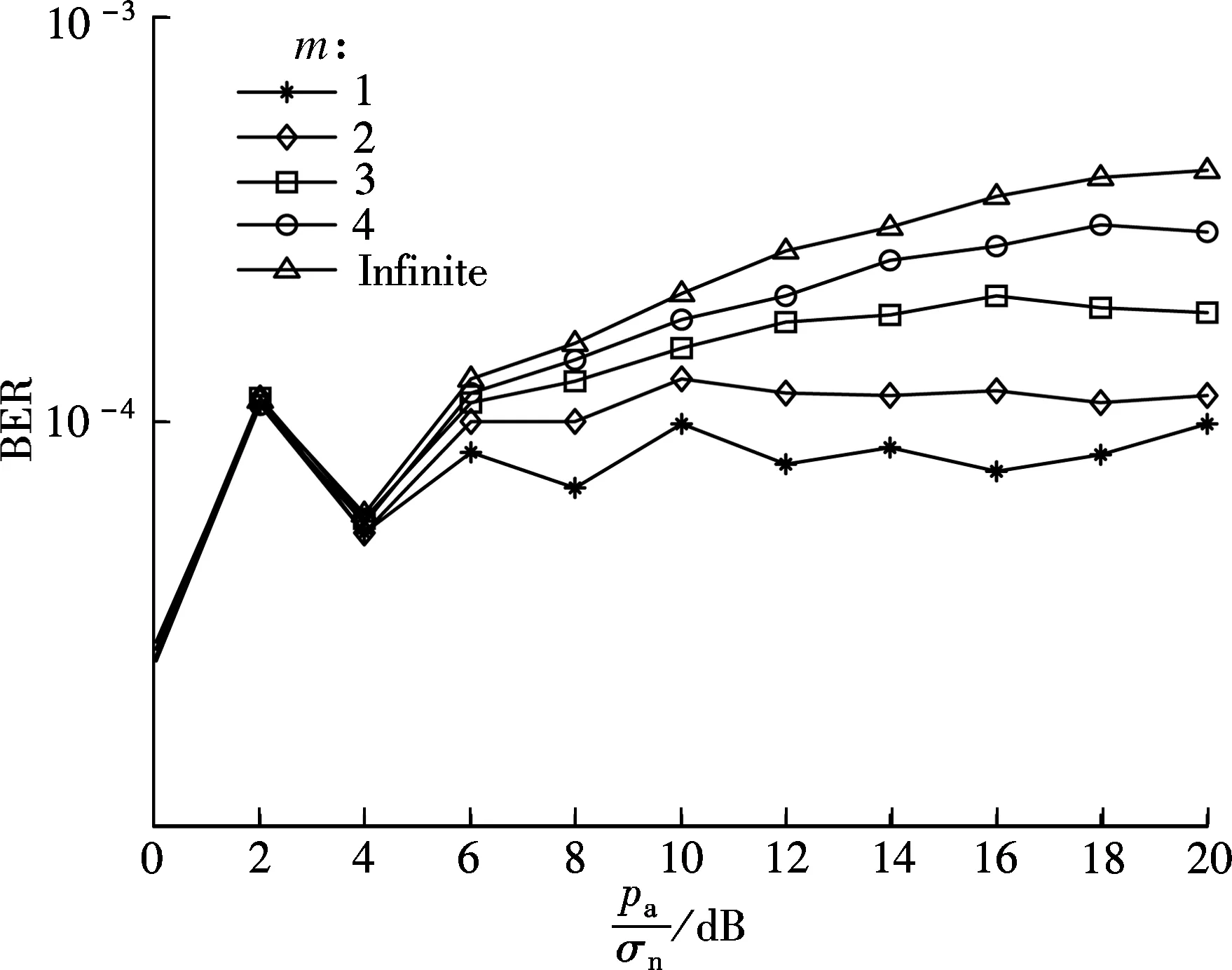
Fig.5 Simulated BER performance of QR decomposition and successive interference cancellation based adaptive modulation scheme with different quantization bits and nt=nr=4.
5 Conclusion
Spatial multiplexing gain in the MIMO technique can effectively improve the spectrum efficiency of the system, while the adaptive modulation techniques under certain specified constraints can further enhance the system performance. In this paper, adaptive modulation schemes in IM/DD MIMO optical wireless communication systems are studied. Two adaptive modulation techniques are proposed. The first scheme is based on DC-bias and SVD, and the second scheme is based on QR decomposition and successive interference cancellation. The first scheme is a straightforward scheme, and the achieved data rate of the second scheme is higher when the number of quantization bits is no less than 2. The maximum data rate and achieved BER performance under a given BER target and constant transmit power constraint are analyzed. Besides, the second proposed adaptive modulation technique can achieve the specified performance using finite rate feedback. The feasibility of the proposed adaptive modulation techniques are verified by the simulation results.
[1]Rusek F, Persson D, Lau B, et al. Scaling up MIMO: opportunities and challenges with very large arrays [J].IEEESignalProcessingMagazine, 2013, 30(1): 40-60.
[2]Ghaffar R, Knopp R, Pin H. Low complexity BICM MIMO OFDM demodulator [J].IEEETransactionsonWirelessCommunications, 2014, 14(1): 558-569.
[3]Nguyen D, Hung N, Tho L. Block-diagonalization precoding in a multiuser multicell MIMO system: competition and coordination [J].IEEETransactionsonWirelessCommunications, 2014, 13(2): 968-981.
[4]Love D, Heath R. Limited feedback unitary precoding for spatial multiplexing systems [J].IEEETransactionsonInformationTheory, 2005, 51(8): 2967-2976.
[5]Biglieri E, Calderbank R, Constantinides A, et al.MIMOwirelesscommunications[M]. Cambridge University Press, 2007.
[6]Zhou Z, Vucetic B, Dohler M, et al. MIMO systems with adaptive modulation [J].IEEETransactionsonVehicleTechnology, 2005, 54(5): 1828-1842.
[7]Fernandez-Plazaola U, Martos-Naya E, Paris J, et al. Adaptive modulation for MIMO systems with channel prediction errors [J].IEEETransactionsonWirelessCommunications, 2010, 9(8): 2516-2567.
[8]Zhou S, Giannakis G. Adaptive modulation for multi-antenna transmissions with channel mean feedback [J].IEEETransactionsonWirelessCommunications, 2004, 3(5): 1626-1636.
[9]Zhou Z, Vucetic B. Adaptive coded MIMO systems with near full multiplexing gain using outdated CSI [J].IEEETransactionsonWirelessCommunication, 2011, 10(1): 294-302.
[10]Park N, Kim Y. Enhanced index assignment for beamforming with limited-rate imperfect feedback [C]//ProceedingsofIEEEVehicularTechnologyConference(VTCFall). Quebec City, Canada, 2012: 13226411-1-13226411-5.
[11]Mesleh R, Elgala H, Haas H. Optical spatial modulation [J].JournalofOpticalCommunicationandNetworking, 2011, 3(3): 234-244.
[12]Barros D, Wilson S, Kahn J. Comparison of orthogonal frequency-division multiplexing and pulse-amplitude modulation in indoor optical wireless links [J].IEEETransactionsonCommunications, 2012, 60(1): 153-163.
[13]Wlodzimierz B.Thenormaldistribution:characterizationswithapplications[M]. New York: Springer-Verlag, 1995.
[14]Proakis J.Digitalcommunications[M]. New York: McGraw-Hill, 2000.
[15]Campello J. Optimal discrete bit loading for multicarrier modulation systems [C]//ProceedingsofIEEEInternationalSymposiumonInformationTheory. Cambridge, MA, USA, 1998:193.
多輸入多輸出無線光通信系統中的自適應調制技術
吳 斌 吳 亮 鄒采榮
(東南大學信息科學與工程學院, 南京 210096)
在基于強度調制、直接檢測的多輸入多輸出無線光通信系統中,為了保證發射信號非負特性,提出一種基于直流偏置的自適應調制技術,并且利用奇異值分解將多輸入多輸出信道轉換為并行信道.此外,提出一種基于QR分解、逐次干擾消除的自適應調制技術.在目標誤比特率性能條件下,利用QR分解、逐次干擾消除的特性將多輸入多輸出信道等效為并行信道.根據最大化可達速率的優化目標,最優地給各個子信道分配功率.仿真結果表明所提出的2種自適應調制方法在保證誤比特率性能和平均發射光功率恒定的前提下,有效地提高了系統的傳輸速率.這2種自適應調制技術在利用多輸入多輸出技術空分復用增益的同時,進一步提高了無線光通信系統的頻譜利用率.
可見光通信;多輸入多輸出;自適應調制
TN92
Foundation items:The National High Technology Research and Development Program of China (863 Program) (No.2013AA013601), the National Science and Technology Major Project of China (No.2015ZX03004009).
:Wu Bin, Wu Liang, Zou Cairong. Adaptive modulation in MIMO optical wireless communication systems[J].Journal of Southeast University (English Edition),2015,31(2):175-180.
10.3969/j.issn.1003-7985.2015.02.003
10.3969/j.issn.1003-7985.2015.02.003
Received 2014-10-23.
Biographies:Wu Bin (1974—), male, graduate; Zou Cairong (corresponding author), male, doctor, professor, zoucairong@seu.edu.cn.
登錄APP查看全文
猜你喜歡
工業設計(2022年8期)2022-09-09 07:43:20
中等數學(2022年2期)2022-06-05 07:10:50
軍民兩用技術與產品(2021年10期)2021-03-16 06:05:30
北京測繪(2020年12期)2020-12-29 01:33:58
小學生學習指導(低年級)(2020年6期)2020-07-25 02:31:36
裝備制造技術(2019年12期)2019-12-25 03:06:46
中國洗滌用品工業(2019年4期)2019-05-11 09:27:34
小學生學習指導(低年級)(2018年9期)2018-09-26 05:59:44
瘋狂英語·新讀寫(2018年2期)2018-09-07 09:32:10
家庭影院技術(2017年9期)2017-09-26 03:41:45
 Journal of Southeast University(English Edition)
2015年2期
Journal of Southeast University(English Edition)
2015年2期
- Journal of Southeast University(English Edition)的其它文章
- Construction of crash prediction model of freeway basic segment based on interactive influence of explanatory variables
- Experimental studies on gas-phase mercury oxidation removal and denitration of coal combustion with NH4Br addition
- CO2 capture using dry TiO2-doped Na2CO3/Al2O3 sorbents in a fluidized-bed reactor
- Comparative study on SO2 release and removal under air and oxy-fuel combustion in a fluidized bed combustor
- Effect of sulfation during carbonation on CO2 capture in calcium looping cycle
- Synthesis of highly reactive sorbent from industrial wastes and its CO2 capture capacity