
(CuIn)n(n=1,2)小團簇的結構與穩定性的從頭算理論研究
2015-07-13 03:39:28胡紀平劉鳳麗劉鳳敏于肇賢
原子與分子物理學報 2015年1期
關鍵詞:結構
胡紀平,劉鳳麗,劉鳳敏,于肇賢
(1.北京信息科技大學理學院,北京100192;2.黑龍江大學物理科學與技術學院,哈爾濱150080)
1 引 言
近年來人們發現摻雜團簇比起單元團簇有特殊的性能,例如含貴金屬Au,Ag 和Cu 的團簇在催化[1-5]、影像技術[6-10]以及納米電子技術[11]等諸多領域有重要的應用價值. 自從1992 年賓州州立大學伯克分校的Yamada 等人[12]通過實驗制備出了CunAlm,CunInm,AgnAlm和Agnlnm團簇,并采用飛行時間質譜法分析研究了該系列團簇,發現此系列團簇存在幻數等性質,之后一些科學家相繼對貴金屬Cu,Ag,Au 與第三主族元素Al,Ga,In,Tl 所形成的合金團簇做了一系列的研究. 例如,1999 年Heinebrodt 和Bouwen 等人[13-14]通過實驗研究了AunXm(0,+1)(X=Al,In)團簇也具有幻數結構;2001 年Tunna Baruah 等人[15]研究了Al12M 和Al13M (M =Cu,Ag 和Au)團簇的基態結構和穩定性,發現摻雜后團簇的原子化能增大;Kumar 教授[16,17]在2001 年和2013 年采用伽馬和電子輻射興盛了Tl/Ag 和Tl/Cu 合金團簇;四川大學王紅艷等人[18]采用密度泛函理論研究了AunXm(n+m =4,X =Cu,Al,Y)團簇的結構和穩定性;美國布朗大學王來生教授等人[19-20]采用光電子能譜和從頭算理論以及密度泛函理論分別于2008 和2009 年研究了MAl-12(M =Li,Cu,Au)和MAu-16(M=Ag,Zn,In)的結構和電子特性. 由此可見,研究合金團簇的結構和穩定性以及電子特性對于設計和制備新型的特殊性能的納米材料具有十分重要意義.
我們課題組相繼應用二階微擾理論MP2 方法和密度泛函B3LYP 方法研究了MnXn(M = Cu,Ag,Au;X=Al,Tl;n=1,2)和AgnAl(0,+1)(n=1 -7)團簇的結構穩定性[21-23],得到的基態結構均具有C2V對稱性的蝴蝶型結構;采用密度泛函B3LYP 方法和小核實贋勢研究CuIn 分子的勢能函數和光譜數據[24]. 在此工作基礎之上,本文將采用從頭算MP2 方法研究(CuIn)n(n =1,2)小團簇的結構和穩定性,并與(CuAl)n(n =1,2)和(CuTl)n(n=1,2)的性能進行比較,同時計算并分析(CuX)n(X =Al,In,Tl;n =1,2)團簇的電子特性,對Cu 原子采用Dolg 和Andrae等人[25-26]給出的19 價電子基組和相對論贋勢PPs,并添加了Pyykk? 等人[27]給出的f 極化函數來描述相關能的作用,即在基組中加了f=0.24 極化函數,In 原子采用小核實贋勢LANL2DZ,為了便于比較,對CuX (X =Al,In,Tl)應用二階微擾理論MP2 方法和相應的基組及贋勢統一進行運算,所有計算采用Gaussian03 程序[28].
2 計算結果與分析
2.1 CuX (X=Al,In,Tl)分子結構和穩定性
對于雙原子分子CuX (X=Al,In,Tl)計算結果均列于表1,同時表1 也給出了相應的實驗數據.

表1 CuX (X=Al,In,Tl)分子的平衡核間距、振動頻率、解離能和能隙Table 1 The equilibrium distances Re,vibrational frequencies ν,dissociation energies De and HOMO-LUMO gaps Egap of CuX (X=Al,In,Tl)
優化得到的CuAl 和CuIn 分子基態電子態均為1Σ,平衡核間距離即鍵長分別為2.3500 ? 和2.5087 ?,振動頻率分別為308 cm-1和191 cm-1,解離能分別為2.12 eV 和2.02 eV,計算結果與參考文獻[29]和[30]分別給出的實驗值鍵長2.3389 ±0.0004 ? 和2.610 ±0.1000 ?、頻率294 cm-1和193 ±20 cm-1,解離能2.315 ±0.012 eV 和1.907±0.082 eV 十分接近,說明我們本文采用的基組、贋勢以及計算方法適用于該體系的計算,可以作為有效數據進行參考. 與CuAl 和CuTl 計算結果對比來看,鍵長大小順序符合元素周期規律RCuAl<RCuIn<RCuTl,解離能的變化規律是DeCuIn<DeCuTl<DeCuAl,如果用解離能的大小判斷分子結構的穩定性,則CuIn 的穩定性相對較差,而CuTl 的穩定性較強,因為沒有查到相關的實驗數據,這里分析其原因是由于Tl 元素的原子序數較大,相對論效應較強. 由Mulliken 布局分析來看,CuAl 中電荷分布為Cu(-0.309774),Al(0.309774);CuIn中Cu(-0.214270),In (0.214270);CuTl 中Cu(-0.222052),Tl(0.222052). 這三個分子中Cu 原子具有親電性,顯負價,同時從庫侖相互作用角度分析,在CuTl 分子的兩原子間庫侖力較CuIn 強,因此解離能要相對大些,穩定性較強.至于CuTl 分子的穩定性是否超過CuAl,則需要進一步實驗驗證.
2.2 (CuIn)n小團簇的結構和穩定性
近年來有人對單元團簇Mn(M =Cu,Ag,Au,Al)進行了理論研究[31-36],得到了M4(M = Cu,Ag,Au,Al)團簇的穩定構型為:菱形、T(C2v)和四面體結構. 因此,本文以M4 異構體為初始結構,將團簇中的不同位置上的兩個M 原子用In 原子替代,另外兩個原子換成Cu 原子,進行幾何優化來尋找(CuIn)2團簇的穩定結構. 同時,我們還優化了梯形、Y 形以及直線形等所有可能構型.優化得到的穩定構型如圖1 所示,得出的幾何參數、振動頻率和總能量列于表2,表中同時給出了電子態和對稱性.
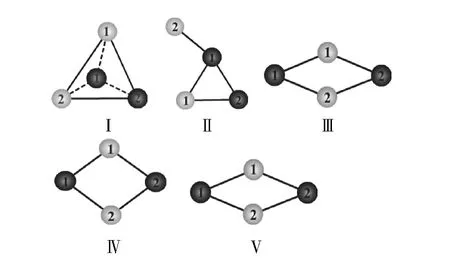
圖1 Cu2In2 團簇的穩定結構. 其中較黑的球代表Cu 原子圖中的結構參數列于表2Fig.1 Geometries of Cu2In2 clusters. The shaded sphere represents the Cu atom. The values of the geometric parameters are reported in Table 2
表2 (CuIn)2穩定結構的幾何參數(鍵長,鍵角(M1-In1-M2)和雙面角),振動頻率和總能量Table 2 Geometrical parameters (bond length in ?,bond angle and dihedral angle in deg),vibrational frequencies (v/cm -1)and total energies (Etot/Hartree)of the structures for (CuIn)2

表2 (CuIn)2穩定結構的幾何參數(鍵長,鍵角(M1-In1-M2)和雙面角),振動頻率和總能量Table 2 Geometrical parameters (bond length in ?,bond angle and dihedral angle in deg),vibrational frequencies (v/cm -1)and total energies (Etot/Hartree)of the structures for (CuIn)2
計算考慮了單重態和三重態,計算得到5 個穩定構型,其振動頻率均為正值. 基態結構如圖1-1 所示,是具有1A1/C2v對稱性的三維蝴蝶型結構,其他四個異構體均為平面結構(圖Ⅰ-Ⅱ,Ⅲ,Ⅳ,Ⅴ),一個是具有1A'/Cs對稱性的變形了的Y結構,另外三個均是菱形結構,對稱性分別為3B2/C2v、3B3G/D2H和1AG/D2H,能量分別比基態能量高出0.86 eV、1.64 eV,1.68 eV 和1.69 eV,按照能量越小越穩定的理論該團簇的穩定性排序為Ⅰ>Ⅱ>Ⅲ >Ⅳ>Ⅴ. 計算得到的(CuIn)2基態構型與前期工作中[21,22]計算得到的(CuAl)2和(CuTl)2的基態構型具有相同的結構和對稱性,Cu 與In 之間鍵長為2.554 ?,Cu 與Cu 為2.392 ?,In 與In 為3.014 ?. 在團簇(CuM)2(M=Al,In,Tl)體系中,Cu 與M 的鍵長大小排序為RCuAl<RCuIn<RCuTl,與雙原子CuM(M=Al,In,Tl)排序一至. 計算得到的(CuIn)2團簇穩定結構的結合能、最高占有軌道能級、最低空軌道能級、能隙和垂直電離能列于表3.
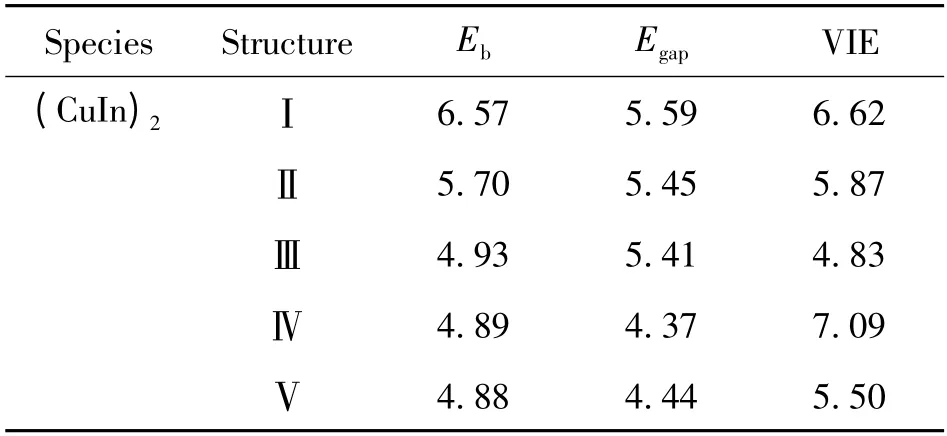
表3 (CuIn)2團簇穩定結構的結合能Eb/eV、最高占有軌道和最低空軌道間能隙Egap/eV,垂直電離能VIE/eVTable 3 Bonding energies Eb (eV),energy gaps Egap (eV)and vetical ionization energies of (CuIn)2
從結合能明顯看到基態結構的結合能最大,為6.57 eV,再次說明基態結構穩定性強. 與前期工作中[26,27](CuAl)2和(CuTl)2結合能相比,大小排序為Eb(CuIn)2<Eb(CuTl)2<Eb(CuAl)2,其中(CuAl)2為7.32 eV,(CuTl)2為7.04 eV. 由Mulliken布局分析來看,(CuIn)2中Cu(-0.193111),In(0.193111);(CuAl )2中電荷分布為 Cu(-0.316610),Al(0.316610);(CuTl)2中Cu(-0.196146),Tl (0.196146). 顯然這里Cu 原子依然具有親電性,顯負價性.
2.3 (CuIn)n (n=1,2)團簇的電子特性
計算得到的(CuIn)n(n=1,2)團簇的能隙列于表1 和表3 中,基態(CuM)n(n=1,2;M=Al,In,Tl)前3 個較高占居軌道和較低空軌道如圖2所示,圖2 同時給出了基態CuAl,CuTl,(CuAl)2和(CuTl)2的分子前線軌道.

圖2 (CuM)2(M=Al,In,Tl)基態結構的前線分子軌道Fig. 2 HOMOs and LUMOs of the ground states of (CuM)2(M=Al,In,Tl)clusters
對于雙原子體系CuIn,能隙大小為6.10eV,CuAl 為6.25eV,CuTl 最小為6.03eV,可見,雙原子分子CuAl 化學活性最弱,而CuTl 化學活性較強. 圖2 顯示雙原子分子有相似的前線分子軌道,HOMO-1 為σ 成鍵軌道,HOMO 為σ 反鍵軌道.對于(CuIn)2穩定結構,計算得到的能隙大小排序為I > II > III > V > IV,所以基態結構的(CuIn)2化學活性較弱,而結構IV 化學活性較強.從圖2 可以看出,(CuM)2(M =Al,In,Tl)體系的前線分子軌道也具有相似性,最高占據軌道由兩個3 中心2 電子M-Cu-M(M=Al,In,Tl)的成鍵軌道組成.
計算得到的垂直電離能列于表3,由于要精確做到確定團簇的結構,往往需要理論和實驗相結合,在實驗上主要通過光電子能譜給出團簇的電子結合能,理論上計算出團簇的電子結合能,如果與試驗吻合說明理論計算得到的團簇結構是存在的. 這里,由于實驗上還沒有給出(CuIn)2的相關報道,這里我們計算出其5 個穩定結構的電子結合能,如圖3 所示,計算方法是以HOMO 為費米能級,用費米能級以下的DOS 譜減去VIE、取負值為電子結合能. 這些穩定結構哪幾個是真實存在的還需要實驗上給出光電子能譜圖來進一步確定.
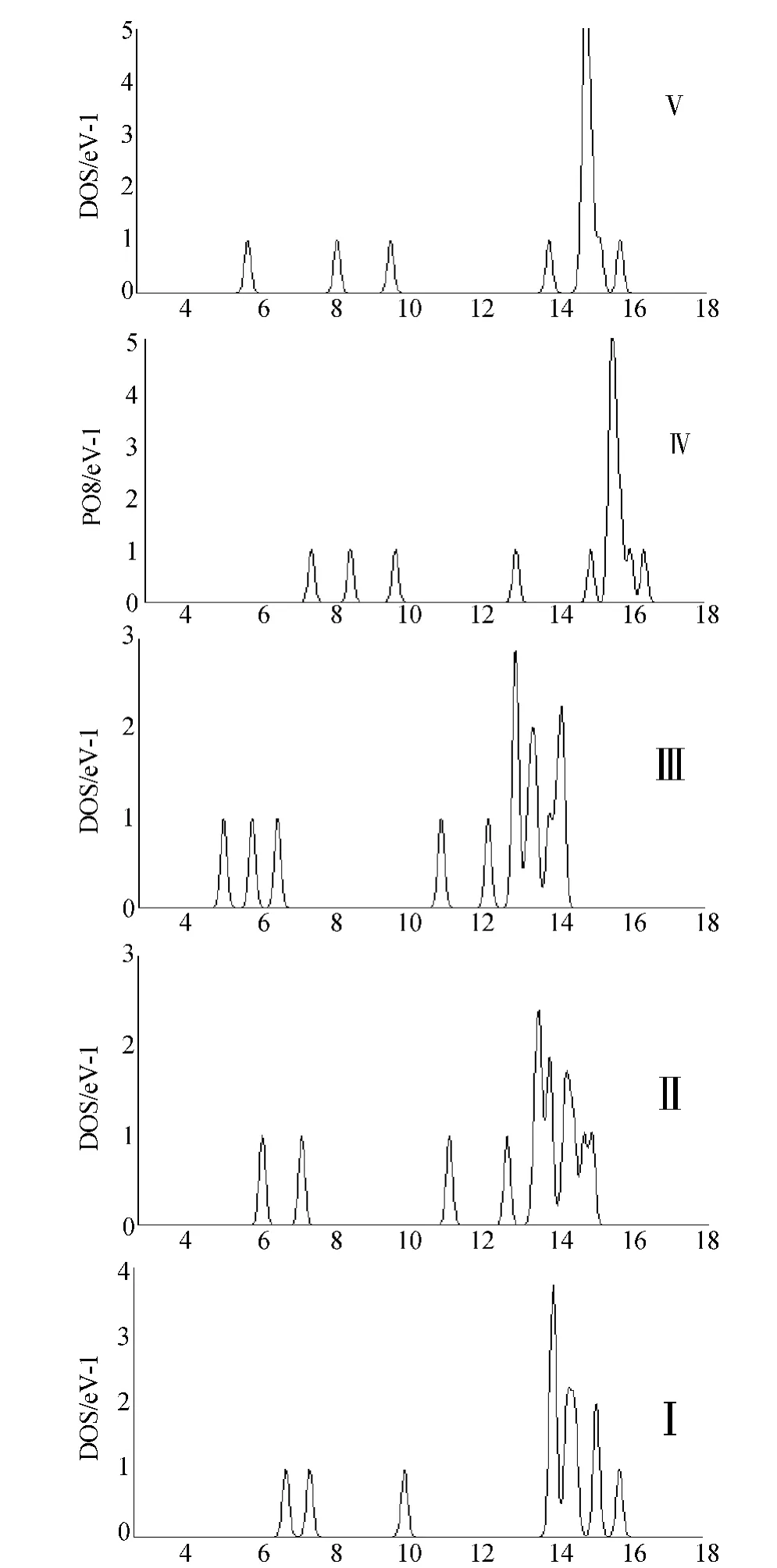
圖3 團簇(CuIn)2的電子結合能Fig. 3 Electron binding energies of (CuIn)2 clusters
3 結 論
本文采用從頭算理論MP2 方法計算了小團簇(CuIn)n(n=1,2)的結構和穩定性. 雙原子分子CuIn 的鍵長2.5087 ?,振動頻率191 cm-1,解離能2.02 eV,這些結果與實驗值十分吻合,計算得到的能隙為6.10 eV. 對于(CuIn)2,計算得到了5種穩定結構,基態結構是具有1A1/C2v對稱性的蝴蝶結構,結合能為6.57 eV,能隙為5.59 eV,同時將計算結果與同族元素體系(CuAl)2和(CuTl)2對比,無論是在構型上,還是在電子特性上都有相似的特性,但由于Tl 原子的原子序數相對較大,相對論效應較為明顯,因此計算得到的結合能大小排序為Eb(CuIn)2<Eb(CuTl)2<Eb(CuAl)2,文中給出了(CuIn)2穩定構型的電子結合能能譜,希望在實驗上得以驗證.
[1] Valden M,Lai X,Goodman D W. Onset of catalytic activity of gold clusters on titania with the appearance of nonmetallic properties[J]. Science,1998,281:11.
[2] Knickelbein M B. Reactions of transition metal clusters with small molecules[J]. Annu. Rev. Phys. Chem.,1999,50:79.
[3] Joo S H,Choi S J,Oh I,et al. Ordered nanoporous arrays of carbon supporting high dispersions of platinum nanoparticles[J]. Nature,2001,412:169.
[4] Hansen P L,Wagner J B,Helveg S,et al. Atom-resolved imaging of dynamic shape changes in supported copper nanocrystals[J]. Science,2002,295:2053.
[5] Huang Y,Zhao B J,Zhu S F,et al. Study on growth of AgGa1-xInxSe2single crystal[J]. J. Synth. Cryst.,2006,35:50 (in Chinese)[黃毅,趙北君,朱世富,等. AgGa1-xInxSe2單晶的生長研究[J]. 人工晶體學報,2006,35:50]
[6] Fayet P,Granzer F,Hegenbart G,et al. Latent-image generation by deposition of monodisperse silver clusters[J]. Phys. Rev. Lett.,1985,55:3002.
[7] Fayet P,Granzer F,Hegenbart G,et al. The role of small silver clusters in photography[J]. Z. Phys.,1986,D3:299.
[8] Mostafavi M,Marignier J L,Amblard J,et al. Sizedependent thermodynamic properties of silver aggregates. simulation of the photographic development process[J]. Z. Phys.,1989,D12:31.
[9] (a)Flad J,Stoll H,Preuss H. Quantum chemical investigations of the latent image formation[J]. Z.Phys.,1987,D6:193.(b)Flad J,Stoll H,Preuss H. Quantum chemical investigations of the latent image formation[J]. Z.Phys.,1987,D6:287.
[10] Eachus R S,Marchetti A P,Muenter A A. The photophysics of silver halide imaging materials[J]. Annu. Rev. Phys. Chem.,1999,50:117.
[11] Sieber C,Buttet J,Harbich W,et al. Isomer-specific spectroscopy of metal clusters trapped in a matrix:Ag9[J]. Phys. Rev. A,2004,70:041201.
[12] Yamada Y,Castleman Jr A W. The magic numbers of metal and metal alloy clusters [J]. J. Chem.Phys.,1992,97:4543.
[13] Heinebrodt M,Malinowski N,Tast F,et al. Bonding character of bimetallic clusters AunXm(X = Al,In,Cs)[J]. J. Chem. Phys.,1999,110:9915.
[14] Bouwen W,Vanhoutte F,Despa F,et al. Stability effects of AunX+m(X=Cu,Al,Y,In)clusters[J].Chem. Phys. Lett.,1999,314:227.
[15] Zope R R,Baruah T. Conformers of Al13,Al12M,and Al13M (M=Cu,Ag,and Au)clusters and their energetics[J]. Phys. Rev. A,2001,64:053202.
[16] Kumar M. Study of the formation of bimetallic aqueous Tl/Cu sols by gamma and electron irradiation[J]. Radi. Phys. Chem.,2001,62:387.
[17] Kumar M. Study of formation of aqueous Tl/Ag bimetallic clusters by gamma and electron irradiation[J].Radi. Phys. Chem.,2003,66:403.
[18] Wang H Y,Li X B,Tang Y J,et al. Structures and stabilities of AunXm(n + m =4,X = Cu,Al,Y)clusters[J]. Chin. Phys. Soc.,2005,54:3565 (in Chinese)[王紅艷,李喜波,唐永建,等. AunXm(n+m=4,X =Cu,Al,Y)混合小團簇的結構和穩定性研究[J]. 物理學報,2005,54:3565]
[19] Pal R,Cui L F,Bulusu S,et al. Probing the electronic and structural properties of doped aluminum clusters:Mal-12(M = Li,Cu,and Au)[J]. J.Chem. Phys.,2008,128:024305.
[20] Wang L M,Pal Rhitankar,Wei H,et al. Tuning the electronic properties of the golden buckyball by endohedral doping:M@ Au-16(M =Ag,Zn,In)[J].J. Chem. Phys.,2009,130:051101.
[21] Liu F L,Zhu Y F,Li X Y,et al. Ab initio study of structure and stability of M2Al2(M =Cu,Ag,Au)clusters[J]. Aust. J. Chem.,2007,60:184.
[22] Liu F L,Zhu Y F,Li X Y,et al. Ab initio study of the structure and stability of MnTln(M = Cu,Ag,Au;n = 1,2)clusters [J]. J. Mol. Struct.(THEOCHEM),2007,809:189.
[23] Liu F L,Jiang G. Density-functional theory study of structural and electronic properties of AgnAl(0,+1)(n=1 - 7)clusters [J]. J. Mol. Struct. (THEOCHEM),2010,953 (1-3):7.
[24] Liu F L. Density functional study of potential energy function and stability of CuX (X=Al,Ga,In)molecules[J]. J. At. Mol. Phys.,2006,23 (5):838(in Chinese)[劉鳳麗. 雙原子分子CuX (X =Al,Ga,In)分子的勢能函數與穩定性的密度泛函研究[J]. 原子與分子物理學報,2006,23 (5):838]
[25] Dolg M,Wedig U,Stoll H,et al. Energy adjusted ab initio pseudopotentials for the first row transition elements[J]. J. Chem. Phys.,1987,86:866.
[26] Andrae D,Haeussermann U,Dolg M,et al. Energyadjusted ab initio pseudopotentials for the second and third row transition elements[J]. Theo. Chim. Acta.,1990,77:123.
[27] Pyykk? P,Runeberg N,Mendizabal F. Theory of the d10-d10closed-shell attraction:1. Dimers near equilibrium[J]. Chem. Eur. J.,1997,3:1451.
[28] Frisch M J,Trucks G W,Schlegel H B,et al.Gaussian 03,Revision C. 02,Gaussian,Inc.,Wallingford CT,2004.
[29] Behm J M,Arrington C A,Langenberg J D,et al.Spectroscopic analysis of jet cooled AlCu [J]. J.Chem. Phys.,1993,99:6394.
[30] Balducci G,Di Nunzio P E,Gigli G,et al. Dissociation energies of the intermetallic molecules CuIn,AgIn,and AuIn[J]. J. Chem. Phys.,1989,90:406.
[31] Bravo-Pérez G,Garzón I L,Novaro O. Ab initio study of small gold clusters[J]. J. Mol. Struct. (THEOCHEM),1999,493:225.
[32] Yang M L,Jackson K A. First-principles investigations of the polarizability of small-sized and intermediatesized copper clusters [J]. J. Chem. Phys.,2005,122:184317.
[33] Walker A V. Structure and energetics of small gold nanoclusters and their positive ions [J]. J. Chem.Phys.,2005,122:094310.
[34] Jones R. O. Simulated annealing study of neutral and charged clusters:Alnand Gan[J]. J. Chem.Phys.,1993,99:1194.
[35] Idrobo J C,?ˇgü T S,Jellinek J. Size dependence of the static polarizabilities and absorption spectra of Agn(n=2 -8)clusters[J]. Phys. Rev. B,2005,72:085445.
[36] Calaminici P,K?ster A,Russo N,et al. A density functional study of small copper clusters:Cun(n≤5)[J]. J. Chem. Phys.,1996,105 (21):9546.
猜你喜歡
小獼猴智力畫刊(2023年4期)2023-04-23 08:49:58
哲學評論(2021年2期)2021-08-22 01:53:34
中華詩詞(2019年7期)2019-11-25 01:43:04
模具制造(2019年3期)2019-06-06 02:10:54
中學生數理化·高一版(2018年1期)2018-02-10 05:20:03
影視與戲劇評論(2016年0期)2016-11-23 05:26:01
七彩語文·寫字與書法(2016年7期)2016-07-28 21:40:22
七彩語文·寫字與書法(2016年6期)2016-07-15 19:36:34
人間(2015年21期)2015-03-11 15:23:21
現代企業(2015年9期)2015-02-28 18:56:50
