
Rediscovering Yoga
2015-07-23 15:36:03byK.NagarajNaidu
China Pictorial 2015年7期
by+K.Nagaraj+Naidu
Yoga is the science of right liv- ing. The term is derived from the Sanskrit word ‘Yuj, which means unity. It establishes integration and harmony between thought, feeling and action. Over centuries, many branches of Yoga have developed; but there is general agreement that Yoga developed at the very beginning of human civilization, in what is known as pre-Vedic times(between 3,000 and 2,000 BCE).
Today, the practice of Yoga is more relevant than ever before and Yoga is one of the most iconic elements of Indias spiritual heritage. Yoga, with its roots in India, has been practiced from time immemorial, and it continues to remain a part of daily life in most Indian homes. The credit for introducing Yoga and creating a special place for it in the hearts of global citizens goes to Swami Vivekananda (1863-1902), who penned books on all four forms of Yoga –Karma Yoga (Yoga of action), Jnana Yoga(Yoga of knowledge), Raja Yoga (Yoga of meditation), and Bhakti Yoga (Yoga of devotion).
Yoga traces its origins to the Vedas. Written in the Indian classical language Sanskrit, the Vedas are among the oldest literature in the world. Over the years, numerous texts have been written, born out of the experience of Yogis – the practitioners of Yoga.
Ancient History
These limbs present a sort of eightfold path to enlightenment, which includes turning inward, meditation, concentration and mindful breathing. Patanjali, the author of the Yoga Sutra, defines Yoga as “the ability to direct the mind towards a chosen object and sustain the focus without any distractions.” It shows a way, through Yoga, to live a healthy and happy life, and manage stress.
Other ancient Indian texts which talk about Yoga include the Hatha Yoga Pradipika, which dates back to the 15th Century, making it one of the oldest surviving texts of Hatha Yoga, or the Yoga of physical exercises. The text, which includes 389 verses, presents the teachings of the Hindu god Shiva on Yoga, as told to his wife, the goddess Parvati.
Yoga Revolutionary
Born in the southern Indian state of Karnataka, Krishnamacharya was a great Sanskrit scholar who had formal education in the Vedas. Krishnamacharya was responsible for the modern emphasis on well-known Yoga postures or asanas, such as the Sirsasana (headstand) and Sarvangasana (shoulder-stand). He was a pioneer in refining postures, sequencing them optimally, and ascribing therapeutic value to specific asanas.
For instance, by combining pranayama(breathing exercises) and asana, he made the postures an integral part of meditation, instead of merely a step leading towards it. In fact, Krishnamacharyas influence can be seen most clearly in the emphasis on asana practice that has become the signature of Yoga today. And more than that, Krishnamacharyas four most famous disciples – Indra Devi(1899-2002), K. Pattabhi Jois (1915-2009), his brother-in-law B. K. S. Iyengar (1918-2014) and his son T. K. V. Desikachar(born 1938) – played a huge role in popularizing Yoga in the West.
From Faith to Science
Until a few years ago, few scientific studies on Yoga had been conducted. Most Western scientists tended to dismiss Indian Yoga. However, today, the same scientists are getting close to proving what the Indian practitioners of Yoga, or Yogis, have held to be true for centuries – that Yoga and meditation can ward off stress and disease. Today, scientists armed with technologies such as neuro-imaging and genomics have been able to better measure the physiological changes brought about through the practice of Yoga. With research funding for alternative and complementary health systems continuing to grow, studies of Yoga are not only getting more thorough, but also more scientific.
Today, research has documented the efficacy of Yoga for ailments and conditions such as back pain, multiple sclerosis, insomnia, cancer, heart disease and even tuberculosis. Studies are also increasingly documenting and exploring how Yoga actually works. Among its many beneficial effects are increases in body strength, flexibility, and balance; enhanced immune function; lower blood sugar and cholesterol levels; and improved psychological wellbeing. For instance, Nobel Prize-winning scientist Elizabeth Blackburn has found that 12 minutes of daily Yoga meditation for eight weeks can increase telomerase activity by 43 percent, which enables a slowing down of stress-induced aging.
The Yoga Boom
As Yogas health benefits became more widely known, variations in the practice of Yoga have begun to proliferate. With the practice becoming more widely accepted, a fledgling Yoga industry has started to cash in. The sudden boom of interest has led to people wanting to fill the demand by getting more teachers trained; Yoga studios have discovered that it is, in fact, more lucrative to train Yoga teachers than merely offer classes.
This has led, in many instances, to standards being compromised. The popular emphasis on only asanas, or Yoga postures, has meant that Yoga institutions have trained new instructors to teach the physical poses without necessarily educating them about the deeper philosophy of Yoga. As the renowned Yoga guru, the late B. K. S. Iyengar, said, “Asanas are not meant for physical fitness, but for conquering the elements, energy, and so on.”
Underlining the need to understand more than just the physical aspects of postures, the Yoga Alliance-certified, 200-hour teacher training programme today includes 20 hours of philosophy, intended to give teachers a deeper understanding of the origins of the practice.
Bringing Yoga to China
Chinas introduction to Yoga perhaps began when Zhenia Labunskaia (more popularly known as Indra Devi), a student of Krishnamacharya, founded the first school of Yoga in Shanghai, where Madame Chiang Kai-shek became her student. In 1947, she moved to the United States. Living in Hollywood, she became known as the “First Lady of Yoga,” attracting celebrity students like Marilyn Monroe, Elizabeth Arden, Greta Garbo and Gloria Swanson. Thanks to Devi, Krishnamacharyas Yoga went global.
Taking forward Devis pioneering legacy, thousands of Yoga studios have mushroomed all over China in the past decade. Young and middle-aged Chinese women and men (the latter in smaller numbers) have taken to Yoga in a major way. At the forefront of the effort of promoting Yoga in China are the Indian Embassy in Beijing and the Indian consulates in Guangzhou and Shanghai, which have been promoting the multifaceted aspects of Indian culture in China, including Yoga and Ayurveda.
In June 2011, a first ever three-day “India-China Yoga Summit” was organized in Guangzhou by the Indian Consulate. The great Yoga guru, the late B.K.S. Iyengar, was able to travel to China with the support of the Health Ministrys Department of AYUSH of the Indian government. The event was path-breaking: It attracted close to 1,500 avid Yoga practitioners not only from China, but from all over the world.
Taking this initiative forward, a second edition of the “India-China Yoga Summit”was organized by the Indian Consulate in Guangzhou in the city of Dali, in Yunnan Province, between July 7 and 12, 2014. On this occasion, the six-day summit, organized with the support of the Ministry of Culture, Government of India, and the Department of AYUSH, saw the participation of 2,000 registered Yoga participants. The summit, which focused on the theme “Science of Yoga,” was, perhaps, the biggest Yoga event ever organized overseas by an Indian organization. Leading Yoga experts made presentations on various themes.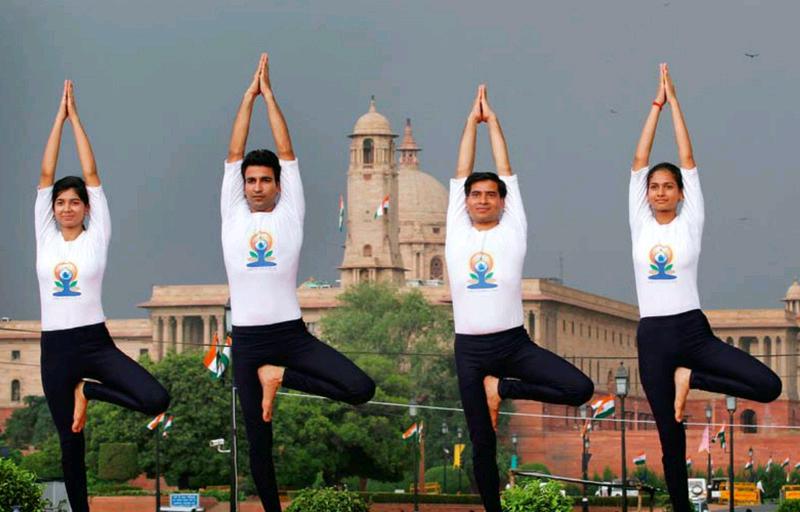
The Road Ahead
“Yoga embodies unity of mind and body; thought and action; restraint and fulfilment; harmony between man and Nature; a holistic approach to health and well-being,” Indian Prime Minister Narendra Modi, himself an avid Yoga practitioner, told the United Nations General Assembly in a speech on September 27, 2014. “It is not about exercise,” he said, “but to discover the sense of oneness with yourself, the world and Nature. By changing our lifestyle and creating consciousness, it can help us deal with climate change. Let us work towards adopting an International Yoga Day.”
In a huge global endorsement for Yoga, on December 11, 2014, 177 out of 193 members of the United Nations agreed by“acclamation” to declare June 21 as the“International Day of Yoga,” recognizing the ancient Indian sciences holistic approach to health and well-being.
India is, at the same time, developing a substantive case to ensure that Yoga is enshrined on UNESCOs list of intangible cultural heritage by 2016. The inclusion of Yoga in the inscription list of UNESCO would provide better visibility for it, helping improve its significance, besides offering international assistance for its promotion and preservation. Though Yoga originated in India, it is now internationally followed.
With the UNs declaration of June 21 as “International Day of Yoga,” the Indian Consulate in Guangzhou, which put together in China two of the largest ever Yoga events by any Indian mission overseas, organized the first edition of the “IndiaChina (Chengdu) International Yoga Festival,” with the theme of taking Yoga back to its roots, in Dujiangyan, Sichuan Province. The four-day Yoga festival, which took place between June 17 and 21, 2015, brought together Yoga gurus from the Ashtanga (Mysore), Kaivalyadhama, Krishnamacharya Yoga Mandiram, Sivananda, Indea, and Isha Hatha Yoga schools – the biggest event of its kind in China. In the past, China discovered India through Buddhism. Today, however, it is through Yoga that China is, once again, rediscovering India.
