
The Fairer Thangka Artists
2015-07-23 16:55:01byXueMing
China Pictorial 2015年7期
by+Xue+Ming
While performing fieldwork in Wutun Village, Tongren County in Huangnan Tibetan Autonomous Prefecture, Qinghai Province, I met a Spanish photographer. He chatted with me while taking photos of Tibetan women at June Festival, a sacrifice ceremony in which villagers pray for harvest and peace for the coming year.“Tibetan women amaze me,” he remarked.“They look so graceful, yet overly shy and submissive at the same time.”
Many get such an impression of Tibetan women, myself included, until meeting Choejor, one of the most accomplished thangka (stylized Buddhist paintings on cotton or silk) artists in Rebgong, and his female students. They redraw cultural boundaries through thangka art.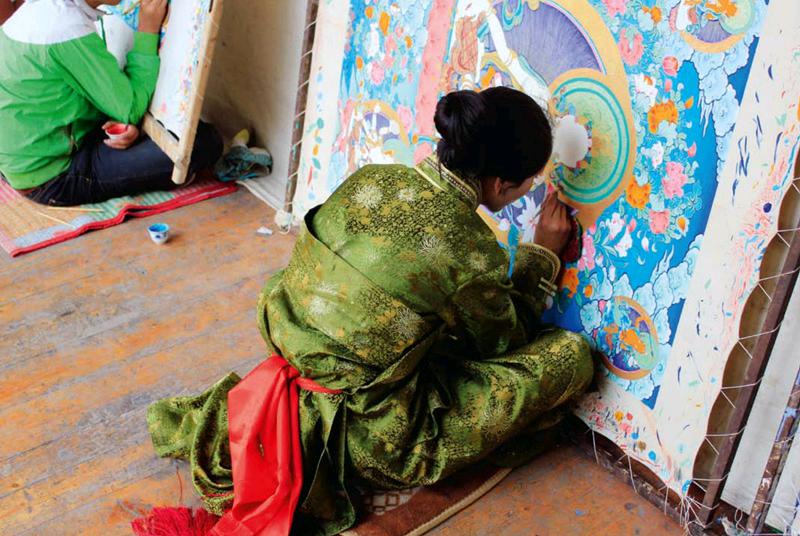
Gender Roles in Rebgong
Wutun Village is located in the area traditionally called Rebgong, with traditions deeply rooted in Tibetan Buddhism. Rebgong is famous for its history of Buddhist art, and thangka is one form. In Wutun, thangka painting is the major source of income for villagers.
In Rebgong, many still consider men in a social class above women. The men spend most of their time painting thangka, while women are responsible for agricultural work, herding, household maintenance, cooking, and raising children. The contrasting social status between genders shows in everyday life activities. For instance, during a family meal, the best food is usually served to men. In some households, women do not eat with men, but instead at a sepa- rate table with their children.
The subjugated status of women also affects educational opportunities. Traditionally, only men were able to learn reading and writing, usually from monks in local monasteries. Women were not expected to learn to read because they rarely worked outside home. Similarly, thangka painting was exclusively passed on to men. Painting thangka required an apprenticeship relationship. Young boys started to learn painting at about six or seven from their fathers or other men in the village. It usually takes seven to eight years to master the skill. When a man painted, his wife and other female family members helped him prepare the canvas and grind pigments. In Wutun, most women over 40 years old are illiterate. Traditionally, after a woman married, she could not seek outside income and had to remain economically dependent on her husband.
Unequal educational opportunities for girls have been a common problem in rural China. To improve education quality, the central government proposed nine-year compulsory education and enacted it in the late 1980s. The local government in Rebgong has enforced this policy since then. Government officials visited each household to persuade parents to send all of their kids, both boys and girls, to school. The local government provided children from povertystricken families additional benefits, including free books and living stipends. Since then, attendance has increased dramatically. When I first visited Rebgong in 2009, all girls above the age of seven were attending elementary school in Wutun.
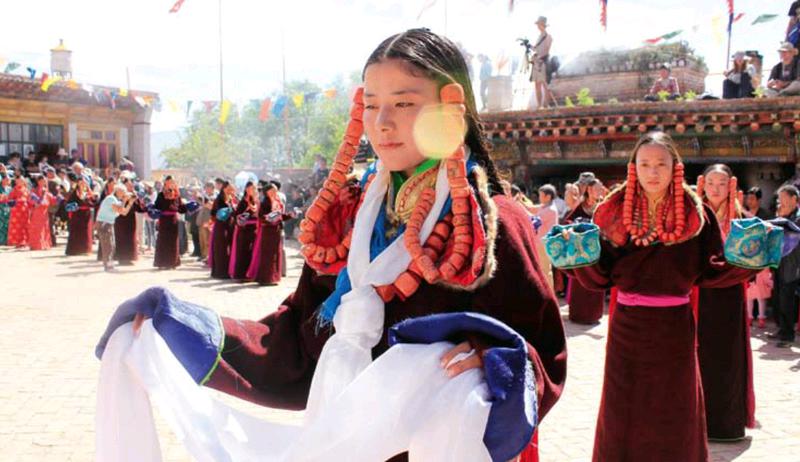
Improved education provides opportunities for Tibetan women. A considerable number of Tibetan girls now attend vocational schools after completing the nine-year compulsory education. Two nursing schools have emerged in town. After nursing students graduate, they can work at the local hospital or private clinics in town. Some also work as pharmacy assistants. Previously, girls usually married at about 15 years old in Wutun. Nowadays, because they go to school and have their own jobs, they usually wait on marriage. Even after they wed, many continue working full or part time. Their improved economic situations enable them to hire farmers from nearby towns to help with agricultural work when it gets busy.
Bridging Cultural Boundaries
Although recent decades helped women in Rebgong receive better education and become more involved in thangka painting than before, they still never received systematic art training until Choejor began to accept female students.
Choejor, in his fifties, is recognized as the most accomplished thangka artist in Rebgong and has recently been dubbed a “national craftsman and artist” by the central government. To preserve thangka art, Choejor, with help from his brothers, began building a school in 2010. He also traveled to various places around China. Those travels changed his opinions about women. “At first, I was shocked to see female artists, and then impressed by their work,” he admits, recalling his visits to the Chinese coastal regions. “I began to wonder why Tibetan women were not allowed to paint thangka and whether women and men could have equal opportunities.”
Inspired by his observations, Choejor began experimenting with the revolutionary idea of recruiting female students. In the beginning, many people in the village objected. He heard comments like, “How can girls paint Buddha? Its pollution!”“What would the girls do after learning? Who would marry them?” and “Guys want wives who can work, not paint.”Choejor expected these objections. He understood that people in the village were very conservative and quite comfortable with contrasting social statuses of men and women. Hoping to avoid hostile feelings towards him and his female students, Choejor did not publically admit female students to his thangka school at first. Instead, he invited some of his female relatives to learn. “It was easier to first teach my relatives than other women in the village,” he explains. “If they can paint well, I prove to other people that women are just as capable as men. Their work convinces others.”
I met Dolma, a woman in her early twenties, at Choejors thangka school in 2013. She was always the first up every morning at 5 a.m., quietly slipping into the downstairs studio. In the studio, she would practice sketching or continue coloring a painting she left unfinished the night before. By doing this, she secured one or two extra hours of practice before other students awoke at around 7 a.m. Dolma revealed to me that she is Choejors cousin-in-law. She has a four-year-old daughter and divorced two years ago from an abusive husband. Aware of her situation, Choejors wife invited her to learn thangka in hopes of helping her make a living by painting. Dolma joined the school a year ago. Compared with other students, she was old, which made her feel the need to work harder. “I like painting. It makes me forget those unhappy things in my life,” she declares calmly. Now, she earns a steady income through painting. She says she has become more confident because she can raise her daughter with her own money.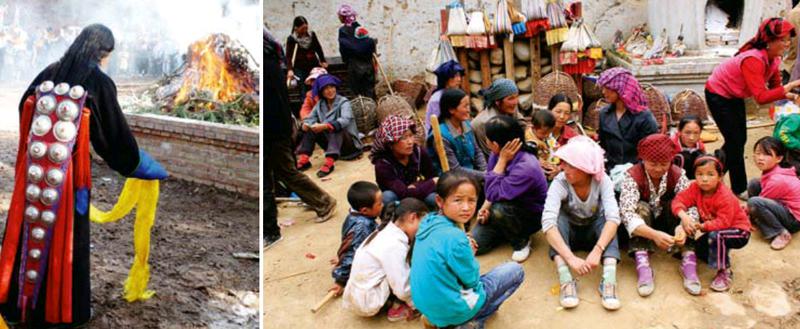
Another female student, Lhuntsen, has been studying thangka with Choejor for five years. Lhuntsens father and Choejor are related. The father realized that his daughter was fond of painting and taught her himself for about two years. As Lhuntsen showed increasing talent, the father decided to send her to Choejor because he heard that Choejor was considering enrolling female students. Choejor remarked that Lhuntsens parents were open-minded and supportive of their daughter, which was rare in the village. After five years of learning, Lhuntsen can paint complete thangkas on her own. When I interviewed her in 2013, she was working on a thangka of Yamantaka, which is considered one of the most complex images in thangka painting.
I asked Lhuntsen whether her parents worried about her marriage prospects since she was already older than twenty. “To some extent, yes.” she admitted. “As you know, many women at my age in the village have kids.” Nevertheless, as villagers recognized her painting ability, she began to receive more encouragement. “Our neighbors always tell me if I learn to paint well, I will get a good job, then a good husband, and a happy family. Both my parents and I believe as much.”
When I interviewed Choejor in 2013, he was working with eight female students. When asked about his future plans, Choejor revealed that he would send the work of his senior female students to competitions and exhibitions province-wide and nationwide. He hopes they will be considered marquee thangka artists and prove that women can create thangka as well as men. Choejor will continue recruiting more female students from Wutun Village and other villages in Rebgong. “One more student, one more virtue,” he said.
