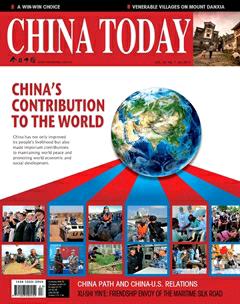
China’s Shifting Role in Global Governance
2015-08-26 22:46:25ByLIHONG
CHINA TODAY 2015年7期
By+LI+HONG
CHINAS Historical Choice in Global Gov- ernance by He Yafei, deputy head of the Overseas Chinese Affairs Office of the State Council, has drawn broad attention from the diplomatic circle in and outside the country. Mr. He, formerly Chinas vice foreign minister, is a veteran diplomat. He says in the book that China should seize upon the opportunities of the time, give play to its status as a major country, actively participate in the reform and transformation of the global governance system, and play in it a constructive, leading role.
Offer Chinese Wisdom
Mr. He has been personally involved in multilateral negotiations over such thorny issues as climate change and the nuclear programs of Iran and North Korea, as well as a number of summits convened since 2008 on the financial crisis. These experiences convinced him that cooperation between major countries including China can play a critical role in global governance.
In his view, global governance falls into the category of multilateral diplomacy. China is a latecomer in this arena, and has lived through the process from passive response, generic participation, proactive participation, and dominance. Historically, China didnt introduce diplomacy until the end of the Qing Dynasty, when its door was forced open by Western warships and canons. Debilitated by both domestic problems and external threats, the imperial Qing court was, however, an underdog in international diplomacy. All it could do was passively respond to any diplomatic issues it encountered. China first sought an active role in global governance with the initiation of the opening-up and reform policy 30-odd years ago.
China has made headway since the 18th National Congress of the Communist Party of China (CPC), contributing “Chinese wisdom” and “Chinese thinking” to global political and economic governance. According to Mr. He, these elements include President Xi Jinpings proposal to build an Asia-Pacific partnership featuring mutual trust, inclusiveness, cooperation, and win-win results, and promoting the Free Trade Area of the Asia Pacific (FTAAP); Chinas advocacy for the new BRICS development bank and a US $100 billion Contingency Agreement Fund among BRICS countries; and the Asian Infrastructure Investment Bank, championed by China and well received among many countries, including the U.K.
Last year, China proposed a dual-track approach to resolving the South China Sea issue whereby issues concerning sovereignty and maritime rights and interests should only be addressed by countries directly concerned through bilateral negotiation; other issues, including exploitation of resources, should be handled through multilateral channels.endprint
Meanwhile, China hews to an impartial stance on such hot issues as Ukraine, Syria, Iran, Israel, Afghanistan, North Korea, North and South Sudan, and the historical feud between India and Pakistan, capably assisting in mediation and seeking appropriate solutions. It has played a constructive role in advancing the progress of political solutions.
Chinas recent Belt and Road Initiatives also have worldwide ramifications, and have received a positive response.
New Platforms for Global Governance
Wealthy Western countries formerly dominated global governance, and the G7, known as the “club of the rich”or “club of big powers,” was the central platform for major developed countries to coordinate international economics and politics. But after the 2008 financial crisis spilled over from Wall Street to almost every part of the world, Western countries realized that they could not handle a disaster of such magnitude on their own, and any possible solution would demand cooperation with their developing and emerging peers.
The question of which platform would best coordinate the worlds major countries discussions on global economic affairs hovered in the minds of the international community, said Mr. He. China discerned a historical opportunity to advance reforms on global governance, and believed that the G20, consisting of such countries as Argentina, Australia, Brazil, India, South Africa, South Korea, and Turkey, would offer a more balanced presentation. As long as the G7 could not tackle this global crisis, the G20 should step in.
In response to the spiraling financial crisis, the G20, founded in 1999, launched annual summits. The first was convened in Washington in November 2008, and the second in London in April 2009. The third opened in Pittsburgh on September 25, 2009. The leaders statement released at the end of that summit announced, “We designate the G20 as the premier forum for our international economic cooperation,” indicating that the G20 had superseded the G7. According to Mr. He, the G20 summit was a mechanism that ushered global governance into a new phase, turning 2009 into a milestone in the history of modern global governance.
Some Western media commented that the “upgrading”of the G20 reflected the reality of todays world and highlighted the importance of emerging economies including China, India, and Brazil. It also signified increasing recognition of the strengths of emerging markets, most prominently the BRICS countries, by politicians in developed Western countries.endprint
According to Mr. He, an understanding was reached within the G20 that the G7 would not canvass global economic issues ahead of the G20 summit, lest it set the tone for the gathering. The G8+5 mechanism was dissolved as a result.
It turned out that the G7 played fast and loose on its promise but, regardless, its sheer dominance on global governance became history. In general, the developed and developing worlds have broken even in the field of global governance since 2008. The consensus has been formed that solutions for structural issues in the global economy and financial system demand all-out cooperation by all countries including developing ones.
This, Mr. He said, is the historical trend, which China follows. By seizing on this opportunity and advancing reforms on global governance, China has achieved historical shifts in its relationship with the wider world.
China rolled out a RMB 4 trillion stimulus package prior to the Washington Summit in November 2008, effectively enlivening the world economy. At the London Summit the following year it agreed to purchase US $50 billion IMF notes, a nod to the G20s call to boost the IMFs lending capacity, enabling it to inject extra liquidity into the global economy during the time of crisis. Following Chinas example, other countries signed up for contributions. Consequently, the IMFs resource base expanded to US $1 trillion, giving it strong leverage and boosting market confidence.
From 2008 to 2013 China was accredited for 52 percent of global GDP growth. The substantial efforts it made built an image of a responsible big country. It is owing to the awareness of shared destiny and collective endeavors by all countries that the global economy stopped short of a collapse.
A Bigger Role to Play
In his diplomatic career, He Yafei witnessed Chinas growth from a regional to a global big country, and then to a global power. In his opinion, in order to exert theoretic influence over the direction of global governance and on global affairs, China must be adept at presenting its plans.
He realized the importance of China involving itself in global governance and the formulation of international rules when he worked in Geneva. In the past, China was in a passive position and had little say in the making of international rules. But its national interests were at stake in negotiations over such global conundrums as climate change and energy security. Nowadays, China plays a prominent role in this regard, defending the collective interests of developing countries.endprint
China will host the 2016 G20 Summit, which offers fresh opportunities. Starting this year it will be part of the troika, with the U.S. and the EU, that leads the group; and next year, as the host country, it will have a greater say in the summit schedule. Other countries are watching China to see what kind of leading role it will play in global governance.
He Yafei predicted that at its current pace, Chinas GDP would outstrip that of the U.S. in a decade. China, therefore, must demonstrate a big heart and sense of responsibility, living up to its economic size. It is expected to think and act in light of both its national interests and the interests of other peoples, and “docking” its own development strategy with that of the world, defending world peace and development, and providing more public products to all humankind.
Mr. He cautioned that this process wont be free of obstructions. But China must press on, releasing its plans and proposals, and improving the global governance system with its wisdom. It shall actively seek a bigger presentation and louder voice for the developing world in international affairs, and contribute to peace and stability in the international community.endprint