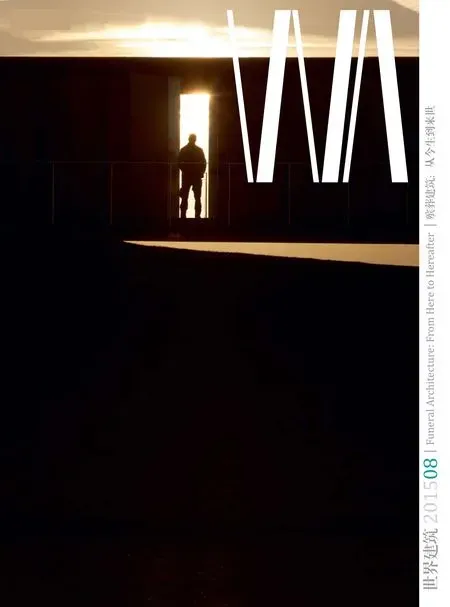
南京新殯儀館,南京,江蘇,中國
2015-10-11 09:05:03建筑設計朱雷龔愷ArchitectsZHULeiGONGKai
世界建筑 2015年8期
關鍵詞:建筑
建筑設計: 朱雷,龔愷Architects: ZHU Lei, GONG Kai
南京新殯儀館,南京,江蘇,中國
建筑設計: 朱雷,龔愷
Architects: ZHU Lei, GONG Kai
南京殯儀館搬遷項目工程(又稱“1231工程”)被納入南京市2010年“十大民生工程”。新殯儀館占地約23hm2,建筑面積50,000m2(含骨灰紀念堂10,000m2)。新館館址位于南京市雨花臺區鐵心橋街道馬家店村西天寺墓園以南,大周路(京滬高鐵)以北,基地主要為丘陵地帶,三面環山。
設計力圖實現功能性和精神性的雙重目標。應對特殊地形條件限制,采取“地景式”的設計策略,將建筑介入地形,也將地形引入建筑。借助地形的分化,安置功能模塊,一方面結合自然生態,減少土方工程;另一方面則借山取勢,提升精神內涵。
在上述目標和策略的引導下,最終形成“一條主軸,三段序列”的總體格局。“一條主軸”沿三面環山的地形縱向伸展,借山取勢,以現代建筑的處理方式回應中國殯葬文化的傳統,凸顯“以山為寢”的場地形式和空間意境。“三段序列”在主軸上漸次展開,以呼應地形變化,滿足功能需求:第一段序列面臨外部道路,銜接兩側山腳,起“悼念臺”;第二段序列架于中間山谷之上,接于兩翼山腰之間,設“守靈橋”;第三段序列環于后部主峰之周,留出自然山巔,成“紀念環”。
悼念臺
悼念臺位于軸線開端,臨道路,銜山腳而起,主要布置大-中-小各類悼念廳,臺下和臺后藏有部分生產服務功能。悼念臺整體平面呈環形發散,臺前留出休息廊和悼念廣場,可供大量人流集散;廣場東側布置有開敞的業務廳,與悼念臺相連。登臺而上,可望后方的守靈橋、紀念環和自然峰巔。
守靈橋
過悼念臺,即到守靈橋。此處建筑主體架于中間山谷之上,接于兩翼山腰之間,故稱“守靈橋”,主要布置為守靈間。橋下兩側架空,留出景觀綠化及人行和車行交通。橋后為等灰區,再往后經道路相隔,局部掩于主峰之下,安置火化生產部分。從中部門廳上到守靈橋,前觀守靈廣場和悼念臺,后瞻紀念環及自然山體,建筑壯美,環境靜謐,滌蕩心靈。
紀念環
紀念環相對獨立,位于主軸線盡端,環于自然峰巔之周,為骨灰堂。骨灰堂下部結構接于山體,呈放射狀,引導人流拾階而上,并于外側形成大小不同的扇形存放區和接待區;骨灰堂上層為環形結構,架于下部結構之上,外圈納屋頂天光而入。整個紀念環內側依山而設,呈臺階狀,上下連通,背靠山體部分預留為紀念墻(相關部門已在此安置城市英烈墻)。順臺梯而上,出骨灰堂,向外可望周匝全貌;環內則是自然山巔,依舊青松藹藹。
在主軸線下部和后部,結合地形和功能需要,適當安排生產區域,以高壓線為界,分前后兩塊,以地下通道相連。其中火化區位于后部,處于整體地塊的下風區,并利用西北側的地形凹口形成排風道。主軸線東側,留出相對獨立和安靜的辦公管理區域。
整體布局考慮到分區合理與遠近期結合,在用地北側、西側和東南側預留一定發展空間,保留功能拓展的潛力。□
項目信息/Credits and Data
項目負責人/Project Directors: 朱雷,齊昉/ZHU Lei, QI Fang
場地面積/Site Area: 23hm2
建筑面積/Floor Area: 50,000m2
建造時間/Construction Period: 2010-2012

1 總平面/General plan

2 從業務廳望悼念臺/View of tribute stand

3 守靈橋/Wake bridge
The relocation project of Nanjing Funeral Parlor (also known as the "1231 Project") was part of Nanjing's "Ten Major Livelihood Projects" in 2010. The new funeral parlor covers an area of about 23 hectares with 50,000-square meter floor area (including 10,000-square meter Ash Memorial Hall). The new parlor is located to the south of Xitiansi Cemetery in Majiadian Village, Tiexinqiao Street,Yuhuatai District, Nanjing, and to the north of Dazhou Road (Beijing-Shanghai high-speed railway). The project site is mainly on hilly terrain surrounded by mountains on three sides.
The design aims to achieve both goals of functionality and spirituality. Responding to the constraints of the special terrain condition, a "landscape style" design strategy was adopted to blend the architecture and the topography into each other. Functional blocks were arranged according to the division of the terrain. On the one hand, natural ecology was considered to reduce earthworks; on the other hand, hilly terrain was used to enhance the spiritual connotation.
Under the guidance of the above objectives and strategies, the overall layout of "one axis, three series" is formed. "One axis" extends longitudinally on the terrain surrounded by mountains on three sides. Taking advantage of the hilly terrain, modern architectural approaches are adopted to respond to the traditional Chinese funeral culture, highlighting the site topography and spatial concept to make "hill as bedroom". The "Three series" extend one after another along the axis in light with the terrain changes to meet the functional requirements: the first series faces external road and links the foothills on both sides, where the "Tribute Stand" was built;the second series is set up in the middle of the valley between two wings halfway up the hills, where the "Wake Bridge" was erected; the third series loops around the main peak at the back keeping the mountain top intact to form a "Memorial Ring".
1. Tribute Stand
The Tribute Stand is located at the starting point of the axis, facing the road and connected to the foothill. It is composed of mainly large, medium and small-sized memorial halls, with production and service space hidden beneath and in the back of the stand. The plan of the entire stand is in ring shape and radiating out. There are rest porch and tribute square in front of the stand to accommodate large crowds of people. To the east of the square,a spacious service hall is connected to the tribute stand. Stepping on top of the stand, one can have a good view of the Wake Bridge, the Memorial Hall and the natural peak in the back.
2. Wake Bridge
The Wake Bridge is located behind the Tribute Stand. It is set in the middle of the valley between two wings halfway up the hills, hence the name "Wake Bridge", with mainly rooms to keep the coffin. The bridge is raised up on both sides leaving space for greenery and landscape, as well as pedestrian and vehicular traffic. Behind the bridge, it is the waiting area for the ashes - further back, separated by the road and partly hidden beneath the main peak is the area for cremation production. Going up the Wake Bridge from the lobby in the middle,one can see the Wake Square and the Tribute Stand at front and the Memorial Ring and the natural mountain in the back. The magnificent buildings and the serene atmosphere help cleanse the soul.
3. Memorial Ring
The Memorial Ring is relatively isolated, lying at the far end of the main axis and circling around the natural mountain top, functioning as the Ash Hall. The bottom structure of the Ash Hall is connected to the mountain in radiating form, guiding the crowds up the steps. Various sizes of fan-shaped storage and reception areas are arranged on the outer side. The upper annular structure of the Ash Hall is built on top of the bottom structure and the outer loop captures day light from the roof. The inner side of the entireMemorial Ring sits into the mountain as steps, with upper and bottom levels connected to each other. A memorial wall is reserved at the space against the mountain at the back (related authority has placed the city's martyr wall there). Going up along the steps and exiting the Ash Hall, one can have a panoramic view of the overall setting; inside the ring lies the natural mountain top covered with verdant pines.
In the bottom and back parts of the main axis,coordinated with the site topography and functional needs, production areas are appropriately arranged. A high-voltage corridor divides this area into two parts, front and rear, which are connected by an underground passage. The cremation area is located in the rear which is the downwind area of the entire site, and a valley in the northwest is used as an exhaust passage. To the east of the main axis, an office management area is located in this relatively independent and quiet part.
The overall layout arranges various zones properly and combines long-term and short-term development plans. Spaces are reserved in the north,west and southeast areas of the site for potential expansion and development in the future.□

4 紀念環/Memorial ring

5 紀念環剖面/Sections of memorial ring
評論
胡越:對于殯儀建筑來說,這是一組規模龐大的建筑群。設計師在功能需求與地形之間取得了某種平衡。如果按照某種慣性思維去考慮,似乎國內這類建筑經常呈現出一種不恰當的中國傳統建筑形態或者某種中國式的歐陸風情,這個設計卻采用了一種適當的現代風格將這類建筑設計得恰如其分。
周漸佳:南京新殯儀館所代表的是另一種宏大的敘事。與其他幾個小型項目相比,它本身展現出的在建筑序列上的清晰性更接近于中國人對紀念性空間的理解,“一軸三環”中出現的單純有力的幾何體量進一步加深了這種印象。也是這些巨大的幾何體量將原先殯儀館內的功能進行拆解與整合,將流線拉長,以一種敘事的方式完成整個儀式。在這里,由軸線開始的整個序列的體驗是極為重要的,它既使對空間的感受不斷變化,也強化了行走本身所經歷的時間感,同時伴隨著山勢、景觀與建筑相互交映。
Comments
HU Yue: In comparison to the typical funeral home typology, this is a huge architectural complex. The designers have also managed to achieve a balance between functional requirements and topography. From this perspective, it is a well-designed funeral home which adopts an appropriately modern style, differing from other similar buildings in China that present either an inappropriate traditional Chinese architectural form or some kind of hybrid Chinese-European style.
ZHOU Jianjia: This project is grounded on a grand narrative. Compared to the other relatively small projects, the explicit rises and sequences seen here are more in tune to how the Chinese understand monumental spaces. The powerful geometric forms in this "one axis three rings" composition further consolidate this understanding. In these grand volumes, the program of the former funeral home is restructured, and its circulation is prolonged; likewise, the ritual now follows a sense of linear narrative. Walking up the axis allows a constant experience of different spaces and also a sense of the passage of time, accompanied with the interweaving of mountain scenes,landscape, and architecture.
Nanjing New Funeral Parlor, Nanjing, Jiangsu, China, 2012

6 火化間室內/Interior view of furnace room

7 殯葬管理處室內/Interior view of mortician office
猜你喜歡
北方建筑(2021年6期)2021-12-31 03:03:54
文苑(2020年10期)2020-11-07 03:15:36
現代裝飾(2020年6期)2020-06-22 08:43:12
現代裝飾(2020年4期)2020-05-20 08:55:08
攝影之友(影像視覺)(2019年2期)2019-03-05 08:27:16
藝術家(2017年3期)2018-01-26 08:54:49
文學自由談(2016年3期)2016-06-15 13:01:16
福建農業科技(2016年10期)2016-03-07 09:46:49
少兒科學周刊·兒童版(2015年6期)2015-11-24 03:49:38
中國工程咨詢(2015年4期)2015-02-14 03:49:56