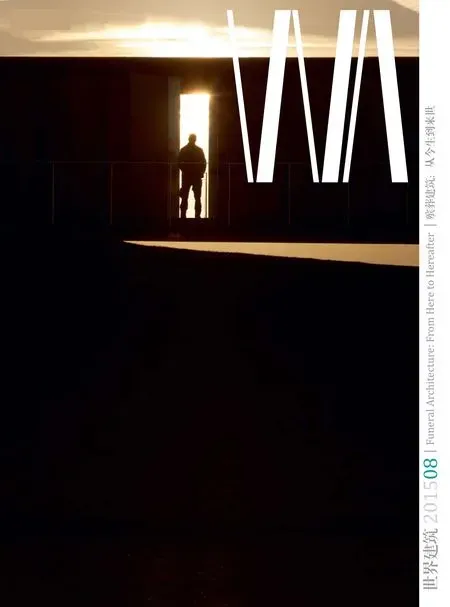
松鶴墓園接待中心,上海,中國
2015-10-11 09:05:19建筑設計張斌周蔚致正建筑工作室ArchitectsZHANGBinZHOUWeiAtelier
世界建筑 2015年8期
關鍵詞:建筑
建筑設計:張斌,周蔚/致正建筑工作室Architects: ZHANG Bin, ZHOU Wei/Atelier Z+
松鶴墓園接待中心,上海,中國
建筑設計:張斌,周蔚/致正建筑工作室
Architects: ZHANG Bin, ZHOU Wei/Atelier Z+

1 西側外觀/View from the west

2 區位/Location
接待中心位于松鶴墓園的核心位置,東臨墓區主干道,北靠墓區停車場,南、西兩側都緊鄰墓園。作為墓園內的主要公共建筑,接待中心集業務接待、入葬儀式和辦公管理等多種功能于一體,承擔了平日的市民購墓、入葬和祭掃事務接待,以及清明、冬至兩大高峰時節的大流量接待工作。由于場地有限,同時面對道路和墓園的外向視野或缺乏特色、或不宜引入,讓我們在一開始就堅定了“內向性”的策略選擇,用江南傳統的“宅園”結構中的多重圍院模式來組織空間,院落與廳室相依相生,并依托內向的、有差異的庭院景觀與使用方式創造出寧靜、平和、冥想性的空間氛圍。
整個場地分成相互串聯的、由院墻限定的4組庭院:居中的大庭院里橫亙的是18m跨度的業務接待大廳,四周都有庭院環繞,大廳北、西兩側的透明界面使空間完全向庭院延展。接待區以北是包含有大小兩個葬儀廳的落葬儀式區,每個葬儀廳都坐落于專屬的庭院空間內,之間以曲廊連接。接待區以南的一組院落里是由數個穿插并置體量曲折串聯起來的辦公會議區,大小會議廳居中向南突出俯瞰整個墓區,兩側的辦公室都配有曲折變化的小尺度庭院。接待區和葬儀區的東側沿路部分布置的是包含有花店、小賣部為葬儀及祭掃服務的配套服務樓;它和其他3個部分之間正好形成兩個內凹的入口庭院,分別對應東側臨路的主入口和北側通停車場的次入口。
庭院景觀的設計在整個項目中具有關鍵性的作用,并奠定了不同區域的空間氛圍基調。北側葬儀區的庭院全部白砂鋪地,不種植物,院內沉寂空靈,透過落地長窗與全白的葬儀廳室內融為一體。南側辦公會議區的庭院草木茂盛,生機盎然,與葬儀區的素簡形成一種對仗關系。中部接待區的庭院兼有南北兩側的素簡與生機,將植有高大喬木的居中石板鋪地平臺與兩側植有睡蓮的水池結合在一起,沉靜中透出靈動的氣息;接待大廳前的入口庭院居中于坡道,兩側跌水結合種植,運用與接待區庭院相似的手法在進入建筑之前就營造出別有洞天、引人入勝的氣氛。
圍合與限定這些庭院的廳室及院墻的物質形式與構造方式也延續了整體上平和大度而又精巧雅致的設計思路。控制建筑形態的主要元素是高低錯落、出檐深遠而又輕盈的深灰色規則雙坡陶瓦屋面。外立面上二層窗臺以下的基座部分及院墻都是帶有深色條石壓頂與勒腳的淺灰色干掛花崗石墻面,二層窗臺以上至屋檐以下的墻面則是帶有幽暗光澤的豎向鎖邊的深灰色氧化鈦鋅板,只有在接待大廳的北、西兩側運用了通高的玻璃幕墻,為大廳引入更多的庭院景觀。接待大廳的室內設計也是本項目的一大重點,鋪地、墻面及大廳一側縱向展開的長長的接待臺都使用了溫潤的米灰色大理石滿鋪,與坡屋面下吊頂的檜木飾面吸音板相得益彰,更顯出大廳的宜人氛圍。大廳西端的一部分地面略有下沉,是玻璃隔斷分隔的收銀后臺及大堂經理用房,其上的夾層是從屋面結構上懸掛下來的、全部由雙層半透明夾紙玻璃包裹的貴賓洽談包房。大廳屋頂在通高部分和有夾層部分之間利用屋脊位置的落差,在兩片屋頂之間形成一個橫向的高側窗采光帶,為大廳深處引入了自然光線。□

3 北側儀式入口/North entrance
The reception center is located in the center of Songhe Cemetery, along the main road on the east and the parking lot on the north, and adjacent to the cemetery on both the south and west sides. As the main public building in the cemetery, the reception center holds multiple functions. It serves as a business center, a burial ceremony space and an administrative place, providing services for customers on tomb purchases, burial ceremonies, and grave tributes, including serving large crowds for tombsweeping on special days as Qingming and Dongzhi.
Due to the lack of space and unappealing surrounding environment, the design determinately strives to create a calm, peaceful and introverted space from the very beginning. Models of traditional "residential garden" in regions south of the Yangtze River were used as design prototype to organize rooms, courtyards and landscapes interdependently to each other.
The whole site is divided into four interconnected courtyards defined by walls. In the central courtyard sits the business reception hall spanning eighteen meters and surrounded by courtyards all around. The glass walls on the north and west sides allows the inner space flowing into the outer courtyard. To the north of the reception hall, a burial ceremony area is located with two funeral rooms, one large and one small. Each room is jointed with its own courtyard and connected to the other with zigzag corridors. The offices and conference center are on the south side with interconnected volumes. The conference halls in the center extruding southward overlook the whole cemetery, while the offices on the sides are adjoined with small courtyards with diversified scenes. The administration building is located to the east of the reception and ceremony areas,equipped with a flower shop, a canteen and service areas for funeral and tomb-sweeping. These four zones create two concave entrance courtyards, with one facing the main entrance by the road on the east side and the other connected with the secondary entrance leading to the parking lot to the north.
The landscape design of the courtyards plays a key role, which sets different tones for each zone. The courtyard by the funeral area in the north is paved with pure white gravels with no vegetation. It is a tranquil and spiritual place merged with the pure white interior space of the burial ceremony hall through the floor-high long windows. The courtyard by the administrative area in the south is filled with lush vegetation and vitality,which makes a strong contrast to the simple yet elegant funeral area. The characters of the central courtyard are both graceful and vibrate. Slate platform with large trees is connected with water lily ponds, revealing sensitivity in stillness. The front yard has a ramp in the center with cascades and plants on both sides, creating a space with charm, beauty and respect.
The material selection and construction methods of the rooms, which enclose and define the courtyards,are also complied with the above simple yet elegant design approach. The main element to shape the architectural form is the dark grey double-slope roofs with clay tiles, whose deep and light eaves are arrangedrhythmically. The fa?ades below the second-floor windowsills, as well as all walls around the courtyards are decorated with light grey dry-hung granite panels,with dark stones defining the plinth and the coping of the walls. The fa?ades above the second-floor windowsills and below the eaves use Titanium-Zinc panels with a dark metallic sheen. Glass walls are only used on the north and west sides of the reception hall to bring in more landscape views from the courtyards.
The interior design of the reception hall is also a focus of the project. The floor, the walls and the long reception desk, which extends along one side of the hall, all use warm beige granite. Ceilings under the pitched roof is covered with juniper acoustic panels. These materials match each other and together create a pleasant atmosphere. The floor on the west side of the hall sinks slightly. This area is used as the cashier's desk and lobby manager's office divided by glass partitions. The mezzanine above this area is suspended from the roof structure and used as VIP rooms,which are enclosed by translucent laminated glass sandwiched with paper. A horizontal high window is designed using the height difference between the two roof ridges, which brings natural light into the hall. □

4 儀式入口庭院/Ceremony entrance courtyard

5 接待區庭院/The courtyard by the reception

6 接待大廳和辦公區之間的庭院/The courtyard between the reception hall and the office

7 軸測圖/Axonometric drawing

8 首層平面/Floor 0 plan
1-業務接待大廳/Reception hall
2-客戶休息室/Client Lounge
3-大落葬司儀室/Big funeral chamber
4-小落葬司儀室/Small funeral chamber
5-辦公室/Office
6-員工休息室/Staff lounge
7-接待室/Reception room
8-會議室/Meeting room
9-禮儀組/Protocol room
10-小賣部/Shop
11-儲藏室/Storage
12-配電間/Switch room
項目信息/Credits and Data
客戶/Client: 上海市嘉定區松鶴墓園/Shanghai Songhe Cemetery
項目建筑師/Project Architects: 袁怡(方案設計)/YUAN Yi(Schematic Design),金燕琳(初步設計、施工圖設計、室內設計、景觀設計)/JIN Yanlin(Development Design, Constructional Drawing Design, Interior Design & Landscape Design)
設計團隊/Design Team: 李佳,何斌,李姿娜,楊敏,王佳綺,何茜,麻宇翔,廉馥寧,王晨曦/ LI Jia, HE Bin, LI Zina, YANG Min, WANG Jiaqi, HE Qian, MA Yuxiang, LIAN Funing, WANG Chenxi
合作設計/Cooperation: 上海伊騰建筑設計有限公司/ Shanghai Yiteng Architectural Design Co., Ltd.
承建方/Construction: 上海均泰建筑工程有限公司/ Shanghai Juntai Architectural Construction Co., Ltd.
主要用途/Program: 殯葬設施/Mortuary Service
造價/Cost: 4,000,000 RMB
結構形式/Structure: 鋼筋混凝土框架結構(局部鋼結構)/Reinforced Concrete Frame (Steel Structure in part)
建筑層數/Floor Number: 地上2層/2 floors above ground
材料/Materials: 干掛花崗石材,鈦鋅板,陶瓦,平板玻璃,夾紙玻璃,大理石,木質飾面吸音板板,塑木板/ Granite panel cladding, titanium-zinc sheeting, clay tiles,slab glass, laminated glass sandwiched with paper, marble,wood veneer acoustic panel, wood plastic composite panel場地面積/Site Area: 6823m2
基底面積/Building Area: 3095m2
建筑面積/Floor Area: 4936m2
設計時間/Design Period: 2011.10-2014.10
建造時間/Construction Period:2013.06-2014.11
攝影/Photos: 頁景/YE Jing


9.10 剖面/Sections

11 業務接待大廳/Reception hall
評論
胡越:這是一組設計細膩、樸實的建筑。簡約的略帶江南韻味的建筑形態,以及低矮的建筑和多重院落構成的復雜的室外空間,弱化了殯儀建筑通常所呈現的某種表情。我想這恰恰是這類建筑應該表達的氛圍,靜穆中帶著某種親和力,從而可以消除人們對于死亡的恐懼感。
劉晨:電影《非誠勿擾2》里,葛優帶奄奄一息的孫洪雷去看墓地,看著看著,孫洪雷說:“不看了!活著擠來擠去,死了還睡大通鋪!”這松鶴墓園讓我一下子想起了“大通鋪”。戲謔的是,新建的接待大廳倒寬綽、寧靜、優美得奢侈,睡大通鋪的若泉下有知,那羨慕嫉妒恨還不讓他們集體造反,來個大遷徙?可轉念一想,生死永隔,好比參商不見。“托體同山阿”,不過是生者的自我安慰。那邊的大通鋪還是要睡的,這邊的禮儀也還是要盡的,越寧靜幽美越好。
Comment
HU Yue: This a complex of delicate and austere buildings. The simple architectural form borrows a slight taste of styles found south of the Yangtze River, but the low buildings and the complex commercial space,composed of multiple-layered courtyards, weakens the expression that funerary architecture usually presents. However, I do think that this is indeed the right atmosphere for this type of architecture to convey,a certain degree of affinity of solemnity and quietness designed to eliminate people's fear of death.
LIU Chen: We live in a crowded world. It seems that when we die, the situation is not getting any better:we will find ourselves lay head to toe in endless arrays of deathbeds. But here, at the Songhe Cemetery, the crowdedness of the dead forms such an ironic contrast to the luxurious ampleness and serenity of the newly completed reception hall that the dead would resurrect to embark on an exodus, had they had feelings. That is not going to happen, given the impassable barrier between life and death. The living beings, like the ancient poet Tao Yuanming, resort to Taoism only for temporary self-relief. As long as we choose to be buried as the others, crowdedness seems unavoidable. So does a proper ritual to be held in a proper space, the ampler and the serener, the better.
Reception Center for Songhe Cemetery, Shanghai, China, 2014

12 落葬司儀室/Funeral chamber

13 貴賓洽談包房/VIP room
猜你喜歡
北方建筑(2021年6期)2021-12-31 03:03:54
文苑(2020年10期)2020-11-07 03:15:36
現代裝飾(2020年6期)2020-06-22 08:43:12
現代裝飾(2020年4期)2020-05-20 08:55:08
攝影之友(影像視覺)(2019年2期)2019-03-05 08:27:16
藝術家(2017年3期)2018-01-26 08:54:49
文學自由談(2016年3期)2016-06-15 13:01:16
福建農業科技(2016年10期)2016-03-07 09:46:49
少兒科學周刊·兒童版(2015年6期)2015-11-24 03:49:38
中國工程咨詢(2015年4期)2015-02-14 03:49:56