
From “Migrant Girls” to Urban Residents
2015-10-15 21:00:12byRuYuan
China Pictorial 2015年10期
by+Ru+Yuan
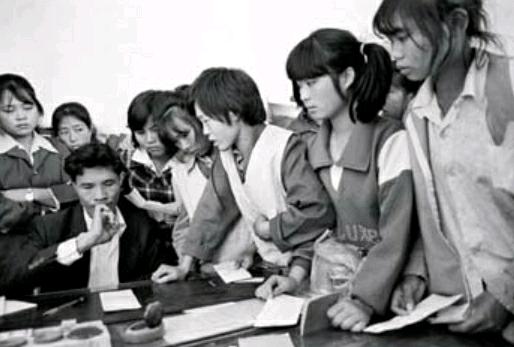
In 1991, Migrant Girls, a 10-episode TV series, caused a huge sensation when it was broadcast on China Central Television. The plot of the series was simple: Soon after China began to implement the reform and opening-up policies in 1978, Guangdong Province, in Chinas southern coastal area, which enjoyed a preferential development policy, soon became paradise in the eyes of many youngsters from other parts of China. Six young people from a rural village in northern China came to work in the Shenzhen Special Economic Zone (SEZ) with hopes of changing their lives. The TV series was named Migrant Girls because females were the preferred workers at the time. Textiles and toy manufacturing were pillar industries in Shenzhen or even greater Guangdong Province back then, and employers preferred girlssmaller, deft hands.
A product of Chinas implementation of reform and openingup, migrant workers first emerged in Chinas special economic zones, and were quickly found in other comparatively developed areas. At present, according to incomplete statistics, China is home to around 250 million migrant workers, likely the largest working demographic in the world.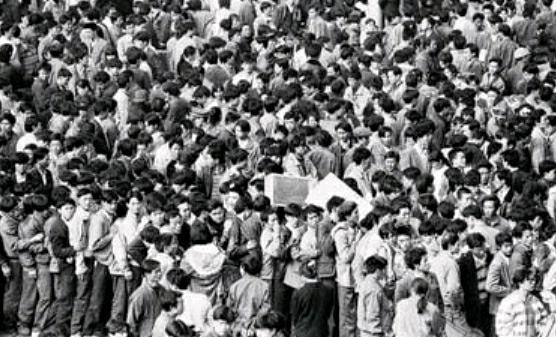
The First Generation: Explorers
Due to the TV series popularity, “migrant girls” soon became a word closely tied to Chinas special economic zones and reform and opening-up. The six young people in the series were representative of tens of thousands of Chinas first-generation migrant workers.
In 1982, a toy company solely funded by a Hong Kong enterprise began operating in Shekou Industrial Zone, Shenzhen. Facing a huge shortage of labor, the toy company recruited about 1,000 young workers from various rural areas in Guangdong, accounting for nearly half of the migrant worker population in Shekou at the time. Eventually, an increasing number of young job-seekers from remote areas of Guangdong began to swarm Shenzhen. In March 1987, the First Shenzhen SEZ Job Fair was held, causing a stream of youngsters from across China, especially less developed areas, to board trains to Guangdong. The phenomenon of people flocking to Guangdong was not difficult to understand. Of the first four SEZs announced by the Chinese government in 1980, three were located in Guangdong. There was even a saying at the time that went: East, west, south, and north, if you want to make a fortune, please come to Guangdong.
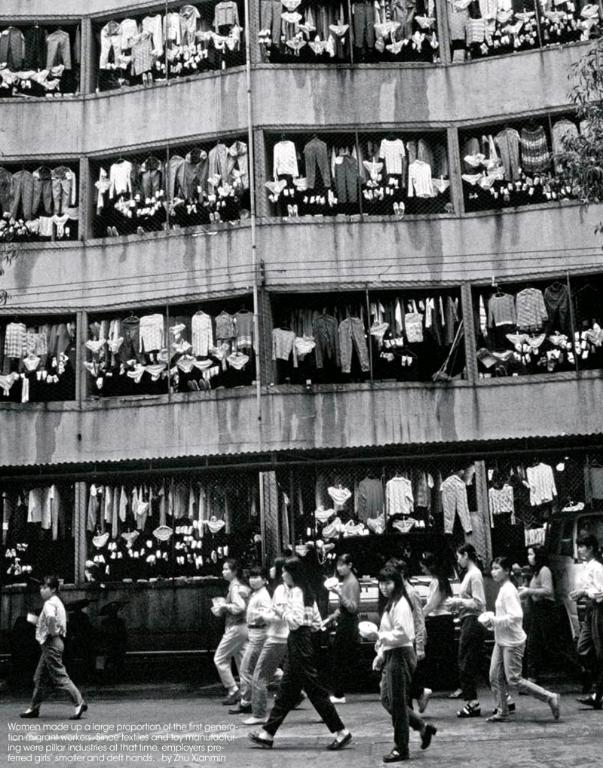
The surplus laborers from Chinas rural areas were dubbed the“first-generation migrant workers.” While providing the workforce for cities development of secondary industry and service sectors, the first-generation migrant workers also realized huge commercial value. They mailed back piles of money orders to their families. According to media reports, in Shenzhen alone, migrant workers mailed more than 82 billion yuan back to their hometowns from 1990 to 2004.
This year marks the 35th anniversary of the SEZ establishment in China, which means most of the first-generation migrant workers are middle-aged. Although many of them returned“home,” very few returned to real rural areas. Quite a few started their own business, moved to cities, and became urban residents. Li Liansheng, 57 years old, quit his job in a shoe factory where he worked for ten years and started his own shoe business in Dongguan. Five years ago, he returned to his hometown in Gushi County, Henan Province, and opened two shoe factories. A county with a large population, Gushi mainly attracts investment from locals working outside as migrant workers.
However, poor education has always been a problem hindering the development of the first-generation migrant workers. According to Introduction to Social Work published in 2006, the majority of first-generation migrant workers only finished elementary school or junior high school, among which nearly 31 percent are illiterate or semiliterate. Thus, although three decades have passed, some are still doomed to manual labor.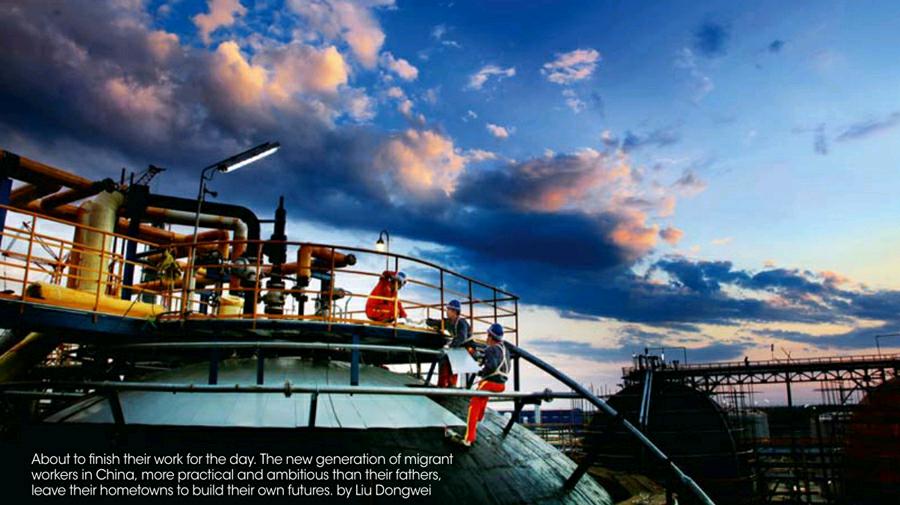
The New Generation: Reformers
According to UKs Financial Times, in China today, an emerging consumer group has been flexing its buying power—the countrys migrant workers, which now number more than 200 million. Todays migrant workers greatly contrast their fathers. These millennials are practical, ambitious, and obviously not too much constrained by the traditional Chinese mindset of “a persons greatest responsibility is to earn money to support family.”
These characteristics, to some extent, are results of changing Chinese society and their fathers sacrifice and hard work. With the development of Chinas economy, the new generation of migrant workers now enjoys better pay and keeps a greater proportion of earned wages in the more open and free society. Their fathershard work in their youth greatly reduced the new generations burden. “The first generation of migrant workers faced tremendous economic and living pressure,” commented Chinas Youth.cn.“Their purpose of working as migrant workers was obvious. They needed to earn money, go back home to build houses, get married, support their parents and raise kids. However, the new generation comes to cities to work for their own futures.”
The new generation has received much more education, making them fit for more demanding jobs. Contrasting their fathers, who thought, “as long as I have a job, Im OK,” the new generation has real demands, including working environment, social security, and salary. At the same time, since many of them never live or work in rural areas and have studied in major Chinese cities, their desire to assimilate into cities is much greater than their fathers. Wang Ling, 28, from Shandong Province, has a college degree and has worked in a Shenzhen-based electronics factory for three years. Like many of his young coworkers in the factory, returning to his hometown has become more and more an unbearable chore.“I studied computer at college,” he explains. “If I was forced to go home and be a farmer, I would be totally illiterate.”
Indeed, the new generation of migrant workers has made major breakthroughs in terms of assimilating into cities. According to a report from China International Capital Corporation, Chinas migrant workers today have already become a powerful consumer group. Their consumption demands have transformed from daily necessities to real estate, cars, and tourism, sharing surprising similarities with Chinas middle class.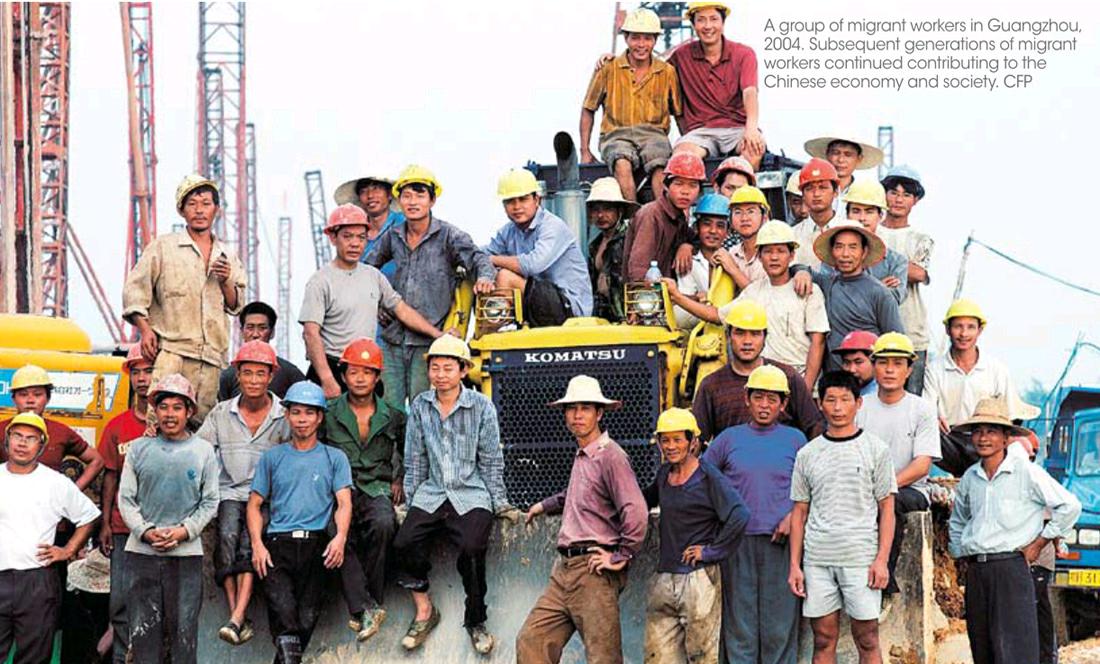
In 2014, Chinas first specialized urbanization project, Chinas New Urbanization Plan (2014-2020), was published. According to the plan, by 2020, Chinas ratio of permanent urban residents to total population should reach about 60 percent. The country will help 100 million migrant workers and other rural residents get permanent urban resident status, improve the living conditions for 100 million by transforming urban shantytowns, and guide 100 million from Chinas central and western regions in obtaining residency in nearby cities. One of the plans aims is to help more people in rural areas enjoy the benefits of urbanization.
Both the first and new generations of migrant workers have provided abundant cheap labor propelling Chinas economic take-off since 1978. During the process, they expanded and renewed Chinas industry, and traveling to work partially solved Chinas problem of rural surplus labor. It is not difficult to understand the Chinese governments sustained attention on the group in recent years. Just as Amartya Sen, the 1988 Nobel Prize winner in Economics, put it, people cannot judge the happiness of a society only by wealth and prosperity; they must understand the lives of grassroots people.
