
霍爾門科倫跳臺滑雪塔,奧斯陸,挪威
2015-12-21 05:17:44建筑設計朱利安德斯梅德JDS建筑事務所ArchitectsJulienDeSmedtJDSArchitects
世界建筑 2015年9期
建筑設計:朱利安·德斯梅德/JDS建筑事務所Architects: Julien De Smedt/JDS Architects
霍爾門科倫跳臺滑雪塔,奧斯陸,挪威
Holmenkollen Ski Jump, Olso, Norway, 2011
建筑設計:朱利安·德斯梅德/JDS建筑事務所Architects: Julien De Smedt/JDS Architects
100 多年前,一位挪威軍官沖入9.5m的高空,創造了滑雪這項運動。1892年,距離奧斯陸20分鐘遠的霍爾門科倫村舉辦了載入史冊的賽事,這里隨即成為該項國際運動的最佳場地之一——包括1952年的冬奧會。霍爾門科倫跳臺滑雪塔與溫布爾登、溫布利賽場并列,同為世界上最受歡迎的體育設施。雖然如此,作為一個跳臺滑雪用地,它卻是世界杯錦標賽中最小的山丘之一。2005年9月,國際滑雪聯盟(FIS)認為,目前這座小山無法滿足讓該市舉辦2011年FIS北歐世界滑雪錦標賽的要求。2005年12月,挪威文化遺產委員會同意拆除這個滑雪跳臺。2007年4月,奧斯陸市政府宣布舉辦新滑雪跳臺的國際設計競賽。
我們戰勝了103家設計公司,于2008年贏得了項目委托。為與市政府官員密切合作,我們在首都設立了辦公室,讓這個能成為城市地標以及跳臺滑雪新舞臺的項目落地。
理念
我們沒有在地段中分散布置一系列場館,而是將各種娛樂設施融合到一個完整的圖面中。裁判、解說員、訓練員、皇室、VIP的席位,擋風屏、走道、大廳、賽場入口,以及賽場本身,還有滑雪運動員大堂、紀念品店、通向現有博物館的通道和頂部的觀眾廣場,這一切都融合在跳臺的造型之中。方案的簡潔造型改善了觀眾的體驗,使人們能集中觀看跳臺滑雪。滑雪跳臺外表為不銹鋼網,高58m,其69m的懸挑為世界第一。在測試滑雪的第一天,霍爾門科倫跳臺滑雪的記錄就被打破了。
滑雪跳臺的頂部是觀眾欣賞奧斯陸以及峽灣遠方絕美景色的平臺。這也是一種新形式的公共空間,以不尋常的建筑造型為主體,為所有來到霍爾門科倫的人提供同樣驚人的極佳觀景點。《孤獨星球》將霍爾門科倫新滑雪跳臺評為2011年世界十大旅游勝地之一。□(尚晉 譯)
More than 100 years ago, a Norwegian lieutenant propelled himself 9.5 meters into the air and the sport of ski jumping was born. Since 1892, the village of Holmenkollen, 20 minutes from Oslo, has hosted legendary competitions and the site remains one of the foremost locales for international sports including the 1952 Winter Olympics. Along with Wimbledon and the Wembley Arena, Holmenkollen Ski Jump is the world's most visited sports facility. Nevertheless as a ski jump it is one of the smallest hills in the World Cup tournament, and in September 2005, the International Ski Federation decided that the current hill did not meet the standards for Oslo to be selected as the host city of the 2011 FIS Nordic World Ski Championships. In December 2005, Norway's Directorate of Cultural Heritage approved the demolition of the ski jump and in April 2007 the Oslo municipality announced an open international competition for a new ski jump.
We beat out 103 other firms to win the commission the following year. Working closely with city officials, we established an office in the capital to bring to fruition a project that will become a beacon for the city and a new showcase for the sport of ski jumping.
Concept
Rather than having a series of dispersed pavilions on site, our design unifies the various amenities into one holistic diagram. The judges booths, the commentators, the trainers, the Royal family, the VIPs, the wind screens, the circulations, the lobby, the entrance to the arena and the arena itself, the lounge for the skiers, the souvenir shop, the access to the existing museum, the viewing public square at the very top, etc., are all contained in the shape of the jump. The resulting simplicity of the solution improves the experience of the spectators and brings clear focus on the skiers jumping. The ski jump is clad in a mesh of stainless steel and rises 58 meters in the air. Its 69m cantilever makes it the longest of its kind. On the first day of jumping tests, the record of the longest jump made at Holmenkollen was broken.
Atop the ski jump is a platform where visitors can take in some of the most breathtaking views of Oslo, the Thord and the region beyond. It's a new form of public space, using an unlikely architectural form as its host while affording the same spectacular vantage point to everyone who comes to Holmenkollen.
The Lonely Planet declared the new Holmenkollen Ski Jump as one of the top 10 world destinations to visit in 2011.□
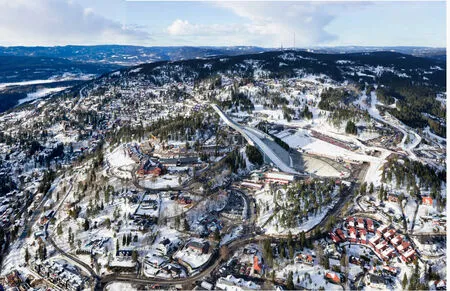
1 鳥瞰/Aerial view
項目信息/Credits and Data
客戶/Client: Oslo Kommune, Idrettsetaten
建筑設計團隊/Architect Team: Julien De Smedt, Morten S. Haave, Kamilla Heskje, Erik Olav Marstein, Torkel Nj?, Kristoffer Harling, Marco Boella, Edna Lueddecke, Michaela Weisskirchner產品及室內設計/Product Design/Interior: Wouter Dons
項目團隊/Project Team: Aleksandra Kiszkielis, Alex Dent, Alf Lassen Nielsen, Andrea Weisser, Andy Vann, Carlos Cabrera, Dries Rodet, Elina Manninen, Eric Gilham, Felix Luong, Filip Lipinsky, Guilherme Cartaxo, Gunnar Hoess, Magdalena Kusowska, Mimmi Wide Gustafson, Ieva Maknickaite, Isabella Eriksson, James McBennett, Johanna Kliment, Josué Gillet, Liz Kelzey, Nicholas Muraglia, Pauline Lavie, Pauline Parcollet, Rasmus Brusgaard Hansen, Robert Huebser, Ruben Rendon, Stefan Bush, Tabea Treier, Tineke Vanduffel, Wolfgang Mitterer, Wouter Dons
競賽團隊/Competition Team: Mikkel H. S?rensen, Babara Costa, Derrick Lai, Victoria Diemer Bennetzen, Mads Knak-Nielsen
結構工程、設備及機電設計/Structural Engineers + Services, M&E: Norconsult
施工技術/Quantity Surveyor: Bygganalyse
景觀設計/Landscape: Grindaker AS
照明顧問/Lighting Consultants: ?F Hansen & Henneberg, Intra立面及鋼結構細部/Facade and Steel Details: Metallplan
拆除工程/Demolition: NKR
地面施工與混凝土/Ground Work and Concrete: Veidekke鋼施工、立面、斜臺、擋風屏/Steelconstructions, Fa?ade, In-Run and Windscreen: Lecor
跳臺技術/Jump Technical: IBM, Ivar Br?ten Mekaniske
場地面積/Site Area: Approx 30,000m2
功能/Program: 滑雪跳臺,大型跳雪山/Ski Jump, Large Jumping hill; K-120, HS 134; 附帶觀賞臺、紀念品店、咖啡廳及博物館的旅游目的地/Tourist destination with viewing plateau, souvenir shop, café and corresponding museum
建筑面積/Gross Floor Area: 室內/Internal: 出發室含設備間/Starthouse with Technical Rooms: 148m3, 國王論壇及精品店/Kings Tribune & Boutique: 261.5m2裁判臺含設備間/Judges Tower with Technical Rooms: 289m2,大廳含設備間/Lobby with Technical Rooms: 438m2, 評論員室/Commentator Boxes: 180m2; 室外/Exterior: 觀景臺/ Observation Deck: 111m2, 公共空間(不含賽場)/Public Space Exluding Arena: ca. 10,000m2
懸挑長度(從混凝土基座計)/Cantilever Length (the Extension from Concrete Base): 69 m
跳臺滑雪跑道/斜臺長度/Skijumper's Running Slope Length/ In-run: 95m
結構最低點到最高點的距離/Structure Lowest to Highest Point: 77.65m
地面從混凝土座到頂部/Ground from Concrete Base to Top: 58m電梯高度、長度、滑行時間/Elevator Height, Length, Maker and Ride Time: 100m in length, 60m high, ca. 2 min觀眾容量/Spectator Capacity: ca. 29,012站席和坐席/sitting and standing
舊跳臺拆除啟動時間/Start Demolition of Old Jump: 2008.10.16現場施工啟動時間/Start Construction on Site: 2009.01.01預算/Budget: Ca. 700 mill. NOK (€ 87,300,000)
攝影/Photos: JDS Architects, Marco Boella (fig. 11)
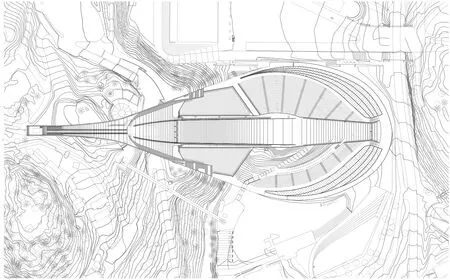
2 總平面/Site plan
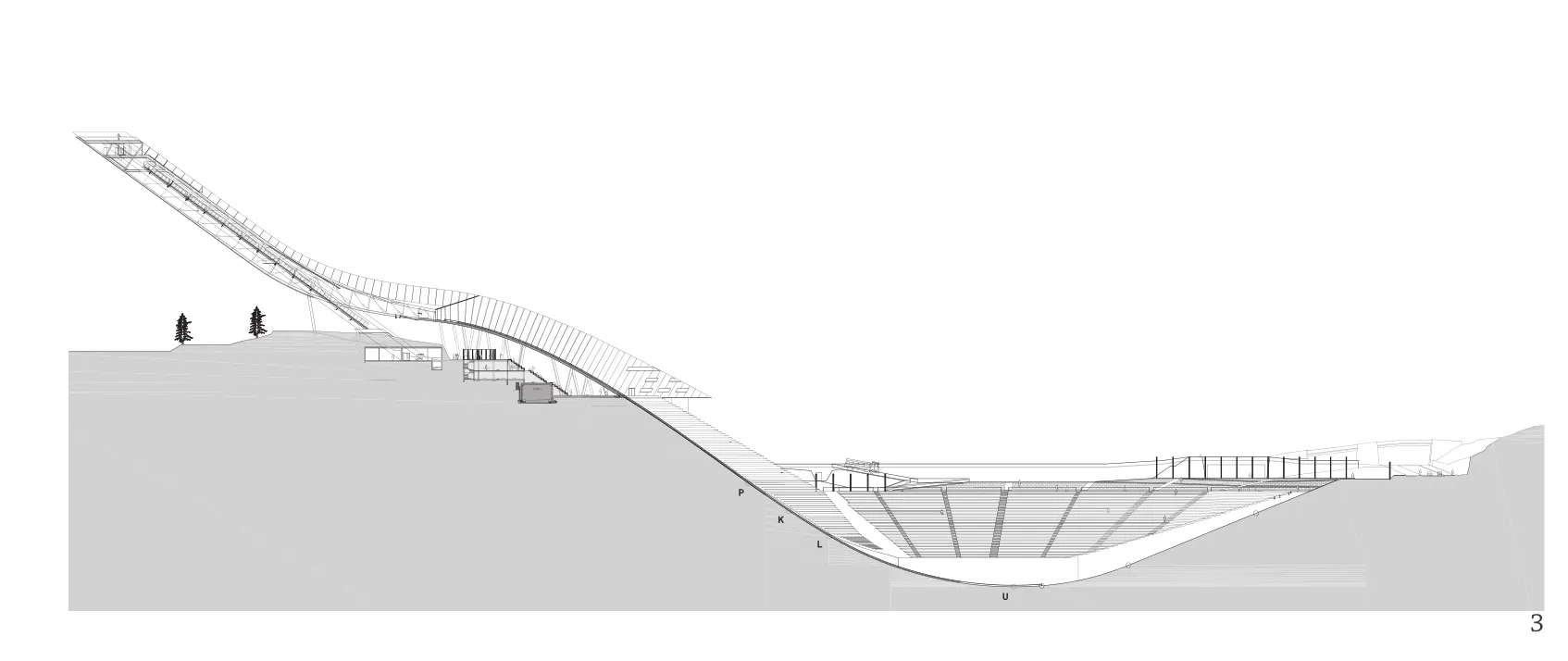
3 長剖面/Long section
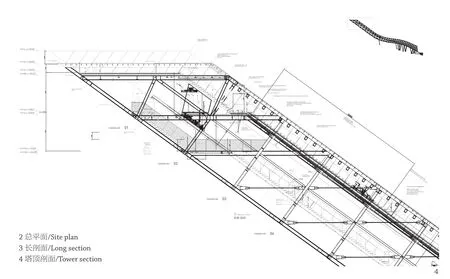
4 塔頂剖面/Tower section
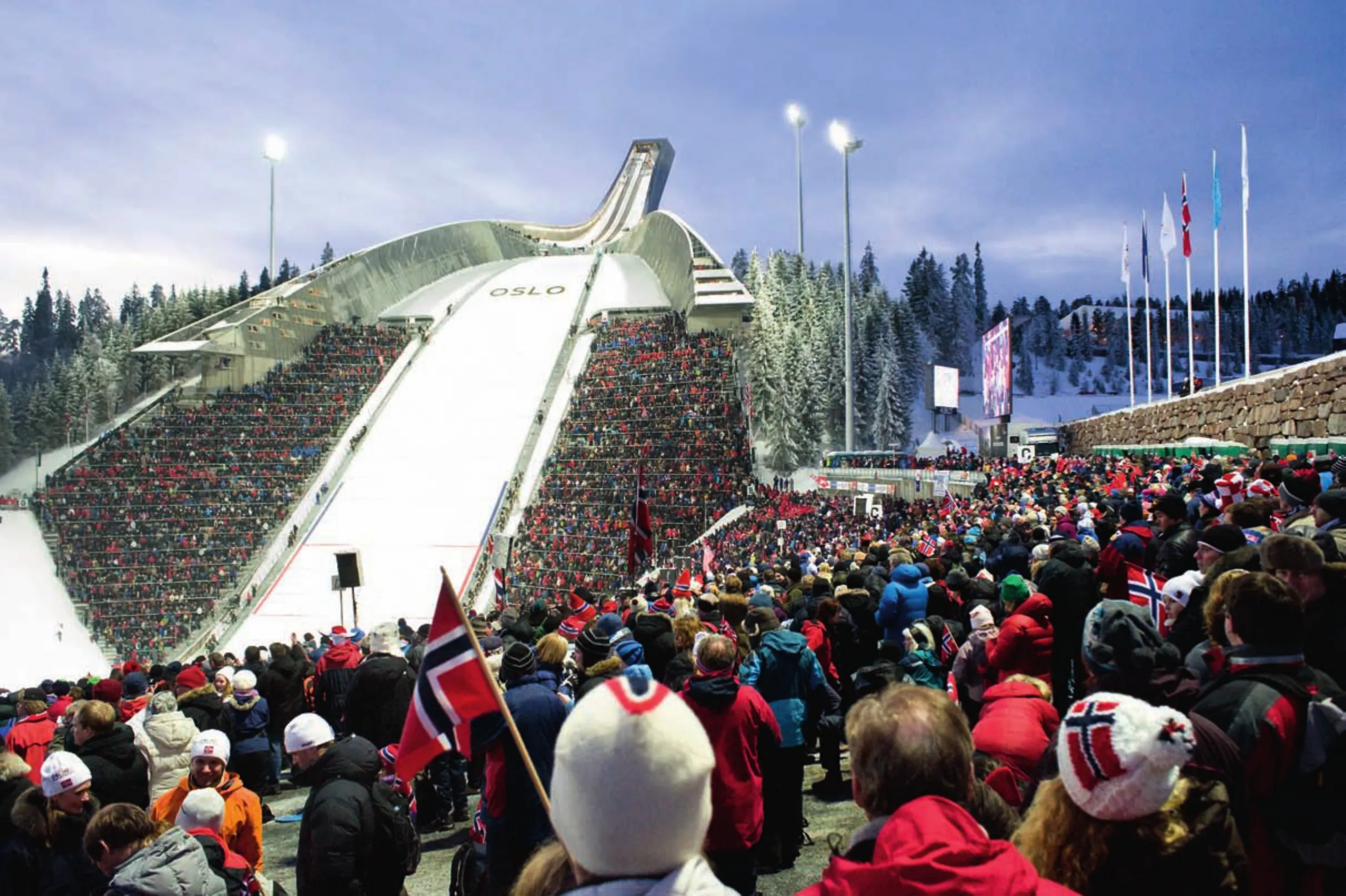
5 看臺視角/View from audience
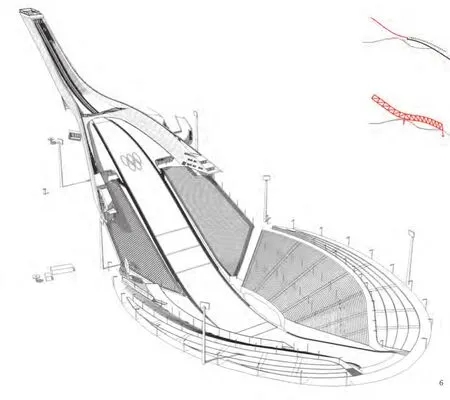
6 三維透視圖解/3D perspective diagram
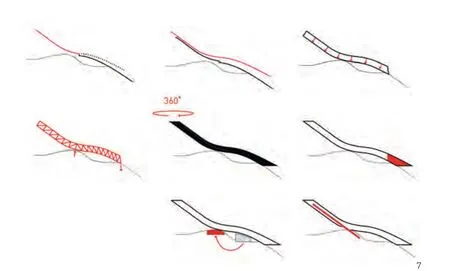
7 圖解/Diagrams
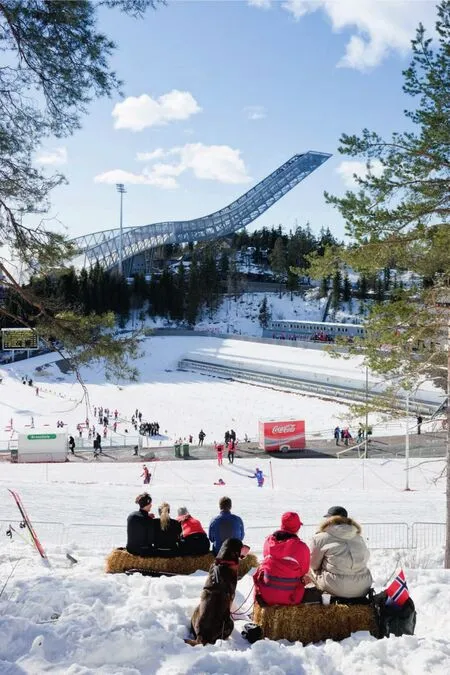
8 塔下視角/View under ski jump
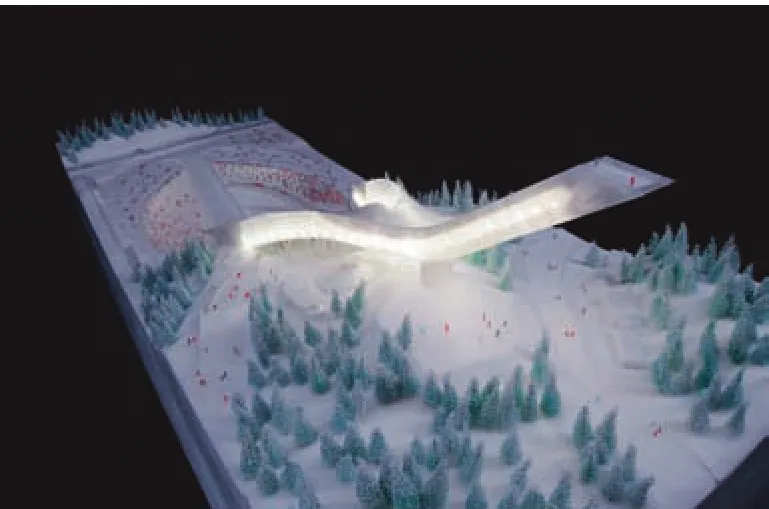
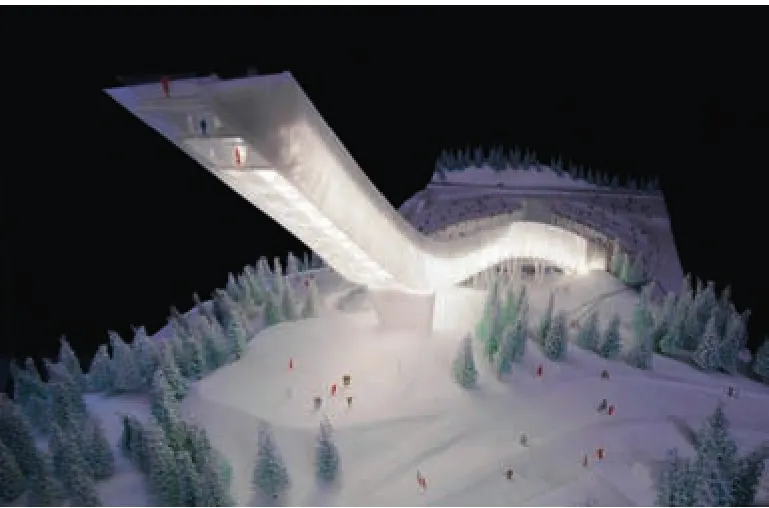
9.10 模型/Models
評論
褚冬竹:該項目呈現出兩個重要的關鍵詞——“專注”與“優雅”。“專注”作為體育賽事的核心精神之一,在建筑中得到了清晰的尊重。除了形態、結構、材料與比賽本身關聯,幾乎沒有任何冗余的添贅;由此出發,結構設計成為這個項目呈現“優雅”、最終能被稱為“作品”的另一層關鍵基礎。輕觸大地的支撐點和桁架傳遞了簡約利落的結構理念。昂首出挑的主體結構同時也構建出獨特體驗的日常公共觀景空間,使這份優雅有了質的內涵。
郭屹民:仿佛是一個嵌入山腰之間的大號湯勺。顯然,相對單純的功能賦予了結構能夠以更加純粹的方式來主宰建筑的造形。從蟄伏于既有地形中的看臺,到蜿蜒向上最終昂首躍出的滑臺,與其說是似乎在試圖掙脫著來自地形的束縛,不如說建筑的形態憑借著結構的理性,在努力地升華著山坡詩意的表情。而在另一方面,跳臺的滑雪道則在功能上強化了剖面上形態生成的依據,從而使建筑成功地實現了在想象與現實之間的呈現。
Comments
CHU Dongzhu: With this project, two words come to mind: concentration and elegance. As one of the core values of sports, "concentration" is clearly respected in this building's architecture. Except in its relation to form, structure, material, and sports per se, the building bears no redundancy. Consequently, structural design becomes another basis for the project to present "elegance", or to achieve a piece of "work". The supporting pier and trusses touch the earth, delivering the concept of a concise and agile structure. In the meantime, the large structure itself contributes unique experiences to the public space, bestowing quality to its elegance.
GUO Yimin: This building resembles a huge spoon, embedded into the hillside. Obviously, given its relatively singular functions, its structure drives the building's form in a decisive manner. From the seating, embedded in the landform, to the winding slipway protruding at its end, it is likely that the architectural form strives to elevate its poetic expressions through structural rationality, rather than trying to break away from the constraints of the landform. On the other hand, the ski ramp on the jumping stand functionally strengthens the profile of the building, successfully presenting an architecture that shifts between imagination and reality.
猜你喜歡
北方建筑(2021年6期)2021-12-31 03:03:54
哲學評論(2021年2期)2021-08-22 01:53:34
文苑(2020年10期)2020-11-07 03:15:36
現代裝飾(2020年6期)2020-06-22 08:43:12
現代裝飾(2020年4期)2020-05-20 08:55:08
中華詩詞(2019年7期)2019-11-25 01:43:04
模具制造(2019年3期)2019-06-06 02:10:54
影視與戲劇評論(2016年0期)2016-11-23 05:26:01
福建農業科技(2016年10期)2016-03-07 09:46:49
少兒科學周刊·兒童版(2015年6期)2015-11-24 03:49:38
