
THE JOKE’S ON ALL OF US
2016-01-10 07:53:16
漢語(yǔ)世界(The World of Chinese) 2016年2期
關(guān)鍵詞:文化

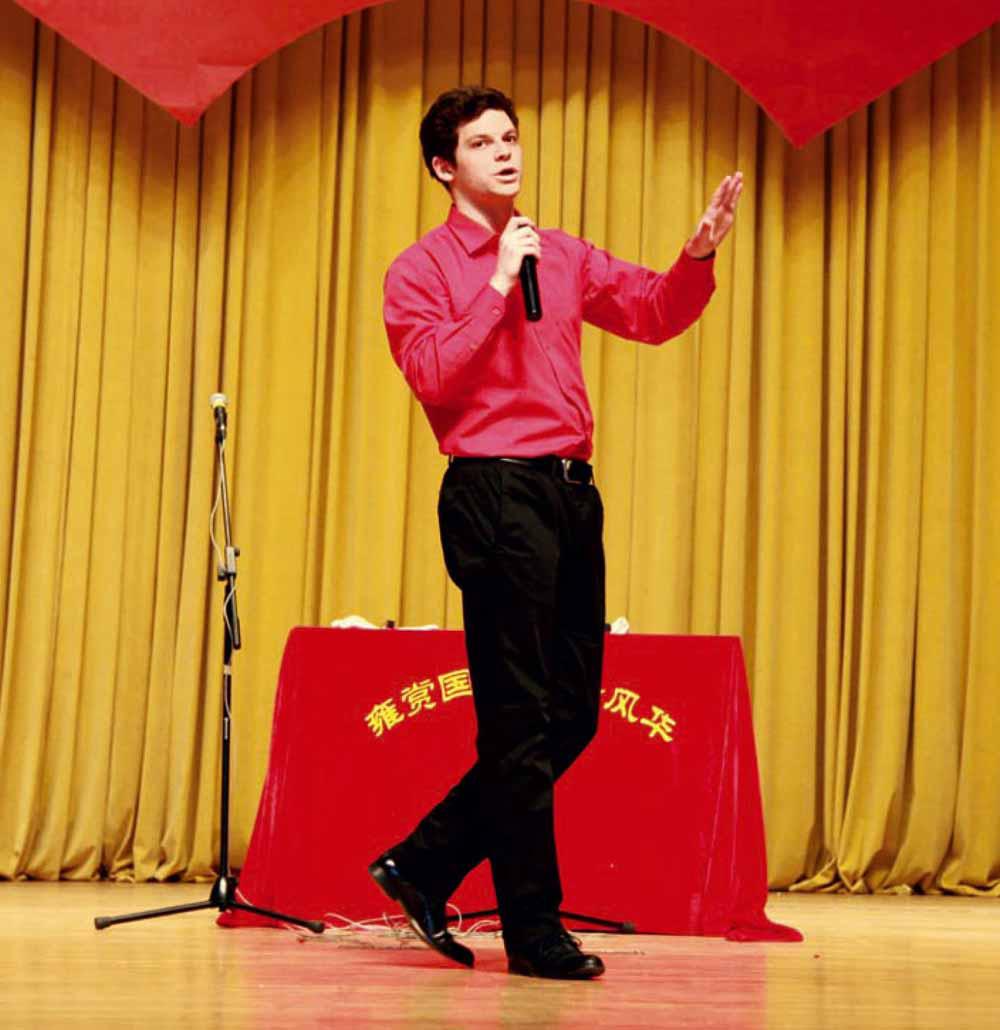
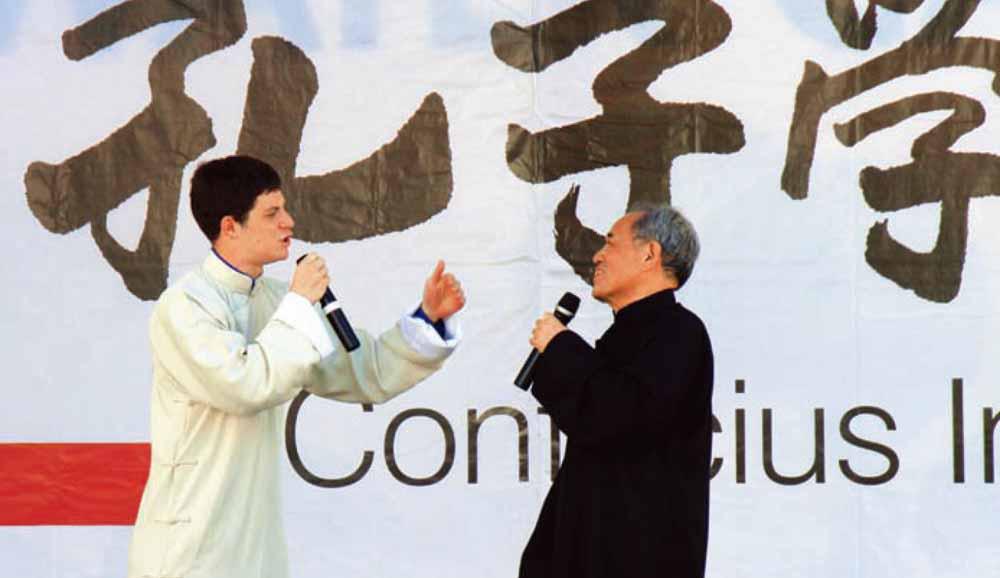
Jesse Appell finds the funny in both East and West
跨越語(yǔ)言和文化的幽默:對(duì)話雙語(yǔ)喜劇演員艾杰西
Despite reams of research projects studying cross-cultural communication between China and the West, the element of humor is often neglected, despite it being one of the most likely areas to draw both sides closer. US comedian Jesse Appell spent a year studying Chinese humor as part of a Fulbright Scholarship, before settling into a career in the Middle Kingdom. This career has seen him perform in stadiums and aboard cruise ships, alternating? between Chinese styles of humor such as xiangsheng (cross-talk) or blends of Western and Eastern comedy, as well as create online web-series such as “The Great LOL of China” and “The Fapiao Rap Song”.
How did you end up studying Chinese humor? What drew you to this scholarship and area of study?
I always did comedy while I was in college. I was in an improv troupe, and I also studied Chinese but that was separately, and when I studied abroad and came to China, I had an interest in Chinese comedy. I was really interested in whether it was similar or different or both at once.
I spent some time with Beijing Improv, a bilingual improv (improvisational comedy) group, I remember one bit about a guanyin—a bodhisattva—who was giving out bad advice. I have done a lot of improv and I had seen this exact same bit before, but with Jesus. Everything came together and while it looked different on the surface, it was funny in the exact same way right down to the use of religion.
That got me interested in doing research into this, and of course, I loved comedy. Going into my senior year, as I put together my application for a Fulbright Scholarship I realized that improv isnt really a particularly Chinese art form and if I wanted to study Chinese comedy I could do improv, but it shouldnt be the only thing I study. I happened to have a professor at Capital Normal University, David Moser, who introduced me to my current xiangsheng master, Ding Laoshi. I spent one year on the Fulbright, but finished that. Now I have been an independent comedian for two years.
Can you explain a bit more about cross-talk for those who might not be familiar with it?
Cross-talk is a special type of Chinese comedy that comes from the late Qing Dynasty (1616 – 1911), its a two-man comedy style—the audience knows that the person to the audiences left is the joker and to the right is the straight man. A lot of the setup is already done for you and you get to play off these jokes. Its a linguistic performance art; there are a lot of puns and language humor, a lot of physical humor. There is a literary element to it, it is accepted that it is not exactly a high art form but it is among the folk arts. Xiangsheng performers need to know a bit of everything to make people laugh. In the North particularly, people really like it. For a Western audience, I guess the most similar style is Abbott and Costellos ‘Whos on first? routine. Vaudeville is an art form very similar in some ways, a two man form performed live that has to work for a lot of audiences. It really comes alive in the performance, which is why I recommend that if people have the chance they should see it live.
Are there any elements of humor that you find dont work in China?
You always want to go right up against the limit of whats appropriate, but what is appropriate is different in different countries. So the really dirty humor that you have in the US would be over the limit here in China, but that is not to say that the Chinese equivalent of “really dirty” doesnt work. But if you translate it directly, people might say, “Thats not really dirty, you could have gone further.” This comes down to political humor as well. What you can do with political humor is restricted because of the political environment but that doesnt mean people dont like to hear political jokes. The line of what you can say is constantly shifting, but people like it when you go right up against that line. Thats also kind of the case in the US; some things are politically off limits. So its about keeping an eye on that line. People also love accent humor here, they work really well, that can be a big part of your routine, some people have built their entire career off being able to do a few accents. When it comes to absurdism, Monty Python kind of stuff doesnt work as well here, there isnt that tradition. Thats not to say you cant be absurd and get jokes off it, but its very difficult to lead with that and make it work. Some directors in Hong Kong have made it work, but its generally an exception to the rule. I think as time passes, and young people are watching things like Big Bang Theory or Two Broke Girls or Game of Thrones, as they grow up and make shows, they will be more in line with a global sense of humor. The audience is extremely well educated here in China, but there are the habits formed from watching a hundred scenes of xiangsheng.
Are there any elements that are more likely to make foreign shows succeed in China?
Obviously physical comedy works everywhere. But I think shows that can connect to life here, whether on purpose or not, have a chance of succeeding. A show like Two Broke Girls, about two girls in the city trying to make it, that fits in with life here. Big Bang Theory, its kind of a joke, but the characters are really nerdy, and that is more relatable; a frat or bro character doesnt have an equivalent. Those nerdy characters are better proxies for life here, Chinese people can say, “Yeah, we take our schooling seriously, we are going for advanced degrees.”
The more I study mass media the more I think it is not as complicated as people think, a lot of it comes down to what people can identify with.
What kind of roles do foreigners play in Chinese comedy?
Comedy is all about connections in peoples heads. You want to surprise them when they connect all the dots. If you have a foreigner with a white face instead of a local, that is going to make people think of different things, and a person from the city is going to think of different things than a person from a rural area. There will always be a lot of connections or associations that will be made with foreigners that cant be made with a local. But pretty much everyone will tell you that theyre tired of foreigners being foreigners for the sake of being foreigners. The fact that state TV is very conservative and worried about Chinese soft power and want these images of foreigners who love China on television has created a bubble market where even though they audience has moved on they are still creating stuff that appears the same as it has been for 25 years. More of my work has been on the internet, outside of TV. The internet is a bit better at this, you can connect more as a person rather than an entertainer with a flag on the desk that represents all the people from your country.
At the same time, there is an interest in the West and people want to understand how China fits into this big world, and how China is viewed by Westerners. What they have currently are these foreigners sitting around a table, and those can be good, but theyre not fundamentally different to what has been done over the last 20 years.
I have been spending some time doing some standup in Chinese, which is a Western-style art form. So no matter what I am doing, I am bringing some of the West to the party. It allows for this really interesting cultural space and people are willing to give me a lot of room to do cultural communication, which I dont really get when I do xiangsheng, which is Chinese environment, Chinese master, Chinese teahouse, Chinese audience, Chinese 100-year history of comedy. With the standup, its Western concept, Western history, Western performer, Western bar or maybe a theater which is at least neutral, but still Chinese audience, Chinese language, Chinese comedy.
What was the process behind your most recent online performance, “The Fapio Rap Song”?
I actually shot that a year ago, but my editor, who did an amazing job, took a long time to edit it. This video is just something I made with my friends after asking how you take a Western comedy style, Saturday Night Live, The Lonely Island type of music video and make it something that works in China—not necessarily for Chinese people in an ethnic sense, but anyone who has had to deal with the corporate hierarchy while working in a Chinese company. I find that the best stuff always comes out in something like two hours. Other stuff I work on for weeks and it just comes out okay, but if it comes out at once it works better.
- David Dawson
猜你喜歡
中國(guó)德育(2022年12期)2022-08-22 06:16:18
湖北教育·綜合資訊(2022年4期)2022-05-06 22:54:06
金橋(2022年2期)2022-03-02 05:42:50
金橋(2022年1期)2022-02-12 01:37:04
英語(yǔ)文摘(2019年1期)2019-03-21 07:44:16
小天使·一年級(jí)語(yǔ)數(shù)英綜合(2018年9期)2018-10-16 06:30:16
西部大開發(fā)(2017年8期)2017-06-26 03:16:12
西部大開發(fā)(2017年8期)2017-06-26 03:15:50
人民中國(guó)(日文版)(2015年10期)2015-04-16 03:53:52
人民中國(guó)(日文版)(2015年9期)2015-03-20 15:08:05
 漢語(yǔ)世界(The World of Chinese)2016年2期
- 漢語(yǔ)世界(The World of Chinese)的其它文章
- 酷漫
- You’ve got questions, she’s got answers
- NERD NEWS
- 紅
- The First RealChina-Watcher
- 炒合菜Stir-fry Spring