Beyond Poverty, Beyond Borders
2017-08-16 05:57:01ByErikNilsson
國際人才交流 2017年8期
By Erik Nilsson
Beyond Poverty, Beyond Borders
By Erik Nilsson
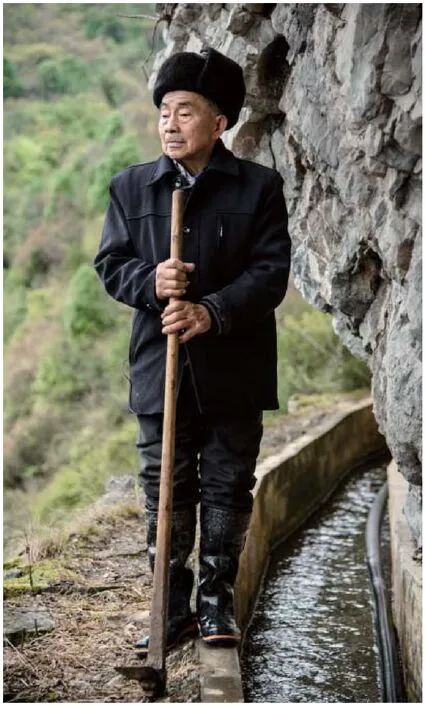
Huang Dafa is hailed as a living personitica of Yu Gong, “the old man who moves mountains”
While Yege’s children are the township’s fi rst generation who can read, they would effectively become illiterate after dusk.
That’s because there was no electricity — and hence, no light —in the seven tents that 78 of the primary school’s 137 nomadic children called their “dorms” in the town in Qumalai county in Qinghai province’s Yushu quake zone.
But that changed in 2011, when a volunteer initiative I founded installed two high-voltage solar panels to enable the children to study after dark.
The electricity transformed education in this Tibetan community of 2,000 nomadic yak herders in Qinghai province’s Yushu prefecture, which is too remote to connect to the fossil-fuel energy grid.
The children cheered when the lights turned on for the fi rst time.
In the past fi ve years, the government has brought electricity in the township to 100 percent. It has also built new dorms for the students and teachers; a new canteen; classrooms; latrines; a clinic; an activity center; computer labs; and much more.
Our volunteer initiative has since expanded from installing solar panels in several schools throughout Qumulai to also purchasing yaks for schools’ pastures after a blizzard killed more than half of their livestock. It has sent metric tons of clothing, shoes, blankets and uniforms; delivered basic medicines; created libraries; purchased coal; and provided other“hardware”.
We’ve also funded surgeries for nomadic students with disabilities and offer full university scholarships for fi nancially underprivileged Tibetan women who, in return, volunteer to teach at Qumalai’s most remote schools.
Our volunteer efforts have increasingly shifted more toward such “software” projects as remarkable government investment has rapidly constructed infrastructure in these isolated communities, where elevations hover around 4,000 meters above sea level.
This is but one of many underdeveloped areas where government measures are swiftly relieving poverty.
I have been grateful for the opportunities to not only contribute my own efforts but also, as a journalist and author, let the world know what China’s government is doing to advance such communities.
A starting point to better tell China’s story is to select and communicate narratives that will be embraced overseas. This is one of many roles international communicators can contribute toward.
Poverty alleviation is a remarkable dimension of Chinese re-ality that’s insuff i ciently understood outside of the country.
This is an amazing feature of the nation’s legacy I have personally witnessed and have worked to make a contribution toward.
Over the past decade, I’ve regularly traveled to remote, underdeveloped communities throughout the country, journeying through nearly every province to not only cover poverty but also its solutions.
China reveals many answers.
This is a nation that has hoisted more people out of poverty faster than any other in history.
China’s astonishing poverty alleviation is an authoritative testament to the eff i cacy of the Chinese model.
Few can disagree with its noble goals and unparalleled success in realizing them.
Yet this message often gets lost in the grander story of the rise of China’s middle class and rapid economic development.
The unprecedented scale, scope and speed of the nation’s poverty alleviation should be a blazing icon of the country, like the Great Wall, when it comes to the question: What is China?
The question then, for journalists, becomes: How do we better tell this story?
This is especially true, as the government works to totally eradicate poverty by 2020.
New media is a vital component to better telling this story to the world. That is, digital communications that are interactive, especially in terms of social media engagement.
About a year ago, China Daily sent six reporters on a journey totaling over 30,000 kilometers to produce a documentary series that shows the world how China is overcoming poverty. The six videos quickly racked up 11 million plays on social media.
This is an example of the power of new media to portray real China to the outside world in a vivid, visual way that puts a human face on the country’s progress.
It was a good start.
The two latest poverty-alleviation videos I hosted racked up roughly 10 million viewers on their own.
This is a leap forward.
It shows what greater engagement of international media experts in all dimensions of China’s new-media production can accomplish in terms of advancing the sector and the country’s storytelling abilities.
That is, for international media professionals to be involved in, not only editing scripts but also hosting, scriptwriting, advising on post-production — that is, every stage of creation.
Yet such recent rapid success merely points to the possibilities of what can be accomplished in this realm.
Continued expansion of government support for media convergence will help the world understand China’s advancements.
That the country has hoisted more people out of poverty faster than any nation in human history is an important yet still largely insufficiently understood dimension of human progress.
It’s a legacy not only of China but also for the world.
That this registers in the international community’s members’ thoughts when conceptualizing China is the good news. The bad news is that it is often at the back of their minds, rather than the front, when they think about: “What is China?”
Poverty-alleviation should be a blazing icon of the country, like the Great Wall, rather than a backburner afterthought to the seemingly basic question: “What is China?”
This is a story China can tell better using new media, especially through greater consultative engagement with international media experts, who not only wish to, but also know how to, help this message better resonate globally.
An analogue is high-speed railway development.
Developing and developed countries both covet such a network.
It also testif i es to the Chinese system’s successes, it literally shows its speed in achievement, getting from starting points to destinations quickly, effectively and eff i ciently.
And, again, new media provides a new avenue to tell this story, one that is unparalleled in terms of eff i cacy.
The roughly 20 major video projects I’ve worked on in three series — dealing with China’s two sessions, the Belt and Road Initiative and poverty alleviation — have racked up about 80 million views in the past four months. Such reach was previously diff i cult to imagine.
The New York Times called one series I cohosted with my daughter about the Belt and Road Initiative Chinese media’s“newest format”.
And such major international media as The Associated Press, Bloomberg and CNN reported on these videos.
A major theme of these reports is that China’s media is becoming more sophisticated.
The world is noticing China’s media innovation.
I’d highlighted this approach in suggestions I gave to government leaders in late February.
It shows China can become an innovative international leader in new media.
And it can help make China’s poverty alleviation — unprecedented in speed and scope in human history — an icon of the country, like the Great Wall or pandas.
While I’ve remained dedicated to the mission of sharing China’s poverty-alleviation legacy with the world — an undertaking that has brought me to remote communities in nearly every corner of the country — now is the time that new tools, namely new media, offer unprecedented opportunities to better tell this story.
The two videos I’ve hosted resonate globally for several reasons, including not only presentation but also content.
That is, namely, the human element that conjures a universal appeal.
The fi rst of the poverty-alleviation videos I hosted, “Searching for the Real Yugong”, is a true tale about overcoming incredible odds — and danger — to improve quality of life.
Huang Dafa is hailed as a living personif i cation of the myth of Yu Gong, “the old man who moves mountains”.
The villagers he led only had hand tools — and explosives.
He’s the stuff of legend — but real.
The saying yu gong yi shan — or “the old man moves mountains” — is a parable of persistence that seems foolhardy in the face of unimaginable odds.
Fable says two peaks separated Yu Gong’s home from the village.
So, he decided to dig them away.
Another elderly man mocked him. Yu Gong responded that while his descendants could dig for generations, the mountains wouldn’t grow any taller.
The gods were so moved by his determination that they moved the mountains for him.
Huang enjoyed no such divine intervention.
He had to rely on pure will.
The 81-year-old spent 36 years persuading and then leading villagers to chisel about 7 kilometers of irrigation channels into the vertical sides of three karst mountains.
Droughts below puckered the soil and left residents with just enough drinking water.
Villagers forging the waterway sometimes had to hike to the top of the ascendable side of the mountains, tie themselves to trees and rappel down sheer —sometimes-concave — cliff faces.
The peaks stood in the way of the water source nearest Caowangba village on the outskirts of Guizhou province’s Zunyi city.
So, like the ancient Yu Gong, Huang grabbed a shovel — and made the impossible possible.
Indeed, this message resonates among all people from all countries.
So, too, does the story of Desheng village, which features in the second poverty-alleviation video I hosted, which quickly racked up about 7 million views and was extensively covered by major Chinese media, such as Xinhua, People’s Daily and CCTV.
Desheng’s villagers are fi nding new prosperity by harvesting light in solar farms and crops grown in greenhouses.
A harsh climate has long made it difficult for residents to plant or herd on its grasslands.
But today, technology and innovation are transforming lives on the outskirts of Hebei province’s Zhangjiakou, where fluctuating temperatures and frequent droughts previously produced poverty.
Technology and innovation are changing lives in Desheng by turning the bad weather that previously challenged their livelihoods into an income source.
Villagers are producing clean energy and natural vegetables for the outside world.
They’re using agricultural technology to harvest prosperity and solar power to generate a brighter future.
This story appeals across borders because it shows the power of innovation to overcome poverty caused by inhospitable climates. It shows China is at the forefront of developing and implementing such creative solutions.
Its reach, again, is the product of not only its content but also its presentation — that is, new media.
While I’ve covered poverty alleviation in such places as Qumalai in writing and photos for a decade, I hope to have the opportunity to someday create new-media products to help the world understand how China’s poverty alleviation initiatives are transforming such communities.
Children in communities like Yege have not only been freed from the hardships of poverty but also stand ready to, someday, make great contributions to the country’s development.
This is a moment in history where the country is better equipped than ever to tackle the last vestiges of poverty —and to share this story with the world in ways that resound in the global public’s consciousness.
I’m grateful for the opportunities to contribute over the past decade and look forward to continuing to do so in the years to come, especially given the innovative tools China now possesses.