
2015-2016金磚國家&新興經濟體大學排名:中國成最熱留學國
2016-05-25 02:56:14編譯Valley設計孫星
留學 2016年2期
編譯_Valley 設計_孫星
2015-2016金磚國家&新興經濟體大學排名:中國成最熱留學國
編譯_Valley設計_孫星
The dominance of China’s universities in the BRICS & Emerging Economies rankings 2016 highlights a wider trend for international students to consider China’s top institutions alongside leading universities elsewhere in the world.
在2016金磚國家&新興經濟體大學排名中,中國的院校占主導地位,這也突出了一個普遍趨勢,即國際生在選擇世界其他頂尖大學時,開始考慮中國的頂級大學。
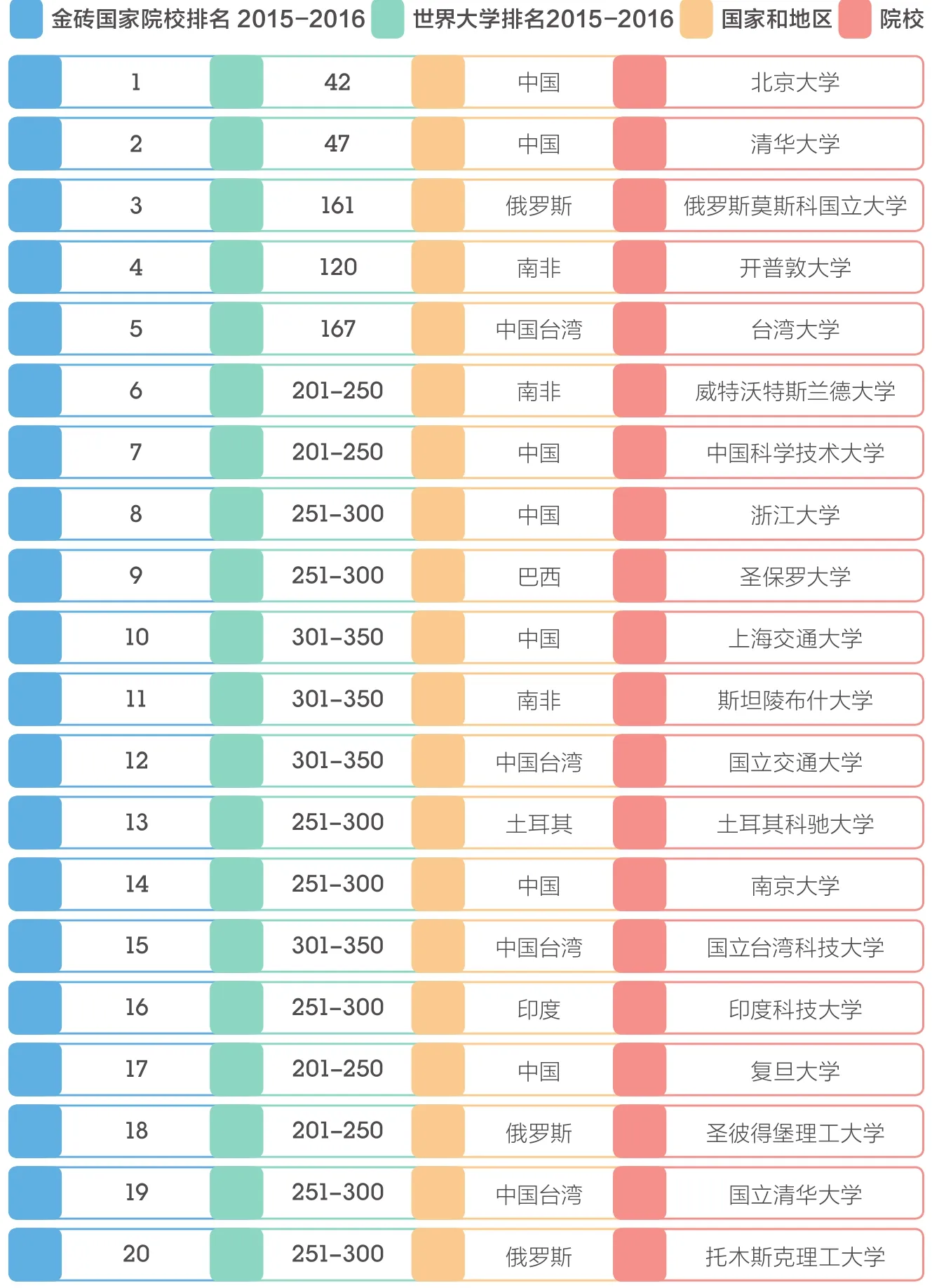
Half the universities in the top 10 are Chinese, with the prestigious Peking University and Tsinghua University taking the first and second place respectively. But 27 Chinese institutions make it into the upper half of the BRICS ranking, which features 200 universities from 35 countries, including Turkey, Czech Republic, Thailand and Chile alongside Brazil, Russia, India, China and South Africa.
此次排名中,前10所大學中有5所中國大學,其中北京大學和清華大學分列一、二位。排名囊括了35個國家的200多所院校,包括巴西、俄羅斯、印度、中國、南非以及土耳其、捷克、泰國和智利,其中27所中國大學排名居前50%。
China hosted the third highest number of international students anywhere in the world last year, behind only the US and the UK, and just ahead of Germany. While 64 per cent of international students in the US study science, technology, engineering or business subjects, 55 per cent of international students in China study a humanities subject. More than 200,000 international students study a humanities subject in China, compared with only 17,500 international students in the US
去年,中國國際生的數量位居世界第三,緊隨美國和英國,德國排名第四位。有64%的國際生在美國學習科學、技術、工程和商科類專業,而55%的國際生在中國則選擇人文專業。在中國學習人文專業的國際生超過200,000人,而美國只有17,500人。
While Asian students have long travelled to the US, UK, Canada and Australia in search of the best education, an increasing number of students from India and Pakistan are opting for higher education opportunities in China, propelling the country into a regional hub for mobile students.
當亞洲學生遠赴美國、英國、加拿大和澳大利亞尋求優質教育的同時,選擇中國的印度和巴基斯坦學生數量卻在不斷增加,中國正逐漸成為一個世界游學的熱門地區。
India has a total of 16 institutions in the BRICS ranking this year. But none of India’s leading universitiesfeatures in the top 10, suggesting that an Indian student seeking a worldclass education in the region is more likely to make the journey to China than stay at home. Since 2010, the number of Indian students in China has increased by 50 per cent, from less than 10,000 students to more than 13,500 students in 2014.
印度今年入選金磚國家大學排行榜的院校有16所,但沒有1所躋身前十,這說明當一個印度學生在金磚五國范圍內尋求世界頂級教育資源時,有很大幾率選擇中國而非印度。從2010年開始,中國的印度學生數量增加了50%,從低于10,000人到2014年突破13,500人。
The number of Pakistani students in China has accelerated over the past years, rising more than 80 per cent since 2010 to reach almost the same number of Indian students.
過去幾年,來中國讀書的巴基斯坦學生劇增,從2010年開始,增幅達80%,幾乎和印度學生持平。
The biggest international community at Chinese universities is still South Korean students, who made up 16.7 per cent of the international students in China in 2014. But their number has fallen every year since 2010 except in 2012, when there was a small increase. The growth of Indonesian students in China has also slowed down over the same period.
不過,在華留學生最大的來源國仍是韓國,占據中國2014年留學生數量的16.7%。但這個數量從2010年開始就一直在減少(2012年有小幅增加),而同期來華的印度尼西亞學生數量增長幅度也逐漸減小。
猜你喜歡
中學生天地(A版)(2022年6期)2022-07-14 12:39:26
中外文摘(2021年23期)2021-12-29 03:54:04
大學(2021年2期)2021-06-11 01:13:12
幼兒100(2021年8期)2021-04-10 05:39:44
海峽姐妹(2020年12期)2021-01-18 05:53:08
民主與法制(2020年16期)2020-08-24 06:54:50
作文世界(小學版)(2018年4期)2018-10-16 17:13:34
快樂作文·低年級(2016年12期)2017-01-03 20:52:44
快樂作文·低年級(2016年6期)2016-06-24 18:58:40
海峽姐妹(2015年5期)2015-02-27 15:11:02
