
Nickel(II)removal from water using silica-based hybrid adsorbents:Fabrication and adsorption kinetics☆
2016-05-26 09:28:15MinXuJunshengLiuKeyanHuCongyongXuYaoyaoFang
Min Xu,Junsheng Liu*,Keyan Hu,Congyong Xu,Yaoyao Fang
Key Laboratory of Membrane Materials and Processes,Department of Chemical and Materials Engineering,Hefei University,99 Jinxiu Avenue,Hefei 230601,China
1.Introduction
With the wide application of Ni-containing products such as Nialloys,Ni-based catalysts,nickel–metal hydride(Ni–MH)batteries and Ni–Cd batteries in industrial processes and in certain portable electronic devices,water pollution caused by the spent Ni-containing products is increased to a new level and attracts Significant public attention[1–3].Generally,Ni-containing wastewater not only pollutes water resources but also damages the humans[4].Consequently,the removal of nickel(II)ions from the spent batteries and industrial effluents is of great importance.
To restrain or remove the pollution from the toxic nickel(II)ions,various innovative methods such as adsorption[3,5,6],electrodeionization(EDI)[4,7,8],chemical precipitation[9],ion exchange[10],solvent extraction[11],membrane separation[12]and biosorption[13],have recently been developed.Among them,adsorption using hybrid materials or the corresponding hybrid membranes as efficient adsorbents was regarded as one of the most effective techniques[5,13-15].Typically,adsorption has advantages over other methods such as lower cost,easier operation and higher efficiency.Thus,it is promising for applications in the treatment of Ni-containing wastewater.Therefore,the removal of nickel(II)ions from water using hybrid adsorbents attracts much interest.
Recently,an attempt was made in our lab to remove heavy-metal ions suchas Cu2+or Pb2+ions from aqueous solutions using hybrid materials or corresponding hybrid membranes as efficient adsorbents[16–19].Our continuing interest in these hybrid adsorbents stimulates us to investigate them further.Therefore,to develop anew type of hybrid adsorbents for nickel(II)removal from water,we propose here a novel route for the preparation of hybrid adsorbents via a sol–gel reaction,in which N-[3-(trimethoxysilyl)propyl]ethylene diamine(TMSPEDA)undergoes a crosslinking reaction with ECH to produce the hybrid materials.Subsequently,their adsorption behavior for nickel(II)ions was examined as a typical model for the removal of toxic heavy-metal ions from aqueous media.
2.Experimental
2.1.Materials
N-[3-(trimethoxysilyl)propyl]ethylene diamine(TMSPEDA,purity≥95.0%)was purchased from Jiangsu Chenguang Coincident Dose Co.,Ltd.(Danyang city,China)and was used without further purification.Epichlorohydrin(ECH,purity≥99.0%)was purchased from Shanghai Chemical Reagent Co.,Ltd.(Shanghai city,China)and used as received.Other reagents were of analytical grade and used as received.
2.2.Sample fabrication
The hybrid adsorbents were fabricated as follows.First,the prescribed amount of ECH was added drop wise into a TMSPEDA solution(20 ml)(the volume ratios of TMSPEDA and ECH in the samples A,B and C were 4:1,4:2 and 4:4,respectively),which was stirred vigorously at room temperature for an additional 4 h to conduct the sol–gel reaction to obtain the hybrid precursor.Next,a homogeneous sol was produced.Subsequently,the previously fabricated hybrid precursor was air-dried at room temperature for an additional 24 h.Third,it was dried at 70°C for an additional 12 h.To remove impurities from the sample,it was rinsed with water three times and dried at 70°C for an additional 12 h.The hybrid adsorbents(labeled as samples A,B and C,respectively)were thus produced.
2.3.Sample characterizations
Fourier transform infrared(FT-IR)spectra of the products were obtained using a Shimadzu FTIR-8400S Fourier transform infrared spectrometer in the region of 4000–400 cm?1.
Thermogravimetric analysis(TGA)thermal analysis of the samples was performed with a TA Q5000IR thermogravimetric analyzer under a nitrogen flow at a heating rate of 10 °C· min?1from room temperature to 800°C.
2.4.Adsorption experiments
Adsorption experiments for the removal of nickel(II)ions were performed in a batch process.Several key factors for the adsorption of nickel(II)ions were investigated,including the content of ECH,contact time and solution temperature.The procedure can be described briefly as follows.Approximately 1.0 g of sample was immersed in a 40 ml 0.025 mol·L?1aqueous Ni(NO3)2solution for seven days;subsequently,it was removed and washed with deionized water.The adsorption capacity of nickel(II)ions(qNi2+)was determined using a flame atomic adsorption spectrometry(PE,900T).The qNi2+value was calculated with Eq.(1):

where Vis the volume of aqueous Ni(NO3)2solution(ml),C0(mol·L?1)and CRare the concentrations of the initial and remaining Ni(NO3)2solution(mol·L?1),respectively,and W is the mass of the examined sample(g).
3.Results and Discussion
3.1.FT-IR spectra
To reveal the occurrence of the crosslinking reaction between the TMSPEDA and ECH in the molecular chains,FTIR spectroscopy was performed,and the related curves are shown in Fig.1.
As shown in Fig.1,curves a to c have similar trends.The large band at approximately 3400 cm?1is in the range of the stretching vibrations due to–NH and –OH groups.The absorption peaks at approximately 2930 cm?1can be ascribed to the C–H stretching and C–H bending vibration of CH3and CH2groups,respectively.The strong peak at approximately 1080cm?1can be ascribed to the overl apping of Si–O–Si,Si–O–C and C–O–C stretching vibrations[20,21].
Due to the existence of silica in the previously prepared samples,they can be considered as hybrid adsorbents.Because these samples contain–NH groups in the molecular chains,they can be used to adsorb nickel(II)from water.

Fig.1.Curves a–c denoted the FTIR spectra of samples A,B and C,respectively.
3.2.TGA analysis
To determine the thermal stability of the previously prepared samples A,B and C,TGA analysis was performed.The related curves are presented in Fig.2.

Fig.2.TGA curves of samples A(a),B(b)and C(c).
As shown in Fig.2,for samples A,B and C,their trends for mass loss(%)are similar,and four degradation steps can be observed.For sample A,the first degradation step was occurred in the range of 27.22 to 181.44°C.The amount of mass loss in this step was 1.666 mg and the percentage of mass loss was 15.140%.In this step,the evaporation of solvents and the degradation of the organic groups were the main influencing factors.The second degradation step was in the range of 181.44 to 418.85°C.The amount of mass loss in this stage was 3.227 mg and the percentage of mass loss was 29.326%.It can be observed that the mass loss had larger alteration,which can be attributed to the further degradation of functionalized groups. The third stage arisen within 418.85 to 568.90°C.The amount of mass loss was 1.593 mg and the percentage of mass loss was 14.477%.It was the formation of the hybrid network between the organic and inorganic moieties.The fourth stage happened in the range of 568.90 to 799.85°C.The amount of mass loss in this stage was 0.601 mg and the percentage of mass loss was 5.462%.It can be found that the mass loss has slight change,which can be ascribed to the further completion of the hybrid network and production of silica.
Furthermore,as shown in Fig.2,the degradation temperatures at mass-loss values of 10%and 50%(Td10and Td50,respectively)indicated different trends.At a mass loss of 10%,the Tdvalue increased from sample A to C markedly,indicating an upward trend with the ECH content in samples A,B and C.In contrast,at a mass loss of 50%,the Tdvalue decreased from sample A to C slowly,which reveals an opposite trend to that for the ECH content in samples A,B and C.This trend suggests that proper addition of ECH into the TMSPEDA can favor the formation of a hybrid network and increase the thermal stability of the hybrid precursor.These findings demonstrate that the thermal stability of hybrid adsorbents can be adjusted via the incorporation of ECH into the TMSPEDA.In addition,Fig.2shows that for samples A and B,the mass loss(%)rapidly increased as it was larger than 83%(the degradation temperature was approximately 245°C at this point).In contrast,for sample C,the mass loss(%)rapidly increased as it was larger than 90%(the degradation temperatures were approximately 208°C),indicating a downward trend with an increasing amount of ECH in these samples.This result suggests that the degradation was accelerated when the temperature was elevated.The degradation of organic components and partial dissociation of functionalized groups can cause this trend.
Based on these findings,it can be reasoned that the thermal stability of the samples can meet the impact of heat on adsorbents in different solution temperature as discussed below.
3.3.Adsorption of the nickel(II)ions
3.3.1.Effect of ECH content on the adsorption capacity
To investigate the effect of the ECH content on the adsorption of nickel(II)ions onto the previously fabricated samples,adsorption experiments of samples A,B and C for nickel(II)ions under a static system were performed,and the data are given in Fig.3.
As shown in Fig.3,the adsorption capacity of nickel(II)ions of samples A,B and C decreased from sample A to C,namely,it decreased with the elevated content of ECH in the TMSPEDA.This finding implies that the ECH has little effect on the adsorption of nickel(II)ions.
Considering sample A reveals the larger adsorption capacity for nickel(II)ions than the others.For the convenience of adsorption analysis,the adsorption behavior for nickel(II)ions onto sample A was therefore chosen as a typical example to examine the adsorption of nickel(II)ions onto the previously-prepared silica-based hybrid adsorbents.The key factors,including the contact time and solution temperature,were investigated to explore the adsorption mechanism of nickel(II)ions onto the hybrid adsorbents.It should be pointed out that the adsorption of nickel(II)ions on the hybrid adsorbent is a slow process,which is clearly different from those of conventional ones.Thus,exploring its adsorption mechanism is Significant importance,which will be done later.
3.3.2.Effect of the contact time on the adsorption capacity of sample A
The adsorption capacity of nickel(II)ions onto sample A versus the contact time t in the time range of 0–8 d was performed and is shown in Fig.4.

Fig.4.Effect of contact time on the adsorption capacity of nickel(II)ions onto sample A.
As shown in Fig.4,the adsorption capacity of nickel(II)ions onto sample A increased with the elapsed contact time and reached equilibrium as the contact time exceeded seven days.This outcome suggests that the adsorption equilibrium time is approximately seven days.It should be emphasized that the equilibrium time of this type of adsorbent was longer than those reported in literatures,however,it provides a new approach to prepare hybrid adsorbent with exceptional performances.
3.3.3.Effect of the solution temperature on the adsorption capacity of sample A
The adsorption capacity of nickel(II)ions onto sample A versus the solution temperature was measured and is illustrated in Fig.5.

Fig.5.Effect of solution temperature on the adsorption capacity of nickel(II)ions onto sample A.The concentration of aqueous Ni(NO3)2solution was 0.025 mol·L?1.
As shown in Fig.5,the adsorption capacity of nickel(II)ions onto sample A decreased with an increase in the solution temperatureThis trend implies that the adsorption process of nickel(II)ions onto sample A is exothermic in nature.
3.4.Adsorption mechanism
It is well accepted that two-parameter theoretical models are very useful tools to predict the adsorption mechanism of metal ions onto a species[22–24].Typical theoretical models mainly include Lagergren pseudo- first-order and pseudo-second-order kinetic models[25–27],the intra-particle diffusion model[28,29],the Elovich equation[30,31]and the diffusion-controlled adsorption mechanism[28].The obtained adsorption data in this case will be modeled using these theoretical models.
3.4.1.Lagergren adsorption kinetics
The Lagergren pseudo- first-order and pseudo-second-order kinetic models can be linearly expressed as Eqs.(2b)and(3b),respectively[25–27]:

where k1and k2are the pseudo- first-order and pseudo-second-order rate constant,respectively;and qtand qeare the adsorption capacity of Ni2+ions at time t and at equilibrium,respectively.
Based on the relationship of the contact time versus the adsorption capacity(see Fig.4),the Lagergren pseudo- first-order and pseudosecond-order kinetic model for the adsorption of nickel(II)ions onto sample A is presented in Fig.6(a)and(b).Meanwhile,on the basis of the intercept and slope of the linear fitting,the Lagergren pseudosecond-order kinetic model parameters could be calculated.These data are summarized in Table 1.

Fig.6.Lagergren kinetic model for the adsorption of nickel(II)ions onto sample A,(a)Pseudo- first order,(b)Pseudo-second order.

Table 1Lagergren pseudo-second order kinetic model parameters of sample A
It can be calculated that the adjusted linear regression coefficientof the Lagergren pseudo- first-order model is approximately 0.865.This result con firms that the experimental data fitted worse with the Lagergren pseudo- first-order model,suggesting that the adsorption of nickel(II)ions onto sample A does not follow the Lagergren pseudo- first-order kinetic model.In contrast,thevalue of the Lagergren pseudo-second-order model fitted better for the adsorption of nickel(II)ions onto sample A
In addition,a comparison of the qevalue obtained via measurement with that obtained by the calculated linear fitting shows that these values are similar(see Table 1).This finding reveals that the Lagergren pseudo-second-order kinetic model can be used to describe the adsorption behavior of nickel(II)ions onto sample A.
3.4.2.Intra-particle diffusion model
The intra-particle diffusion model is usually used to examine the in-terfacial transport performance of metal ions from the solution through the interface between the solution and the adsorbent into the pores of the particles[28,29].To investigate the interfacial transport property of nickel(II)ions from the interior of sample A,the intra-particle diffusion model was used on the basis of the contact ti met versus the adsorption capacity qt,which can be calculated using Eq.(4)[28,29].

where qtis the adsorbed amount(mg·g?1)at time t,kpis the intraparticle diffusion rate constant and xiis the intercept of the straight line,which is related to the boundary-layer thickness.
Generally,if the plot of qtversus t0.5gives a straight line,the adsorption process is solely controlled by intra-particle diffusion.Otherwise,the adsorption process will be influenced by two or more diffusion steps[28,29].The fitted intra-particle diffusion curve for the adsorption of nickel(II)ions onto sample A is presented in Fig.7,and the model parameters are tabulated in Table 2.

Fig.7.Intra-particle diffusion plot of nickel(II)ions onto sample A.

Table 2 Intra-particle diffusion model parameters of sample A
As shown in Fig.7,the fitting of qNi2+versus t0.5reveals a straight line.However,thevalue does not fit well(Furthermore,it can also be found that the intercept of the fitted straight line is larger and does not intersect the origin(see Table 2).This finding demonstrates that the adsorption of nickel(II)ions onto sample A is not solely controlled by the intra-particle diffusion model and that more diffusion processes might be involved.Further investigation is thus required and discussed as follows.
3.4.3.Elovich model
To date,many researchers have reported that the Elovich equation[30,31]can be used to explore the kinetics of liquid-state sorption.This equation can be linearly expressed as Eq.(5):

where a(mg·g?1)and b are the Elovich parameters,which can be obtained from the intercept and slope of the straight line.
The Elovich model for the adsorption of nickel(II) ions onto sample A was applied and is illustrated in Fig. 8. The related model parameters arelisted in Table 3.
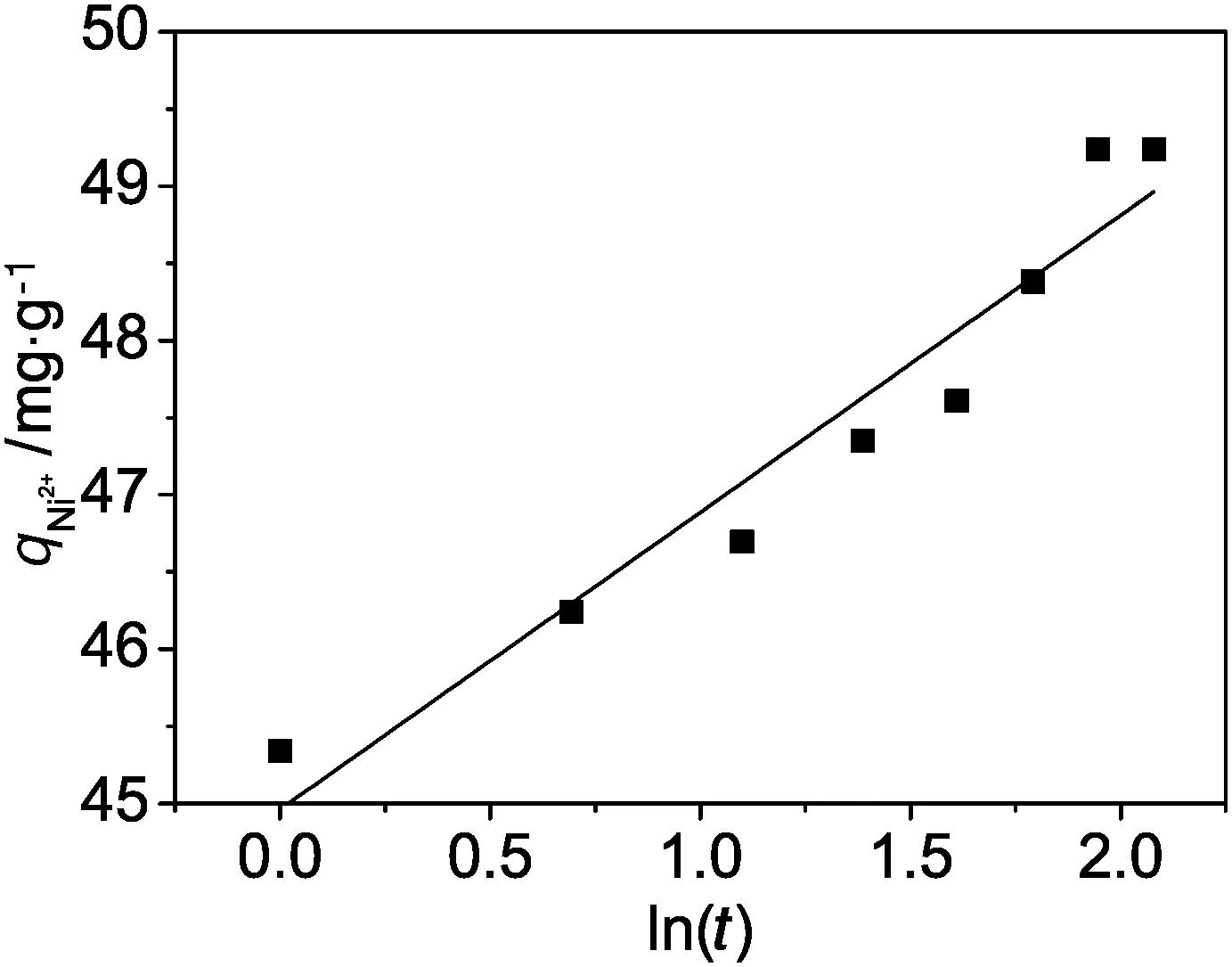
Fig.8.Elovich model for the adsorption of nickel(II)ions onto sample A.
The linear curve does not pass through the origin.Additionally,thevalue does not fit better with the Elovich model(R2adj=0.847).This result suggests that the adsorption of nickel(II)ions onto sample A cannot be described using the Elovich model.This finding indicates that chemical adsorption between the active sites on the surface of sample A and nickel(II)ions is not the key factor.
3.4.4.Diffusion–chemisorption model
It was reported[28]that diffusion–chemisorption model is a useful tool to describe the sorption of heavy metal ions onto heterogeneous media.This model can be linearly expressed as Eq.(6):

where KDCis the diffusion–chemisorption constant.
The diffusion–chemisorption model for the adsorption of nickel(II)ions onto sample A is exhibited in Fig.9.The diffusion–chemisorption kinetic parameters are listed in Table 4.

Fig.9.Diffusion–chemisorption model for the adsorption of nickel(II) ions onto samples A.

Table 4 Diffusion–chemisorption kinetic parameters of sample A
It can be found that the curve fitted well with the diffusion–chemisorption model(R2adj=0.997;see Table 4).This trend demonstrates that the adsorption of nickel(II)ions onto sample A can be described using the diffusion–chemisorption model.On the basis of this outcome,it can be concluded that diffusion–chemisorption is the main controlling step during the adsorption of nickel(II)ions onto sample A.
Comparison of the qe,calvalue obtained by the diffusion–chemisorption model(51.975 mg·g?1)with that obtained via the Lagergren pseudo-second-order kinetic model(50.075 mg·g?1)indicates that these calculated data are very similar,although they are all slightly larger than the qe,expvalue(49.240 mg·g?1).This result reveals that it is more reasonable to use the diffusion–chemisorption model to interpret the adsorption behavior of nickel(II)ions onto sample A.
3.5.Surface appearance
To further prove the existence of nickel(II)ions on the previously prepared hybrid adsorbents, a comparison was performed of the surface appearance of the adsorbed sample and that of the original sample. As a typical example, the surface appearance of the adsorbed sample A and the original one is shown in Fig. 10.
The surface color of the original sample A is yellow(see Fig.10(a)).In contrast,the surface color of the adsorbed sample A changes to dark blue(see Fig.10(b)).This change in the surface color of the adsorbed sample A demonstrates that nickel(II) ions had been adsorbed onto the surface of the sample A.
For comparison,Table 5 lists the maximum adsorption capacity,qeobtained from sample A with those of other adsorbents reported in literature[3,13,15,20].Clearly,the adsorption capacity of nickel(II)ions was satisfactory.On the basis of these data,it can be concluded that these hybrid adsorbents are promising in the treatment of Nicontaining wastewater.
3.6.Desorption experiment

Fig.10.The surface colors of the original sample A(a),and the adsorbed sample A(b),respectively.
Currently,for the removal of heavy metalions,researchers put more emphasis on desorption and reuse of metal ion in industrial processes rather than the simple adsorption and disposal[32].To regenerate and recycle the adsorbent spent,desorption experiment for the reuse of an adsorbent was conducted using sample A as a typical example in the case of regenerated one time.The experimental results are shown in Table 6.
Obviously,for nickel(II)desorption,the percentage of desorption efficiency of sample A using 0.1 mol·L?1aqueous solution at 45 °C for 6 h could reach up to 26%,indicating an effective regeneration cycle although it has lower desorption efficiency at low concentrations ofdesorbents.We believe that the desorption efficiency can be highly increased as the adsorbent is regenerated many times at high concentration of desorbents.

Table 5 A comparison of maximal qeobtained from sample A with those of different types of sorbents reported in references
Notice that this study mainly focuses on the exploration of adsorption mechanism;little work is done on the determination of the composites in the hybrid.However,this does not mean that it is less important.Actually,for their industrial applications,further work is needed to optimize the preparation process of adsorbents and to improve the adsorption capacity of nickel(II)ions.When these issues were done,the composites in the hybrid will be further measured,which will be our future job.

Table 6 Desorption efficiency of sample A for nickel(II)ions in various desorbents
4.Conclusions
A series of silica-based hybrid adsorbents were prepared via a sol–gel process.TGA thermal analysis showed that these hybrid adsorbents had relatively high thermal stability. Adsorption experiments confirmed that nickel(II) ions could be adsorbed onto the surface of sample A. Investigation of the adsorption mechanism demonstrates that the adsorption of nickel(II) ions onto sample A is not controlled by intra-particle diffusion and chemical adsorption. Diffusion–chemisorption is the dominant process controlling the adsorption of nickel(II) ions onto the adsorbents. Desorption experiment reveals that these hybrid adsorbents can be regenerated.
[1]V.Coman,B.Robotin,P.Ilea,Nickel recovery/removal from industrial wastes:A review,Resour.Conserv.Recycl.73(2013)229–238.
[2]M.J.Yang,J.M.Nan,X.L.Hou,W.S.Li,Preparation and electrochemical performances of nickel metal hydride batteries with high specific volume capacity,Chin.J.Chem.Eng.16(2008)944–948.
[3]S.S.Gupta,K.G.Bhattacharyya,Adsorption of Ni(II)on clays,J.Colloid Interface Sci.295(2006)21–32.
[4]G.H.Shang,G.Q.Zhang,C.J.Gao,Treatment of simulated dilute Ni2+-containing wastewater by electrodeionisation with a bipolar membrane:Feasibility and current density distribution,Desalination 353(2014)1–7.
[5]L.R.Rad,A.Momeni,B.F.Ghazani,M.Irani,M.Mahmoudi,B.Noghreh,Removal of Ni2+and Cd2+ions from aqueous solutions using electrospun PVA/zeolite nanofibrous adsorbent,J.Chem.Eng.256(2014)119–127.
[6]J.-W.Wang,Y.-M.Kuo,Preparation and adsorption properties of chitosan–poly(acrylic acid)nanoparticles for the removal of nickel ions,J.Appl.Polym.Sci.107(2008)2333–2342.
[7]Y.Z.Wang,J.Y.Wang,H.X.Lu,S.M.Wang,H.Dong,Concentration and separation of nickel-containing solution by electrodeionization with polarity reversal,CIESC J.61(2010)2688–2693.
[8]H.X.Lu,B.Yan,J.Y.Wang,X.Q.Fu,Recovery of nickel ions from dilute solutions by electrodeionization process,CIESC J.58(2007)1259–1261.
[9]I.Giannopoulou,D.Panias,Copper and nickel recovery from acidic polymetallic aqueous solutions,Miner.Eng.20(2007)753–760.
[10]P.G.Priya,C.A.Basha,V.Ramamurthi,S.N.Begum,Recovery and reuse of Ni(II)from rinse water of electroplating industries,J.Hazard.Mater.163(2009)899–909.
[11]L.Li,H.Zhong,Z.Cao,L.Yuan,Recovery of copper(II)and nickel(II)from plating wastewater by solvent extraction,Chin.J.Chem.Eng.19(6)(2011)926–930.
[12]L.Pei,L.Wang,W.Guo,N.Zhao,Study on a novel disphase supplying supported liquid membrane for transport behavior of divalent nickel ions,Chin.J.Chem.Eng.20(4)(2012)633–640.
[13]M.M.Montazer-Rahmati,P.Rabbani,A.Abdolali,A.R.Keshtkar,Kinetics and equilibrium studies on biosorption of cadmium,lead,and nickel ions from aqueous solutions
by intact and chemically modified brown algae,J.Hazard.Mater.185(2011)401–407.
[14]M.M.Sun,Y.X.Xiao,L.Zhang,X.Gao,W.B.Yan,D.M.Wang,J.X.Su,High uptake of Cu2+,Zn2+or Ni2+on calcined MgAl hydroxides from aqueous solutions:Changing adsorbent structures,J.Chem.Eng.27(2015)17–27.
[15]M.Irani,A.R.Keshtkar,M.A.Mousavian,Removal of Cd(II)and Ni(II)from aqueous solution by PVA/TEOS/TMPTMS hybrid membrane,J.Chem.Eng.175(2011)251–259.
[16]J.S.Liu,Y.Ma,T.W.Xu,G.Q.Shao,Preparation of zwitterionic hybrid polymer and its application for the removal of heavy metal ions from water,J.Hazard.Mater.178(2010)1021–1029.
[17]Y.P.Zhang,X.Wang,J.S.Liu,L.L.Wu,Removal of copper(Cu2+)from water using novel hybrid adsorbents:Kinetics and isotherms,J.Chem.Eng.Data 58(2013)1141–1150.
[18]J.S.Liu,J.Y.Si,Q.Zhang,J.H.Zheng,C.L.Han,G.Q.Shao,Preparation of negatively charged hybrid adsorbents and their applications for Pb2+removal,Ind.Eng.Chem.Res.50(2011)8645–8657.
[19]J.S.Liu,L.L.Wu,X.H.Chen,Kinetic model investigation on lead(II)adsorption using silica-based hybrid membranes,Desalin.Water Treat.54(2015)2307–2313.
[20]V.N.Tirtom,A.Dincer,S.Becerik,T.Aydemir,A.C.C.Bayar,Comparative adsorption of Ni(II)and Cd(II)ions on epichlorohydrin crosslinked chitosan–clay composite beads in aqueous solution,J.Chem.Eng.197(2012)379–386.
[21]R.Laus,T.G.Costa,B.Szpoganicz,V.T.Favere,Adsorption and desorption of Cu(II),Cd(II)and Pb(II)ionsusing chitosan crosslinked with epichlorohydrin–triphosphate as the adsorbent,J.Hazard.Mater.183(2010)233–241.
[22]A.A.Atia,A.M.Donia,A.M.Yousif,Removal of some hazardous heavy metals from aqueous solution using magnetic chelating resin with iminodiacetate functionality,Sep.Purif.Technol.61(2008)348–357.
[23]E.Guibal,C.Milot,J.M.Tobin,Metal–anion sorption by chitosan beats:Equilibrium and kinetic studies,Ind.Eng.Chem.Res.37(1998)1454–1463.
[24]J.Wang,Y.Kuo,Preparation of fructose-mediated(polyethylene glycol/chitosan)membrane and adsorption of heavy metal ions,J.Appl.Polym.Sci.105(2007)1480–1489.
[25]M.A.Ashraf,M.A.Rehman,Y.Alias,I.Yusoff,Removal of Cd(II)onto Raphanussativus peels biomass:Equilibrium,kinetics,and thermodynamics,Desalin.Water Treat.51(2013)4402–4412.
[26]Y.S.Ho,Review of second-order modelsfor adsorption systems,J.Hazard.Mater.136(2006)681–689.
[27]L.He,D.-D.Liu,B.-B.Wang,H.-B.Xu,Adsorption of lead(II)from aqueous solution using a poly(ethyleneimine)-functionalized organic–inorganic hybrid silica prepared by hydrothermal-assisted surface grafting method,Asia Pac.J.Chem.Eng.9(2014)800–809.
[28]D.Mohan,K.P.Singh,Single-and multi-component adsorption of cadmium and zinc using activated carbon derived from bagasse:An agricultural waste,Water Res.36(2002)2304–2318.
[29]Z.-Y.He,H.-L.Nie,C.Branford-White,L.-M.Zhu,Y.-T.Zhou,Y.Zheng,Removal of Cu2+from aqueous solution by adsorption onto a novel activated nylon-based membrane,Bioresour.Technol.99(2008)7954–7958.
[30]A.Z.M.Badruddoza,A.S.H.Tay,P.Y.Tan,K.Hidajat,M.S.Uddin,Carboxymethyl-βcyclodextrin conjugated magnetic nanoparticles as nano-adsorbents for removal of copper ions:Synthesis and adsorption studies,J.Hazard.Mater.185(2011)1177–1186.
[31]Y.Fu,J.Wu,H.Zhou,G.Jin,Removal of nickel(II)from aqueous solutions using iminodiacetic acid functionalized polyglycidyl methacrylate grafted-carbon fibers,Chin.J.Chem.Eng.23(6)(2015)919–923.
[32]A.-H.Chen,C.-Y.Yang,C.-Y.Chen,C.-Y.Chen,C.-W.Chen,The chemically crosslinked metal-complexed chitosans for comparative adsorptions of Cu(II),Zn(II),Ni(II)and Pb(II)ions in aqueous medium,J.Hazard.Mater.163(2009)1068–1075.
 Chinese Journal of Chemical Engineering2016年10期
- Chinese Journal of Chemical Engineering的其它文章
- An investigation on dissolution kinetics of single sodium carbonate particle with image analysis method
- Rapid synthesis of CNTs@MIL-101(Cr)using multi-walled carbon nanotubes(MWCNTs)as crystal growth accelerator☆
- Hydrodynamic cavitation as an efficient method for the formation of sub-100 nm O/W emulsions with high stability
- Isobaric vapor–liquid equilibrium for binary system of aniline+methyl-N-phenyl carbamate☆
- Proposal and evaluation of a new norm index-based QSAR model to predict pEC50and pCC50activities of HEPT derivatives☆
- Correlation of the mean activity coefficient of aqueous electrolyte solutions using an equation of state