
A Highland Home
2016-05-28 13:21:13byZiRan
China Pictorial 2016年4期
by+Zi+Ran
Procapra przewalskii, or Przewalskis gazelle, was so named in 1875 for Russian explorer Nikolai Przhevalsky, who first catalogued the animal discovered on the Ordos Grassland in todays Inner Mongolia Autonomous Region.
Only found in China, the gazelle averages a total body length of 110 centimeters and shoulder height of 50 centimeters. Males can be identified by two curled black horns, about 30 centimeters long. Adult males average 27 kilograms and females 23, each with a short 11-centimeter tail.
As an animal under first-class state protection in China and an ungulate spe- cies in imminent danger globally, the antelope was classified “endangered” in 2008 by the International Union for Conservation of Nature. Once widespread in Gansu Province and the autonomous regions of Inner Mongolia, Ningxia, Xinjiang, and Tibet, its habitat has shrunk to the area immediately around Qinghai Lake some 3,000 meters above sea level.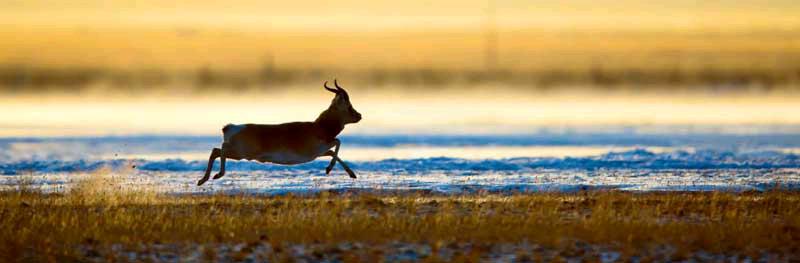
Endangered
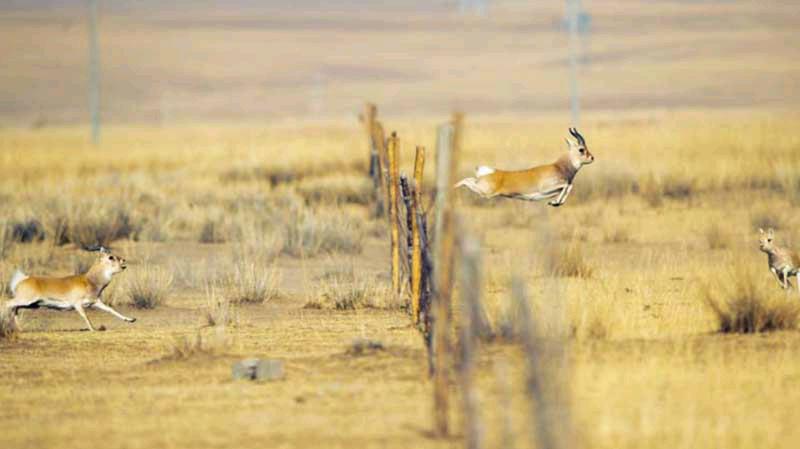
The gazelles habitat was further fragmented by grazing activities around Qinghai Lake after its pastures were contracted to herders, who fenced their shares. Even worse, the construction of highways and development of tourist attractions alienated various groups of the animal, increasing the likelihood of inbreeding and decreasing reproductive and infant survival rates. All of this leads to decimation of Przewalskis gazelle survivability and impending extinction.
“Today, the area around Qinghai Lake is surrounded by barbed wire fences to keep each ranchers sheep or cows from wandering off,” sighed Lu Zhi, a professor of conservation biology at Peking University. “It seems that the grassland has a new dependent. The original tenants, the gazelles, have been marginalized little by little.”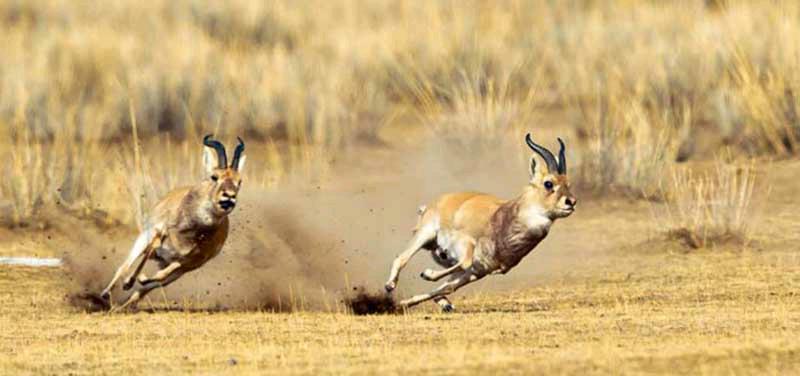
To pinpoint the most destructive factor threatening the existence of Przewalskis gazelles as well as the specific impact of the railing fences, Prof. Lu asked her students to hike 1,000 kilometers around the fences, measuring them, eventually concluding that the height of the nets would indeed be harmful to the gazelles, many of which were found wounded or dead after a failed attempt to get over.
At least a few volunteer herders are contributing to the protection of the gazelles. Nan Jia, a veterinarian, is one of them. He has been patrolling the grassland with friends since 1991. For over two decades, his team has used bicycles to check on the habitats of the animals, rescuing the wounded and sending them back to nature.
“Przewalskis gazelles like to live in an open space with water,” explains Ye Runrong, an associate research fellow at the Northwest Plateau Institute of Biology under the Chinese Academy of Sciences, who joined the investigation team on the population and habitat of animals in Qinghai Province in 2004. “They cant survive in hilly areas. They like to stay in an area with sand dunes or the conjunction of sand and grassland, where they can hide easily. Lakeside in Qinghai is their top choice.”
The investigation reveals that in 2004, there were some 600 Przewalskis gazelles around Qinghai Lake. The number has gone up to more than 1,300 thanks to the unremitting efforts over the last decade.
Protection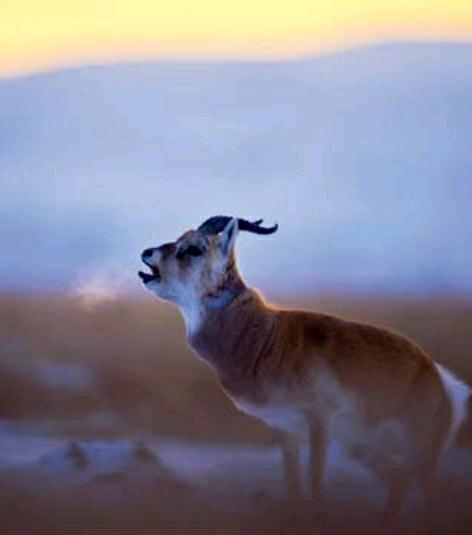
To better protect Przewalskis gazelles, the Forestry Department of Qinghai Province has established ranger stations in some of their habitats. To prevent them from being injured by the fencing, the local government has built “green thoroughfares” for the gazelles. Moreover, a care center has been set up in Qinghai Lake National Nature Reserve, where the wounded can be treated and artificial fertility work can be done to blaze new trails to preserve the species.
The height of fences in the lake area has been lowered to help the gazelles more easily jump them to graze on contracted grassland. In fact, Nan Jians team includes more than 20 herders. From 2012 to 2014, they rented 100 hectares of pastures to support 100 Przewalskis gazelles.
In recent years, Nature University, a non-governmental organization for environmental protection, has been working on the establishment of the Non-Governmental Przewalskis Gazelles Nature Reserve, with support from philanthropic sources, in hopes of renting a larger habitat for the gazelles and encouraging local ranchers to tear down their fences to preserve the natural living environment, exploring new approaches to species conservation.
The China Biodiversity Conservation and Green Development Foundation has gained extensive experience protecting endangered species after it successfully relocated Davids deer. As for Przewalskis gazelles, specialists suggest a similar model that affords the gazelles an ideal permanent home. A lot more space than the relatively cramped lake area could possibly be provided.
“As a large, stunning mammal, Przewalskis gazelle has preserved a special gene pool of evolutionary history,” explains Ye.“It will be an irreparable loss for earths natural ecology if they die out.”
