泰國(guó)東北部猜也奔府Noen Sa-nga地區(qū)Yasothon土壤剖面中的澳大拉西亞玻隕石
2012-09-20 00:46:44WICKANETSONGTHAM,JAROONDUANGKRAYOM,PRATUENGJINTASAKUL
地球?qū)W報(bào) 2012年1期
關(guān)鍵詞:關(guān)鍵
泰國(guó)東北部猜也奔府Noen Sa-nga地區(qū)Yasothon土壤剖面中的澳大拉西亞玻隕石
* Corresponding author. E-mail: wic.wickanet@gmail.com.
0 Introduction
The tektites are widely accepted as glasses formed by melting of terrestrial continental crust during meteoritic or cometary impacts (Blum et al., 1992).They were reported as the Australasian tektites in four forms, Muong Nong-type, intermediate type,splash-form type, and microtektites. The Australasian tektite strewn field covers an immense area extending from southern China to Indochina, the Philippines,Malaysia, Indonesia, and Australia. Microtektites belonging to this strewn field have been found throughout much of the Indian Ocean, the western equatorial Pacific Ocean, and the South China, Philippines, Celebes, and Sulu seas (Glass and Fries, 2008). Radiometric dating indicates that these tektites were derived from a single impact event which is inferred to be within an area of Indochina at about 0.7-0.8 Ma ago(Stauffer, 1978; Ford, 1988; Blum et al., 1992;Schnetzler, 1992; Izett and Obradovich, 1992; Koeberl,1994; Kunz et al., 1995; Hou et al., 2000; Ma et al.,2004). The impact craters have been proposed by many investigators but most of them suggested the source craters are confined within the areas of Indochina (Cohen, 1962; Hartung and Rivolo, 1979; Ford,1988; Hartung, 1990; Wasson, 1991; Barnes, 1964,1989). Many possible impact sites have been proposed but the precise impact crater is still unknown while Stauffer (1978) and Barnes (1989) suggested that it was hidden under the alluvium of the Mekong River delta. Many large shallow depressions have been reported as the source craters (Ford, 1988; Hartung,1990; Bunopas et al., 1999; Songtham et al., 2011) but no detail investigations have been made. Whereas Schnetzler (1992) suggested that the source is in a limit area near the southern part of the Thailand-Laos border on the basis of the distribution of both Muong Nong and splash-form tektites.
This immense tektite strewn field confirms a large impact or multiple impacts that should generated vast volume of tektites and other sedimentary deposits.We recognize a peculiar sedimentary formation in northeastern Thailand that its sedimentary structures are unexplainable in term of colluvial, fluvial, lacustrine, aeolian, and glacial deposits. It was described as the Yasothon soil series by Moormann et al. (1964)characterized by bright reddish-brown loamy sand,low organic matter and plant nutrients, and very acidic in reaction. The soil series is widely distributed throughout the Khorat basin and might be further extended into Laos, Cambodia, and nearby countries with thickness about 1-5 meters but as thick as 15 meters in Kalasin. It is well exposed at high elevation overlying the abandoned river gravel deposits along the north of Chi River and along the south of Mun River as well as in low lying areas where it has been disturbed by active erosion and deposition (Satarugsa, 1987). The soil series has somewhat unique characters with bright reddish brown in color but might be varied into brownish yellow in some places. Its texture is quite homogenous with sand in major and silt and clay in minor. Structureless is almost presented throughout the soil series in both lateral and vertical directions. Formerly, the soil series was described as an aeolian deposit (Boonsener, 1977) and later it was suggested as the result of deposition in a widespread Late Pleistocene Khorat lake (Dheeradilok and Chaimanee, 1986). However, L?ffler and Kubiniok (1991)argued that the Yasothon soil series lacks laminations or other features to indicate lacustrine or aeolian conditions meant that the Yasothon soil series could neither be fluvial nor aeolian.
The tektites were generally found scattering on gravel ground surface with uncertain sources in many areas from Phetchabun, Chaiyaphum, Khon Kaen,Nakhon Ratchasima, Kalasin, Yasothon, Mukdahan,Buri Ram, Surin, Si Sa Ket, and Ubon Ratchathani.There are two reports suggested that they were from the topmost of pisolitic laterite underlying the reddish brown Yasothon soil series (Satarugsa, 1987; L?ffler and Kubiniok, 1991). Recently we found another piece of tektite occurring on the top of a ferricrete layer (pisolitic laterite) covered with the Yasothon soil series in Noen Sa-nga, Chaiyaphum, on the west of Khorat basin. The Yasothon soil series where the piece of tektite occurred at the base demonstrates that the sedimentary features differ from other observed areas with significant values. This paper is written to describe the Yasothon soil series and the associated tektite to confirm the nature and provenance of the soil series recently proposed by Songtham et al. (2011).
1 Physiographical and Geological settings
The study area is in the western part of the Khorat basin in northeastern Thailand (Figure 1). It is about 2-3 kilometers north of Ban Ba Sio, Nong Chim sub-district, Noen Sa-nga district, Chaiyaphum province. It is around 101°58’00” E, 15° 36’ 30” N. The area is characterized by flat to slightly undulating terrain ranging in elevation from 210 to 245 meters above mean sea level with dry deciduous forests in general but they have been mostly deforested for plantations such as sugar canes and tapioca. Some areas have been used as soil quarries producing construction materials covering an area about 4-5 square kilometers. The soil quarries provided good locations for investigating about the soil profiles.
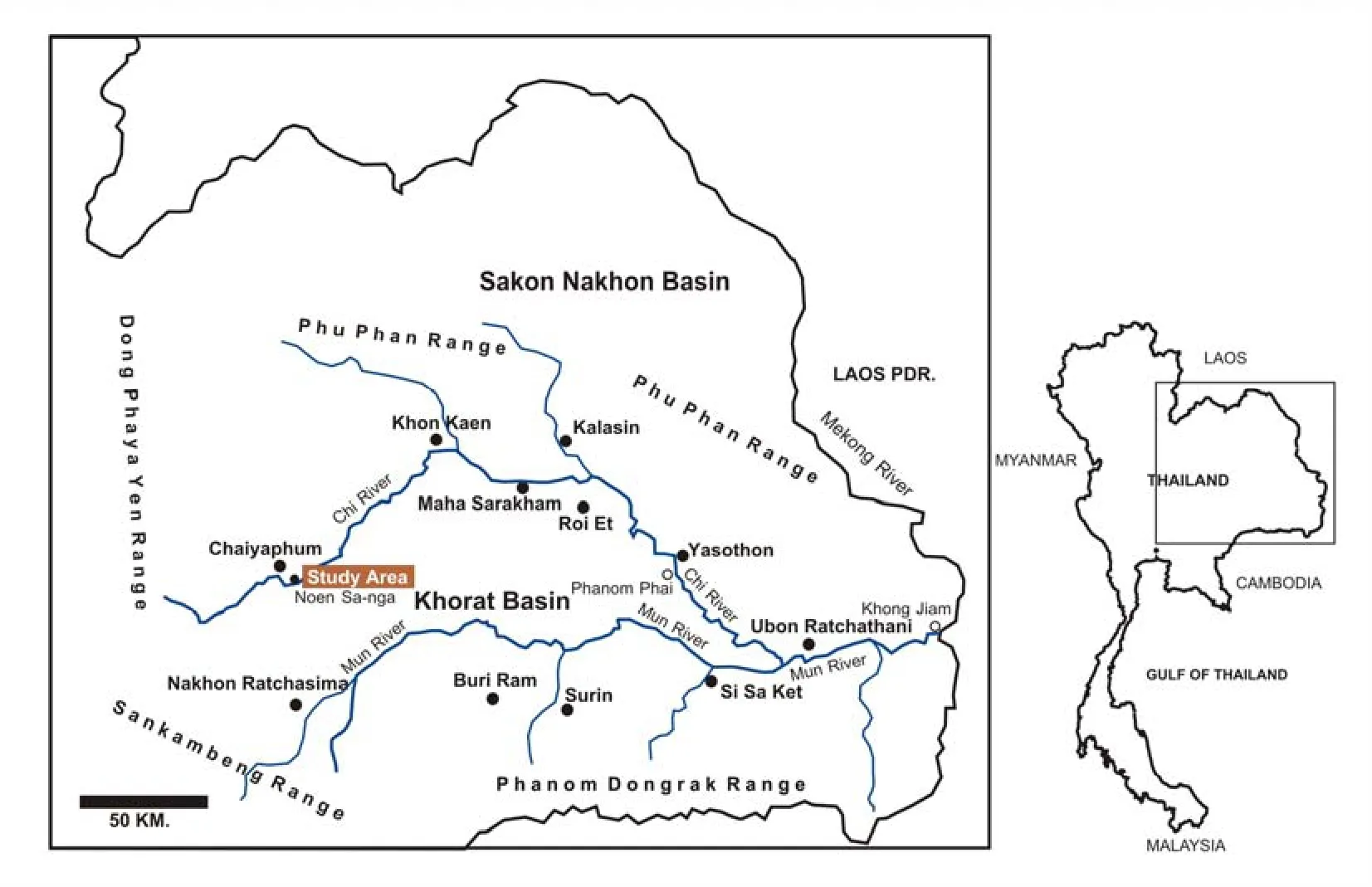
Fig. 1 Map of northeastern Thailand showing the major city locations, Chi and Mun rivers and their tributaries,and study area
Northeastern Thailand is characterized by a plateau, the Khorat Plateau, with elevation above mean sea level about 150-250 meters. The region is bounded by high reliefs and mountain ranges along the plateau margin with the Phu Phan ranges dividing the plateau area into two basins, Sakon Nakhon basin in the north and Khorat basin in the south. The Khorat basin covers an area about 33,000 square kilometers where it is situated by 12 provinces including Chaiyaphum, Nakhon Ratchasima, Khon Kaen, Kalasin, Maha Sarakham,Roi Et, Buri Ram, Yasothon, Amnat Charoen, Surin, Si Sa Ket, and Ubon Ratchathani. There are two main rivers in the basin, Chi River in the north and Mun River in the south flowing eastwards to join at Ban Khon Mai in Ubon Ratchathani and flowing further eastwards joining the Mekong River in Khong Jium(Figure 1).
The two main rivers have their own long histories developed by the Quaternary tectonic events. During this tectonism the terrain has been gradually uplifted forming the plateau, mountain ranges, and river basins.During the basin development the Chi and Mun rivers have been gradually shifted towards the center of the basin leaving traces of abandoned river sediments particularly the gravel deposits in parallel to the two main rivers. The gravel sizes decreased remarkably from the west to the east and are regarded as indicating fluvial transport in an easterly direction. These gravel deposits are overlain by the Yasothon soil series with a sharp contact boundary. Pieces and trunks of petrified wood are common to abundant in some places in the gravel deposits such as from Sawathee and Mancha Khiri in Khon Kaen and Ban Krok Duean Ha in Nakhon Ratchasima and others.
Tektites were also common in some places as floated specimens scattered on the ground surface particularly the abandoned river gravel from uncertain sources but Satarugsa (1987) and L?ffler and Kubiniok(1991) reported the tektites as occurring on the top of pisolitic laterite underlying the reddish brown Yasothon soil series. Abundant and diversified taxa of fossils are reported from sand deposits along the Mun and Lam Chiang Krai river banks such as 8 genera of proboscideans, orangutan relative, fruits and seeds,and diversified species of reptiles (Chaimanee et al.,2004; Saegusa et al., 2005; Grote, 2007; Claude et al.,2011; Thasod et al., 2012). These sedimentary deposits and fossils mentioned above are supported by the Mesozoic sandstone formations of the Khorat Group.
2 Results
The Yasothon soil series and a piece of tektite are described. The soil series was clearly observed from many soil quarries in the study area where two sedimentary units were recognizable. The underlying sedimentary unit is the abandon river gravel deposit with sporadic occurrence of small fragments of petrified wood. The gravel bed reveals some sedimentary structures indicating some directions of river flow such as cross beddings and gravel imbrications. Thin ferricrete band at the uppermost part of the gravel bed is common throughout the study area. The gravel bed is overlain by a fine sand unit with peculiar sedimentary features, the Yasothon soil series. It is characterized by a bright reddish brown in color with about 1-2 meters in thickness that is easy to recognize from distance. It is generally homogenous or structureless in sedimentary features with poorly sorting but however the bottom part of the soil series shows a grain size variation in vertical direction from fine pebble to granule at the bottommost part and gradually fining upward into fine sand in the range of about 30 cm thick (Figure 2). These sedimentary features are extensively uniformed throughout the study area.
A small piece of black glassy tektite was recovered from the contact boundary between the ferricrete layer and the Yasothon soil series (Figure 3). The piece of tektite is an irregular shape with a smooth concave surface regarding as an external mold of a piece of well-rounded egg-shaped pebble approximately 4x3 cm in size that was already detached from the piece of tektite. The tektite was at the topmost of the ferricrete layer where the upper part of the gravel bed was coated by the matrix of iron oxide. The opposite side to the smooth concave surface is a rough convex surface closely resembled the surface of a kaffir lime recognizable as a characteristic of general tektite.When the pebble grain was detached from the tektite it left an external mold as a smooth concave surface. The tektite is about 4.3x2 cm in size, 8.75 grams by weigh,with thickness varying from 8 mm to as thin as yellowish brown translucent film.
3 Discussions and conclusions
The provenance of any sedimentary deposits is generally explainable as caused by one of the three factors, water, wind, or glacier. Each factor produces its own sedimentary styles as its unique characteristics.Water, wind, and glacier can produce sediments by weathering and erosion then transport and deposit with different features of lithology, fossil contents, stratigraphy, geometric body, and sedimentary structures depending upon sourced materials and degree of weathering and erosion, transportation, depositional locations and environments, and others. However, the structureless sedimentary features with fining upward sedimentary structure at the basal portion of the Yasothon soil series seem to be unexplainable by the three factors. Even though it used to be described as wind-blown sediment by Boonsener (1977) and lake sediment by Dheeradilok and Chaimanee (1986) but its structureless feature is still questionable.
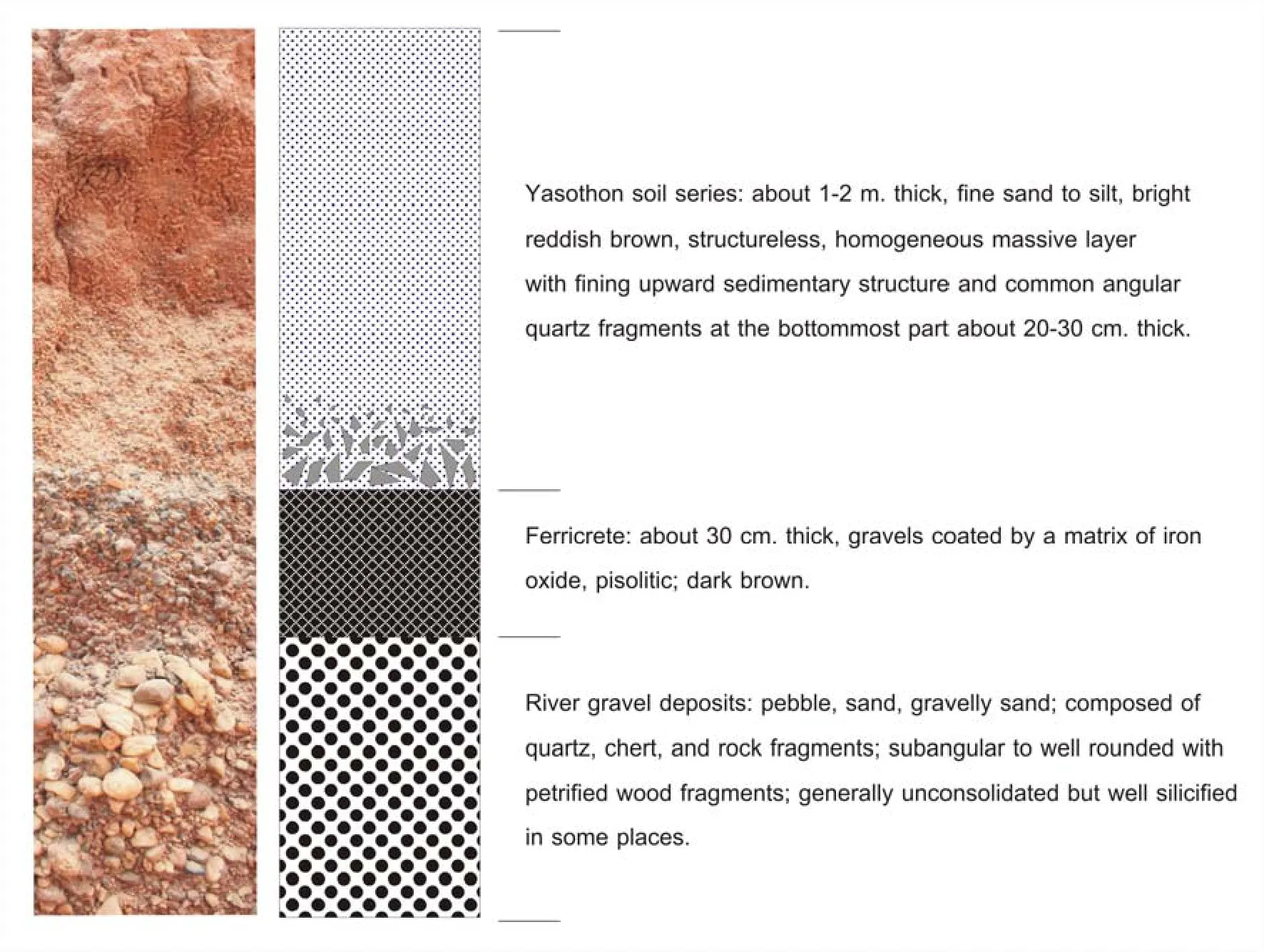
Fig. 2 General sedimentary profile described from soil quarries in Noen Sa-nga district, Chaiyaphum Province showing a sedimentary succession from gravel bed, ferricrete, and Yasothon soil series
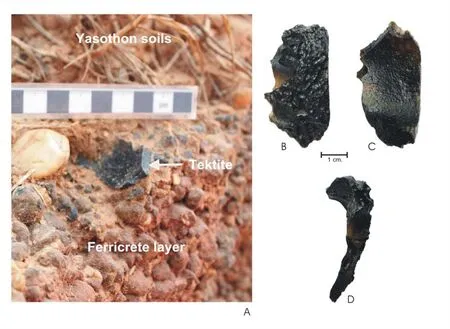
Fig. 3 Occurrence and morphology of a tektite A-a piece of tektite at the contact boundary between the gravel bed (ferricretized) and Yasothon soil series; B-D-a piece of tektite in different views; B-showing a rough convex surface; C-showing a smooth concave surface; D-side view showing concave curvature side as a contacted surface with a well-rounded pebble
The structureless with fining upward sedimentary structure at the base of the soil series clearly suggeststhat the sediment had been mostly accumulated in vertical direction by gravity within a single event without any breaks and interruptions. The coarsest sediments and rock fragments were the heaviest sedimentary debris that must be reached the ground surface in earliest time of the accumulation and followed by the finer sediments. This process formed the fining upward sedimentary structure at the lower part of the soil series and fine sand deposit without any sedimentary structures onward. Wide distribution of the soil series with these sedimentary features is unexplainable in term of its depositional environment such as colluvial, alluvial fan, alluvial, lake, marine, wind-blown,and glacial deposits and others related to the wind,water, and glacier.
The environment that controlled the sedimentation should be under the role of gravity without any lateral sedimentary transportation that is why the soil series has no any cross beddings or such sedimentary structures generated by wind or water currents. Additionally, the vertical sedimentary profile also has no any traces of sedimentary structures that showing cycles of sedimentation like the laminations. The provenance of this soil series is thus needed to find out additional evidences to support such the environments mentioned above.
Fortunately, we found a piece of tektite at the contact boundary between the gravel bed and the Yasothon soil series. The occurrence of the tektite described above leads us to connecting with a meteoritic impact event that scientists have been accepted worldwide as mentioned earlier of this article. Even though the source crater or craters are still unknown but the presence of the Australasian tektite strewn field in the region suggests that it was generated by a meteoritic impact event at about 0.7-0.8 Ma ago. The meteoritic impact catapulted numerous melted silica ejecta and a vast volume of dust into the sky all over the region within a period of time. The melted silica ejecta had been solidified forming numerous splash-form tektites while they were in the high sky.They became to fall down to the ground surface as an immense tektite strewn field followed by a sedimentary deposit of the Yasothon soil series.
During the splash-form tektites falling down to the ground surface some of them had remelted into a plastic form prior to reach the ground surface. The mechanism of remelted tektites was also mentioned by Barnes and Pitakpaivan (1962) by observation the bubble shapes indicates that many splash-form tektites had fallen back to the earth while they were still plastic. The vast volume of dust was a mix of various-sized particles ranging in size from fine pebbles to granules, sand, silt, and clay. The mix of particles suspended in the air had gradually settled down to the ground surface producing grain-sized variation in form of the fining upward sedimentary structure. Finally,the particles left above the sky had settled down forming the structureless portion of the Yasothon soil series.
利用夾逼定理(設(shè) ,若當(dāng) n>M 時(shí),恒有 an≤cn≤bn,則)求極限的關(guān)鍵是將數(shù)列cn作適當(dāng)?shù)目s小和放大來(lái)得到數(shù)列an 與bn,即an≤cn≤bn,且an 與bn有相同的極限值。
Therefore, the age of the Yasothon soil series must be the same as the age of the tektites, about 0.7-0.8 Ma old, that is relatively younger than the underlying gravel deposits. According to the presence of basalt pebbles in an abandoned river gravel deposit in Surin (Raksaskulwong and Sianghen, 2008), the age of the gravel deposit must be accordingly younger than the age of the basalt as dated from a Khao Kradong basalt flow in Buri Ram, 0.92 ± 0.03 Ma. (Barr and Macdonald, 1981), and must be continuously younger and younger towards the modern sedimentary deposits of the Mun River.
Conclusively, we are quite confident to say that the Yasothon soil series is the soil formation that was originated far from the well known processes related to the water, wind, and glacier. The soil series must be originated by the accumulation of sediments suspended in the atmosphere prior to falling down to the ground surface by the gravity. The sediments could go up to the high sky by an impact of a large object from space to the earth surface that catapulted vast volume of dust with melted silica ejecta into the sky. This large object is believed to be a meteorite or comet nucleus as the evidence of tektite occurring at the boundary between the gravel bed and the Yasothon soil series.The time that the event occurred is about 0.77 Ma ago determined by the tektite radiometric age dating(McCall, 2001).
AMARE K, KOEBERL C. 2006. Variation of chemical composition in Australasian tektites from different localities in Vietnam.Meteoritics & Planetary Science, 41(1), 107-123.
BARNES V E, PITAKPAIVAN K. 1962. Origin of Indochinite tektites. Proceedings of the National Academy of Sciences, the USA 48, 947-955.
BARR S M, MACDONALD A S. 1981. Geochemistry and geochronology of Late Cenozoic basalts of Southeast Asia.Geological Society of America Bulletin, 92, 508-512,1069-1142.
BLUM J D, PAPANASTASSIOU D A, KOEBERL C,WASSERBURG G J. 1992. Neodynium and strontium isotopic study of Australasian tektites: new constraints on the provenance and age of target materials. Geochemica et Cosmochemica Acta, 56: 483-492.
BUNOPAS S, WASSON J T, VELLA P, FONTAINE H. 1999.Catastrophic loess, mass mortality and forest fire suggest that a Pleistocene cometary impact in Thailand caused the Australasian tektite field. Journal of the Geological Society of Thailand, 1: 1-17.
CHAIMANEE Y, SUTEETHORN V, JINTASAKUL P,VIDTHAYANON C, MARANDAT B, JAEGER J J. 2004. A new orang-utan relative from the Late Miocene of Thailand.Nature, 42: 439-441.
CLAUDE J, NAKSRI W, BOONCHAI N, BUFFETAUT E,DUANGKRAYOM J, LAOJUMPON C, JINTASAKUL P,LAUPRASERT K, MARTIN J, SUTEETHORN V, TONG H.2011. Neogene reptiles of northeastern Thailand and their paleogeographical significance. Annales de Paléontologie, 97:113-131.
FORD R J. 1988. An empirical model for the Australasian tektites field. Australian Journal of Earth Sciences, 35: 483-490.
GLASS B P, FRIES M. 2008. Micro-Raman spectroscopic study of fine-grained, shock-metamorphosed rock fragments from the Australasian microtektite layer. Meteoritic & Planetary Science, 43(9): 1487-1496.
GROTE P. 2007. Studies of fruits and seeds from the Pleistocene of northeastern Thailand. Cour. Forsch-Inst. Scnckenberg, 258:171-181.
HARTUNG J B. 1990. Australian tektite source crater? Tonle Sap,Cambodia. Meteoritics, 25: 369-370.
HOU Y, POTTS R, YUAN B, GUO Z, DEINO A, WANG W,CLARK J, XIE G, HUANG W. 2000. Mid-Pleistocene Acheulean-like stone technology of the Bose Basin, South China. Science, 287: 1622-1626.
IZETT G A, OBRADOVICH J D. 1992. Laser-fusion40Ar/39Ar ages of Australasian tektites (abstract). 23rdLunar and Planetary Science Conference,593-594.
KOEBERL C. 1994. Tektite origin by hypervelocity asteroidal or cometary impact: Target rocks, source craters, and mechanisms.In Large impacts and planetary evolution, edited by Dressler B.O., Grieve R.A.F., Sharpton V.L. GSA Special Paper 293.Boulder, Colorado: Geological Society of America, 133-151.
KUNZ J, BOLLINGER K, JESSEBERGER E K, STORZER D.1995. Ages of Australasian tektites (Abstract). 26thLunar and Planetary Science Conference, 809-810.
LACROIX A. 1935. Météorites – Les tektites sans formes figures de l’Indochine. C.R. Académie de Sciences (Paris) 200(26):2129-2132.
MA P, AGGREY K, TONZOLA C, SCHNABEL C, DE NICOLA P,HERZOG G F, WASSON J T, GLASS B P, BROWN L, TERA F, MIDDLETON R, KLEIN J. 2004. Beryllium-10 in Australasian tektites: Constraints on the location of the source crater.Geochemica et Cosmochemica Acta, 68: 3883-3896.
MCCALL J. 2001. Tektites in the geological record: showers of glass from the sky. The Geological Society, London: 256 .
MOORMANN F R, MONTRAKUN S, PANICHAPONG S. 1964.Soils of North Eastern Thailand. Department of Land Development, Bangkok.
RAKSASKULWONG M, SIANGHEN N. 2008. Geology and geomorphology along Mun River, Surin Province. Meeting on Mineral Resources, 22-26 September 2008, Chiang Mai, 1-12.
SAEGUSA H, THASOD Y, RATANASTHIEN B. 2005. Notes on Asian stegodontids. Quaternary International, 126-128, 31-48.
SATARUGSA P. 1987. Engineering geology of Khorat City. Master Thesis, Asian Institute of Technology, Thailand.
SCHNETZLER C C. 1992. Mechanism of Muong Nong-type tektite formation and speculation on the source of the Australasian tektites. Meteoritics, 27, 154-165.
SONGTHAM W, MILDENHALL D C, JINTASAKUL P,DUANGKRAYOM J. 2011. Evidence of sedimentary deposits generated by an Early Pleistocene meteor impact in northeastern Thailand. In: Satarugsa P., Lertsirivorakul R., Kromkhun K., Promkotra S. (eds.), pp. 66-71, Proceedings of the International Conference on Geology, Geotechnology and Mineral Resources of Indochina (GEOINDO 2011), 1-3 December 2011, Khon Kaen, Thailand.
STAUFFER P H. 1978. Anatomy of the Australasian tektite strewnfield and the probable site of its source crater. 3rdRegional Conference on Geology and Mineral Resources of Southeast Asia, 285-289.
THASOD Y, JINTASAKUL P, RATANASTHIEN B. 2012. Proboscidean fossil from the Tha Chang sand pits, Nakhon Ratchasima Province, Thailand. Journal of Science and Technology of Mahasarakham University, 31(1): 33-44.
An Australasian Tektite from the Yasothon Soil Series, Noen Sa-nga,Chaiyaphum, Northeastern Thailand
Wickanet SONGTHAM*, Jaroon DUANGKRAYOM, Pratueng JINTASAKUL
Northeastern Research Institute of Petrified Wood and Mineral Resources, Nakhon Ratchasima Rajabhat University,Nakhon Ratchasima30000, Thailand
A sedimentary profile exposed in soil quarries a few kilometers north of Noen Sa-nga district,Chaiyaphum province, NE Thailand, reveals a Quaternary geological history. The lower part of the soil profile is a gravel deposit characterized by sub-angular to well-rounded pebbles representing an abandoned river sedimentary deposit. The gravel bed in some places is coated by iron oxide as a thin layer of ferricrete at the uppermost part.The upper part of the soil profile is a bright reddish brown structureless sand deposit with fining upward sedimentary structure at the basal portion, the Yasothon soil series. A piece of tektite was discovered at the contact boundary between the two sedimentary units. It is characterized by an irregular shape with a smooth concaved surface regarding as an external mold of a piece of well-rounded pebble. This piece of tektite indicates that a solidified tektite had fallen from high sky then was remelted into a plastic form prior to reach and partly cover a piece of well-rounded pebble. These evidences suggest that there was a meteoritic or cometary impact on our earth surface somewhere in the region then catapulted numbers of melted silica ejecta with vast volume of dust into the sky. The melted silica ejecta were solidified into splash-form tektites with various shapes while they were in the high sky. After that the tektites had fallen down and remelted into a plastic form prior to reach the ground surface and then solidified as a tektite deposit followed by larger-sized sediments and angular quartz fragments forming a fining upward sedimentary structure. The finer sediments were gradually settled down forming a bright reddish brown structureless sand deposit, the Yasothon soil series. This meteoritic impact event occurred at about 0.77 Ma ago as the evidence of the previous tektite radiometric dating.
Australasian tektite; Yasothon soil series; Meteoritic impact; Northeastern Thailand
We specially thank the Northeastern Research Institute of Petrified Wood and Mineral Resources, Nakhon Ratchasima Rajabhat University, for financial and logistical supports throughout the research project. We thank Parichat Klahan, Nattarika Romklang, Chadaporn Hadkrathok, Juthamas Songkrathok, Tanatorn Punyarungka, Wittaya Pathombut, Chalee Saingam, Jantima Lakumlek, Wassana Chomdee, and Navapol Plookchaly, the students from Nakhon Ratchasima Rajabhat University who strongly assisted our field investigations. We sincerely thank Suphunnee Chokkhun, a research assistant of the Northeastern Research Institute of Petrified Wood and Mineral Resources, Nakhon Ratchasima Rajabhat University, who drafted some parts of the figures illustrated in this paper.
10.3975/cagsb.2012.s1.28
猜你喜歡
中老年保健(2022年1期)2022-08-17 06:14:48
中學(xué)生數(shù)理化(高中版.高考理化)(2021年6期)2021-07-28 06:21:04
保健醫(yī)苑(2020年1期)2020-07-27 01:58:24
流行色(2020年9期)2020-07-16 08:08:32
人大建設(shè)(2019年9期)2019-12-27 09:06:30
當(dāng)代水產(chǎn)(2019年1期)2019-05-16 02:42:14
NBA特刊(2014年7期)2014-04-29 00:44:03
傳記文學(xué)(2014年8期)2014-03-11 20:16:54
中國(guó)商人(2013年1期)2013-12-04 08:52:52
汽車與新動(dòng)力(2012年5期)2012-03-25 10:09:44