中國土壤容重特征及其對區域碳貯量估算的意義
2016-08-29 02:38:51何念鵬
生態學報 2016年13期
關鍵詞:特征
柴 華,何念鵬
1 中國科學院地理科學與資源研究所,生態系統網絡觀測與模擬重點實驗室,北京 100101
2 西藏大學農牧學院,林芝 860000
?
中國土壤容重特征及其對區域碳貯量估算的意義
柴華1,2,何念鵬1,*
1 中國科學院地理科學與資源研究所,生態系統網絡觀測與模擬重點實驗室,北京100101
2 西藏大學農牧學院,林芝860000
容重是土壤最重要的物理性質之一,不僅能反映土壤質量和土壤生產力水平,還是區域尺度土壤碳貯量估算的重要參數。由于野外測定土壤容重費時費力、并且操作過程也容易造成較大的誤差,因此,土壤容重在國內外大多數清查數據庫中均缺失嚴重。通過收集和整理中國第二次土壤普查數據、中國生態系統研究網絡數據和1980—2014年論文內的中國土壤容重數據(共11845條記錄),系統地探討了中國陸地生態系統土壤容重的整體分布特征、垂直分布特征以及不同土壤類型間的差異。分析結果表明:中國陸地生態系統的土壤容重數據整體呈正態分布,平均值為(1.32 ± 0.21)g/cm3,中值為1.35g/cm3;土壤容重隨土層深度增加而增加,兩者間表現為顯著的冪函數關系。土壤容重與有機質含量呈顯著的正相關關系,與沙粒含量的負相關關系較弱。此外,不同土壤類型間的土壤容重差異較大,高山土平均容重最低(0.93 g/cm3),而鹽堿土平均容重最高(1.41 g/cm3)。結果全面闡釋了中國陸地生態系統土壤容重的基本特征及其變異規律,其結論還將為準確評估區域乃至全國土壤碳貯量提供重要參數。
碳貯量; 頻率分布; 土壤類型; 土壤容重; 土壤深度
土壤容重是指一定容積內(包括土壤孔隙)的土壤重量,單位通常為g/cm3。土壤容重是最重要的土壤物理性質之一,不僅可以較準確地反映土壤物理性狀的整體狀況[1],還可有效地指示土壤質量和土壤生產力[2]。土壤容重的變化與土壤孔隙度密切相關,可較好地反映土壤透氣性、入滲性能、持水能力和溶質遷移潛力等[3-4]。過大的土壤容重常會抑制植物葉片生長,降低植物光合速率或地上生產力[5-7]。除了上述物理和生物功能外,土壤容重還是估算土壤持水力和導水性的關鍵參數[8-9]。此外,土壤容重是估算土壤有機碳貯量的重要參數[10],甚至被認為是區域及至全球尺度土壤有機碳貯量估算不確定性的重要因素之一[11]。
測定土壤容重的經典方法為環刀法[12-13]。環刀法需要先挖掘標準的土壤剖面,因此在實際操作上費時費力;在巖石和根系較多、土壤太干或砂粒太多等情況下,環刀法常難以實施[14-15]。此外,環刀法還受人為操作過程、稱量和后期土壤水分測定等多種因素的影響,使測試結果存在較大的不確定性[16]。因此,盡管土壤容重是非常重要的土壤屬性(或參數),在國內外大尺度的土壤清查數據中土壤容重缺失嚴重[10]。例如,我國最大規模的全國第二次土壤普查,也未系統地測定土壤容重;因此,科學家在估算全國土壤碳貯量時大多只能采用土壤容重傳遞函數來估算對應的土壤容重,是不同評估結果存在較大不確定性的重要原因之一[17]。
本文收集和整理了第二次全國土壤普查數據、中國生態系統研究網絡(CERN)數據和1980—2014年公開發表論文的數據(共11845條土壤容重數據),探討了中國陸地生態系統土壤容重的基本特征與規律。主要目的:1)闡明我國土壤容重的整體分布特征;2)探討不同土壤類型間土壤容重的差異;3) 通過探討土壤容重特征,為準確估算區域或全國土壤碳貯量提供基礎數據的支撐。
1 數據來源及研究方法
1.1數據來源
本文所使用的土壤容重數據主要來自3個方面:1) 中國第二次土壤普查數據,包括6卷《中國土種志》和地方土種志;2) CERN的36個野外生態站的長期監測數據;3) 1980—2014年公開發表的中國陸地生態系統土壤容重數據。在收集土壤容重數據的同時,我們還收集了各個取樣點的地理坐標、土壤類型、土地利用類型和土層深度等信息。
1.2數據處理
為了數據的規范性以及考慮到研究結果的準確性,盡量避免特殊環境(干旱和潮濕)對土壤容重測定結果的干擾,參考Wu等[18]和Yang等[19]研究,采用介于0.4—2 g/cm3的土壤容重數據;共獲得11845個土壤容重數據,這些數據來自3361個樣地的4529個土壤剖面(圖1)。收集的容重數據來源于土壤發生層(土種志)和土壤標準深度取樣(其它數據源),在分析土壤容重整體特征及其垂直分布特征前,需要對土壤容重數據進行規范化處理。首先,獲取所報道土壤容重數據的土壤剖面分布的平均深度,根據土壤容重數據的平均深度,按容重數值與深度分布特征的加權平均推算每20cm的土層厚度標準化土壤容重數據(1m剖面劃分為5層)。在分析過程中,結合我國第二次土壤普查所用的土壤分類系統,將土壤劃分為12個土綱(分別為人為土、半水成土、初育土、淋溶土、半淋溶土、鐵鋁土、鈣層土、鹽堿土、高山土、水成土、干旱土和漠土),探討了不同土壤類型間土壤容重的差異。

圖1 土壤容重取樣點的分布圖 Fig.1 The distribution of sampling sites for soil bulk density in this study
利用回歸分析探討了土壤容重的剖面特征,顯著性差異水平為P= 0.05。統計分析方法和圖表利用Excel 2003和SPSS 13.0完成。
2 實驗結果
2.1中國土壤容重基本特征和剖面分布
中國陸地生態系統的土壤容重在數值上符合正態分布特征(P< 0.001),峰度和偏度分別為1.07和-0.75;全國土壤容重平均值和中值分別為1.32、1.35 g/cm3(圖2)。在0—100 cm土壤垂直剖面,不同土層的容重也呈正態分布(allPs< 0.001),峰度值介于0.74—2.98之間,偏度值介于-1.07—-0.61之間(圖3)。容重隨土層深度增加而增大,最低值出現在0—20 cm (1.28 g/cm3),最高值出現在80—100 cm (1.42 g/cm3),容重與土壤深度的關系可用冪函數擬合(R2= 0.90,P= 0.015)。

圖2 中國陸地生態系統土壤容重頻率分布和剖面特征Fig.2 The frequent properties of soil bulk density and its vertical distribution with soil depth in Chinese terrestrial ecosystems
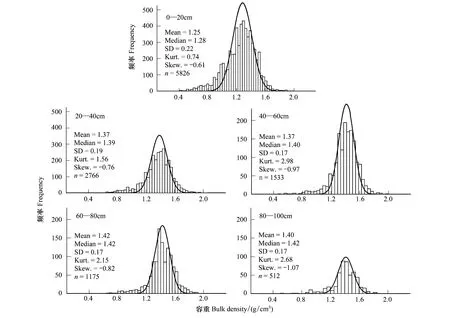
圖3 不同土層深度的土壤容重頻度特征Fig.3 The frequency distribution of soil bulk density in different soil depth
2.2不同土壤類型的土壤容重及其剖面分布特征
土壤容重在不同土壤類型間差異非常大,平均值的變化范圍為0.93 g/cm3至1.41 g/cm3(圖4);其中,最低為高山土,最高為鹽堿土。土壤容重平均值和中值在不同土壤類型具體表現為:人為土(1.35、1.37 g/cm3)、半水成土(1.37、1.38 g/cm3)、初育土(1.39、1.40 g/cm3)、淋溶土(1.28、1.33 g/cm3)、半淋溶土(1.28、1.32 g/cm3)、鐵鋁土(1.30、1.32 g/cm3)、鈣層土(1.35、1.36 g/cm3)、鹽堿土(1.41、1.40 g/cm3)、高山土(0.93、0.94 g/cm3)、水成土(1.21、1.28 g/cm3)。整體而言,不同土壤類型的土壤容重基本都隨著深度增加而增大(圖5)。由于干旱土和漠土的土壤容重數據較少,本文未分析其頻度分布特征。

圖4 不同土壤類型的土壤容重頻度分布特征Fig.4 The frequent distribution of soil bulk density in different soil types
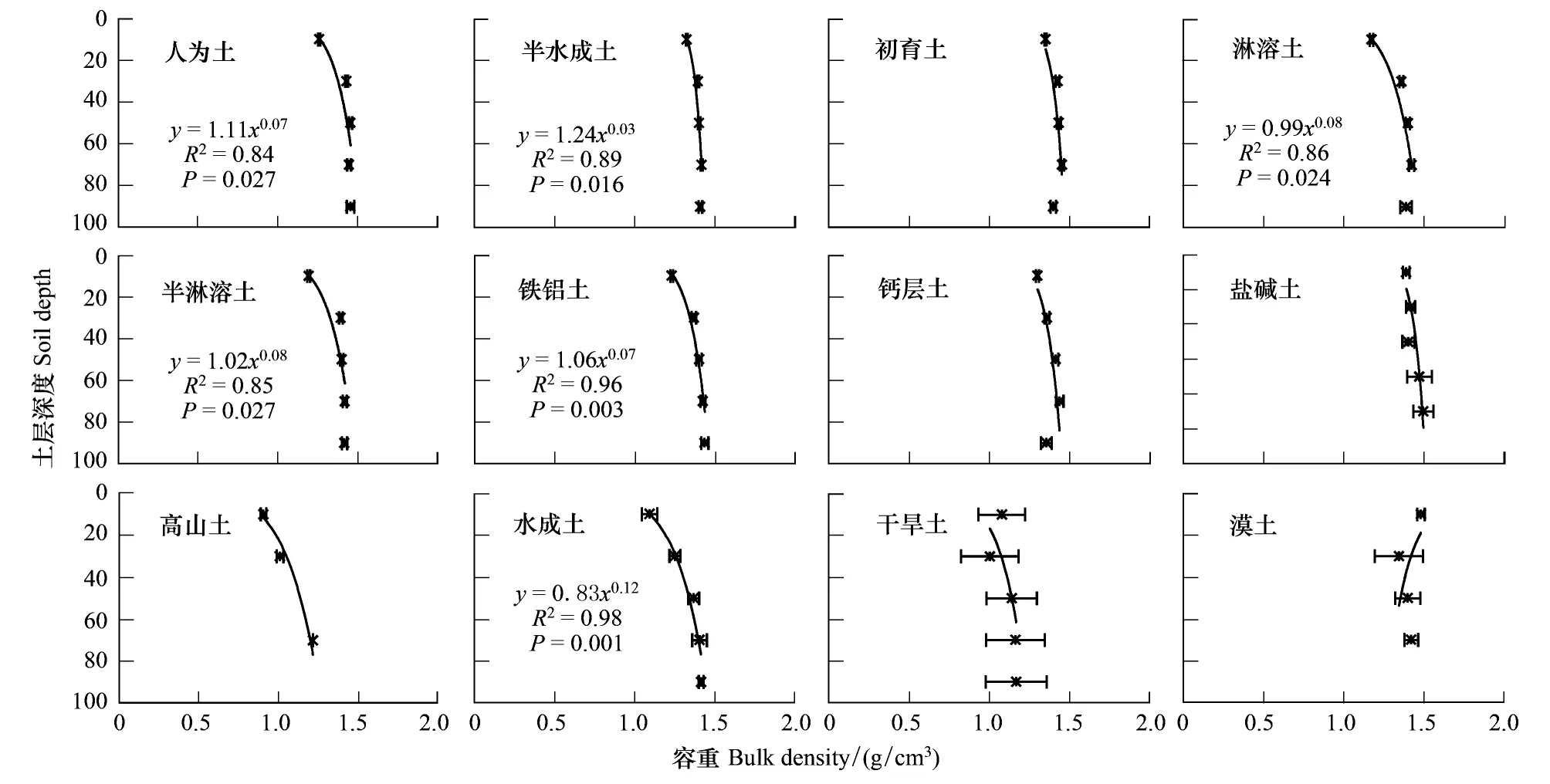
圖5 不同土壤類型的土壤容重垂直分布特征Fig.5 The vertical distribution of soil bulk density with soil depth in different soil types
土壤有機質(0.77%—9.61%)與沙粒(37.91%—57.07%)在不同土壤類型之間存在顯著差異,其中高山土、干旱土和漠土的沙粒含量缺失。通過進一步分析我們發現:土壤容重與土壤有機質含量存顯著的負相關關系,而與沙粒含量存在弱的正相關關系。

圖6 不同土壤類型容重與有機質含量和沙粒含量的關系Fig.6 The relationships between bulk density and soil organic matter and sand in different soil types
3 討論
3.1成土因素和土壤母質對土壤容重的影響
中國土壤容重整體符合正態分布特征,平均值約為1.32 g/cm3;然而,土壤容重在不同土壤類型間存在較大差異(0.93—1.41 g/cm3)。19世紀后期,俄國土壤學奠基人道庫恰耶夫提出了“成土因素學說”,即土壤發生是在母質、氣候、地形、生物和時間等諸多因素共同作用下的產物;1966年,科學家將人為活動也界定為了成土因素之一[20]。鄭紀勇等[3]指出:成土母質、成土過程、氣候、生物作用以及耕作的影響使土壤容重具有非常大的變異。成土原因是土壤容重在不同土壤類型間差異顯著的重要原因。不同母質由于其礦物組成和理化性質的差異影響了其風化速率,據估計花崗巖地區風化速率為0.173 t km-2a-1[21]、碳酸巖的風化速率約為47.5 t km-2a-1、硅酸巖的風化速率為5.6 t km-2a-1[22]。當然,其他成土因素也會不同程度地影響土壤風化速率,并對土壤容重造成影響。此外,土體在各成土因素的作用下富集、損失、轉化和遷移等成土過程及其相互作用[23],共同形成了陸地表面各種不同的土壤[24-25]。
3.2土壤結構對土壤容重的影響
土壤結構是在干濕凍融交替等自然物理過程作用下,由有機物和礦物顆粒等土壤成分參與下形成的不同大小的多孔單元[26]。不同土壤類型之間土壤有機質含量和沙粒含量存在較大的差異,這與陳雅敏等[27]對我國不同土壤類型有機質含量的研究結果類似。Calhoun等[28]表示碳含量和土壤質地對容重變化的解釋度通常超過50%。結果顯示,不同土壤類型容重與有機質之間存在著顯著的負相關關系。土壤有機質含量對土壤結構具有重要影響,是造成不同土壤類型間土壤容重明顯差異的重要原因[2,29]。以高山土為例,高山土容重平均為0.93 g/cm3,在各類土壤中最低;主要是由于高山土主要分布于海拔較高的區域,其寒冷的氣候特征不易于有機質的分解,從而使土壤有機質含量較高,造成土壤容重較低。由于無機膠體在土壤中的變化很小,因此有機膠體對改善土壤質量具有重要重要,是調節土壤微團聚體組成比例的重要途徑[30]。有機質改變了土壤顆粒的膠結狀況,同時有機質具有很強的吸水性[31],研究表明,有機質會對土壤孔隙度和持水量產生重要影響,從而對土壤容重產生影響[32]。Yang等[19]研究表明,有機質含量可解釋土壤容重81%的變異。土壤沙粒含量與土壤容重呈現弱相關性,隨土壤沙粒含量的增加土壤容重呈升高的趨勢。一些研究顯示,土壤質地的差異對容重起著決定性的作用,高孔隙率土壤的容重值較低[33-36]。當小的土壤顆粒(粉粒、粘粒)完全填滿由大土壤顆粒(沙粒)形成的空隙時會出現高的土壤容重值,土壤容重受沙粒比例的影響,沙粒比例70—75%[37],或80%[36]時容重值達到最大。
3.3土壤容重的剖面分布特征
土壤容重沿0—100 cm土壤剖面呈現出從低到高的趨勢。這與其他研究者的研究結果類似[2,36]。土壤有機質是改變土壤空隙結構的重要聚合體,直接影響土壤礦物的結構[38];研究結果表明土壤有機質含量與土壤容重存在顯著的負相關關系,這與Suuster等[2]研究結果相同。隨著土層深度的增加,土壤有機質含量逐漸降低[39-40],是造成土壤容重隨土壤深度增加逐漸增大的主要原因。此外,隨著土壤剖面深度的增加,土體由于超負荷的壓力而變得更加堅實,也是造成土壤容重沿土壤剖面逐漸增大的重要原因[36]。
3.4土壤容重估算對區域碳貯量評估的意義
了解全國尺度和不同土壤類型的土壤容重分布特征及其剖面分布特征,對準確評估區域乃至全國的土壤碳貯量具有重要意義。由于大量獲取土壤容重是一項非常費時費力的工作[9,41],因此,我國土壤基礎數據庫中容重數據非常缺乏。在計算任意尺度的土壤碳貯量時,土壤容重均是最重要的基礎參數,因此被認為是影響區域土壤有機碳貯量估算精度的重要原因[10, 17,42]。通過對本文數據和結論的合理利用,研究人員一方面可以對擬使用的土壤容重數據進行初步質量控制、并甄別特異值;另一方面,科研人員可直接使用本文的結果、或用于插補部分缺失值,這對土壤容重難以準確獲取的區域或深層土壤尤為重要。必須指出:本研究所使用的土壤容重數據源自不同數據庫,其取樣時間跨度較長、且容重測量標準存在一定的差異,使我們結論存在一定的局限性和不確定性。此外,土地利用方式和植被類型對土壤容重也具有重要的影響,但受數據的限制,本研究無法進一步深入探討相關問題,希望在未來的研究中可以對不同土地利用方式和植被類型土壤容重進行深入研究。在實際使用過程中,研究人員仍需根據實際情況再結合本文結論選取合適的土壤容重值。總之,本文較系統地定量評估了中國土壤容重頻度特征和剖面分布特征,并提供了不同土壤類型的土壤容重參考值,為準確估算區域或全國土壤碳貯量提供了重要參考。
[1]Saini G R. Organic matter as a measure of bulk density of soil. Nature, 1966, 210(5042): 1295-1296.
[2]Suuster E, Ritz C, Roostalu H, Reintam E, K?lli R, Astover A. Soil bulk density pedotransfer functions of the humus horizon in arable soils. Geoderma, 2011, 163(1/2): 74-82.
[3]鄭紀勇, 邵明安, 張興昌. 黃土區坡面表層土壤容重和飽和導水率空間變異特征. 水土保持學報, 2004, 18(3): 53-56.
[4]李志洪, 王淑華. 土壤容重對土壤物理性狀和小麥生長的影響. 土壤通報, 2000, 31(2): 55-57.
[5]Oussible M, Crookston R K, Larson W E. Subsurface compaction reduces the root and shoot growth and grain yield of wheat. Agronomy Journal, 1992, 84(1): 34-38.
[6]Andrade A, Wolfe D W, Fereres E. Leaf expansion, photosynthesis, and water relations of sunflower plants grown on compacted soil. Plant and Soil, 1993, 149(2): 175-184.
[7]劉晚茍, 山侖. 不同土壤水分條件下容重對玉米生長的影響. 應用生態學報, 2003, 14(11): 1906-1910.
[8]Kaur R, Kumar S, Gurung H P. A pedo-transfer function (PTF) for estimating soil bulk density from basic soil data and its comparison with existing PTFs. Australian Journal of Soil Research, 2002, 40(5): 847-858.
[9]Benites V M, Machado P L O A, Fidalgo E C C, Coelho M R, Madari B E. Pedotransfer functions for estimating soil bulk density from existing soil survey reports in Brazil. Geoderma, 2007, 139(1/2): 90-97.
[10]Sequeira C H, Wills S A, Seybold C A, West L T. Predicting soil bulk density for incomplete databases. Geoderma, 2014, 213(1): 64-73.
[11]Dawson J J C, Smith P. Carbon losses from soil and its consequences for land-use management. Science of the Total Environment, 2007, 382(2/3): 165-190.
[12]Huntington T G, Johnson C E, Johnson A H, Siccama T G, Ryan D F. Carbon, organic-matter, and bulk-density relationships in a forested spodosol. Soil Science, 1989, 148(5): 380-386.
[13]Rawls W J. Estimating soil bulk-density from particle-size analysis and organic-matter content. Soil Science, 1983, 135(2): 123-125.
[14]Mouazen A M, Ramon H. Development of on-line measurement system of bulk density based on on-line measured draught, depth and soil moisture content. Soil and Tillage Research, 2006, 86(2): 218-229.
[15]Quraishi M Z, Mouazen A M. Calibration of an on-line sensor for measurement of topsoil bulk density in all soil textures. Soil and Tillage Research, 2013, 126: 219-228.
[16]王貴連, 苗黨生. 淺談土壤容重的測定. 北京農業, 2012, (3): 86-86.
[17]He N P, Yu Q, Wu L, Wang Y S, Han X G. Carbon and nitrogen store and storage potential as affected by land-use in aLeymuschinensisgrassland of northern China. Soil Biology and Biochemistry, 2008, 40(12): 2952-2959.
[18]Wu H B, Guo Z T, Peng C H. Distribution and storage of soil organic carbon in China. Global Biogeochemical Cycles, 2003, 17(2): 1048, doi:10.1029/2001GB001844.
[19]Yang Y H, Mohammat A, Feng J M, Zhou R, Fang J Y. Storage, patterns and environmental controls of soil organic carbon in China. Biogeochemistry, 2007, 84(2): 131-141.
[20]Yaalon D H, Yaron B. Framework for man-made soil changes -an outline of metapedogenesis. Soil Science, 1966, 102(4): 272-277.
[21]Riebe C S, Kirchner J W, Finkel R C. Erosional and climatic effects on long-term chemical weathering rates in granitic landscapes spanning diverse climate regimes. Earth and Planetary Science Letters, 2004, 224(3/4): 547-562.
[22]Li S Y, Xu Z F, Wang H, Wang J H, Zhang Q F. Geochemistry of the upper Han River basin, China 3: Anthropogenic inputs and chemical weathering to the dissolved load. Chemical Geology, 2009, 264(1/4): 89-95.
[23]Simonson R W. Outline of a generalized theory of soil genesis. Soil Science Society of America Journal, 1959, 23(2): 152-156.
[24]盛浩, 周清, 黃運湘, 廖超林, 張楊珠. 中國亞熱帶山地土壤發生特性和系統分類研究進展. 中國農學通報, 2015, 31(5): 143-149.
[25]Phillips J D, Marion D A. Biomechanical effects, lithological variations, and local pedodiversity in some forest soils of Arkansas. Geoderma, 2005, 124(1/2): 73-89.
[26]Dexter A R. Advances in characterization of soil structure. Soil and Tillage Research, 1988, 11(3/4): 199-238.
[27]陳雅敏, 馮述青, 楊天翔, 張韋倩, 王壽兵. 我國不同類型土壤有機質含量的統計學特征. 復旦學報, 2013, 52(2): 220-224.
[28]Calhoun F G, Smeck N E, Slater B L, Bigham J M, Hall G F. Predicting bulk density of Ohio soils from morphology, genetic principles, and laboratory characterization data. Soil Science Society of America Journal, 2001, 65(3): 811-819.
[29]Alexander E B. Bulk densities of california soils in relation to other soil properties. Soil Science Society of America Journal, 1980, 44(4): 689-692.
[30]Alakukku L. Persistence of soil compaction due to high axle load traffic. Ⅱ. Long-term effects on the properties of fine-textured and organic soils. Soil and Tillage Research, 1996, 37(4): 223-238.
[31]Davidson S E, Page J B. Factors influencing swelling and shrinking in soils. Soil Science Society of America Journal, 1956, 20(3): 320-324.
[32]王益, 王益權, 劉軍, 閆亞丹, 高希望. 黃土地區影響土壤膨脹因素的研究. 干旱地區農業研究, 2005, 23(5): 93-97.
[33]Adams W A. The effect of organic matter on the bulk and true densities of some uncultivated podzolic soils. Journal of Soil Science, 1973, 24(1): 10-17.
[34]Gardner W R. An introduction to the physical basis of soil water phenomena. Soil Science, 1970, 110(3): 218-218.
[35]Pachepsky Y A, Rawls W J, Lin H S. Hydropedology and pedotransfer functions. Geoderma, 2006, 131(3/4): 308-316.
[36]Tranter G, Minasny B, Mcbratney A B, Murphy B, Mckenzie N J, Grundy M, Brough D. Building and testing conceptual and empirical models for predicting soil bulk density. Soil Use and Management, 2007, 23(4): 437-443.
[37]Koltermann C E, Gorelick S M. Fractional packing model for hydraulic conductivity derived from sediment mixtures. Water Resources Research, 1995, 31(12): 3283-3297.
[38]Stewart V I, Adams W A, Abdulla H H. Quantitative pedological studies on soils derived from silurian mudstones 2 relationship between stone content and apparent density of fine earth. Journal of Soil Science, 1970, 21(2): 248-255.
[39]Hobley E, Willgoose G R, Frisia S, Jacobsen G. Environmental and site factors controlling the vertical distribution and radiocarbon ages of organic carbon in a sandy soil. Biology and Fertility of Soils, 2013, 49(8): 1015-1026.
[40]Jobbágy E G, Jackson R B. The vertical distribution of soil organic carbon and its relation to climate and vegetation. Ecological Applications, 2000, 10(2): 423-436.
[41]Heuscher S A, Brandt C C, Jardine P M. Using soil physical and chemical properties to estimate bulk density. Soil Science Society of America Journal, 2005, 69(1): 51-56.
[42]He N P, Zhang Y H, Dai J Z, Han X G, Baoyin T G T, Yu G R. Land-use impact on soil carbon and nitrogen sequestration in typical steppe ecosystems, Inner Mongolia. Journal of Geographical Sciences, 2012, 22(5): 859-873.
Evaluation of soil bulk density in Chinese terrestrial ecosystems for determination of soil carbon storage on a regional scale
CHAI Hua1,2, HE Nianpeng1,*
1KeyLaboratoryofEcosystemNetworkObservationandModeling,InstituteofGeographicSciencesandNaturalResourcesResearch,ChineseAcademyofSciences,Beijing100101,China
2AgricultureandAnimalHusbandryCollegeofTibetUniversity,Linzhi860000,China
Soil bulk density (BD, g/cm3) is one of most important properties of soil. BD can be used to characterize the conditions of soil quality and soil productivity and is an important parameter used for estimation of soil carbon storage within a plot or on regional and national scales. In practice, the common methods used to measure BD in the field are laborious and expensive, particularly for deeper soil layers. Moreover, it is difficult to control the quality of BD data when classical protocols utilizing soil cores are used. Therefore, large-scale field investigations of BD have not been conducted, resulting in a deficiency of BD data in databases in China and other countries. In this study, we collected BD data (11845 records) for Chinese terrestrial ecosystems from sources including the database of China′s Second National Soil Survey, the database of the Chinese Ecosystem Research Network, and public publications from 1980 to 2014 in order to explore the properties of BD on a national scale and to identify general changes in BD with soil depth and types. The results showed that the reported BD data in China were normally distributed across all soil types and at different soil depths. The mean and median values of BD were (1.32 ± 0.21) g/cm3and 1.35 g/cm3, respectively. BD increased with increasing soil depth along the soil profile, which could be well depicted by power functions. There was a significant positive correlation between BD and soil organic matter content and a weak negative correlation between BD and sand content. Furthermore, the values of BD seemed to vary among different soil types, and the mean values of BD ranged from 0.93 g/cm3(alpine soil) to 1.41 g cm-3(alkali-saline soil). In summary, our study demonstrated the patterns of BD distribution among different soil depths and types on a national scale, and the findings may be used to estimate soil carbon storage both regionally and nationally.
carbon storage; distribution frequency; soil type; soil bulk density; soil depth
10.5846/stxb201411222312
國家自然科學基金項目(31270519, 31470506);中國科學院戰略性先導科技專項——應對氣候變化的碳收支認證及相關問題(XDA05050X0X)資助;中國科學院地理科學與資源研究所可貞杰出青年學者項目(2013RC102)
2014-11-22; 網絡出版日期:2015-10-30
Corresponding author.E-mail: henp@igsnrr.ac.cn
柴華,何念鵬.中國土壤容重特征及其對區域碳貯量估算的意義.生態學報,2016,36(13):3903-3910.
Chai H, He N P.Evaluation of soil bulk density in Chinese terrestrial ecosystems for determination of soil carbon storage on a regional scale.Acta Ecologica Sinica,2016,36(13):3903-3910.
猜你喜歡
數學小靈通·3-4年級(2024年2期)2024-05-15 02:02:28
中學生數理化(高中版.高考數學)(2022年3期)2022-04-26 14:04:16
數學年刊A輯(中文版)(2020年1期)2020-05-19 00:30:36
空間科學學報(2020年2期)2020-04-01 03:50:40
瘋狂英語·新策略(2019年10期)2019-12-13 08:43:28
中等數學(2019年8期)2019-11-25 01:38:14
當代陜西(2019年10期)2019-06-03 10:12:04
新聞傳播(2018年11期)2018-08-29 08:15:24
數學小靈通·3-4年級(2017年9期)2017-10-13 08:10:54
廣西科技大學學報(2016年1期)2016-06-22 13:10:38