匡溪科學研究所,布隆菲爾德山,密歇根,美國
2016-10-20 03:41:40陳茜
世界建筑 2016年8期
匡溪科學研究所,布隆菲爾德山,密歇根,美國
建筑設計:斯蒂文·霍爾建筑師事務所Architects: Steven Holl Architects
場地策略
外部空間的塑造及與實體建筑的組織,賦予了匡溪校園清晰的特色。而在匡溪科學研究的加建項目中,我們將這一特征進行了延續。設計的目標在于盡可能減少對原有沙里寧建筑作品的擾動,同時盡可能增加潛在流線與參觀體驗。
新的內部庭園以傾斜和折疊的連接方式,形成了由花園至外部校園空間高程的柔和銜接。西北角的加建空間懸跨于地面之上,創造出一種自校園平面的“滲透性”過渡方式,提供了面朝花園展覽的空間導向,以及開放而友好的空間感受。一條名為“無法解釋的階梯空間”的軸線自新的入口空間開始形成,大略與現存的“中華犬之坡”平行。這條新的動線將研究所與東側現存沿緩坡地面延伸的自然小徑連接到一起。
建筑概念
加建建筑將1937年保存至今的展館空間“礦物廳”與“人類廳”中的盡端流線重新打開。建筑以平置的U型布局,如同描述科學中“奇異吸引子”的圖解一般,在展覽區域與研究所其他功能之間創造了多樣化的路徑。與此概念類似,斯蒂文·霍爾建筑師事務所試圖令增建空間以自由、開放的方式存在,并能輕易適應后續的改造。建筑中的環線組織很獨特,因而很可能每個來到新科學博物館的參觀者都將經歷毫無重復的參觀體驗,與這座建筑的每一次相遇都是令人興奮又不可預測的。
新的研究所圍繞內部花園空間組織,園中同時也進行著露天的科學現象展覽。在這座“科學花園”中,包括以液體、固體、氣體三態水講述的“水之故事”,分布于流動水池、“冰屋”和“蒸汽屋”中。朝向花園的視角對博物館參觀者的空間引導貫穿進入建筑后的整個展覽環線。以新的“光之實驗室”呈現的入口大廳,承載了臨時展覽的功能,其南向的墻面布置了各種類型的玻璃。借此,不同的光學現象,例如折射、色棱鏡等,隨著太陽光線的變化而被隨時展示在大廳的墻面上。
加建部分的基本結構采用了鋼桁架框架,包覆以預制混凝土板,中空部分布置了服務管線及空調系統。建筑外部在入口立面覆以黃色卡索塔石材,向北逐漸過渡為整體混凝土砌塊。這種從石材至砌塊的過渡關系與“相空間”的理念相呼應,這正是“奇異吸引子”所具有的特性之一。□(陳茜 譯)


1 設計概念,水彩畫/Concept watercolors
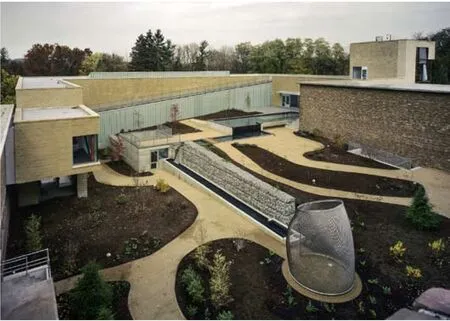
2 科學花園,“水之故事”展/Science garden with "Story of Water" exhibition
項目信息/Credits and Data
客戶/Client: Cranbrook Educational Community
建筑設計/Architect: Steven Holl Architects(主持建筑師/Design Architect: Steven Holl; 項目負責人/Project Architect: Chris McVoy; 設計團隊/Project Team: Hideaki Ariizumi,Tim Bade,Stephen Cassell,Pablo Castro-Estevez,Martin Cox,Janet Cross,Yoh Hanaoka,Lisina Fingerhuth,Bradford Kelley,Jan Kinsbergen,Justin Korhammer,Anna Müller,Tomoaki Tanaka)
工程設計/Engineer: Ove Arup & Partners(主要負責人/ Principal in Charge: Guy Nordenson)
聲學顧問/Acoustical Consultant: Arup Acoustics
展陳設計/Exhibition Designer: Cranbrook Architecture Ofce
照明顧問/Lighting Consultant: L'Observatoire International(主持設計師/Principal: Hervé Descottes; 項目經理/Project Manager: Dusti Helms)
景觀設計/Landscape Architect: Edmund Hollander Design,Cranbrook Architecture Ofce(Peter Osler)
土木工程/Civil Engineer: Johnson Johnson & Roy(合作/ Associate: Charles Gott)
水池顧問/Pool Consultant: Dr.Gerald Palevsky
光學實驗室顧問/Light Lab Consultant: James Carpenter Design Assoc.,R.A.Heintges & Associates
冰屋合作方/制造方/House of Ice Collaborators/ Fabricators: Dan Hoffman,Alfred Zollinger
加建部分項目經理/Construction Maganger Addition: O'Neal Construction
改造部分項目經理/Construction Manager Renovation: Barton Malow Construction Services
建造時間/Construction Period: 1993-1998
攝影/Photos: Paul Warchol
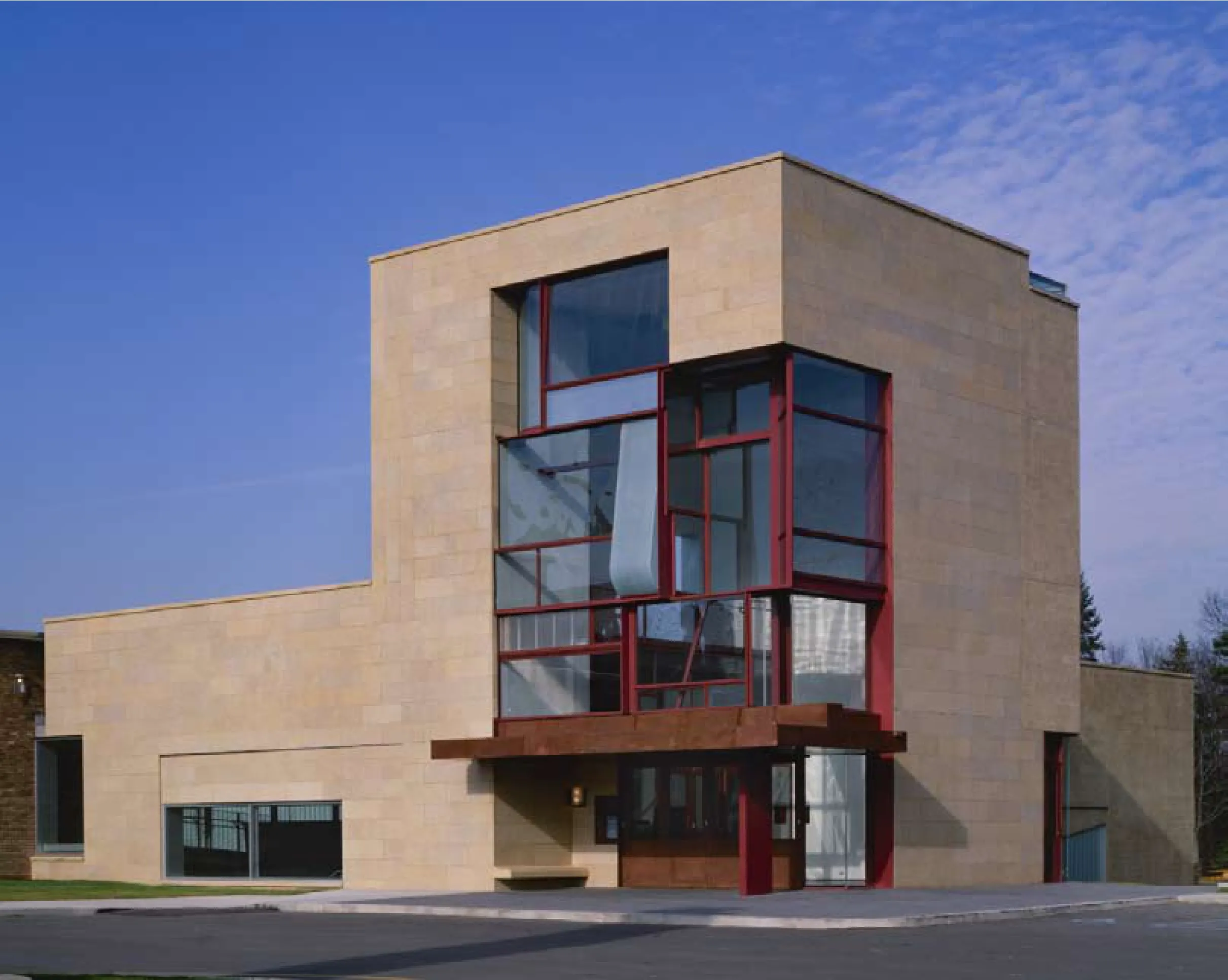
3 外景,主入口“光之實驗室”/Exterior,main entrance / "Light Laboratory"

4 “光之實驗室”外景/Exterior,"Light Laboratory"

6 首層平面/Floor 0 plan

5 “光之實驗室”內景/Interior,"Light Laboratory"
Site Strategy
The bracketing and shaping of exterior spaces with buildings which characterizes the Cranbrook campus is continued in Steven Holl Architects' addition to the Cranbrook Institute of Science.The aim was to make the least intrusion on the architecture of the original Saarinen building while maximizing the potential for circulation and visiting experiences with the addition.
The addition's inner garden has a gently sloping and folding connection to the exterior campus grade.At the northwest corner,the addition passes above the ground,allowing a "permeable" campus grade connection which provides orientation to garden exhibits,and an open and inviting feeling.An axis called "Stairway of Inexplicables" is formed from the entry,roughly parallel to the existing "Ramp of the Chinese Dog." This line of movement connects the Institute to existing nature trails along the sloping ground to the east.
Building Concept
The addition opens up the dead end circulation of the existing 1937 galleriess: the Hall of Minerals and the Hallof Man.A slipped "U" shape,like the scientific diagram for "Strange Attractors",allows for multiple paths withinthe exhibitions and other programs of the Institute.With this concept as an analog,Steven Holl Architects aims fora free and open-ended addition that can easily adapt to change.Its circuits are unique,allowing for the potential that no visit to the science museum will be a repeated experience,rather each engagement is provocative and unpredictable.
The Institute is centered around an inner garden where scientific phenomena are exhibited in the open air.Within this "Science Garden" is the Story of Water; water in liquid,solid and vapor is featured in fow pools,a "House of Ice" and a "House of Vapor".Upon entering,and throughout the exhibition loops,views of the science garden orient the museum visitor.A "Light Laboratory" forms an entrance hall which functions as a changing exhibit with a south-facing wall of many types of glass.Different phenomena of light,such as refraction andprismatic color,are displayed on the lobby walls as the sunlight changes.
The basic structure of the addition is formed of steel truss frame spanned in pre-cast concrete planks which carry services and distribute air in their hollow cores.The exterior is clad in yellow Kasota Stone at the entry elevation,but gradually it changes to integral color concrete block on the North.The relation of stone to block is analogous to "phase space" which is a property of "Strange Attractors."□
Cranbrook Institute of Science,Bloomfeld Hills,Michigan,USA,1998

8 “光之實驗室”內景,展示了光的折射和棱鏡效應/ Interior View,"Light Laboratory" demonstrating refraction and prismatic phenomena of light

9 基于“奇異吸引子”的交通流線分析圖/Circulation diagram based on "Strange Attractors"
猜你喜歡
北方建筑(2021年6期)2021-12-31 03:03:54
文苑(2020年10期)2020-11-07 03:15:36
現代裝飾(2020年6期)2020-06-22 08:43:12
小小藝術家(2019年6期)2019-06-24 17:39:44
電子競技(2019年22期)2019-03-07 05:17:26
電子競技(2019年21期)2019-02-24 06:55:52
電子競技(2019年20期)2019-02-24 06:55:35
電子競技(2019年19期)2019-01-16 05:36:09
今古傳奇·故事版(2016年15期)2016-09-07 06:57:32
少兒科學周刊·兒童版(2015年6期)2015-11-24 03:49:38