
G20 Hangzhou:Chartering a New Course
2016-10-25 13:13:21byLiuHaile
China Pictorial 2016年10期
by+Liu+Haile
As the world has been grappling with weak growth, sluggish trade and investment, as well as fragile recovery since the 2008 financial crisis, leaders of the Group of 20 (G20) gathered on September 4 and 5, 2016, in Hangzhou, China, an ancient city known for its picturesque West Lake and the worlds largest e-commerce giant, Alibaba. They hoped to blaze a new path toward an “innovative, invigorated, interconnected and inclusive global economy,” as the theme of this years G20 Summit implied.
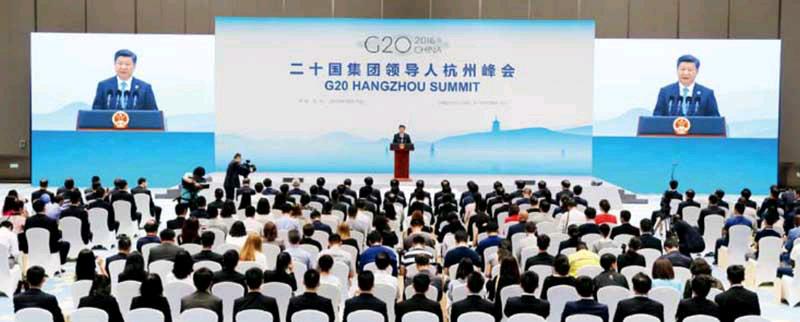
In his address at the opening ceremony, Chinese President Xi Jinping noted that the G20 has drawn up action plans in multiple fields including sustainable development, green finance, and energy efficiency. He called on all parties to “implement each of them seriously.”
Chinese Remedy
This is the first time China hosted the G20 Summit. In assuming the G20 presidency, China has inherited the challenges at a time when the world economy struggles at another crucial juncture. Just as former Chinese G20 Sherpa He Yafei said, the nation hosted the summit at a historic crossroads, when the G20 “needs to transform from a fire brigade” into a global mechanism to “address long-term and structural deficiencies” in the world economy.
Although Chinas economy has entered a “new normal” phase, characterized by economic growth shifting to a slower and more sustainable rate, over the past couple of years, the country continues to serve as a major global economic powerhouse.
China, which has lifted more than 700 million people out of poverty in less than four decades, may have some insight into building an inclusive, sustainable world economy. In this context, expectations were high that the Hangzhou summit would charter a new course for world economic growth.
As the presiding country of the summit, China has proposed solutions and strategies. Even before the summit, the country had suggested four key priorities under the summit theme, namely, “blazing new paths for growth,” “more effective and efficient global economic and financial governance,” “robust international trade and investment,” and “inclusive and interconnected development.”
In his speech at the opening ceremony, President Xi prescribed a “Chinese remedy” for the chronically stagnant world economy: strengthened coordination of macroeconomic policies and joint efforts to boost economic growth and maintain financial stability while improving global economic governance.
Robert Milliner, a senior adviser at Union Bank of Switzerland and the G20 Sherpa for Australia in 2014, called Xis speech “very comprehensive and inspiring.” He predicts that Xis vision for the role and focus of the G20 will not only foster global economic growth but, perhaps more importantly, broaden and deepen relationships between G20 countries.
Neil Renwick, professor of global security at Britains Coventry University, believes that a big priority of the Hangzhou summit is “to get the group back to medium and long-term strategic planning rather than improvised crisis response.”
“This is where Chinas year of G20 leadership has already made a positive difference,” Renwick noted. “It has shifted sustainable development into the political mainstream and set the goal of formulating real plans and implementing massive global agreements. It brings a mindset of actually getting things done, by, for example, setting up an innovative economic indicator system for structural reforms.”


More Concrete Action, Less Empty Talk
By offering innovative solutions for reform, the Hangzhou summit adopted the G20 Blueprint on Innovative Growth and formulated pragmatic action plans such as the G20 Action Plan on the 2030 Agenda for Sustainable Development, delivering the consensus reached by G20 leaders.
“The outcomes of the summit, many of which are of pioneering significance in the history of the G20, are expected to help the global economy regain vitality,” declared Chinese State Councilor Yang Jiechi in an interview.
Christine Lagarde, managing director of the International Monetary Fund(IMF), also praised this years G20 Summit, calling it a “very successful meeting,”and remarked that IMF looks forward to implementing the agreements reached in Hangzhou. “We met against the backdrop of a global landscape characterized by major economic and technological shifts, and by growth that has been too slow for too long—and has benefited too few,” she said. “Through the Hangzhou Action Plan, the G20 leaders expressed determination to address these challenges with a set of forceful policy actions.”
The G20 has been criticized in the past for failing to produce concrete measures to coordinate international macroeconomic policies. “Hangzhou is perhaps the best hope for rebuilding the G20 as a respected and effective global steering committee,”said Barry Carin, senior fellow of the Center for International Governance Innovation based in Waterloo, Canada.
While urging the group to take substantial action, President Xi called on all members to make the G20 an “action team instead of a talk shop.”
China and the United States ratified the 2015 Paris Agreement to cut global greenhouse gas emissions just one day ahead of the opening of the G20 Summit in Hangzhou, marking a significant step toward finalizing the pact and paving the way for other countries to follow suit. It also offered an example of China honoring its pledges.
To achieve an inclusive development, President Xi called on the leading G20 economies to support developing countries and take concrete measures to avoid a scenario in which the developing world is stripped of the opportunities to draw foreign investment, participate in global trade and improve peoples livelihood.
Global governance should encourage participation and benefits for all. To make economic globalization more inclusive, the Hangzhou summit has, for the first time, placed the issue of development at the center of the global macro policy framework. For the first time, cooperation is in place to support Africa and least developed countries to become industrialized.
The Hangzhou summit has drawn a blueprint for an innovative future characterized by interconnected and inclusive global development. The next step is to implement the blueprint and reach all of its goals.
