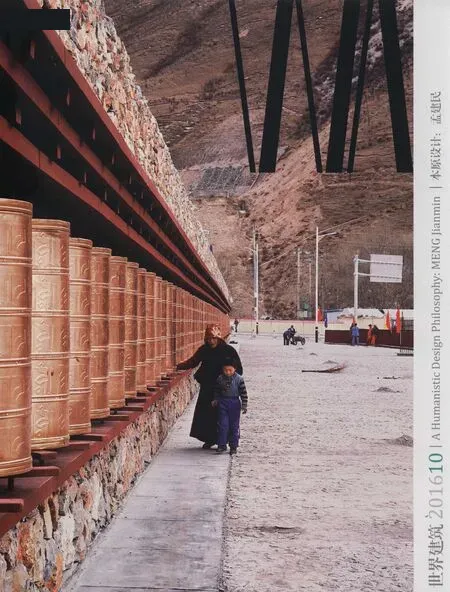
玉樹地震遺址紀念館,青海,中國
2016-11-14 10:18:50孟建民
世界建筑 2016年10期
玉樹地震遺址紀念館,青海,中國


1 外景/Exterior view
2 總平面/Site plan
3 外景/Exterior view
2010年4月14日上午7時49分,青海省玉樹藏族自治州玉樹縣發生7.1級地震,遇難人數達2800多人。中國建筑學會隨后代表建設部為玉樹重建組織了一次建筑師的集群設計,我也有幸參加并創作了玉樹地震遺址紀念館。
玉樹地震遺址紀念館的規模并不大,總建筑面積為3000m2。在面對這個被預設為記錄災難事件、體現藏地生死觀的命題式設計任務時,建筑師所面臨的最大困境在于如何深刻理解藏地信仰所帶來的文化差異——對于身處藏地的玉樹人來說,信仰作為一種強大的精神力量,已經深刻地融入“儀式化”的生活方式中;當這種“儀式化”成為一種生活常態,必然深刻影響到他們的生命哲學以及對于空間的理解。我們試圖以平視的視角來審視這種差異,并重新思考地震遺址紀念館表達的文化意義:它不僅是災難事件的記憶載體,同時更應該成為當地藏民日常化的生活場所。
基地位于結古鎮的南入口格薩爾王賓館遺址旁邊,成為進出玉樹的必經之路。方案以保留的格薩爾王賓館遺址為展示主體,紀念館主體隱于地下。新舊建筑“一隱一顯”,通過控制地面體量,盡可能突出遺址本身的視覺震撼力和紀念意義。地面通過兩條線性元素進行限定,兩者之間圍合的廣場是舉行儀式集會的紀念場所。貫穿場地的折線形“裂痕”作為采光縫限定出遺址保護范圍,同時建立起遺址與地下展廳的視覺聯系。極簡的直線形紀念長墻以暖色毛石制成,直指結古寺。長墻不僅隱含著內在精神寓意,同時作為遺址的背景與遠方群山相融。沿著墻體設計的85個轉經筒,成為人們進出玉樹時的標志性構筑物,在紀念館轉經祈福也成為當地藏民宗教生活的重要組成部分。
建筑主體藏于地下,以純粹的“方”和“圓”為基本原型。方案采取地域建筑設計策略,通過“材料、色彩、光”3種基本建筑要素的運用,表達藏地建筑特色。內部空間采用暖色毛石、素混凝土、藏紅色耐候鋼板等現代材料營造內斂而莊重的空間氛圍。當人們通過線性空間序列緩緩進入中央的祈福之庭,內聚的圓形空間和環繞的壁龕矩陣試圖喚起觀者內心的精神共鳴,把沉重的災難記憶轉化為對生命的祈福,傳達出人與自然和諧共生的生命哲學。□(孟建民 文)

4 地上一層平面/Floor 1 plan
5 地下一層平面/Floor B1 plan
6 地下二層平面/Floor B2 plan
項目信息/Credits and Data
設計團隊/Design Team: 徐昀超,邢立華,招國健,施水清等/XU Yunchao, XING Lihua, ZHAO Guojian, SHI Shuiqing, et al.
用地面積/Site Area: 6303m2
設計時間/Design Time: 2010
攝影/Photos: 招國健,張廣源/ZHAO Guojian, ZHANG Guangyuan
At 7:49 in the morning of April 14, 2010, an earthquake of 7.1 magnitude occurred in Yushu Tibetan Autonomous Prefecture, Qinghai province,with the number of victims totaling more than 2800. Te Architectural Society of China, representing the Ministry of Housing and Urban-Rural Development,organized a group of architects to reconstruct the Yushu area. I was also honored to be engaged in the design of Yushu Memorial of Earthquake Ruins.
Yushu Memorial of Earthquake Ruins is not particularly large, with a total floor area of about 3000m2. While given the propositional design task that is preset to record the disaster and reflect the view of life in the Tibetan region, the biggest difficulty that architects were facing was how to comprehensively understand the cultural diferences brought up by the religious beliefs in the Tibetan region. For Yushu people living in the Tibetan region, religious belief, as a strong spiritual power,has deeply melted into their ritualized lifestyle. When the ritualization becomes a normal living state, it inevitably poses impact on their philosophy of life and understanding of space. Architects tried to look at the differences from a horizontal point of view and rethink the cultural meanings that the memorial of earthquake ruins should communicate: the memorial of earthquake ruins should not only be a carrier of memories of the disaster, but also an everyday place for local Tibetans.
The memorial is located beside the KingGesar Palace Relics at the southern entrance of the town of Jiegu, and is the gateway to Yushu. The project takes the preserved King Gesar Palace Relics as the main body of exhibition, and the main body of the memorial is hidden below the ground. Old and new structures are above and under the ground respectively, thus the volume above the ground is controlled in order to emphasize the visual impact and commemorative meaning of the relics itself to the maximum. The ground is defined by two linear elements,and the square enclosed by the elements is the commemorative place for holding ceremonies and gatherings. The fold line shaped "cracks" that run through the square define the protection area of the relics as lighting cracks, on the other hand,they establish the visual connection between the relics and the underground exhibition halls. The minimal linear long commemorative wall is made of bluish ashlars and directly points to the Jiegu Temple. The wall not only implies inherent spiritual meanings but also becomes the background of the relics, and the 85 prayer wheels installed along the wall also become an important part of the gateway to Yushu and path of prayers.

7 外景/Exterior view
Te main body of the building is hidden below the ground, and pure "square" and "rotundity" are taken as the basic prototype. Te project adopts the strategy of regional architectural design, showcasing the unique characteristics of Tibetan architecture with the application of three basic architectural elements - materials, colours and lights. The interior space creates a modest and solemn spatial atmosphere by applying modern materials such as bluish ashlars, plain concrete and safron weatherproof and antirust steel plates. When people gradually walk into the central blessing hall via the linear spatial sequence, the cohesive round space and surrounding niche matrix attempt to arouse the spiritual resonance deep inside the visitors' hearts,transform the heavy memories of the disaster to the blessing for lives, and convey a philosophy of life that promotes the harmonious coexistence between human beings and the nature.□(Text by MENG Jianmin)


8 內景/Interior view
9.10 剖面/Sections
評論
莊惟敏:每個建筑都承載著功能并扮演著對環境的角色。很多建筑師都堅信他們有權用建筑空間實現個人的追求和表達。然而,這會讓空間喪失意義、功能和公平。而博物館—紀念館一類的文化建筑,又往往能刺激起建筑師更多的創作激情,傾向于以一種強力的造型和視覺沖擊力去表現個性的追求,而忽視了建筑的本原和對文化及其場所的尊重。然而,有一批建筑師他們能夠拋開“自我”,以清晰的自省的態度去尋找自身在項目中的定位,堅守自己最基本的創作信條,尊重歷史文脈,和諧環境場所,體現人文關懷,以建筑的作品表達著對社會和民眾的責任。孟建民就是這樣一位建筑師。
這是一個在青海玉樹海拔近4000m的雪域高原的項目。建筑師面對這樣一個被預設為紀錄災難事件、體現藏地生死觀的命題式設計任務時,其最大挑戰就是深刻理解藏地信仰所帶來的文化差異,以及如何理解在“儀式化”生活方式影響下的當地民眾的生命哲學,進而進行與之相適應的空間表達。這的確是一個挑戰,不僅是對建筑師體力的挑戰,更是精神的挑戰。
項目位于通向結古鎮主路的南入口格薩爾王賓館遺址旁邊,是進出玉樹的必經之路。建筑師以格薩爾王賓館的震后遺址為展示主體,將新建紀念館主體建于地下。地面建筑體量控制得極為節制和純粹,簡潔到極致的外部體形,將人工環境對自然的關系進行了詮釋,體現設計師對環境與自然的深刻理解。地面通過不規則大地裂縫的線性元素組織外部空間,形成儀式感的紀念場所。巧妙地運用 “裂痕”造型元素作為地下空間的采光,建立起遺址與地下展廳的視覺聯系。
建筑師的設計在平實內斂中又展現出嫻熟有力的空間控制力,以當地毛石砌筑的極簡的線型紀念長墻直指結古寺,表達著內在精神的向往與對藏地信仰和文化的理解。這種將新建筑作為背景,又通過沿墻體設置的85個轉經筒所形成的空間引導,給人們帶來了深刻的精神與場所文化的體驗。地下紀念空間以最純粹的空間形體,營造空間序列,通過中央祈福之庭,內聚的圓形空間和環繞的壁龕矩陣,喚起觀者內心的精神共鳴,通過“材料、色彩、光”的運用,把沉重的災難記憶轉化為對生命的祈福,表達了建筑師對人與自然和諧共生的哲學命題的理解與釋義。
孟建民的設計使我們看到他將地震遺址紀念館表達成不僅是災難事件的記憶載體,更成為當地藏民日常化的生活場所。這也正體現了他是一位有情懷的建筑師,關注弱勢群體,注重社會環境。他的設計中體現出人文關懷,使得這個作品與他其他的作品相比更具人文的光芒。
1-紀念廣場/Memorial plaza
2-下沉庭院/Subsided court
3-采光井/Light well
4-祈福廳/Prayer hall


11 內景/Interior view
12 外景/Exterior view
Comments
ZHUANG Weimin: Each building has a certain functionality and role in its environment. Many architects strongly believe that they have the right to use building spaces to fulfll their personal dreams and expressions. However, this causes a space to lose its meaning, functionality, and neutrality. Cultural buildings, such as museums and memorials, have the potential to induce feelings of creativity and passion in other architects, yet the designs of these buildings have a tendency toward a forceful type of construction that utilizes visual impact to express individuality while neglecting the building's origins and respect toward its culture and place. Nonetheless, there are a small number of architects who are able to rid themselves of subjectivity to search for their role in a project with clarity and humility while adhering to their most basic tenets of creation. Tese architects respect the historical context of a place to harmonize with its environment while showing concern for human culture, so they may express their responsibility to society and its people through architectural works. MENG Jianmin is one such architect.
Tis project is situated 4,000m above sea level in the snowy highlands of Yushu in Qinghai Province. When the architect was confronted by a design task involving a disaster that reflected on the Tibetan concept of life and death, the greatest challenge was in obtaining a deep understanding of the cultural differences brought about by Tibetan beliefs and understanding how a ritualistic lifestyle affected the life philosophies of the local inhabitants so as to create an appropriate space. Tis was a challenge that strained the architect's physical and mental limits.
The project stands beside the King Gesar Palace Relics located at the southern entrance of the main road leading to Jiegu town, the solitary road to Yushu. Te architect used the ruins from the earthquake-destroyed King Gesar Palace as the primary exhibit subject and built the main body of the new memorial underground. Te structures on the surface were fnely controlled and built in simplicity to form an outer shape of exquisite concision; this interpretation of the relationship between artificial and natural environments was a manifestation of the architect's deep understanding of nature and the environment. The surface spaces were organized by irregular cracks in the ground, thus forming a memorial with a ritualistic theme. Te cracklike styling elements were cleverly used as a means to draw light underground to build a visual relationship between the ruins and underground exhibition hall.
The architect exhibited skillful and powerful control of space through his plain and restrained designs; the use of a simple and linear long commemorative wall built from local rubble masonry that points directly at the Jiegu monastery was an expression of spiritual direction and understanding of Tibetan beliefs and culture. Visitors to the memorial are provided a deeply spiritual and cultural experience with this new building as a backdrop and the spatial guidance provided by the 85 prayer wheels installed along the wall. The underground memorial uses the purest form of space to create a spatial sequence that evokes spiritual resonance in the hearts of its viewers through a cohesive circular area and arrays of alcoves in the central court of blessing, thus transforming solemn memories of the disaster into prayers of life through the use of materials, color, and light. This expresses the architect's understanding and belief in the philosophical subject of humankind's harmonious coexistence with nature.
The earthquake memorial designed by MENG Jianmin serves not only as a commemoration of the disaster but also as a local place for Tibetans. Tis shows that he is a compassionate architect who cares about the weak and has a strong regard for the social environment. His designs in this work are an embodiment of care for human culture, which paints this in an even greater humanistic light than his other works.
Yushu Memorial of Earthquake Ruins, Qinghai, China, 2013
猜你喜歡
北方建筑(2021年6期)2021-12-31 03:03:54
文苑(2020年10期)2020-11-07 03:15:36
現代裝飾(2020年7期)2020-07-27 01:27:42
現代裝飾(2020年6期)2020-06-22 08:43:12
現代裝飾(2020年4期)2020-05-20 08:55:08
流行色(2020年1期)2020-04-28 11:16:38
藝術啟蒙(2018年7期)2018-08-23 09:14:18
海峽姐妹(2017年7期)2017-07-31 19:08:17
Coco薇(2017年5期)2017-06-05 08:53:16
福建農業科技(2016年10期)2016-03-07 09:46:49