Private Enterprises Are Global Investors
2016-12-14 19:45:50ByLIUSHAOHUA&LEI
CHINA TODAY 2016年12期
By+LIU+SHAOHUA+&+LEI+GONGMING


THE year 2016 marks the 15th year since China formally proposed the “Go Global” strategy. The countrys outbound investment is amid a transition as its focus switches from quantity to quality. In the process, more and more private businesses are becoming proactive global investors.
Private Giants Lead Investment Boom
Chinese enterprises are going global faster. Although state-owned enterprises(SOEs) have stepped up overseas mergers and acquisitions (M&As), private enterprises have surpassed SOEs in terms of transaction volume for the first time, two thirds of the 20 largest outbound M&As in the first half of 2016 having been private deals.
In 2015, 138 of the top 500 Chinese private enterprises achieved a total overseas revenue through outbound direct investment (ODI) and project contracting of US $164.154 billion, representing a 35.2 percent year-on-year growth. Private companies invested in 1,328 overseas projects in 2015, as compared with the 1,061 of the previous year, with total investment hitting US $28.863 billion.
Tencent Holdings Ltd. is to buy from SoftBank Group Corp. an 84.3 percent stake in Finnish mobile game maker Supercell, a deal worth around US $8.6 billion, according to The Wall Street Journal. The biggest acquisition so far in the global games market, Supercell has an estimated value exceeding US $10 billion.
Since 2006, Tencent has spent RMB 17.8 billion on the purchase of 34 game developers, seven of whom are Chinese enterprises, the others mainly from the U.S., South Korea, and Japan.
The proportion of private enterprise investment in Chinas total ODI has steadily risen in the past few years, Long Yongtu, chairman of the Center for China and Globalization (CCG), said. Private Chinese companies investments in the U.S. market in 2013 accounted for 76 percent of the total from China, and the projects in which they invested represented 90 percent by Chinese companies as a whole.
Chinese private enterprises are also proactive in emerging areas such as Virtual Reality (VR) and Augmented Reality(AR). Last February, Alibaba led the US$793.5 million funding for investment in the Florida-based Magic Leap. In the same month, Shanghai-based online games operator and book publisher Shanda Group announced its investment in The Void, a U.S.-based company that specializes in VR technologies. It also plans to establish in China a theme park dedicated to The Void. And on August 9, NetEase announced its participation in the funding of NextVR, an emerging leader in live virtual reality broadcast technology.
Since 2015, Chinese film and TV companies investments in the international arena have drawn world attention. After acquiring AMC Theaters, the Dalian Wanda Group embarked on a series of mergers and acquisitions through holdings or equity participation, so reaping profits from the international film market. Huayi Brothers Media Corp., Chinas largest private film production company, has signed a deal with the U.S. STX Entertainment to finance, coproduce and release more than 18 films by 2017. The Shanghai-based China Media Capital (CMC) and Warner Brothers Entertainment, moreover, have formed a joint venture to produce Chineselanguage movies for the international market.
Chinese enterprises preferred investment destinations are North America and Europe, due to their cutting-edge technology, advanced platforms and mature consumer groups.
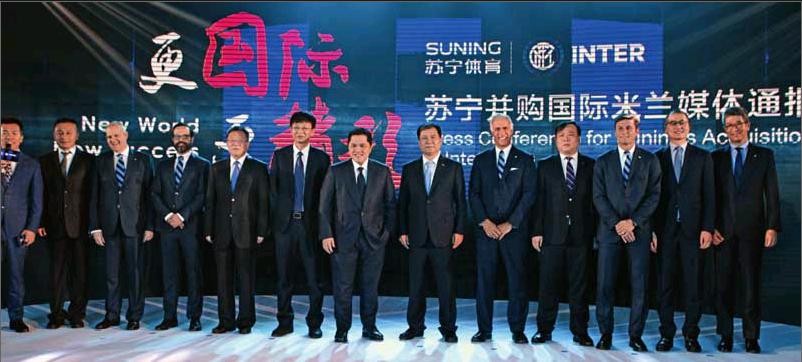
Last June, Chinas retail giant Suning Holdings Group acquired a 70 percent holding in Italian soccer club Inter Milan for € 270 million, (US $307 million) through the purchase of its existing and new shares.
Surging Investment in “Belt and Road” Countries
Ernst & Young Global Limited (EY) recently released Going Out: the Global Dream of a Manufacturing Power – 2016 China Outbound Investment Outlook, which intimated that Chinas outbound investment will likely hit another historical high. National strategies such as the “Belt and Road” and “Made in China 2025” have gradually come into effect under the “Go Global” policy. Chinas outbound investment is hence expected to grow by more than 10 percent, and maintain sustainable high growth for the next five years.
The first-ever freight train set out from Yiwu in Zhejiang Province to Afghanistan, carrying 100 containers of goods, on August 28. This marked the fifth cargo train route linking Yiwu to the world. The other four include that from Yiwu to five countries in Central Asia since April 23, 2013; the Yiwu-Madrid line since November 18, 2014; the Yiwu- Teheran line since January 28, 2016; and the Yiwu-Russia line since August 13, 2016.
China-Europe cargo lines serve as a springboard for Zhejiangs privately run enterprises exploration of the markets in countries along the Belt and Road. Bao Weidong, vice director of the Yiwu Bureau of Land Port Affairs and Management, declared that cooperation will extend to wherever the trains go.
In March, 2016, Yiwu Small Commodities Market saw the opening of its first overseas market in Warsaw, Poland, a stop along the Yiwu-XinjiangEurope Railway. Private enterprises in Yiwu have moreover established 22 overseas warehouses in cities such as Moscow, Madrid, Lisbon, Cape Town, and Sydney.
Implementation of the Belt and Road Initiative has thus encouraged more and more Chinese private enterprises to go global.
In 2016, the Sichuan provincial government launched the “1,000 enterprises travelling along the Silk Road” program, with the aim of promoting market development and investment cooperation in such regions as the Middle East, Eastern Europe, Africa, South Asia, and the ASEAN region. “Around 700 of our enterprises, almost all of them privately owned, are making investments overseas,” head of Sichuan Provincial Department of Commerce Xie Kaihua said.
The Sichuan provincial government plans to implement 30 key projects to improve collaboration in international production capacity. It will also establish three overseas demonstration bases for overseas trade and economic cooperation which are expected to generate total export and import volumes exceeding US $3 billion.
Many private enterprises have shown great interest in countries along the Belt and Road.
“Southeast Asia holds a strategic position in the Belt and Road Initiative, and supportive government policies have encouraged us to ‘go out and invest in Laos,” Chairman of Guangyao Dongfang Group Li Guibin said. This commercial real estate company has been making investments in Laos since 2010, in the fields of electric power, mining, and industry, evident, for example, in implementation of a hydroelectric project in Lamphun and of an iron deposits project in Phalek.
The Tsingshan Holding Group, a private ferrous metal and stainless steel production enterprise in Zhejiang Province, has also stepped up its going global efforts. The company has purchased nickel resources in Indonesia, obtained mining rights for chrome ore mines in Zimbabwe, and established factories in the United States.
“Every move the company has made closely relates to the national strategy and structural transformation of Chinas economy,” Chairman of Tsingshan Holding Group Xiang Guangda said.
The Tsingshan international investment roadmap echoes the choice of a substantial number of private enterprises in China that are making exploratory forays into the global market.
Meet Local Needs
So how do such private enterprises survive and develop in local markets?
Its not easy. Boston Consulting Group Statistics show that Chinese acquirers complete only 67 percent of their outbound deals – a result which does not compare favorably with those of developed-world acquirers. Many Chinese entrepreneurs say that disparities in market principles and culture are the main stumbling blocks.
“We cant simply apply domestic principles to foreign markets,” Chairman of New Hope Group Liu Yonghao said. “Nor can we stick to conventions when conducting M&As and developing business overseas,” he added.
The successful experience of leading Chinese web services company Baidu has been to release mobile products that accord with local customers needs. For example, it launched a social livestreaming site in Indonesia, a group buying business in Brazil, and its map services cover more than 100 countries. A Baidu worker revealed on September 1 during the 2016 Baidu Technology Innovation Conference that Baidu mobile products are available in more than 200 countries and regions. The company now has 1.6 billion registered users and 300 million active users – double those in 2015.
Today, many knowledge intensive firms prefer to establish overseas research and development (R&D) centers to sharpen their innovation capabilities and international competitiveness.
Huawei announced on June 14, 2016 during the Fourth European Huawei Innovation Day, the opening of a Mathematics Research Center in France. It employs more than 80 researchers, all of whom have doctorate degrees. The move highlighted Huaweis advancement of its role in basic scientific research, particularly mathematical algorithms, since setting up its first mathematics research center in Russia.
To date, Huawei has established 16 research centers worldwide, including the France Research Center, where four teams respectively focus on design, digital imaging, mathematics, and home devices.
On November 4, 2015, ZTE Corporation opened an R&D center in Tokyo. Its focus is on developing key 4G and 5G network technologies and accelerating commercialization of the Pre-5G and 5G technologies, as well as deepening collaboration with operators and academic institutions in Japan.
There are many other examples. Wuhan Guanggu Lanyan New Energy Co., Ltd. established an R&D center in Denmark which has innovated biomass heating technology. The Tri-Ring Group Corporation established an R&D center in Germany which helped generate higher revenues from overseas markets for the company amounting to RMB 215 million. Companies such as Shandong Linyi Transnational Procurement Center and Shandong Huasheng International Trade Co., Ltd. have also set up overseas warehouses, R&D centers, and sales branches, so forming a relatively complete international sales network.
Guo Guangchang, chairman of Fosun Group, said that because in the past most Chinese enterprises were “pushed”to go global, they often acted passively. Now, however, they take more initiative, and are proactive in their optimum utilization of international resources and expansion of common economic development.