Guangzhou:Cantonese Culture and Dim Sum Heaven
2016-12-14 20:31:57
CHINA TODAY 2016年12期
LOCATED in the middle south of Guang- dong Province, Guangzhou, the provincial capital, is among Chinas top three most developed metropolises, the other two Beijing and Shanghai.
Guangzhou has throughout its 2,200-year history been the political, military, economic, and cultural focal point of South China. As a hub of Cantonese culture that evolved within the area encompassing Guangzhou and the Pearl River Delta, Guangzhou is distinct for its traditions and folkways.
The cultural legacy of the citys 2,200-year civilization is manifest in all facets of daily life, in particular Guangzhous cuisine, architecture, commerce and trade, as well as the local dialect, etiquette, art, and frequent festivals. Guangzhou sustains with ease the high reputation that is rooted in its many cultural assets.
Core Region of Lingnan Culture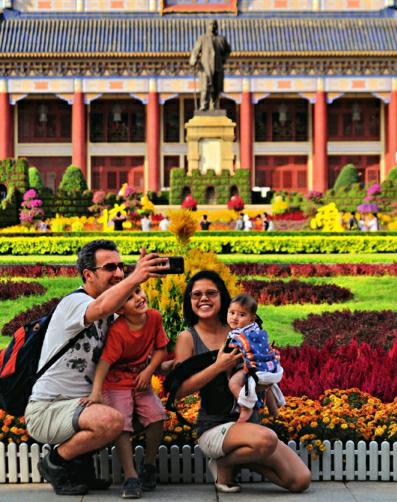
Lingnan, literally south of ridges, refers to three provincial regions south of Wuling Ridges – Guangdong, Guangxi, and Hainan, all of which are seats of the Lingnan culture. Guangzhou is the most promi-nent city by virtue of its striking characteristics and wide influence.
Guangzhou has been known during its history, which goes all the way back to the Qin Dynasty(221-206 BC), as Nanhai Prefecture, Panyu, and Guangzhou Area Command. It has always been an administrative center.
Around AD 330, Guangzhou became a major port along the Maritime Silk Road, and also Chinas sole foreign trade port. Owing to its frontier location, Guangzhou was never at center stage of Chinese history, a fact that has more clearly defined its local features.
In earlier times, people living in the Central Plains would head south to escape the wars and turmoil that so frequently erupted there. These newcomers gradually infused and enriched Lingnan Culture with that of the Central Plains. Guangzhous distinct character gradually took shape in this process of blending and evolvement to eventually become a center of the Lingnan Culture.
After the First Opium War (1840-1842), Guangzhou advanced from a mere border town to the forefront of Chinas interchanges with Western countries. Guangzhous unique culture, characterized by global vision with a commercial focus, is the result of a blending of the Orient with the West. Its consequent openness, pragmatism, and inclusiveness are what make Guangzhou so distinct.
This communication, collision, and intermingling made Lingnan Culture foremost in modern Chinas politics and ideology, as well as the countrys revolutionary and cultural development.
Guangzhou is the cradle of Chinas national industry. The countrys modern military industry and civil industry, established during the Westernization Movement of the latter half of 19th century, were distributed throughout Southeast Chinas coastal areas. Guangzhou Machine Bureau was the first Westernized enterprise in Guangdong Province.
The city also witnessed the planning of modern Chinas democratic politics. Prominent political thinker and reformer Kang Youwei (1858-1927) founded the modern school in Guangzhou called Wanmu Caotang. There he disseminated his thoughts on constitutional reform and modernization.
Revolutionists Sun Yat-sen and Huang Xing launched an armed uprising in Guangzhou in 1911, their aim to overthrow the Qing Dynasty and establish a bourgeois republic. Despite its failure, the Lingnan Culture, with Guangzhou as the core, was a driving force of modern Chinas political reform.
Over the past decades, Guangdong has been at the forefront of Chinas reform and opening-up. For example, Baoan, a county under the administration of Guangzhou, was renamed Shenzhen City, and so became Chinas first special economic zone in 1980. Meanwhile the Pearl River Delta took the lead in Chinas opening-up, so acting as an archetype of Chinas economic development.
Diverse Lingnan Architecture
Guangzhou is site of the archetypal Lingnan architecture that retains its original appeal. Its evolution started in the Ming (1368-1644) and Qing dynasties, the formers influence evident in various academic and ancestral halls. The late Qing Dynasty left its mark in the form of the folk residential mansions in Xiguan and various arcade buildings, whereas the early Republic of China period (1912-1949) bestowed on Guangzhou the Western-style buildings that gained popularity after the official end of the Qing Dynasty.
After the founding of the Peoples Republic of China in 1949, modern buildings commingling Chinese and Western architectural styles dominated Guangzhous landscapes. The combination of these buildings and Lingnan style gardens showcase Guangzhous architectural versatility.
The representative Lingnan style folk residences in Xiguan Corner (now known as Liwan District) are symmetrical structures with a main hall at the center. One hall encloses a courtyard that has a dooryard separating the two major halls.
The study, bedrooms, and stairwells are usually beside the major hall, to the right of which is usually a courtyard ornamented with flower gardens, pot plants, and a rockery or fishpond. Their interior décor of elegant rosewood furniture, exquisite wood carvings, and stained glass panels inlaid with paintings and calligraphies are also rich in Lingnan appeal.
Commercial arcades first appeared in ancient Greece more than 2,000 years ago, and spread throughout the world in modern times. Those in Guangzhou were first built after the 1920s. A struc- ture designed to protect pedestrians from wind, rain, and sunshine, they are an especially welcome feature during Guangzhous intense heat and monsoon-style rains.
Arcades also provide a convenient space for shops lining the sidewalk to display goods. They are hence a feature of such commercial thoroughfares as Beijing Road Pedestrian Street, Shangxiajiu Pedestrian Street as well as Dishifu, Zhongshan, Jiefang, South Renmin, and Yide roads.
The huge influx of Western culture in the late 19th to early 20th centuries gave rise to folk residences that combined both traditional Chinese and Western-style architecture. The houses and gardens in Dongshan and Meihua Village, with usually front or back yards, pillared porches, and walls and iron gates to insulate these mansions from the world outside, are representative of this period.
The foreign-style cottages built by overseas Chinese feature more traditional Chinese grey-tiled porch roofs, often a whole section of Taihu Lake stone that stands in the fountain pool and enshrines a statue of Guanyin, Goddess of Mercy, and a traditional Chinese santos rosewood chair on an Italian concrete floor. The owners of these houses clearly believed that the combination of Chinese and Western styles afforded optimum comfort.
If these historical buildings represent the citys traditional facets, visitors are amazed and thrilled at the vibrant modern beauty of its brand-new modern buildings.
The ultra-modern Pazhou International Convention and Exhibition Center perfectly combines hi-tech, intelligentization, and ecological awareness. Guangzhou Opera House is, after Beijings National Center for the Performing Arts, and the Shanghai Grand Theater, Chinas third state-level opera house, and one of the provinces cultural landmarks. Baiyun International Convention and Exhibition Center, with its original style and bold conception of incorporating natural landscape into the building, was awarded the highest honor for public buildings at the 2008 World Architecture Festival in Barcelona.
Cantonese Cuisine
Visitors to Guangzhou are always dazzled by its array of restaurants. If you are hungry, a multitudinous range of dishes awaits you, simple or sumptuous, high-end or cheap. Guangzhous developed economy has fueled its catering industry, and the citys time-honored toothsome snacks and other delicacies have earned it a high culinary reputation.
Cantonese cuisine is one of Chinas four major styles of cooking. It features a wide range of ingredients, diverse choices, and balanced flavors. Various soups form another characteristic of Cantonese cuisine, to which Cantonese teahouse desserts and herbal tea also contribute.
The teahouse is the most appealing aspect of Cantonese culinary culture, but not just because it provides all manner of savory and sweet refreshments at reasonable prices.
Tea drinking is actually a way of socializing. You can always see at the teahouse small groups of people on weekdays, or big family outings at weekends or holidays.
Alternately enjoying selections from several trays of snacks and sipping cups of tea, they gather there to talk about life and current news topics. This is part of the Guangzhou lifestyle. Taking morning tea, or yum cha, at the teahouse is a regular feature of daily life here, and also a Guangzhou cultural motif.
Cantonese refreshments, or dim sum, are based on Lingnan snacks, and have absorbed the techniques used to make imperial pastries and Western cakes. With more than 2,000 varieties and diverse flavors, Cantonese refreshments lead those of the entire nation.
Most famous are shrimp dumplings, steamed rice noodle rolls, steamed buns stuffed with barbecued roast pork, steamed chicken stuffed with glutinous rice, fried white radish patty, water chestnut cake, and steamed dumpling with pork, mushrooms, and bamboo shoots. Moreover, Cantonese mooncakes are popular at home and also have a high reputation abroad.
To best adapt to local geographic and climatic conditions, the Guangzhou people specialize in soup – a smart innovation – as it both appeases hunger and enhances health. Different combinations of ingredients and herbs perform different functions, such as maintaining youth and beauty, nourishment, and warding off disease.
The Cantonese peoples love of soups is wellknown throughout China. Almost every housewife is skilled in this culinary specialty. Anyone whose meal doesnt include a bowl of soup is to be pitied, as this implies they live in a loveless vacuum.