
Guiding the Global Economic Governance System Reform in the Spirit of BRICS
2017-01-02 04:06:29WangChanglin,JinRuiting
Peace 2017年3期
?
Guiding the Global Economic Governance System Reform in the Spirit of BRICS
By Wang Changlin, Jin Ruiting
Chinese Academy of Macroeconomic Research
BRICS cooperation is praised as a typical model of emerging market economies and developing countries. With the joint efforts of Member States, BRICS cooperation has successfully passed through the first decade, and has yielded fruitful results in politics, economy, humanity and many other fields. On the occasion of the start of cooperation in the second decade, the BRICS 5 members should uphold the spirit of openness, inclusiveness, cooperation and all-win outcomes, enhance mutual understanding, consolidate the consensus on development, strengthen solidarity and cooperation, effectively enhance the institutional discourse and influence of the emerging economies in the global trade and investment, the sustainable development, the international financial system and energy governance pattern, promote the reform of the global economic governance system with the BRICS members cooperation to work together to build a community of shared future for mankind.
The right time to push the global economic governance system reform
Currently, the situation of international economic cooperation and competition is undergoing profound changes, and the global economic governance system and rules are facing major adjustments. The existing global economic governance framework has been unable to effectively cope with a series of problems and challenges facing the global economy, so the urgency to reform the global economic governance system has become increasingly prominent. Only by adapting to the new requirements of the international economic pattern, can we provide a strong safeguards for the global economic development.
In the past 10 years, the proportion of the BRICS total economy to the world economy rose from 12% to 23%, the total trade volume rose from 11% to 16%, the foreign investment rose from 7% to 12%, 3 billion people's quality of life is improving continuously, and the international role and standing of the BRICS 5 members are constantly upgrading. In the past decade, the BRICS cooperation continues to get deeper and more effective, and has formed multi-level, all-dimensional, and wide-ranging cooperation mechanisms led by the leaders summit, with senior representatives of security affairs, professional ministers meeting and coordinator meetings as the backbone and with business forum, financial forum, entrepreneurs forum and think tank meetings as the support. With further deepening of the mechanisms, pragmatic cooperation of economics and trade between the BRICS member countries is becoming more and more mature and improved, has basically formed a rather comprehensive and solid economic and trade cooperation framework covering trade and investment facilitation, trade in services, e-commerce, intellectual property rights and multilateral policy coordination.
In the second decade of cooperation among the BRICS, the BRICS 5 member countries should actively participate in promoting international economic and financial reform, in consolidation and innovation of the multilateral trading system and international relations democratization, legalization and rationalization, so as to ensure equal opportunities, equal rights, and equal rules, to become active participant, and firm promoter and leading reformer of the global economic governance system, and to contribute to the world the "BRICS program".
Work together to build a new-type global economic governance system in 21st Century
As a new force in the international political and economic arena, the BRICS has become an indispensable player in participating in global affairs. But be aware, compared to the mature Group of 7 (G-7) and the Group of 20 (G-20), the institutional arrangements of BRICS cooperation mechanisms are still lagging behind in the role deciding, agenda setting, program performing, agreement reaching and membership admitting, etc. In this regard, the BRICS members should uphold the open, inclusive, cooperative and all-win spirit, conform to the trend of adjusting and involving world political and economic situation, follow the principle of multilateralism and the basic principles of international relations, work together to build a new-type global economic governance system in 21st Century with enhancing the representation and discourse of emerging market economies and developing countries as the goal, with promoting reforms of world trade and investment pattern, the global development governance structure and international financial governance system as well as global energy governance pattern as the priorities.
Crystallizing consensus, leveraging the comparative advantages of member countries, strengthening the industrial chain and value chain division and collaboration, promoting trade and investment continuously to play an important engine for global economic growth with implementing the BRICS Strategy for Economic Partnership and Framework on Strengthening BRICS Economic and Technological Cooperation as an opportunity to inject new vitality into the process of the world trade and investment governance pattern in difficulties. Speeding up and facilitating the free flow of personnel, goods and services, capital and technology, promoting trade liberalization with the greatest sincerity and making contributions to the construction of an open, inclusive, universal, balanced and all-win economic globalization. Continuously supporting and maintaining the multilateral trading system, promoting the progress achieved by the Doha Round negotiations as early as possible, opposing all forms of trade protectionism, and safeguarding the common interests of emerging market economies and developing countries. Guided by the Outline for BRICS Investment Facilitation Cooperation, improving the transparency of investment policies and measures, reducing the cost and administrative burden of potential investors, enhancing coordination and consistency of transnational investment cooperation, reducing the fragmentation tendency of investment rules from the head source, and striving to create a transparent, efficient, fair and stable investment environment. Speeding up the discussions for establishment of the BRICS free trade area, exploring new models of economic and trade cooperation for emerging economies, and setting an example for South-South cooperation worldwide.
. Strengthening strategic docking to ensure inclusiveness of different systems, mutual learning of different civilizations, mutual benefit of different models, and striving to achieve coordinated and linked development. Strengthening the core position of the right to development, adhering to the principle of common but differentiated responsibilities, promoting the implementation of the United Nations 2030 Agenda for Sustainable Development, attaining the inclusive, universal and sustainable growth, assuring everyone to enjoy the dignity and development. Giving constructive play to the role of the BRICS New Development Bank in promoting deep cooperation among the member countries, and concentrating resources on building a number of demonstrative and leading quality projects to inject new vitality into the development of emerging market economies. Holding high the banner of righteousness, and striving to achieve new breakthroughs in poverty eradication, disease prevention and control capacity, and the creation of high-quality employment, and ensuring more countries and various groups to share the fruits of world economic growth.
. Strengthening high-level policy coordination; and actively promoting the BRICS cooperation mechanized, systematic and solid; and striving to enhance the legitimate rights and interests of emerging economies in international financial governance. Continuously promoting the International Monetary Fund (IMF) voting rights and governance structure reform so as to start as soon as possible the implementation of the15th round of inspection on total shares, and effectively enhance the financial discourse of emerging economies. Supporting the construction of the international official debt restructuring platform, so as to promote the Paris Club to expand its membership to admit more emerging creditor countries. Further expanding the market use of the special drawing rights (SDR) and strengthening its role of a stabilizer and ballast as an above-sovereign currency in the international financial and monetary system. Drawing on the successful experience of the World Bank, the Asian Development Bank and other multilateral development financial institutions, further building, maintaining, and developing the BRICS New Development Bank and the Stringent Reserve Arrangement, and maintaining the stability of the international financial markets. Promoting the construction of anti-cyclical macro-prudential financial management system framework, closely monitoring potential risks and signs of problems to avoid a negative impact of high-intensity cross-border capital flows on economic growth.
. Deepening practical cooperation in the field of energy, and promoting the construction of a more effective, open, inclusive and universal global energy governance framework. Orderly promoting the global energy network construction, making great efforts to build a clean energy + smart grid + UHV grid ecosystem, and comprehensively enhancing the efficiency of energy development and utilization by emerging economies. Vigorously promoting green financial innovation, strengthening environmental protection and ecological construction efforts through environmental funds, green credit, green securities, green bonds, green insurance and other innovative financial products. Further calling on the international community to fully comply with the Paris Agreement on Climate Change, and earnestly enhancing the ability to respond to climate change by developing countries.
( Excerpts of the article from Guangming Daily, August 31, 2017)
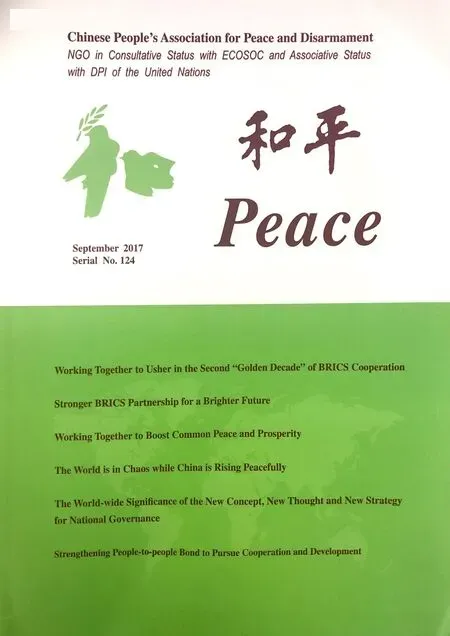
- Peace的其它文章
- Working Together to Boost Common Peace and Prosperity
- The World Order and Global Challenges Faced by BRICS Cooperation
- Stronger BRICS Partnership for a Brighter Future
- Working Together to Usher in the Second "Golden Decade" of BRICS Cooperation
- Strengthening People-to-people Bond to Pursue Cooperation and Development
- People-to-people Contributions to Building Lasting Peace