
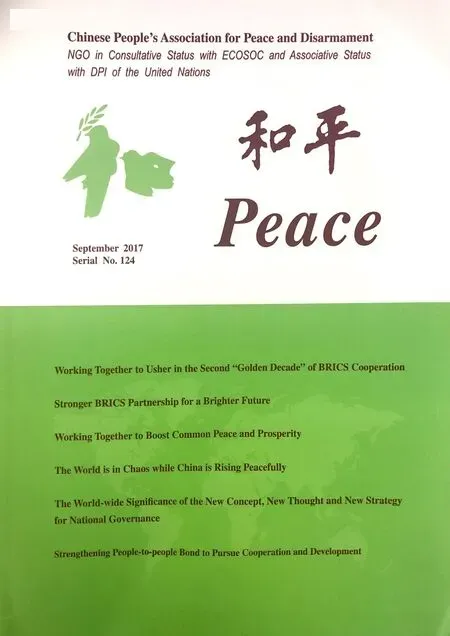
The World is in Chaos while China is Rising Peacefully
2017-01-02 04:06:29YuHongjun
Peace
2017年3期
?
The World is in Chaos while China is Rising Peacefully
By Yu Hongjun
Foreign Affairs Committee Member of the CPPCC National Committee, Vice President of Chinese People's Association for Peace and Disarmament and former Vice Minister of the International Department of the CPC, as well as part-time professor and doctoral tutor for National School of Administration and Renmin University
What should China do in the current situation when the world situation is undergoing major changes, adjustments and transformation? How should China co-ordinate both the international overall situation and domestic overall situation?
The world today is in a period of profound changes, adjustments and transformation. The international situation is changing unpredictably, the vagaries of the world economy, and geopolitical conflict continues unceasingly, global problems are increasing, China’s surrounding environment is also facing profound changes. Facing the world of chaos, China, under the guidance of Xi Jinping diplomatic thought, has constantly written a new chapter in major country diplomacy with Chinese characteristics.
Instability, uncertainty and unpredictability become the new normal of international relations
The chaos in the world today began in the late 1980s as the former Soviet Union and Eastern European countries were changing significantly. In the mega-changes that led to a serious imbalance of international power, the Soviet Union was disintegrated, Warsaw Pact dissolved, and the Council for Mutual Economic Assistance disappeared. Both the European Union and NATO have expanded eastward, and the geopolitical environment in Europe has undergone profound changes. In the past 30 years, the mega-changes in the region have not yet completely come to an end, the turmoil in the Middle East has spread indefinitely, and the upheaval of the world has become even worse.
There are piles of problems seen in the western world. After the outbreak of the sovereign debt crisis in EU in 2008, a rift suddenly came to the surface. In recent years, the surging refugees intensified the EU crisis, the UK announced its withdrawal from the EU. In this context, conservatism, populism and racism are on the rise, and the de-globalization movement within the European Union is surging high..
The polarization of the United States has intensified, and many cities have witnessed the outbreak of the "occupying" protests movement. Faced with the increasingly deepening institutional crisis, struggles between the Democratic Party and the Republican party constantly lead to the great disappointments of the broad public in traditional politics. The already disordered world has become increasingly confused and at a loss.
Xi Jinping diplomatic thought provides a powerful thinking engine for China's diplomacy
"What could we do when the world is in such a mess?" In response to the century-old question, China has worked out a satisfactory answer. Since the 18th National Congress of the Communist Party of China, China has held high the banner of peace, development, cooperation and all-win outcomes, and has put forward building a community of shared future for mankind as a new foreign policy. Since then, seeking all-win cooperation has become another core task of China's foreign policy. Building a "community of shared future for mankind" has become China's lofty goal in international affairs.
In March 2013 during a visit to Russia, Xi Jinping for the first time stated his basic views and policy propositions on the world. He points out that in our world, peace, development, cooperation and all-win outcomes have become the trend of the times. A large number of emerging market economies and developing countries have embarked on the fast track of development, and the balance of international power continues to develop in the direction for world peace and development. Interconnectivity and interdependence of various countries are unprecedentedly deepened, which more and more becomes a community of shared future.
Based on the above judgment, Xi Jinping stressed that in the face of perplexing international security threats, neither single-handed efforts nor force superstition are feasible, only cooperative security, collective security and common security are the right choice for solution. Cooperation and win-win outcomes are the practical way to achieve this goal.
In March 2013, having attended the BRICS Leaders' Summit in South Africa, Xi Jinping once again analyzed the world situation and the common problems faced by mankind. He proposed that no matter how the international situation changes, we should always adhere to peaceful development and all-win cooperation; no matter how the international architecture changes, we should always adhere to equality and democracy, inclusiveness, respect for the rights to independent choice of social system and the road of development, and respect for the diversity of civilizations; no matter how the global governance system changes, we should actively participate in and play a constructive role, and promote the international order to develop in more just and equitable direction, and provide an institutional guarantee for world peace and stability. He advocates vigorously promoting the construction of a global partnership for development, and the common prosperity of all countries; making efforts to develop economy, improve people's livelihood, and add more points of growth for world economy; pushing various countries to strengthen macroeconomic policy coordination, reform the international monetary and financial system, promote trade and investment liberalization and facilitation; participating in the international development agenda making, making full use of the accumulation of human productivity and material resources to complete the UN Millennium Development Goals, narrowing the development gap between the South and the North, and promoting global development more balanced.
In November 2014, Xi Jinping presided over the Central Foreign Affairs Work Conference, which first proposed that China's diplomacy should show the Chinese characteristics, Chinese spirit and Chinese style, and has made overall arrangements for a major country diplomacy with Chinese characteristics. Since then, Xi Jinping, taking a broad view of the changing international situation, and the overall command of China’s diplomacy, has soon formed the theoretical system of international relations with all-win cooperation as the basic concept, and building a community of shared future for mankind as the value pursuit, composed of a new world outlook, a new civilization concept, a new security concept, a new development concept, a new cooperation concept, a new responsibility concept. Under the guidance of Xi Jinping diplomatic thought, a major country diplomacy with Chinese characteristics has continuously yielded achievements.
Vigorously build major countries relations and a peripheral environment of good neighborliness
The relationship among major countries is the core element in international relations and the vane and navigator of the developing international situation.
The Sino-U.S. relations is the most important relations among the major countries in the world today. Xi Jinping attaches great importance to the Sino-U.S. relations. As soon as having become Chinese president, Xi Jinping defines the Sino-U.S. relations as a new-type major countries relationship featuring non-conflict, non-confrontation, mutual respect and all-win cooperation. Then, he puts forward four-point suggestion on the Sino-U.S. relations: enhancing mutual trust and commanding the orientation; strengthening consensus to resolve differences with mutual respect; deepening cooperation with equality and mutual benefit; focusing on the people and deepening friendship. After Trump took office, Xi Jinping has adopted a constructive attitude and strengthened communication with Trump to guide the bilateral relations to the development trajectory of cooperation and competition complementary to each other, and urged the U.S. new administration to accept the principles of new-type major countries relations put forward by China, and abide by "one China" policy. Facing the new variables of the Sino-U.S. relations, China has taken the "struggle and maintenance" as its bottom line and firmly commanded the initiative of bilateral relations.
China-Russia relations play a pivotal role in the world today. The two sides confirm that the central task of the developing bilateral relations is to increase mutual political support, expand pragmatic cooperation and strengthen coordination and cooperation in international and regional affairs. In 2014, Xi Jinping made a special trip to Russia to attend the Opening Ceremony of the Winter Olympics. In 2015, the two sides signed the Joint Statement on Deepening the Comprehensive Strategic Cooperative Partnership and Promoting All-win Cooperation, the two head of states from the two countries attended each other’s anti-fascist victory parade, highlighting the maturity and stability of the strategic cooperative partnership of the two sides. Over the past two years, the Sino-Russian political mutual trust has been continuously strengthened, and pragmatic cooperation has been advancing at full speed. In regional and international affairs, broad prospects for cooperation are shown.
The relationship between China and the European Union is also one of the most important bilateral relations in the world today. The two sides have already reached a consensus on the combination of the two major forces, the two major markets and the two major civilizations. In March 2014, during Xi Jinping's visit to Europe, China and the EU issued a "Joint Statement" on deepening China-EU comprehensive strategic partnership for mutually benefit and all-win outcomes, jointly established "four partnership" development goals on peace, growth, reform and civilization. Despite the difficulties faced by the European Union, China still regards the European Union as an important force in the world multi-polarization. Xi Jinping unequivocally expresses China's firm support for European integration building. In the context of the deepening integration of China-EU interests, China will take measuressuch as establishing a joint investment fund to expand bilateral cooperation in such fields as high technology, infrastructure, finance and so on.
China attaches great importance to relations among major countries and to its relations with neighbors as well. In October 2013, the CPC Central Committee held a Peripheral Diplomatic Work Forum to further enhance the position of its peripheral diplomacy in the overall layout of China's major country diplomacy. Over the past 4 years, Xi Jinping has visited neighboring countries, participated in multilateral meetings in the surrounding regions, personally carried out public diplomacy on peripheral affairs, and vigorously promoted the establishment of various forms of communities such as community of development, community of interests, community of responsibility and a community of shared future. Although there are some problems in regions surrounding China, yet the features that the situation is controllable have not changed. The Chinese policy to maintain friendship and partnership with our neighbors, and to build harmonious, secure and prosperous neighborhood, and especially Xi Jinping's promotion of amity, sincerity, benefit and inclusiveness concept has been widely recognized. China's unique role in the Asia-Pacific region and the world at large will eventually be accepted by the surrounding countries.
The Belt and Road Initiative opens up a new path of peace, development and all-win cooperation.
Between September and October 2013, during his visit to Central Asian and Southeast Asian countries, Xi Jinping proposed a initiative that China will expand cooperation with relevant countries by jointly building the Silk Road Economic Belt and the 21st Century Maritime Silk Road (The Belt and Road Initiative). The Belt and Road Initiative conforms to the trend of world multi-polarization, economic globalization, cultural diversity, and social informationization, in an effort to promote the free flow of economic factors orderly, high-efficient allocation of resources and the market deepened integration, and economic policy coordination of various countries along the routes, and to build an open, inclusive, balanced and universal regional cooperation framework, the focus of which is policy connectivity, infrastructure connectivity, trade connectivity, financing connectivity and people-to people connectivity.
Pushed by China directly, the international community gives extensive support and participates in the construction of the Belt and Road. China-initiated establishment of an Asian Infrastructure Investment Bank has opened with a good start, and the China-funded Silk Road Fund operates smoothly. China-Pakistan, China-Mongolia-Russia, China - Central Asia - West Asia, China - South China Peninsula, India-China-Bangladesh-Burma and the new Eurasian Continental Bridge, these six economic corridors construction comprehensively unfolded. Unicom, China and Europe's "Central Europe commuter express are being built into the world's well-known logistics brands with an international competitiveness and good reputation. The early harvest and achievements are far greater than expected.
In May 2017, The Belt and Road Forum for International Cooperation held in Beijing. Xi Jinping in his speech expounded the lofty goals of China’s advocating the Belt and Road construction and era significance of carrying forward the spirit of the Silk Road. This makes the international community more aware that The Belt and Road Initiative is essentially for China to guide neighboring countries for mutually beneficial cooperation, to bring the whole world to work together for linked development, to jointly pioneer the path to peace and prosperity, the path of openness and innovation and the path of civilization, and to collectively build a community of shared future for mankind.
Nowadays, The Belt and Road construction as China-advocated and promoted cause has become the common action of various countries, especially the developing countries in the world for cooperative development, inclusive development, linked development and all-win development. The comprehensive rejuvenation of the Chinese nation is making a new contribution to the cause of human progress.
(Excerpts of the article in the Study Times 26 July 2017 )
登錄APP查看全文
- Peace的其它文章
- Working Together to Boost Common Peace and Prosperity
- The World Order and Global Challenges Faced by BRICS Cooperation
- Stronger BRICS Partnership for a Brighter Future
- Working Together to Usher in the Second "Golden Decade" of BRICS Cooperation
- Strengthening People-to-people Bond to Pursue Cooperation and Development
- People-to-people Contributions to Building Lasting Peace