PBOC Chief Says Bankers Chose Lesser of Two Evils to Fix Financial Crisis
2017-05-04 21:53:25
中國經貿聚焦·英文版 2017年4期
Zhou Xiaochuan, governor of the Peoples Bank of China, said central bankers around the world chose the lesser of two evils — an easy monetary policy — to save the global economy from crashing after the 2008 global financial crisis, even though they knew extremely loose monetary policies would cause serious problems such as asset bubbles.
Now its time to shift peoples attention back to fiscal policy combined with structural reform to solve the challenges that monetary policy alone couldnt handle, he said March 26 at the Boao Forum for Asia, held in Beijing.
Zhou offered his opinion on several issues related to monetary policymaking, Chinas economic reform and further opening-up, as well as Chinas trade relations with the United States and other countries.
The U.S. Federal Reserve has begun to raise interest rates. Does this mean that the unconventional monetary policies prevailing over the last 10 years have come to an end?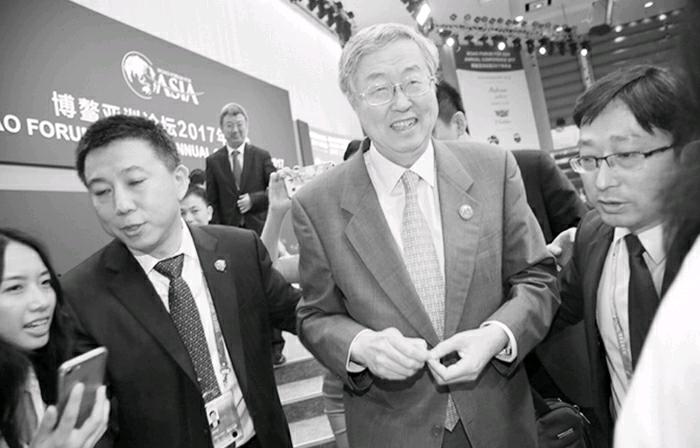
Zhou Xiaochuan: This is a very challenging question. I agree that after so many years of quantitative easing,monetary policy is no longer as loose as it had been. However, the recovery from the global financial crisis may play out differently from country to country. Each country is working under different conditions, and they may not have very synchronized monetary policies.
In China, we first used quite-accommodating monetary policies to deal with the global financial crisis in September 2008. Then toward the end of 2010, the State Council announced in the Economic Work Congress that we would return to a more prudent monetary policy.
Regarding the global recovery, there is still a sovereigndebt problem in Europe, and other countries are encountering their own problems. Therefore, we are pursuing a very gradual change of monetary policy back to a more prudent level. We know there are challenges for the central banks of many countries, including Japan. But I think everyone has seen the limits (of monetary policy) and started considering how and when to exit quantitative easing.
Second is about inflation. Some countries have seen reflation, but globally I think its still too early to say. We have to stay vigilant about inflation. It has a very direct impact on monetary policy-making.
My third point is that, after so many years of quantitative easing, there has been excess liquidity in many countries. Their monetary authorities may have started to tighten the supply, but its still a very gradual process. For now, we have to emphasize structural reform and other long-term developments. Its very important to signal that there should not be an overreliance on monetary policy. This signal is important.
Whats your view about the progress of Chinas economic reforms?
Thats a very big topic! Ill talk about the structural reform then, including long-term goals and priorities in the short and medium term.
For the long term, we have emphasized the goal of stimulating domestic demand. China was very dependent on exports, and we are changing the structures to emphasize consumer and household demand. In recent years, especially at the beginning of the global financial crisis, China has substantially increased investment in infrastructure.
Also, known as “the worlds factory,” we have relied too much on manufacturing. The service sector is relatively weak, so the Chinese government is strongly pushing for faster growth of the service sector, and for a variety of services. Yesterday, Vice Premier Zhang Gaoli said that the service sectors contribution to the total GDP has gone up from 43% to 50%, so thats a big change. For the medium and short term, we are focused on cutting overcapacity and inventories, reducing operating cost in the sector, and trying to break production bottlenecks.
Globally, one reason that countries might shift their focus from monetary policy to fiscal policy and structural reforms is that at the beginning of the financial crisis, many countries had a very high public debt-to-GDP ratio. The European Union maintains that public debt should not exceed 60% of GDP, but many European countries had come close to or even broken that limit at that time.
In 2010, the sovereign-debt crisis swept across Europe. The G20 group called for fiscal consolidation, but the policymakers in many countries thought that there was no room for fiscal policy maneuvers. But fiscal policy is very important to structural reforms. Without it, its very difficult to carry out the reform, so even though there is only very limited room to maneuver, fiscal policy must be used. I think more countries will turn to fiscal policy and structural reform.
The International Monetary Fund encourages the use of fiscal policy. But of course, different countries have different conditions, so judgments must be made on a caseby-case basis. Japan, for example, already has a high ratio of public debt to GDP, while Chinas central-government debt relative to GDP has remained small. But China is a large country and we have more than 30 provinces and regions. It is important to straighten up the central-and-local government relationship. Local governments need to be able to borrow more in order to progress with structural reforms, infrastructure projects, urbanization and development of the service sector. But they also need to be held more accountable for the spending and be subject to a limit on debt. A recent report showed that the fiscal conditions of different local governments varied quite a lot. Some of them have taken on too much debt, and some still have room for more borrowing. I think there is room for more exploration.
This is not to say that monetary policy doesnt play a role in structural reforms. Its just that generally, monetary policy is used to address aggregate demand rather than structural problems. But there are some creative tools that could be used to guide capital to specific sectors in ways that support the reform. Take for example the Funding for Lending Scheme launched by the Bank of England. In China, we have adopted similar policies to encourage lending to rural areas and to small and medium-sized enterprises. Assessing the effectiveness of these measures will take some time.
Whats your opinion on the negative consequences of easy monetary policy, which may not have been anticipated?
Regarding the negative effects of easy monetary policies, Ive participated in a lot of discussions organized by the Bank of International Settlements, the IMF, and so on. These discussions concluded that asset bubbles should not be considered an “unintended” consequence of easy monetary measures. Both theory and experience have showed us that a relaxed monetary policy could lead to higher inflation or cause bubbles in financial markets, in real estate, etc. But a tradeoff needs to be made, and currently we must focus on getting the economy to recover from the crisis. So even though the monetary policy may cause negative consequences like this,we had no choice but to implement it anyway. Three years ago, at the G20 summit in Brisbane, Australia, the state leaders set a goal to lift the G20s GDP by at least an additional 2%(by 2018). This is a trade-off, and the result would have been expected. Its possible that some politicians and decisionmakers may have developed overreliance on monetary policy, and for this very reason, central banks around the world are reminding people that monetary policy is not a panacea, and it causes negative consequences.
Every policy has a different function, so decision-makers should optimize the ways they apply their toolbox to different issues. From a rational point of view, we should implement at the current stage a combination of fiscal policies and structural reform.
Public opinion is also like that. In recent years, investors investing in stock markets, real estate markets or other financial products have also been paying too much attention to monetary policy. This has caused the market to overreact to the monetary policy, and that is to some extent an unintended consequence. But I think that after this period, both decisionmakers and the public will develop a more rational approach.
A border adjustment tax (BAT) that is being pushed in the U.S. would affect the yuans exchange rate, if implemented. One piece of advice is to open the Chinese market more for foreign direct investment to come in. Are Chinese policymakers and central bank regulators considering any measure to further open up the domestic market, or to compensate for this potential negative impact on the yuans exchange rate?
Recently, the whole world has been talking about the U.S. proposed border tariff. One opinion goes that the dollar may appreciate by 20% to 25% (because of the proposed tax adjustment). This would affect not only the Chinese currency but also all major currencies around the world.
Whether that will happen or not … well, well see. We have to wait and see if the U.S. would really implement the tax. We dont know yet. But if such a fast appreciation of the U.S. dollar occurs, I think it would be a global problem. It would also be a very big headache for the U.S. government.
In recent years, we have been making efforts to open up, but the measures we took didnt target the yuans exchange rate. Opening up is very positive for both China and many other countries. The central bank has been involved in the making of opening-up policies, including whether the financial sector could be further opened up. Three years ago, we launched the pilot Shanghai Free Trade Zone. The same arrangement has been expanded to 11 regions in both coastal and inland areas. These free trade zones have policies encouraging trade and investment, including foreign direct investment. These policies share in common two characteristics. One is better market access. We used to have a “positive list” of who was allowed to come in, which we have now changed to a negative list. We are going to substantially cut short the negative list, so itll be a short list. The other characteristic is equal national treatment. Were going to give equal treatment to domestic and foreign investors alike, and ensure that state-owned and private sector get equal access to the market. They should enjoy the same treatment in both pre-entry and post-entry stages.
China is conducting negotiations with the U.S. on a bilateral investment treaty. Were also engaged in discussions of cooperation with Europe, and in Asia negotiating with other countries on the Regional Comprehensive Economic Partnership. Were going to open up wider the financial sector, including banking, insurance, investment banking, security and payment systems. While we continue to open up these industries, were also very interested in seeing Chinese investors, particularly private investors, being more fairly treated in other countries, for example regarding the acquisition of nonmilitary high technology. I think its dependent on the negotiations, and that each side can compromise. That way we can make globalization go forward— everyone can benefit from that. Unfortunately, some negotiations have encountered setbacks. Were waiting for the new U.S. administration to decide on how to proceed with our previous discussions. Meanwhile, we are still having active talks with the Europeans, Japan, and the member countries of the Association of Southeast Asian Nations. I hope we can reach positive results.
From the perspective of a central banker, could you describe your view about “helicopter money”? (Editors note: “Helicopter money” describes an alternative monetary policy of direct payments to consumers when the interest rate cant be lowered any further.
Hopefully, were not going to depend on helicopter money. I think that after the global financial crisis, many countries are still recovering and need to remedy their fiscal position and repair their national balance sheet by using fiscal policy wisely and pushing forward structural reform. If we can get fiscal policy and structural reform right, there is no need to rely excessively on monetary policy, let alone to use helicopter money.
Helicopter money is often the last resort of policymakers when confronted with extreme deflation. Another way to approach the problem is to adopt negative interest rates. But historically, negative interest rates have not worked because they have made people hold cash in their pockets instead. If they hold the cash, then the negative interest rate doesnt work — we call it the “zero lower bound problem.” The recent digitization trends may change this. When people use electronic payments or digital currency, the cash remains in the account, which may mean that negative interest rates could work in case of extreme situations of deflation and economic slumps — at least better than helicopter money.