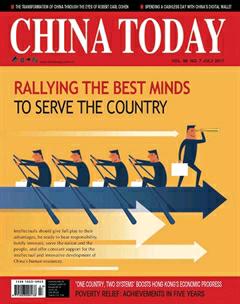
Spending a Cashless Day with China’s Digital Wallet
2017-07-21 21:07:33BystaffreporterVE
CHINA TODAY 2017年7期
By+staff+reporter+VERENA+MENZEL
CELL phone, keys, and wallet – this trio is a must-bring whenever you step out of your apartment. It should be part of every well-sorted handbag or coat pocket, right? Not necessarily!
The last item, namely, your wallet, might well be dispensable in the near future – at least in China, where wallets often arent found in the trouser or jacket pocket anymore, but instead on peoples mobile phones!
In fact, a little revolution is going on at supermarket checkouts and shop counters all over the country, widely transforming Chinese consumers paying habits. The traditional wallet, the cultur- al origins of which date back to ancient times, might soon be sat permanently on the sidelines.
For several years now, mobile online payment services have been gaining ground in China. This rapid change has been driven by local Internet giants like Alibaba or Tencent. Alipay and WeChat Pay both entered the race with their very own digital payment service platform.
Alipay, a service originally launched by Alibaba to handle the payment processing on its e-commerce platforms Taobao and Tmall, has been widely available since 2004. It still is Chinas most widely used online payment system. However, Alipay is closely followed by the payment function of Chinas most popular social media app WeChat (weixin) which is part of Tencent.
WeChat Pay went online in 2013, only two years after the launch of WeChat itself. Since then, WeChat Pay has gained more and more market shares, as the payment service is an integral part of Tencents social media application and in this way gives way to plenty of new interactive features.
Recently, a fierce battle for market shares broke out between these Internet giants. Both want to dominate Chinese consumers digital wallets.
But what makes digital payment systems so popular in China? What features do these apps for tablets and mobiles offer that traditional purses are not capable of? And how far do you really get, if you dare to step out of the door without carrying a real purse or cash for one whole day in a Chinese metropolis? Lets give it a try!
Leave Your Wallet at Home
It is a morning like any other in my Beijing life. As usual, I am late for work and so I quickly grab my phone, my keys and – nothing. This time my wallet has to stay at home.
Instead, with a few clicks, I activate WeChats virtual wallet on my smart phone. I installed the instant messaging app a good while ago on my mobile, as it is the most common social media app in China. After activating WeChat Pay on my phone, I fill the digital wallet with Chinese Yuan from my Chinese bank account.
One whole day without cash or debit cards in Chinas capital Beijing – is this a good idea? I feel somewhat queasy, when I close the apartment door behind me. But what the heck, close your eyes and go for it! May the self-experiment start!
The clock is ticking, which is why I grab one of the shared-economy rental bikes that can now be found at nearly every roadside in Chinas big cities. This is the first mission for my WeChat wallet.
First I scan the bikes QR code, enter the digital transmitted code for opening the lock and the bike is ready for the journey to work. The fee is debited automatically at the end of the ride from my digital account, which is connected to my WeChat. So, my e-wallet has successfully cleared the first hurdle. But will I also be able to pay for my breakfast at one of the small corner shops without any cash? I have strong doubts.
Shortly after, I stop by a little street shop that sells steamed buns. From a distance I can already see the blurred 2D-barcode, printed on a simple sheet of white paper, put into a clear plastic holder and hung directly next to the steamy bamboo baskets.
While the chubby vendor lady packs baozi (steamed buns) stuffed with spicy tofu into a little plastic bag, I scan the code and transfer the small amount of money via WeChat into her account. Perfect. Even without cash I dont have to sit with a hungry stomach at my office desk.
Send a Red Envelope
In a survey conducted by the China Association for Quality in May 2016, 62.7 percent of those surveyed stated they had used at least one of the countrys two big e-payment systems. In comparison, in a similar survey by the U.S. credit card provider TSYS in 2015, only one percent of those Americans surveyed claimed to have used the major online payment service PayPal, although PayPal can be used in many shops and malls throughout the United States.
In Western countries online transactions are still dominated by credit card payment, no matter if they are conducted from home via computer or on the road via mobile devices. In the vast majority of shops, cash, credit cards and debit cards are still the most common methods of payment.
Why the payment apps are so popular in China seems obvious if you take a closer look at the additional functions they offer. These features completely eclipse the range of abilities of traditional debit cards or other online-banking tools commonly used in the West.
WeChat Pay, for instance, is directly connected to other features of the social media app which it is part of. For example, users can easily transfer small amounts of money to their contacts with only a couple of clicks.
Another special highlight: In WeChat Pay as well as on Alipay the transferred money appears in the form of traditional little red envelopes on the smart phone display. By clicking on the transferred link you can easily open the envelope and in this way accept the money. It is automatically credited to your personal digital account.
Tencents WeChat was the first company to present this option of money transfer in red envelopes at the beginning of 2014. It is closely connected to the old Chinese habit of presenting cash gifts inserted in traditional red envelopes, or hongbao.
No matter if it is paying pocket money, giving small gifts to friends for holidays or birthdays or just the refund of small sums of borrowed money – all this can easily be done in a virtual manner in modern China. The only thing you need is your smart phone.
How great the take-up of this payment revolution is in China has become most obvious in recent years during the annual spring festival. On Spring Festivals Eve of 2017, for instance, around RMB 14.2 billion were sent solely over WeChat hongbao.
From my office desk I insert a couple of Yuan into a digital WeChat envelope and send it to a friend of mine who helped me to bring some books back from Germany. With only a couple of clicks I can repay my debts via WeChat. What more could you ask for?
But there are more features awaiting the users of WeChat Pay and Alipay! And seeing as I have my cell phone in my hand anyway, I take the opportunity to pay my water bills via my digital wallet as well.
Since 2015, municipal service charges like electricity, gas or water bills as well as administrative fees can be paid via online payment platforms. WeChat was the first company to make this option available. Alipay followed with a similar feature shortly after.
I simply choose the water bill paying option in my WeChat wallet and transfer the money. Thats it. Once more you can cut out a walk to the bank. The same, by the way, is also true for charging phone credit and paying Internet fees.
I use the time I have saved to order a cup of coffee straight to my office, which is, as you might have guessed already, also easily possible via online payment through one of the many delivery service apps offering their services in Chinese cities.
Not surprisingly, it is also not a big deal to order myself a good lunch equipped only with my digital wallet. Since its early days, Alipay has pursued the strategy of directly cooperating with big restaurant chains like Starbucks or McDonalds as well as clothing giants like H&M or the popular Japanese fashion chain Uniqlo. Through discounts and other special rates, Alipay and WeChat convinced not only companies but also their customers of the advantages of digital payment systems. Smaller shops and restaurants followed suit shortly after, in order to keep pace with the new mobile payment trend.
At noon I walk to the mall near my office, order a rice dish at a small chain restaurant and pay via WeChat at the counter, without having to rummage about for cash or small change in a physical wallet.
A Cashless Future
In the survey conducted by the China Association for Quality, 71.8 percent of participants stated that they enjoyed using mobile payment services especially because of the opportunity to save time. Other advantages mentioned by the participants were discounts and the fact that payment apps dispensed with the need to carry debit cards or cash around all the time.
About 89.3 percent of surveyed users of online payment service providers furthermore stated that they would be most likely to use payment apps for smaller amounts, around 200 Yuan (27 euros). However, for bigger sums of around RMB 1,000 (137 euros) or above, 68.2 percent still preferred more traditional payment methods like credit or debit card.
In the afternoon, I book some movie tickets for the evening, online of course, paying via WeChat. In this way, you only have to print the tickets out at the cinemas ticket machine on arrival. In the same way, you can also conveniently buy plane or train tickets.
After work, I call a cab via a mobile app and head for Beijings trendy Sanli- tun area. The taxi fee, big surprise, can also easily be paid via WeChat.
Before going to the movies with some friends, we go to have dinner together, as a good bite to eat should always be part of every gathering in China, the country of food. But will I also be able to manage a restaurant visit without my wallet, or will I experience a rude awakening this time? Once more, I do feel a little nervous.
Paying the bill via WeChat? “Of course, its possible!” the waitress says, giving a bemused smile when confronted with such a backwoods question. For German souls, who like to calculate precisely, WeChat even holds another trump card feature in its back pocket for restaurant lovers. With WeChat you can automatically split the bill, provided everyone at the table has installed the application on their smart phones, of course.
On my walk to the subway station I review my day without cash and admit to myself that the small change and coins in my wallet have actually been annoying me for a long while.
However, when I arrive at Dongsishitiao Subway Station, the evening takes a rather surprising turn. Unfortunately, it is not possible to pay for subway tickets via WeChat or Alipay, as the nice young lady behind the ticket counter explains to me. And the ticket machine also only accepts cash or debit cards.
Thus, all that remains for me is to take a taxi home. So in the end, Beijing still put a spoke in my mobile payment wheel, but only a very tiny one.
Some ticket machines in the city, as my online research later reveals, already provide mobile payment via special sensors provided with sonic wave technology. Alibaba made this technology available for its payment app as early as 2013, but it is not yet consistently in use throughout the country.
Anyway, I still find myself truly impressed with how smoothly everyday life in Beijing can be managed without cash. I have learned that in the future there is no need for me to painstakingly climb the five stories up to my apartment when I realize I have forgotten my wallet. My conclusion: The virtual wallet is very real in Chinas everyday life and a cashless future has already begun.